
Quick Answer: How Does GFRP Rebar Bond to Concrete?
GFRP rebar bonds to concrete through a combination of mechanical interlock, surface friction and chemical adhesion between the bar surface and the surrounding concrete. Unlike steel rebar, GFRP rebar does not have one universal standardized surface profile. Its bond performance depends strongly on the bar’s surface geometry, rib winding, sand coating, bar diameter, concrete cover, embedment length, concrete strength and manufacturing quality.
For high-quality GFRP rebar, the surface profile is not just cosmetic. It is a structural feature that helps transfer tensile stress from concrete to reinforcement. Research on GFRP-to-concrete bond behavior shows that ribbed GFRP bars can provide good bond behavior, and that ribs, cover thickness, bar diameter and concrete strength all influence bond strength and slip.
Composite-Tech production lines are designed to help manufacturers control the key production variables that affect bond performance: resin impregnation, bar forming, computer-controlled rib winding, curing, two-stage cooling and stable pulling.
Key Takeaways
- Bond to concrete is one of the most important performance factors for GFRP rebar.
- GFRP rebar does not work only because it has high tensile strength; it must also transfer stress effectively to and from concrete.
- Bond behavior depends on surface profile, rib geometry, bar diameter, concrete cover, embedment length, concrete strength and manufacturing quality.
- GFRP bars may have ribbed, helically wrapped, sand-coated, indented, wrapped-and-coated or combined surface profiles.
- Beam bond tests and splice tests are especially useful because they better represent real reinforced concrete behavior than simple pullout tests.
- Research shows that GFRP bars can provide good bond behavior, mainly due to ribs on the bar surface.
- Larger bar diameter can reduce ultimate bond stress, which means diameter selection and development length must be engineered carefully.
- Lower concrete cover can reduce bond stress, making cover and detailing important.
- Surface profile consistency depends on production equipment.
- Computer-controlled rib winding is important because rib angle, spacing and adhesion influence concrete bond.
- Professional manufacturing equipment helps produce repeatable surface geometry, stable diameter and consistent bond-related quality.
Why Bond Is Critical for GFRP-Reinforced Concrete
Concrete is strong in compression but weak in tension. Reinforcement is placed inside concrete to carry tensile forces. But reinforcement can work only if force can transfer between concrete and the bar.
That transfer mechanism is called bond.
If the bond is weak, the bar may slip before reaching its full tensile capacity. This can reduce structural performance, increase crack width and create anchorage problems.
For GFRP rebar, bond is especially important because the material behaves differently from steel:
- GFRP has lower modulus of elasticity than steel;
- GFRP does not yield like steel;
- GFRP is anisotropic;
- GFRP surface profiles vary by manufacturer;
- GFRP bond depends strongly on resin and surface geometry;
- GFRP cannot be bent on site after curing.
This means that a high tensile strength value alone is not enough. A professional GFRP rebar must also have a surface profile that can bond effectively with concrete.
GFRP Rebar Bond Is Not the Same as Steel Rebar Bond
Steel rebar has a long history of standardized rib geometry and design rules. GFRP rebar is different because surface preparation is not universal across all manufacturers.
Different GFRP bars may use:
- sand-coated surfaces;
- ribbed surfaces;
- helical wrapping;
- rope winding;
- indented surfaces;
- wrapped and sand-coated surfaces;
- molded deformation patterns;
- combined mechanical surface profiles.
This is why two GFRP bars with the same nominal diameter can behave differently in concrete.
Table 1: Steel Rebar Bond vs GFRP Rebar Bond
| Factor | Steel Rebar | GFRP Rebar |
|---|---|---|
| Surface standardization | Highly standardized rib patterns | Surface profiles vary by manufacturer |
| Material behavior | Metallic, ductile, isotropic | Composite, linear-elastic, anisotropic |
| Stress transfer | Through steel ribs and concrete interlock | Through surface profile, resin, fibers and concrete interlock |
| Corrosion behavior | Can corrode and damage bond over time | Does not rust |
| On-site bending | Possible | Not recommended after curing |
| Design approach | Conventional reinforced concrete design | FRP-specific design rules required |
| Main bond concern | Rib geometry, concrete cover, confinement | Surface profile, resin shear strength, rib adhesion, cover, embedment length |
Summary: GFRP rebar can bond well with concrete, but its bond performance depends strongly on manufacturing quality and surface design.
The Three Main Mechanisms of Bond
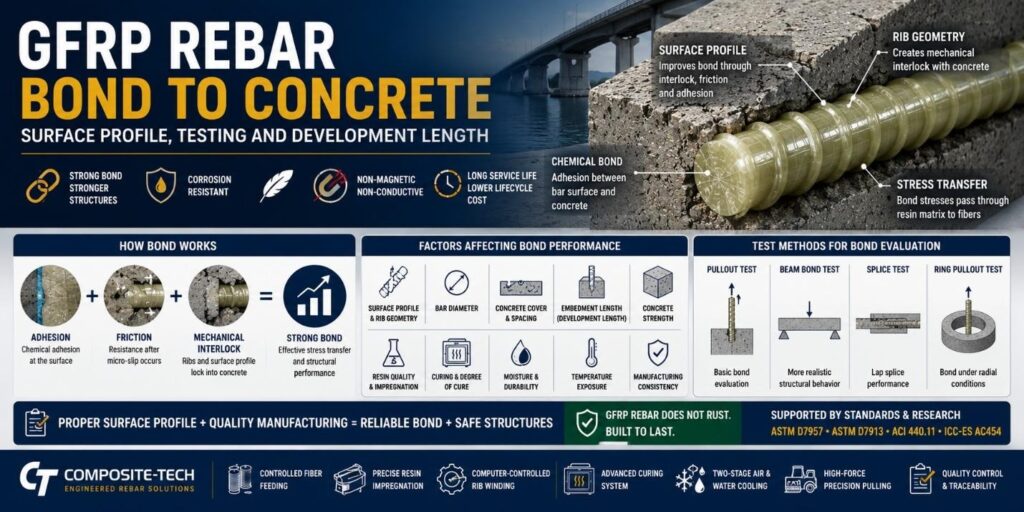
Bond between reinforcement and concrete is usually created by three mechanisms:
- Chemical adhesion between bar surface and concrete;
- Friction after micro-slip begins;
- Mechanical interlock from ribs, wrapping, sand coating or surface deformation.
For GFRP rebar, mechanical interlock is especially important because the external surface profile is the main feature that helps the bar transfer force to concrete.
Table 2: Bond Mechanisms in GFRP Rebar
| Bond Mechanism | What It Means | Why It Matters |
|---|---|---|
| Chemical adhesion | Initial adhesion between bar surface and concrete | Helps at low slip levels |
| Friction | Resistance after relative movement begins | Supports continued load transfer |
| Mechanical interlock | Ribs, sand coating or wrapping engage with concrete | Main contributor to strong bond behavior |
| Resin-to-fiber stress transfer | Bond stresses pass through the resin matrix to fibers | Depends on resin quality and curing |
| Concrete confinement | Concrete cover and surrounding concrete restrain splitting | Important for bond strength and failure mode |
Professional production must create a surface that supports mechanical interlock without damaging the bar.
Why Surface Profile Is the Most Important Bond Feature
The surface profile of GFRP rebar controls how the bar interacts with concrete.
A smooth GFRP rod may have limited bond performance. A properly designed ribbed or sand-coated bar can improve bond because concrete can lock into the surface profile.
However, surface profile must be produced correctly. If ribs are weak, poorly bonded, irregular or unstable, they may shear off or slip under load.
Table 3: Common GFRP Rebar Surface Profiles
| Surface Profile | Bond Concept | Practical Comment |
|---|---|---|
| Smooth surface | Adhesion and friction only | Usually not enough for serious reinforcement |
| Sand-coated surface | Friction and micro-mechanical interlock | Can improve bond compared with smooth bars |
| Ribbed surface | Mechanical interlock | Strong bond potential if ribs are stable |
| Helically wrapped surface | Spiral mechanical interlock | Depends on wrap strength and consistency |
| Indented surface | Mechanical keying | Requires stable geometry |
| Wrapped and sand-coated | Combined friction and interlock | Often used to improve bond |
| Ribbed and coated | Combined mechanical and surface friction | Can provide strong bond if manufactured consistently |
Summary: Surface profile is not decoration. It is part of the structural performance of GFRP rebar.
What Research Shows About GFRP Bond to Concrete
Research on GFRP bond behavior shows several important patterns:
- GFRP-to-concrete bond is affected by surface preparation.
- Beam bond tests and splice tests can better represent real structural behavior than simple pullout tests.
- Bar diameter affects bond stress.
- Concrete cover affects bond stress.
- Concrete compressive strength affects bond behavior.
- Ribbed bars can show good bond behavior due to the mechanical action of ribs.
- Increasing bar diameter can reduce ultimate shear bond stress.
- Reducing concrete cover can reduce bond stress.
This means that GFRP bond design cannot rely on one universal number. It must consider geometry, concrete, cover, embedment length and surface type.
Table 4: Main Factors Affecting GFRP Rebar Bond
| Factor | Effect on Bond |
|---|---|
| Bar surface profile | One of the strongest factors in bond behavior |
| Rib geometry | Controls mechanical interlock |
| Rib adhesion to bar body | Weak ribs can shear off or slip |
| Bar diameter | Larger diameters may reduce average bond stress |
| Concrete cover | Lower cover can reduce bond capacity |
| Bond length / embedment length | Longer embedment can improve anchorage |
| Concrete compressive strength | Higher strength can improve bond behavior |
| Resin matrix quality | Transfers bond stresses to fibers |
| Curing quality | Affects resin strength and stability |
| Manufacturing consistency | Determines repeatable bond behavior |
Beam Bond Test vs Pullout Test: Which Is More Realistic?
Several test methods are used to study FRP-to-concrete bond:
- direct pullout test;
- beam test;
- splice test;
- ring pullout test.
Pullout tests are useful and relatively simple, but they may not fully represent the stress state in real reinforced concrete members. Beam tests and splice tests are often considered more realistic because they better simulate actual flexural behavior.
Table 5: Main Bond Test Methods for GFRP Rebar
| Test Method | What It Measures | Practical Value |
|---|---|---|
| Direct pullout test | Pulling a bar from a concrete block | Useful for basic bond comparison |
| Beam test | Bond behavior in a flexural beam-type setup | More realistic for structural behavior |
| Splice test | Performance of lap splices | Important for detailing and design |
| Ring pullout test | Bond behavior under radial conditions | Useful for research comparison |
| ASTM-style pullout testing | Standardized bond evaluation | Important for documentation and quality control |
Summary: For serious engineering understanding, bond should be evaluated in ways that reflect actual reinforced concrete behavior.
Development Length: Why GFRP Needs Careful Anchorage
Development length is the length of embedded bar needed to develop the required tensile stress without bond failure.
For steel rebar, development length is familiar to most engineers. For GFRP rebar, development length must be treated carefully because GFRP has different stiffness, surface behavior and failure mode.
If the embedment length is too short, the bar may not develop its required stress. Possible failure modes include:
- bar pullout;
- splitting of concrete;
- rib shearing;
- bond failure;
- excessive slip;
- premature anchorage failure.
Table 6: Factors That Influence GFRP Development Length
| Factor | Why It Matters |
|---|---|
| Required tensile stress | Higher stress requires stronger anchorage |
| Bar diameter | Larger bars generally require careful development |
| Surface profile | Better mechanical interlock can improve anchorage |
| Concrete strength | Higher concrete strength can improve bond |
| Concrete cover | Greater cover improves confinement |
| Bar spacing | Affects splitting resistance |
| Bond length | Directly affects anchorage capacity |
| Top-bar effect | Casting position can affect bond |
| Bent anchorage | Must be factory-made for GFRP |
| Design standard | FRP-specific rules must be used |
Development length is one of the main reasons why GFRP should not be treated as a simple one-to-one steel replacement.
Lap Splices: Why Bond Quality Matters in Real Construction
Lap splices are used when reinforcement bars overlap to transfer force from one bar to another through concrete.
For GFRP rebar, lap splice behavior depends on:
- splice length;
- bar diameter;
- surface profile;
- concrete cover;
- bar spacing;
- concrete strength;
- confinement;
- stress level;
- design code;
- installation quality.
If bond quality is poor, lap splice performance can become unreliable.
This is why standards, testing and manufacturer data are important. Buyers should ask for technical documentation, not only diameter and price.
Why Rib Geometry Must Be Controlled by the Production Line
A GFRP rebar surface must be consistent from meter to meter and batch to batch. If rib angle, pitch, depth or adhesion changes during production, bond behavior can also change.
This is where manufacturing technology becomes critical.
Composite-Tech production lines use computer-controlled rib winding. This helps manufacturers control:
- rib angle;
- rib pitch;
- rib continuity;
- rib position;
- surface repeatability;
- product appearance;
- bond-related consistency.
A stable rib winding system is important because the surface profile directly affects concrete bond.
How Resin Impregnation Affects Bond
Bond stress does not stop at the outer surface of the bar. In GFRP, bond stresses must be transferred through the resin matrix to the glass fibers.
If impregnation is poor, the bar may contain:
- dry fiber zones;
- voids;
- weak fiber-matrix contact;
- inconsistent resin content;
- weak outer surface;
- lower shear transfer capacity.
This can reduce both mechanical performance and bond reliability.
Controlled resin impregnation helps the bar behave as a unified composite material.
Why Curing and Cooling Matter for Surface Quality
Curing transforms the resin into a solid polymer matrix. Poor curing can reduce resin strength, thermal stability and durability.
Cooling is also important. If a hot GFRP bar is cooled too aggressively, thermal shock can affect surface quality and potentially create microdamage.
Composite-Tech uses a patented two-stage cooling concept:
- air cooling first to remove peak temperature;
- water cooling second to complete the cooling process.
This approach is designed to protect surface quality and reduce thermal shock risk.
Bond and Durability: Why Corrosion Resistance Is Not Enough
GFRP rebar does not rust, which is a major advantage over steel. But corrosion resistance alone does not make a good reinforcement product.
A high-quality GFRP bar must provide:
- corrosion resistance;
- tensile strength;
- stiffness appropriate for design;
- stable diameter;
- proper surface profile;
- reliable bond with concrete;
- durability in alkaline concrete;
- batch consistency;
- traceability;
- test documentation.
In other words, GFRP rebar must be both durable and bond-capable.
Standards and Test Methods Related to GFRP Bond
Standards and guidelines are important because GFRP bond cannot be judged visually.
Important references include:
- ASTM D7913 / D7913M for bond strength of FRP bars to concrete by pullout testing;
- ASTM D7205 / D7205M for tensile properties of FRP composite bars;
- ASTM D7957 / D7957M for solid round GFRP bars for concrete reinforcement;
- ACI 440.3R test methods for FRP reinforcement;
- ACI CODE-440.11 for structural concrete reinforced with GFRP bars;
- ICC-ES AC454 acceptance criteria for GFRP bars;
- CSA S806 for design and construction with FRP materials;
- CNR-DT 203 for FRP reinforcement design and construction guidance.
Table 7: Standards-Related Bond and Quality Data
| Data / Test | Why It Matters |
|---|---|
| Bond strength | Shows load transfer to concrete |
| Pullout behavior | Helps compare surface profiles |
| Beam bond behavior | More realistic structural evaluation |
| Tensile strength | Confirms bar load capacity |
| Tensile modulus | Needed for serviceability |
| Effective area | Needed for stress calculation |
| Surface profile description | Explains bond mechanism |
| Development length data | Needed for anchorage design |
| Lap splice data | Needed for construction detailing |
| Batch traceability | Supports quality assurance |
A professional manufacturer should prepare data that engineers can use.
Practical Buyer Checklist: How to Evaluate GFRP Rebar Bond Quality
Before buying or specifying GFRP rebar, ask the supplier for more than a price.
Table 8: Buyer Checklist for GFRP Bond Performance
| Question | Why It Matters |
|---|---|
| What surface profile does the bar use? | Bond depends strongly on surface geometry |
| Is the surface ribbed, wrapped, sand-coated or combined? | Different profiles behave differently |
| Is bond test data available? | Supports engineering confidence |
| What is the recommended development length? | Needed for design and anchorage |
| What is the recommended lap splice length? | Needed for construction detailing |
| What concrete strength was used in tests? | Bond depends on concrete |
| What bar diameters were tested? | Diameter affects bond stress |
| What cover and embedment lengths were tested? | Detailing affects bond behavior |
| Is the rib geometry consistent? | Consistency affects repeatability |
| Is the bar manufactured on professional equipment? | Production controls surface quality |
| Is batch traceability available? | Important for serious projects |
A supplier that cannot answer these questions may not be ready for demanding engineering projects.
Practical Manufacturer Checklist: How to Produce Bond-Ready GFRP Rebar
A manufacturer that wants to sell GFRP rebar to serious markets must produce a bar that is not only strong, but also bond-ready.
Table 9: Manufacturing Requirements for Bond-Ready GFRP Rebar
| Manufacturing Requirement | Why It Matters |
|---|---|
| Stable roving tension | Supports uniform bar structure |
| Controlled impregnation | Prevents dry fibers and voids |
| Correct resin ratio | Helps strength and cost control |
| Accurate bar forming | Stabilizes diameter and area |
| Computer-controlled rib winding | Creates repeatable surface profile |
| Proper curing | Strengthens the resin matrix |
| Controlled cooling | Protects surface quality |
| Stable pulling | Maintains geometry and rib consistency |
| Quality inspection | Detects defects early |
| Batch traceability | Supports documentation and standards |
Composite-Tech production lines are designed to support these process requirements.
Composite-Tech Production Technology and Bond Performance
Composite-Tech does not manufacture simple “plastic rod machines.” The company develops professional FRP rebar production lines for industrial GFRP rebar manufacturing.
Key features that support bond-related quality include:
- controlled fiber feeding;
- resin impregnation system;
- stable bar forming;
- computer-controlled rib winding;
- patented short-wave infrared booster polymerization;
- curing ovens;
- patented two-stage air-and-water cooling;
- high-force pulling system;
- cutting and coiling options;
- process control for repeatable production.
For manufacturers, this matters because the surface profile and internal composite quality are created during production. Good bond behavior begins on the production line.
Where GFRP Bond Quality Matters Most
Bond quality matters in every reinforced concrete application, but it becomes especially important in:
- bridge decks;
- marine structures;
- parking garages;
- slabs;
- foundations;
- retaining walls;
- precast elements;
- beams;
- walls;
- tunnels;
- wastewater facilities;
- industrial floors.
In these applications, engineers need confidence that force can transfer properly between concrete and GFRP reinforcement.
Table 10: Applications Where Bond Quality Is Critical
| Application | Why Bond Matters |
|---|---|
| Bridge decks | Crack control and long-term reinforcement performance |
| Marine structures | Durability plus reliable concrete interaction |
| Parking garages | Chloride exposure and structural serviceability |
| Slabs and floors | Crack width and distributed reinforcement action |
| Foundations | Anchorage and load transfer |
| Retaining walls | Reinforcement development and soil pressure resistance |
| Precast concrete | Repeatable production and controlled detailing |
| Tunnels | Special reinforcement zones and durability |
| Wastewater facilities | Chemical exposure and crack control |
| Industrial floors | Load transfer and surface durability |
FAQ: GFRP Rebar Bond to Concrete
Does GFRP rebar bond well to concrete?
Yes, properly manufactured GFRP rebar can bond well to concrete, especially when it has an engineered ribbed, wrapped, sand-coated or combined surface profile. Bond depends on surface geometry, concrete strength, cover, diameter and embedment length.
Why does GFRP rebar need a surface profile?
A surface profile creates mechanical interlock with concrete. Without ribs, wrapping, sand coating or another surface enhancement, a smooth GFRP rod may not transfer load effectively.
Is GFRP rebar bond the same as steel rebar bond?
No. Steel and GFRP have different material behavior and surface systems. GFRP bond depends strongly on resin, surface profile and manufacturing consistency.
What affects GFRP rebar bond strength?
The main factors are bar surface profile, rib geometry, bar diameter, concrete cover, embedment length, concrete strength, resin quality, curing quality and manufacturing consistency.
What is development length for GFRP rebar?
Development length is the length of embedded bar required to develop the needed tensile stress without bond failure. For GFRP, it must be calculated using FRP-specific design rules.
Can GFRP rebar be bent for anchorage on site?
No. GFRP rebar should not be bent on site after curing. Bent shapes and stirrups should be manufactured under controlled factory conditions.
Which test is used for GFRP bond to concrete?
Bond can be evaluated using pullout tests, beam bond tests, splice tests and ring pullout tests. Beam and splice tests are often more representative of real reinforced concrete behavior.
Why does bar diameter affect bond?
Larger bar diameters can reduce average bond stress and change slip behavior. This is why development length and anchorage must be designed carefully.
Why does concrete cover affect GFRP bond?
Concrete cover provides confinement around the bar. Lower cover can reduce bond performance and increase the risk of splitting or premature bond failure.
Why does rib winding matter?
Rib winding creates the external profile that helps the bar bond to concrete. Computer-controlled rib winding helps maintain consistent rib angle, pitch and surface geometry.
How does Composite-Tech improve GFRP surface consistency?
Composite-Tech production lines use controlled fiber feeding, resin impregnation, computer-controlled rib winding, curing, two-stage cooling and stable pulling to support repeatable product geometry and surface quality.
What should buyers ask about GFRP bond?
Buyers should ask for surface profile details, bond test data, development length recommendations, lap splice guidance, tested bar diameters, concrete strength used in testing, and batch traceability.
Conclusion
GFRP rebar bond to concrete is one of the most important topics in composite reinforcement. A GFRP bar cannot be evaluated only by tensile strength, weight or corrosion resistance. It must also transfer force effectively to concrete.
Research shows that GFRP bond behavior depends on surface preparation, bar diameter, concrete cover, embedment length and concrete strength. Ribbed GFRP bars can provide good bond behavior, but the ribs and surface profile must be manufactured consistently.
This is why production equipment matters. The bond-related surface of the bar is created during manufacturing. Resin impregnation, rib winding, curing, cooling and pulling all affect the final product.
Composite-Tech manufactures professional FRP rebar production lines designed to help producers manufacture consistent, bond-ready GFRP rebar for serious construction markets.
To learn more about professional GFRP rebar manufacturing equipment, visit: Professional GFRP Rebar Production Line
Learn more:
- CT2 FRP Rebar Production Line
- GFRP Bent Rebar Production Line
- GFRP Rebar Limitations and Best Applications: Where Fiberglass Rebar Works Better Than Steel
- How Long Does GFRP Rebar Last in Concrete?
- When Is GFRP Rebar Better Than Steel Rebar?
- GFRP Rebar vs Steel Rebar: Numerical Comparison
- GFRP Rebar Quality Control: Fiber Content, Resin Impregnation, Tg, Testing and Traceability
- How to Read a GFRP Rebar Technical Datasheet: Strength, Modulus, Area, Bond and Durability
- How to Start a GFRP Rebar Manufacturing Business