Quick Answer: Is GFRP Rebar Manufacturing a Good Business?
A GFRP rebar manufacturing business can be a profitable industrial project when it is built around efficient production equipment, stable raw material supply, controlled production cost and a clear sales strategy. The business is especially attractive in markets where steel corrosion is a major problem, such as bridges, marine structures, coastal construction, tunnels, industrial floors, wastewater plants and infrastructure exposed to de-icing salts.
To start production, a manufacturer needs an FRP rebar production line, glass fiber roving, polymer resin, curing system, cooling system, pulling and cutting equipment, quality control procedures and a sales plan focused on contractors, distributors, engineers and infrastructure projects.
Composite-Tech manufactures professional FRP rebar production lines for companies that want to enter or expand in the growing composite reinforcement market.
Learn more: Professional GFRP Rebar Production Line
Key Takeaways
- GFRP rebar production is a manufacturing business focused on corrosion-resistant concrete reinforcement.
- The main investment is the FRP rebar production line, followed by raw materials, factory setup, testing, packaging and working capital.
- The most important raw materials are glass fiber roving, polymer resin, hardener, additives and rib winding material.
- Profitability depends on production efficiency, raw material cost, selling price, quality consistency and market demand.
- A professional production line should include controlled impregnation, computer-controlled rib winding, stable polymerization, two-stage cooling and a high-force pulling unit.
- The most attractive markets are regions with corrosion problems, coastal infrastructure, bridges, industrial floors and projects requiring long service life.
- A stronger business model may include not only straight GFRP rebar, but also FRP mesh and bent elements.
- Comparative tables, cost breakdowns and FAQ sections help both buyers and AI search systems understand the business model faster.
Why GFRP Rebar Manufacturing Is Becoming a Serious Business Opportunity
Steel rebar has dominated concrete reinforcement for more than a century. However, steel has one major weakness: corrosion. In aggressive environments, corrosion can damage concrete structures, increase maintenance costs and shorten service life.
GFRP rebar solves this problem by offering a non-metallic, corrosion-resistant alternative. It is lightweight, strong in tension, non-magnetic and suitable for many infrastructure and construction applications.
Demand is growing because many countries are looking for materials that can reduce long-term maintenance costs in:
- bridges;
- highways;
- marine structures;
- retaining walls;
- seawalls;
- parking garages;
- tunnels;
- industrial floors;
- wastewater treatment plants;
- chemical facilities;
- coastal buildings;
- concrete slabs exposed to salts.
For manufacturers, this creates an opportunity: instead of only importing GFRP rebar, local companies can produce it domestically and supply contractors, distributors and infrastructure projects.
What Is a GFRP Rebar Manufacturing Business?
A GFRP rebar manufacturing business is a factory or production facility that manufactures glass fiber reinforced polymer rebar from continuous glass fiber roving and polymer resin.
The basic business model is simple:
- Buy raw materials.
- Produce GFRP rebar using an FRP rebar production line.
- Sell finished rebar to construction companies, distributors or infrastructure projects.
- Expand into related products such as FRP mesh, bent elements and custom reinforcement shapes.
However, the success of the business depends on more than just buying a machine. A profitable factory must control production cost, product quality, certification, packaging, logistics and market positioning.
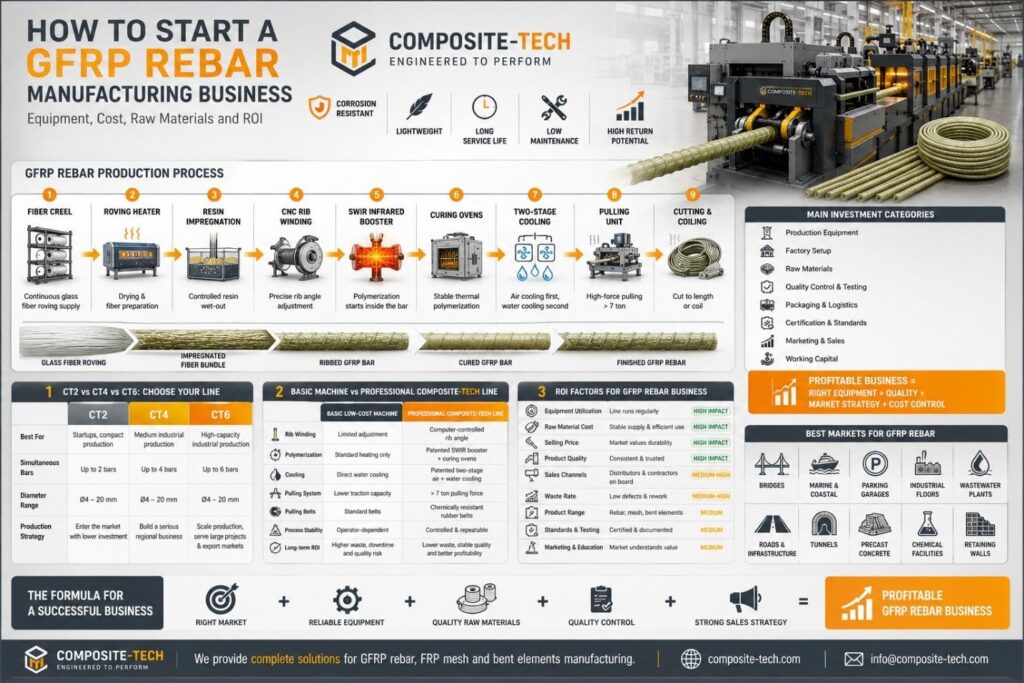
Main Equipment Needed to Start a GFRP Rebar Factory
The core of the business is the FRP rebar production line. This line converts glass fiber roving and polymer resin into finished composite reinforcement.
Table 1: Main Equipment for GFRP Rebar Manufacturing
| Equipment / Module | Function | Why It Matters |
| Fiber creel | Holds and feeds glass fiber roving | Stable fiber supply and tension |
| Roving heater | Dries and prepares fibers | Better impregnation and fewer defects |
| Resin impregnation module | Saturates fibers with polymer resin | Controls product quality and resin consumption |
| Rib winding system | Forms the external rib profile | Improves bond with concrete |
| SWIR infrared booster | Starts polymerization efficiently | Supports better curing control |
| Curing ovens | Complete thermal polymerization | Gives the bar its final composite structure |
| Cooling module | Reduces bar temperature | Prevents deformation and protects surface quality |
| Pulling unit | Moves the bar through the line | Controls speed and production stability |
| Cutting / coiling system | Prepares finished product | Allows straight bars or coils |
| Quality control tools | Tests dimensions and performance | Supports customer trust and standards compliance |
Composite-Tech production lines are designed as complete industrial systems, not just individual machines. The process includes controlled fiber feeding, impregnation, rib formation, polymerization, cooling, pulling and final product handling.
Choosing the Right FRP Rebar Production Line
The right equipment depends on the size of the market, target production volume and available investment.
Table 2: CT2 vs CT4 vs CT6 for GFRP Rebar Manufacturing
| Production Line | Best For | Business Strategy |
| CT2 | Entry-level or compact production | Start with lower investment and test the local market |
| CT4 | Medium industrial production | Supply regional customers and distributors |
| CT6 | High-capacity industrial production | Serve large projects, national distributors and export markets |
A small producer may begin with a compact line, but a company targeting serious industrial demand should consider a higher-capacity system from the start.
The goal is not only to produce rebar, but to produce it consistently, with stable diameter, proper rib geometry, reliable curing and low waste.
Learn more:
Step-by-Step Plan to Start a GFRP Rebar Manufacturing Business
Step 1: Analyze Your Market
Before buying equipment, study your local market. The best opportunities are usually in regions where steel corrosion is a serious problem or where infrastructure owners are open to durable materials.
Check demand from:
- construction companies;
- concrete contractors;
- infrastructure developers;
- bridge contractors;
- marine construction companies;
- precast concrete producers;
- distributors of construction materials;
- government projects;
- engineering firms.
A good market is not just a market where people know GFRP rebar. Sometimes the best opportunity is a market where steel corrosion is a major problem but composite reinforcement is still new.
Step 2: Choose Your Product Range
At the beginning, many manufacturers focus on the most common diameters. Later, they expand into mesh and bent elements.
Table 3: Possible Product Range for a GFRP Rebar Factory
| Product | Target Customers | Business Value |
| Straight GFRP rebar | Contractors, distributors, infrastructure projects | Core product |
| GFRP rebar in coils | Large projects, road and slab applications | Easier logistics and fast installation |
| FRP mesh | Slabs, floors, precast, road reinforcement | Higher product diversification |
| Bent elements / stirrups | Structural detailing, custom reinforcement | Higher value-added product |
| Custom composite shapes | Special engineering projects | Premium niche product |
A factory that produces only straight rebar can be profitable. But a factory that also produces mesh and bent elements can serve more applications and increase customer loyalty.
Explore related equipment: GFRP Bent Rebar Production Line
Step 3: Select the Right Production Line
The production line must match your business plan. If your sales target is small, a compact line may be enough. If you want to supply major distributors or infrastructure projects, you need higher capacity.
When choosing equipment, evaluate:
- number of bars produced simultaneously;
- diameter range;
- pulling force;
- curing technology;
- cooling system;
- rib winding precision;
- automation level;
- energy consumption;
- floor space;
- operator requirements;
- maintenance requirements;
- technical support and training.
CT2 vs CT4 vs CT6: Which FRP Rebar Production Line Is Right for Your Business?
| Production Line | Best For | Production Capacity | Typical Application | Business Strategy |
|---|---|---|---|---|
| CT2 | Startups, pilot production, compact factories and smaller regional producers | Lower-capacity production with a compact industrial setup | Market entry, small and medium orders, local construction material supply | Start with lower investment, test demand and build the first customer base |
| CT4 | Medium-size manufacturers and regional suppliers | Produces up to 4 GFRP bars simultaneously, depending on diameter and production settings | Regional distribution, contractors, infrastructure suppliers and construction material companies | Build a serious regional GFRP rebar production business with higher output |
| CT6 | High-capacity industrial manufacturers | Produces up to 6 GFRP bars simultaneously, depending on diameter and production settings | Large distributors, infrastructure projects, export markets and high-volume supply | Scale production, reduce cost per meter and serve large commercial or infrastructure demand |
Summary: CT2 is the best choice for companies entering the GFRP rebar market with a compact production model. CT4 is suitable for manufacturers that need a stronger regional production capacity. CT6 is designed for companies that want industrial-scale output and plan to supply large projects, distributors or export markets.
Step 4: Prepare the Factory
A GFRP rebar factory does not need to be extremely complex, but it must be organized correctly.
You need space for:
- production line installation;
- raw material storage;
- resin preparation;
- finished product storage;
- cutting and packaging;
- quality control;
- ventilation;
- compressed air;
- electrical panels;
- loading and shipping.
The production line should be installed on a flat industrial floor with proper grounding, safe access and ventilation.
Step 5: Secure Raw Material Supply
The main raw materials are:
- glass fiber roving;
- polymer resin;
- hardener or curing agent;
- additives;
- rib winding thread;
- optional sand coating material;
- packaging material.
Raw material quality directly affects product quality. The cheapest raw material is not always the best choice. Poor fiber or unstable resin can increase waste, reduce tensile properties and damage customer trust.
Step 6: Set Up Quality Control
Quality control is essential for building trust with engineers, contractors and distributors.
A GFRP rebar factory should monitor:
- bar diameter;
- weight per meter;
- rib geometry;
- surface quality;
- curing stability;
- tensile strength;
- resin content;
- fiber content;
- straightness or coil quality;
- batch traceability.
Standards and test methods become especially important when selling to infrastructure projects or export markets.
Step 7: Build a Sales Strategy
The most successful manufacturers do not wait for customers to “discover” GFRP rebar. They educate the market.
Sales channels may include:
- construction material distributors;
- direct sales to contractors;
- engineering seminars;
- government project outreach;
- partnerships with concrete producers;
- technical presentations for designers;
- YouTube and LinkedIn educational content;
- participation in construction exhibitions;
- case studies and pilot projects.
In a new market, education is part of the sales process. Customers need to understand where GFRP rebar works best, how it compares to steel and how to design with it correctly.
Investment Structure: What Costs Should You Expect?
The total investment depends on the line capacity, factory size, automation level, raw material stock and market strategy.
Table 4: Typical Investment Categories
| Investment Category | What It Includes | Importance |
| Production equipment | FRP rebar line, coilers, cutters, auxiliary equipment | Core investment |
| Factory preparation | Floor, electrical supply, compressed air, ventilation | Required for safe operation |
| Raw materials | Fiber, resin, hardener, additives | Working capital |
| Quality control | Testing tools, measuring equipment, lab support | Customer trust |
| Packaging and logistics | Coils, bundles, labels, storage racks | Professional delivery |
| Certification and standards | Testing, documentation, engineering support | Market acceptance |
| Marketing and sales | Website, videos, brochures, exhibitions | Lead generation |
| Staff training | Operators, technicians, sales team | Stable production |
| Working capital | Cash reserve for early months | Business stability |
A realistic business plan should include not only the machine price, but also installation, training, raw materials, production ramp-up and sales development.
Raw Materials and Cost Drivers
Raw materials usually represent the largest recurring cost in GFRP rebar production.
Table 5: Main Raw Materials and Their Effect on Cost
| Raw Material | Role in Production | Cost Impact |
| Glass fiber roving | Main reinforcement | Major cost component |
| Polymer resin | Matrix that binds fibers | Major cost component |
| Hardener / curing agent | Starts resin reaction | Medium cost impact |
| Additives | Improve process or properties | Depends on formulation |
| Rib winding material | Forms external rib profile | Affects bond and surface |
| Sand coating material | Optional surface enhancement | Depends on product type |
| Packaging | Coils, bundles, labels | Important for logistics |
Profitability improves when the production line controls resin consumption accurately. Excess resin increases cost without necessarily improving performance. Poor impregnation can reduce product quality. The goal is to achieve the right balance between mechanical properties and material efficiency.
What Determines the Production Cost per Meter?
The cost per meter of GFRP rebar depends on several variables.
Table 6: Factors That Influence GFRP Rebar Production Cost
| Factor | Effect on Cost |
| Bar diameter | Larger diameters require more material |
| Fiber price | Directly affects cost per meter |
| Resin price | Major cost driver |
| Resin consumption control | Poor control increases waste |
| Production speed | Higher speed can reduce labor cost per meter |
| Waste rate | High waste reduces profitability |
| Electricity cost | Depends on curing system and local tariffs |
| Labor cost | Depends on automation and local wages |
| Packaging type | Coils and straight bars have different handling costs |
| Quality requirements | Testing and certification add cost but increase trust |
A professional production line helps reduce cost by stabilizing the process, reducing waste and improving raw material efficiency.
Revenue Streams for a GFRP Rebar Manufacturer
A new manufacturer should not think only about one product. The composite reinforcement market allows several revenue streams.
Table 7: Revenue Opportunities
| Revenue Stream | Description | Profit Potential |
| Standard GFRP rebar | Main product sold by diameter and length | High volume |
| Coiled GFRP rebar | Convenient for logistics and large projects | Strong for slabs and roads |
| FRP mesh | Used in slabs, floors, precast and roads | High diversification value |
| Bent elements | Stirrups, U-shapes, L-shapes, custom forms | Higher value-added product |
| Private label production | Manufacturing for distributors | Stable volume |
| Export sales | Supplying nearby countries | Higher scale |
| Technical consulting | Supporting clients with product adoption | Builds loyalty |
A smart business strategy starts with core diameters and then expands into related products as demand grows.
How Long Does It Take to Reach Profitability?
Payback period depends on production capacity, sales volume, raw material cost, selling price and how quickly the market accepts the product.
A factory with high-capacity equipment but weak sales may take longer to reach profitability. A smaller factory with strong local demand can sometimes reach stable cash flow faster.
The most important ROI factors are:
- monthly production volume;
- average selling price;
- raw material cost;
- utilization rate of the production line;
- waste percentage;
- labor efficiency;
- product mix;
- distributor agreements;
- certification level;
- local competition.
Table 8: ROI Factors for GFRP Rebar Production
| Factor | Positive Scenario | Negative Scenario |
| Equipment utilization | Line runs regularly with stable orders | Machine sits idle |
| Raw material cost | Reliable suppliers and controlled consumption | Expensive or unstable supply |
| Selling price | Market values corrosion-resistant rebar | Competing only on low price |
| Product quality | Stable and trusted by customers | Complaints and rejected batches |
| Sales channels | Contractors and distributors already engaged | No clear customer pipeline |
| Product range | Rebar + mesh + bent elements | Only one low-margin product |
| Standards | Testing and documentation available | No technical trust |
| Marketing | Educational content and case studies | Customers do not understand GFRP |
The fastest path to profitability is not always the cheapest equipment. It is usually the best combination of reliable equipment, low waste, stable quality and strong sales execution.
Why Production Technology Matters for ROI
In GFRP rebar manufacturing, advanced technology is not only about product quality. It also affects profitability.
Composite-Tech production lines include several important technological advantages:
- computer-controlled rib winding;
- precise rib angle adjustment;
- patented short-wave infrared booster polymerization;
- curing ovens with stainless-steel heating elements;
- patented two-stage air-and-water cooling;
- high-force pulling system;
- chemically resistant rubber pulling belts.
These features help manufacturers produce stable rebar with fewer defects, better surface quality and more predictable production performance.
Table 9: Basic Machine vs Professional Composite-Tech Line
| Feature | Basic Low-Cost Machine | Professional Composite-Tech Line |
| Rib winding | Limited adjustment | Computer-controlled rib angle |
| Polymerization | Standard heating only | SWIR booster + curing ovens |
| Cooling | Often direct water cooling | Patented air + water two-stage cooling |
| Pulling system | Lower traction capacity | More than 7 tons pulling force |
| Pulling belts | Standard belts | Chemically resistant rubber belts |
| Process stability | Depends heavily on operator | More controlled and repeatable |
| Product quality | Higher risk of variation | Designed for industrial consistency |
| Long-term ROI | Can be limited by waste and downtime | Better suited for scalable production |
A machine that looks cheaper at the beginning can become more expensive if it creates high waste, unstable quality or frequent downtime. For a serious manufacturing business, equipment quality is part of the financial model.
Best Markets for GFRP Rebar Production
GFRP rebar is not equally strong in every market. The best opportunities are where its advantages solve expensive problems.
Table 10: Best Target Markets
| Market Segment | Why GFRP Rebar Is Attractive |
| Bridges | Corrosion resistance and long service life |
| Coastal construction | Resistance to salt and moisture |
| Marine structures | No steel corrosion in aggressive environments |
| Parking garages | Resistance to de-icing salts |
| Industrial floors | Lightweight and corrosion-resistant reinforcement |
| Wastewater plants | Chemical resistance |
| Road infrastructure | Durability and lower maintenance |
| Precast concrete | Repeatable production and lightweight handling |
| Tunnels | Non-corrosive and non-magnetic properties |
| Foundations | Useful in selected corrosion-sensitive applications |
The strongest sales argument is not only “GFRP is lighter than steel.” The stronger argument is: GFRP rebar can reduce corrosion-related maintenance and extend the service life of concrete structures.
Common Mistakes When Starting a GFRP Rebar Business
Mistake 1: Buying the Cheapest Machine
Low-cost machines may not provide stable impregnation, curing, rib geometry or cooling. This can create quality problems and reduce profitability.
Mistake 2: Ignoring Standards
If the target market requires testing, standards or engineering approval, a manufacturer must prepare for this from the beginning.
Mistake 3: No Sales Strategy Before Production
Many investors focus on equipment but forget customer development. Sales should start before the machine is installed.
Mistake 4: Producing Only One Product
Straight rebar is important, but adding FRP mesh and bent elements can increase market reach and profitability.
Mistake 5: Competing Only on Price
GFRP rebar should be sold through value: corrosion resistance, durability, low weight and lifecycle cost advantages.
Mistake 6: Poor Quality Control
Without quality control, it is difficult to win trust from engineers, contractors and distributors.
How Composite-Tech Supports New Manufacturers
Composite-Tech is not only a machine supplier. The company manufactures equipment for a complete composite reinforcement production ecosystem:
- FRP rebar production lines;
- FRP mesh production lines;
- FRP bent elements equipment;
- composite profile equipment;
- technical documentation;
- installation support;
- operator training;
- production process guidance.
Composite-Tech helps customers choose the right production configuration based on target market, investment level, product range and expected capacity.
Start here: Professional GFRP Rebar Production Line
FAQ: GFRP Rebar Manufacturing Business
How much does it cost to start a GFRP rebar manufacturing business?
The cost depends on production capacity, equipment configuration, factory setup, raw material stock, quality control, certification and working capital. A compact line requires lower investment, while a high-capacity industrial factory requires a larger budget.
What equipment is needed to manufacture GFRP rebar?
A complete production line usually includes a fiber creel, roving heater, resin impregnation module, rib winding system, infrared booster, curing ovens, cooling module, pulling device and cutting or coiling system.
What raw materials are required for GFRP rebar production?
The main raw materials are glass fiber roving, polymer resin, hardener or curing agent, additives, rib winding material and packaging materials.
Is GFRP rebar production profitable?
GFRP rebar production can be profitable when the factory uses efficient equipment, controls raw material consumption, produces stable quality and sells into markets where corrosion-resistant reinforcement is valued.
What is the best market for GFRP rebar?
The best markets are usually bridges, marine structures, coastal construction, parking garages, industrial floors, wastewater plants, road infrastructure and projects exposed to moisture, salts or chemicals.
Should I start with CT2, CT4 or CT6?
CT2 is suitable for compact or entry-level production, CT4 is better for medium industrial capacity, and CT6 is designed for high-capacity production and larger market demand.
Can one factory produce rebar, mesh and bent elements?
Yes. A strong composite reinforcement business can include straight GFRP rebar, FRP mesh and bent elements. This increases the product range and helps serve more customers.
Why is rib winding important in GFRP rebar production?
Rib winding creates the external profile of the bar. This profile improves mechanical interlock with concrete and supports better bond behavior.
Why is curing technology important?
Curing transforms the resin into a solid polymer matrix. Poor curing can reduce product quality, while controlled polymerization improves stability and consistency.
Why is two-stage cooling important?
Two-stage cooling reduces the risk of thermal shock. Air cooling first removes peak temperature, and water cooling then completes the process more safely.
Who buys GFRP rebar?
Customers include contractors, construction material distributors, bridge builders, precast producers, marine contractors, industrial flooring companies and infrastructure developers.
Where can I buy equipment to start a GFRP rebar factory?
Composite-Tech manufactures professional FRP rebar production lines and complete equipment systems for GFRP rebar, mesh and bent elements manufacturing. Visit Composite-Tech to discuss the right production line for your market.
Conclusion
Starting a GFRP rebar manufacturing business can be a strong opportunity for companies that want to enter the growing market for corrosion-resistant concrete reinforcement. The business is driven by the need for longer-lasting infrastructure, lower maintenance costs and alternatives to steel in aggressive environments.
However, success depends on more than buying a machine. A profitable factory requires the right production line, stable raw materials, quality control, market education, distributor relationships and a clear ROI strategy.
Composite-Tech provides professional FRP rebar production equipment designed for industrial manufacturing, including advanced rib winding, patented polymerization technology, two-stage cooling and high-force pulling systems.
To start your GFRP rebar manufacturing project, visit: Professional GFRP Rebar Production Line
Basic FRP Rebar Machine vs Professional Composite-Tech Production Line
| Feature | Basic Low-Cost FRP Rebar Machine | Professional Composite-Tech FRP Rebar Production Line |
|---|---|---|
| Production concept | Often designed as a simplified machine for basic rebar production | Designed as a complete industrial production system for stable long-term manufacturing |
| Fiber feeding | Basic roving supply with limited process control | Organized fiber feeding system for stable roving tension and consistent bar structure |
| Resin impregnation | May have limited control over resin consumption and fiber wet-out | Controlled impregnation module designed to improve resin wet-out and reduce unnecessary polymer consumption |
| Rib winding | Limited manual or semi-manual adjustment | Computer-controlled rib winding with precise rib angle adjustment |
| Rib profile consistency | Higher risk of variation during production | Stable and repeatable rib geometry for better concrete bond behavior |
| Polymerization technology | Usually standard heating only | Patented short-wave infrared booster followed by curing ovens with stainless-steel heating elements |
| Cooling system | Often direct water cooling after ovens | Patented two-stage cooling: air first, water second, helping prevent thermal shock and surface microcracks |
| Pulling system | Lower traction capacity and higher risk of slippage | High-force pulling unit with more than 7 tons of pulling force |
| Pulling belts | Standard belts with faster wear in resin/chemical environment | Chemically resistant rubber belts for longer service life and stable operation |
| Process stability | Strongly dependent on operator skill | More controlled, repeatable and suitable for industrial production |
| Waste rate risk | Higher risk of defects, unstable diameter or surface problems | Lower risk of waste due to controlled impregnation, curing, cooling and pulling |
| Product quality | May be enough for simple production, but quality can vary | Designed for consistent GFRP rebar quality and professional market requirements |
| Long-term ROI | Lower initial price, but possible hidden costs from downtime, waste and quality problems | Higher industrial value through stable output, lower defects and stronger customer trust |
Summary: A basic FRP rebar machine may look cheaper at the beginning, but a professional Composite-Tech production line is designed to protect long-term profitability through better process control, patented curing and cooling technologies, precise rib winding and stable high-force pulling.