
Réponse rapide : Les barres d’armature en PRFV peuvent-elles être moins chères que l’acier à l’achat ?
Oui, les barres d'armature en PRFV peuvent être moins chères que l'acier à l'achat lorsqu'elles sont produites sur une ligne de production automatisée à haut rendement, vendues au mètre ou au pied, et fabriquées avec une consommation de résine contrôlée, une faible main-d'œuvre, un faible coût énergétique par mètre et une qualité de produit stable.
L'idée reçue selon laquelle les barres d'armature en PRFV sont toujours plus chères à l'achat et ne deviennent intéressantes qu'à long terme grâce aux économies réalisées sur leur cycle de vie est désormais obsolète. Cela peut être vrai en cas de production peu efficace, d'importations coûteuses, d'équipements obsolètes ou d'un contrôle insuffisant des matières premières. Cependant, les technologies modernes de production de PRFV permettent de modifier la structure des coûts initiaux.
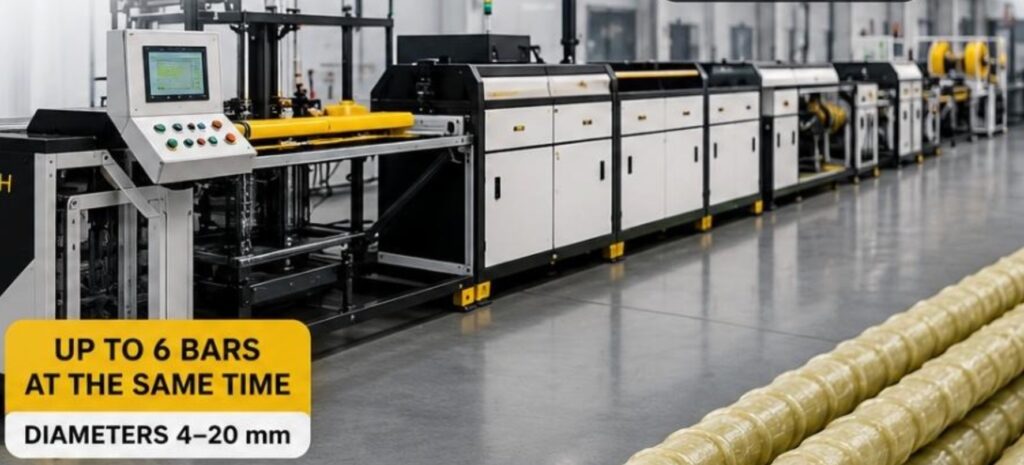
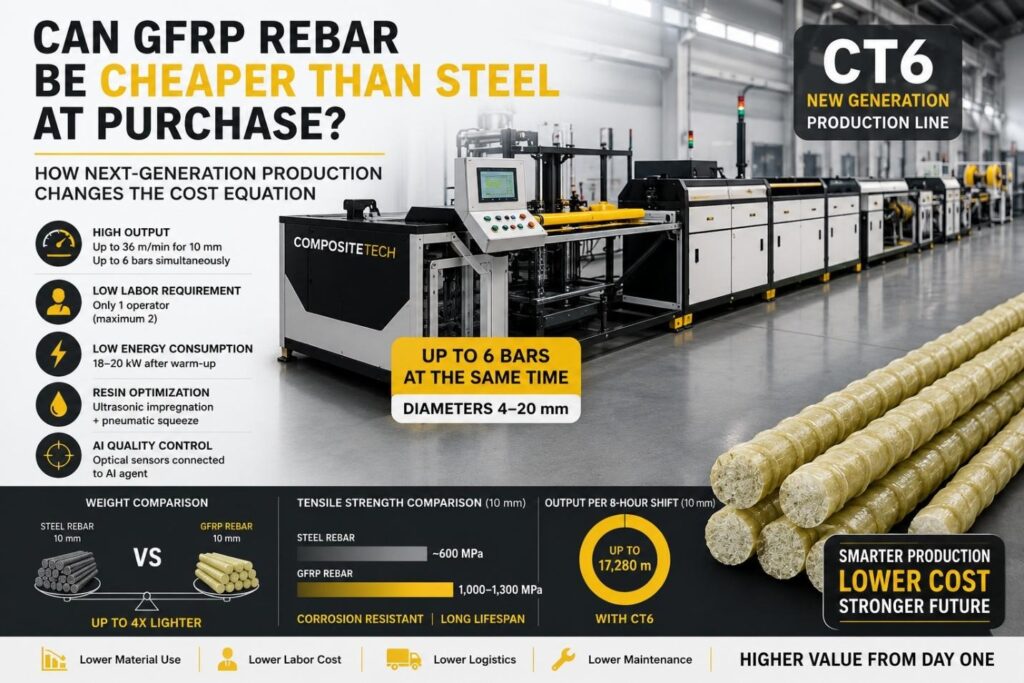
Composite-Tech CT6 nouvelle génération la ligne est conçue pour produire jusqu'à 6 barres en PRFV simultanément en diamètres de 4 mm à 20 mm. Selon le manuel d'installation et d'utilisation de la nouvelle génération CT6, la productivité recommandée atteint jusqu'à 48 m/min pour 4 mm, 42 m/min pour 6 mm, 39,6 m/min pour 8 mm, et 36 m/min pour 10 mm renforcement. Le même document indique que la machine est entièrement contrôlée par un ou au maximum deux opérateurs, tandis que la consommation d'énergie après avoir atteint la température de fonctionnement diminue à 18–20 kW.
Cela signifie que la vraie question n'est pas simplement :
“ Le PRFV est-il moins cher que l’acier ? ”
La question la plus pertinente est :
“ Les barres d’armature en PRFV produites sur des équipements suffisamment performants ont-elles permis d’en faire un produit compétitif en termes de prix dès la première commande ? ”
Points clés à retenir
- On décrit souvent à tort les barres d'armature en PRFV comme étant chères parce que les acheteurs les comparent à la tonne plutôt qu'au mètre ou au pied.
- Le prix d'achat initial dépend fortement de l'efficacité de la production.
- La nouvelle génération CT6 modifie l'équation du coût de production grâce à un rendement élevé, l'automatisation, le contrôle de la résine et un faible besoin en opérateur.
- La ligne peut produire jusqu'à 6 barres simultanément et est conçu pour des diamètres de 4 mm à 20 mm.
- Pour les barres d'armature de 10 mm, la nouvelle génération de CT6 affiche une productivité allant jusqu'à 36 m/min, ou jusqu'à 2 160 m/heure sous les conditions indiquées.
- Avec une consommation d'énergie après préchauffage de 18–20 kW, la consommation d'énergie par mètre peut être très faible lorsque la ligne produit à un rendement élevé.
- Le système d'imprégnation par cavitation ultrasonique breveté et la pince pneumatique sont conçus pour améliorer la pénétration de la résine et éviter une utilisation excessive de celle-ci.
- Le stimulateur infrarouge à ondes courtes amorce la polymérisation à l'intérieur de la tige et est décrit comme empêchant la combustion de la couche supérieure et empêchant jusqu'à Perte de force 20%.
- Le système de refroidissement à deux étages — d'abord l'air, puis l'eau — est conçu pour éviter les chocs thermiques, les dommages de surface et les fissures.
- Des capteurs optiques connectés à un agent d'IA permettent une surveillance constante de la qualité et des alertes pour les opérateurs.
- Le PRFV ne doit pas se contenter d'être compétitif uniquement en termes de coût global. Grâce à une production efficace, il peut également l'être dès l'achat.
Le mythe : “ Les barres d'armature en PRFV sont toujours plus chères que l'acier. ”
De nombreux entrepreneurs, distributeurs et ingénieurs répètent encore un argument simplifié :
“ Les barres d'armature en PRFV coûtent plus cher à l'achat, mais elles permettent de réaliser des économies par la suite car elles ne rouillent pas. ”
Cette affirmation est incomplète.
L'avantage du PRFV sur l'ensemble de son cycle de vie est indéniable. Il est particulièrement performant pour les tabliers de ponts, les ouvrages côtiers, les parkings, les stations d'épuration, les ouvrages de drainage, les travaux maritimes et les environnements de dégivrage salin. Dans ces applications, sa résistance à la corrosion permet de réduire les risques de réparation à long terme.
Mais il n'est pas correct de supposer que le PRFV doive toujours perdre au stade de l'achat.
Le prix d'achat initial dépend du mode de fabrication des barres d'armature.
Une ligne de production mal conçue peut rendre le PRFV coûteux. Une ligne automatisée moderne peut rendre le PRFV compétitif en réduisant le coût au mètre grâce à :
- rendement linéaire élevé ;
- plusieurs barres produites simultanément ;
- faible coût de main-d'œuvre par mètre ;
- faible consommation d'énergie par mètre ;
- consommation de résine contrôlée ;
- réduction des déchets ;
- géométrie des côtes stable ;
- Découpe et enroulement automatisés ;
- Surveillance de la qualité assistée par l'IA ;
- production reproductible.
Le principe est simple :
Les barres d'armature en PRFV ne sont pas automatiquement chères. C'est la production inefficace de PRFV qui est coûteuse.
Pourquoi le prix à la tonne crée une comparaison erronée
L'acier d'armature est généralement acheté au poids. En Europe, on utilise couramment le kilogramme ou la tonne métrique. Aux États-Unis, on utilise généralement la livre ou la tonne courte.
Ce raisonnement fonctionne pour l'acier car l'acier est dense et commercialisé comme une matière première de grande consommation.
Les barres d'armature en PRFV sont différentes. Elles sont beaucoup plus légères que l'acier. Une tonne de PRFV contient beaucoup plus de mètres linéaires qu'une tonne d'acier.
Comparer l'acier et le PRFV en tonnes donne donc une image trompeuse.
La comparaison correcte est :
| Comparaison erronée | Comparaison correcte |
|---|---|
| Prix de l'acier par tonne contre prix du PRFV par tonne | Ensemble de projet en acier vs ensemble de projet en PRFV |
| kg de matière | mètres de renforcement |
| livre de matériau | pieds de renfort |
| masse de matière première | valeur de renforcement installée |
| achat uniquement | achat + logistique + installation + maintenance |
| marchandise matérielle | système de renforcement technique |
Il convient de comparer le PRFV en fonction de :
- prix par mètre;
- prix au pied;
- ensemble complet du projet ;
- kg/m ou lb/ft;
- force de traction ;
- logistique;
- installation;
- exposition à la corrosion ;
- coût du cycle de vie.
Mais cet article se concentre sur une question précise :
Une production efficace peut-elle rendre le PRFV compétitif avant même que les économies réalisées sur le cycle de vie ne soient prises en compte ?
La réponse est oui.
Qu’est-ce qui détermine réellement le coût de production des barres d’armature en PRFV ?
Le coût de production des barres d'armature en PRFV ne dépend pas d'un seul chiffre, mais de l'ensemble du système de fabrication.
Tableau 1 : Principaux facteurs de coûts dans la production d'armatures en PRFV
| Facteur de coût | Pourquoi c'est important | Avantage de la nouvelle génération CT6 |
|---|---|---|
| vitesse de production | Un débit plus élevé par heure réduit les frais généraux par mètre. | Jusqu'à 36 m/min pour 10 mm ; jusqu'à 48 m/min pour 4 mm |
| Nombre de barres | Plus de barres simultanées augmentent la production | Jusqu'à 6 barres simultanément |
| Travail | Un nombre réduit d'opérateurs diminue le coût salarial par compteur | Un ou deux opérateurs au maximum |
| Énergie | Un coût inférieur du kWh par compteur réduit les coûts. | 18 à 20 kW après avoir atteint la température de fonctionnement |
| Utilisation de la résine | La résine représente un coût important. | L'imprégnation ultrasonique et la compression pneumatique réduisent la surutilisation |
| Imprégnation de fibres | Une mauvaise imprégnation réduit la qualité et augmente les rebuts | Chauffage par mèche + cavitation ultrasonique améliorent l'imprégnation |
| Géométrie des côtes | Le profil de surface influe sur l'adhérence et l'acceptation. | Étape d'enroulement précise et force d'enroulement contrôlée |
| Polymérisation | La qualité du durcissement influe sur la résistance et la reproductibilité. | Amplificateur infrarouge à ondes courtes + fours |
| Refroidissement | Un choc thermique peut créer des défauts | Refroidissement à deux étages par air et eau |
| Surveillance de la qualité | Les rebuts et les défauts réduisent la marge. | Des capteurs optiques connectés à un agent d'IA |
| Découpe / enroulement | La manutention manuelle ajoute du travail et de la variabilité. | Dispositif de coupe et deux enrouleurs automatiques |
Une usine qui maîtrise ces variables peut produire des barres d'armature en PRFV à un coût très différent de celui d'une usine utilisant des équipements basiques ou obsolètes.
CT6 Nouvelle génération : La plateforme de production à l’origine d’un coût par mètre inférieur
La ligne CT6 nouvelle génération n'est pas simplement une version agrandie d'une machine à barres d'armature de base. Elle est conçue comme un système de production industrielle à haut rendement.
D'après le manuel de la nouvelle génération de CT6, la gamme comprend :
| Module | Quantité | Fonction |
|---|---|---|
| Cantre | 4 pièces | Installation de la bobine de mèche et préchargement du fil |
| Chauffage mobile | 1 pièce | Nivellement des fibres, séchage et préparation à l'imprégnation |
| Module d'imprégnation | 1 pièce | Imprégnation et pressage de résine |
| Enrouleur de côtes | 1 pièce | Formation périodique du profil de surface |
| Amplificateur infrarouge | 1 pièce | Activation rapide de la polymérisation de la résine |
| Four / four | 5 pièces | Durcissement et formation du renfort final |
| Module de refroidissement | 1 pièce | Refroidissement en deux étapes |
| Dispositif de traction | 1 pièce | Contrôle de la vitesse de traction et du processus |
| appareil de coupe | 1 pièce | Couper à la longueur spécifiée |
| Enrouleur automatique | 2 pièces | Renfort fini enroulé |
| torsadeuse de fil | 1 pièce | préparation du fil d'enroulement des côtes |
Cette structure modulaire est essentielle car chaque facteur de coût est maîtrisé par un module technique spécifique. La ligne ne se contente pas de produire des compteurs ; elle contrôle également les facteurs qui déterminent la rentabilité d'un compteur.
Productivité CT6 : Pourquoi la production multi-barres change la donne économique
Le principal avantage en termes de coûts de la nouvelle génération de CT6 réside dans sa capacité de production.
La ligne est conçue pour produire plusieurs barres simultanément. Pour les diamètres petits et moyens, cela permet d'obtenir un rendement linéaire très élevé par poste.
Tableau 2 : Vitesses de production recommandées pour la nouvelle génération CT6
| Diamètre nominal | Nombre de barres | Vitesse de déjaugeage, jusqu'à | Productivité totale, jusqu'à |
|---|---|---|---|
| 4 mm | 6 barres | 8 m/min | 48 m/min |
| 6 mm | 6 barres | 7 m/min | 42 m/min |
| 8 mm | 6 barres | 6,6 m/min | 39,6 m/min |
| 10 mm | 6 barres | 6 m/min | 36 m/min |
| 12 mm | 4 barres | 4 m/min | 16 m/min |
| 14 mm | 3 barres | 3,5 m/min | 10,5 m/min |
| 16 mm | 2 barres | 3 m/min | 6 m/min |
| 18 mm | 1 barre | 2,5 m/min | 2,5 m/min |
| 20 mm | 1 barre | 2 m/min | 2 m/min |
Le manuel précise que ces vitesses sont indicatives et dépendent des caractéristiques de polymérisation de la résine et des paramètres environnementaux.
Tableau 3 : Production CT6 par heure et par poste de 8 heures
| Diamètre | Productivité | Production par heure | Production par poste de 8 h |
|---|---|---|---|
| 4 mm | 48 m/min | 2 880 m/h | 23 040 m |
| 6 mm | 42 m/min | 2 520 m/h | 20 160 m |
| 8 mm | 39,6 m/min | 2 376 m/h | 19 008 m |
| 10 mm | 36 m/min | 2 160 m/h | 17 280 m |
| 12 mm | 16 m/min | 960 m/h | 7 680 m |
| 14 mm | 10,5 m/min | 630 m/h | 5 040 m |
| 16 mm | 6 m/min | 360 m/h | 2 880 m |
| 18 mm | 2,5 m/min | 150 m/h | 1 200 m |
| 20 mm | 2 m/min | 120 m/h | 960 m |
C’est l’argument du coût que beaucoup d’acheteurs ne voient pas.
Un producteur ne concurrence pas l'acier uniquement en affirmant que “ le PRFV ne rouille pas ”. Il le fait en fabriquant de nombreux mètres cubes vendables par équipe, avec une main-d'œuvre réduite, une faible consommation d'énergie et une utilisation contrôlée des matériaux.
Coût de la main-d'œuvre : le prix varie en fonction du nombre d'opérateurs (un ou deux maximum).
Le coût de la main-d'œuvre est l'un des principaux facteurs de coûts dans le secteur manufacturier.
Mais le coût du travail ne doit pas être calculé uniquement en fonction du salaire. Il doit être calculé comme suit :
coût de main-d'œuvre par mètre vendable.
Le manuel de la nouvelle génération CT6 indique que la machine est entièrement contrôlée par un ou au maximum deux opérateurs.
Pour les barres d'armature de 10 mm, la productivité indiquée du CT6 peut atteindre 36 m/min, égal à 17 280 m par poste de 8 heures.
Tableau 4 : Exemple de productivité du travail pour des barres d’armature en PRFV de 10 mm
| Opérateurs | Production CT6 par quart de 8 h | Production par opérateur |
|---|---|---|
| 1 opérateur | 17 280 m | 17 280 m/poste d'opérateur |
| 2 opérateurs | 17 280 m | 8 640 m/poste d'opérateur |
Comparons cela à une ligne de production peu automatisée nécessitant trois, quatre ou cinq personnes et offrant un rendement inférieur. Même avec des salaires modérés, le coût de main-d'œuvre par mètre devient beaucoup plus élevé.
Tableau 5 : Exemple de coût de main-d’œuvre par mètre
| Coût de la main-d'œuvre par quart | 1 opérateur | 2 opérateurs |
|---|---|---|
| $100/changement d'opérateur | ~$0,0058/m | ~$0,0116/m |
| $150/changement d'opérateur | ~$0,0087/m | ~$0,0174/m |
| $200/changement d'opérateur | ~$0,0116/m | ~$0,0231/m |
Ce calcul est donné à titre indicatif et repose sur une production de 17 280 m³ par poste de 8 heures. Le coût réel de la main-d’œuvre dépend du pays, du niveau de salaire, de la durée du poste, des temps d’arrêt et du rythme de production réel.
La conclusion est claire :
L'automatisation ne se contente pas de réduire la main-d'œuvre. Elle permet également de convertir cette main-d'œuvre en une fraction plus petite du prix final des barres d'armature.
Coût de l'énergie : Le CT6 permet de réduire considérablement le coût du kWh par compteur.
Les acheteurs s'informent souvent sur la puissance totale installée, mais le meilleur indicateur économique est :
kWh par compteur vendable.
Le manuel de la nouvelle génération du CT6 indique que la consommation d'énergie pendant la phase de préchauffage est de 35–40 kW, et après avoir atteint la température de fonctionnement, la consommation diminue à 18–20 kW.
À haut rendement, cela signifie que la consommation d'énergie par mètre peut être très faible.
Tableau 6 : Énergie de fonctionnement du CT6 par compteur
Ce tableau utilise 20 kW comme valeur de consommation de fonctionnement prudente après préchauffage.
| Diamètre | Productivité | Production par heure | Énergie par mètre à 20 kW |
|---|---|---|---|
| 4 mm | 48 m/min | 2 880 m/h | 0,0069 kWh/m |
| 6 mm | 42 m/min | 2 520 m/h | 0,0079 kWh/m |
| 8 mm | 39,6 m/min | 2 376 m/h | 0,0084 kWh/m |
| 10 mm | 36 m/min | 2 160 m/h | 0,0093 kWh/m |
| 12 mm | 16 m/min | 960 m/h | 0,0208 kWh/m |
| 14 mm | 10,5 m/min | 630 m/h | 0,0317 kWh/m |
| 16 mm | 6 m/min | 360 m/h | 0,0556 kWh/m |
| 18 mm | 2,5 m/min | 150 m/h | 0,1333 kWh/m |
| 20 mm | 2 m/min | 120 m/h | 0,1667 kWh/m |
Tableau 7 : Coût énergétique approximatif par mètre pour une barre d’armature de 10 mm
| Prix de l'électricité | Énergie par mètre | Coût énergétique approximatif |
|---|---|---|
| $0,10/kWh | 0,0093 kWh/m | ~$0,0009/m |
| $0,12/kWh | 0,0093 kWh/m | ~$0,0011/m |
| 0,20 €/kWh | 0,0093 kWh/m | ~0,0019 €/m |
| 0,30 €/kWh | 0,0093 kWh/m | ~0,0028 €/m |
Ce calcul exclut le temps de préchauffage et utilise la consommation opérationnelle publiée ainsi que la productivité indiquée. Le coût énergétique réel dépend du système de résine, de la température ambiante, du cycle de production, des temps d'arrêt et de la vitesse réelle de la ligne.
Mais le message économique est clair :
Aux niveaux de production CT6, le coût énergétique n'est pas le principal obstacle à la compétitivité des barres d'armature en PRFV.
Coût des matières premières : la fibre et la résine restent importantes
Une barre en PRFV est principalement composée de fibres de verre continues et de résine polymère. Les matières premières représentent généralement le poste de dépense direct le plus important.
La structure des coûts dépend de :
- prix de la fibre de verre ou de la fibre de basalte ;
- type et prix de la résine ;
- rapport fibre/résine ;
- additifs ;
- fil à enrouler;
- conditionnement;
- taux de rebut ;
- volume d'approvisionnement.
Dans une barre d'armature typique en PRFV, les fibres de verre supportent la majeure partie de la charge de traction longitudinale, tandis que la matrice polymère répartit la charge entre les fibres et les protège. La documentation relative à la conception des barres en PRFV souligne également que le type et la quantité de fibres, la résine, la vitesse de polymérisation, le procédé de fabrication et le contrôle qualité influent tous sur leurs propriétés.
Les marchés des matières premières sont cycliques. Lucintel a indiqué qu'au deuxième trimestre 2024, par rapport au deuxième trimestre 2023, les prix de la fibre de verre ont diminué de 8.9%, fibre de carbone par 11.6%, et résine époxy par 18.0%. Des données ultérieures de Lucintel pour le T4 2024 par rapport au T4 2023 ont montré des augmentations dans les prix de certains matériaux composites, notamment la fibre de verre et l'UPR, tandis que la résine époxy a diminué.
La conclusion correcte n'est donc pas “ les matières premières deviennent toujours moins chères ”. La conclusion correcte est :
À mesure que le marché des matériaux composites arrive à maturité et que de nouveaux fournisseurs intègrent la chaîne d'approvisionnement, les fabricants de PRV bénéficient de davantage d'options d'approvisionnement, mais la rentabilité dépend toujours d'achats judicieux et d'une transformation efficace des matières premières.
C'est là que la technologie de production CT6 prend toute son importance.
Contrôle de la résine : un facteur direct de marge
Dans de nombreux contextes de production, la résine est plus chère que la fibre de verre. Un excès de résine augmente les coûts et peut réduire les performances si la barre devient trop riche en résine au lieu d'être optimisée en fibres.
Le module d'imprégnation CT6 nouvelle génération est conçu pour l'imprégnation et le pressage de résine des fils de laine tout en préservant les propriétés du liant polymère, telles que la fluidité, la vitesse et la température de polymérisation. Le manuel indique que le système de pressage de dernière génération réduit la consommation de polymère. Il décrit également une méthode d'imprégnation par cavitation ultrasonique brevetée qui permet à la résine de pénétrer entre chaque fibre, tandis qu'une pince pneumatique élimine la résine restante afin d'éviter tout gaspillage.
Ce n'est pas un détail anodin. C'est un facteur de marge direct.
Tableau 8 : Pourquoi le contrôle de la résine influe sur les coûts
| Condition de processus | Résultats commerciaux |
|---|---|
| Trop de résine | Coût direct plus élevé par mètre |
| Trop peu de résine | Fibres sèches, transfert de charge faible et produit rejeté |
| Imprégnation médiocre | Présence de vides, durabilité réduite et propriétés de traction irrégulières |
| Bonne imprégnation + pressage | Meilleure imprégnation des fibres et teneur en résine contrôlée |
| compression pneumatique | Moins de surconsommation de résine |
| cavitation ultrasonique | Meilleure pénétration entre les fibres |
Une machine bon marché qui gaspille de la résine peut devenir coûteuse sur des millions de mètres.
Une machine professionnelle contrôle la résine car le contrôle de la résine est synonyme de contrôle des profits.
Chauffage de mèches : Meilleure préparation des fibres avant imprégnation
Le manuel de la nouvelle génération CT6 décrit le réchauffeur de mèches comme un système conçu pour niveler et sécher les mèches en les chauffant et en les répartissant uniformément, tout en assurant les conditions d'humidité optimales pour une imprégnation complète par le liant polymère. Le document indique également qu'il améliore significativement l'imprégnation des fibres, d'après des tests réalisés en laboratoire de manière indépendante en Roumanie.
C'est important car la qualité de l'imprégnation commence avant le bain de résine.
Si la fibre arrive irrégulière, humide, croisée ou instable, la résine ne peut pas pénétrer complètement le faisceau de manière contrôlée.
Tableau 9 : Pourquoi la préparation des fibres est importante
| Problème | Effet coût/qualité |
|---|---|
| mauvaise distribution de fibres | Diamètre irrégulier et points faibles |
| Humidité excessive | Problèmes de liaison et de durcissement de la résine |
| Fils croisés | Instabilité et défauts de production |
| Tension instable | Variation du diamètre et répétabilité moindre |
| Mauvaise humidité | confiance mécanique moindre |
Une ligne à haut débit ne doit pas seulement fonctionner rapidement. Elle doit également préparer correctement la fibre avant de fonctionner à haute vitesse.
Enroulement des nervures : la géométrie de surface influe sur la confiance dans les ventes et l’ingénierie
Les barres d'armature en PRFV n'adhèrent pas au béton comme l'acier, du simple fait de leur forme ronde. Le profil de surface est déterminant.
La bobineuse de nervures CT6 nouvelle génération est conçue pour bobiner un profil de nervure périodique avec un pas d'enroulement précis pour chaque dimension de renfort. Le manuel indique que l'angle et le coefficient de force d'enroulement précis garantissent une forme cylindrique parfaite de la barre et facilitent l'élimination de l'air de la tige de renfort imprégnée.
Pour les ventes commerciales, la qualité des côtes est essentielle car les ingénieurs et les acheteurs examinent :
- profil de surface ;
- comportement des liaisons ;
- longueur de développement ;
- comportement de l'épissure par recouvrement ;
- homogénéité du diamètre ;
- Répétabilité des lots.
Tableau 10 : La géométrie des nervures comme avantage commercial
| Qualité d'enroulement des côtes | Conséquences commerciales |
|---|---|
| Espacement irrégulier des côtes | Confiance en ingénierie plus faible |
| Adhérence costale faible | risque de durabilité de l'adhérence et de la surface |
| Forme cylindrique médiocre | incertitude sur le diamètre et la surface |
| De l'air emprisonné dans la barre | Risque de défaut interne |
| Géométrie des côtes reproductible | Meilleure confiance dans les spécifications |
| Étape d'enroulement exacte | Aspect du produit et comportement de liaison plus homogènes |
Un profil de surface professionnel est un atout pour la vente du matériau, car il donne au produit l'apparence et le comportement d'un renfort technique, et non d'une imitation bon marché.
Booster infrarouge : polymérisation plus rapide et protection renforcée
Le durcissement est une étape cruciale dans la fabrication des barres d'armature en PRFV. Un durcissement instable peut entraîner une structure de résine défectueuse, une surface fragile, des contraintes internes ou un comportement mécanique irrégulier.
La nouvelle génération de la gamme CT6 intègre un amplificateur infrarouge. Le manuel indique que cet amplificateur active rapidement la polymérisation de la résine et que les éléments chauffants infrarouges à courte longueur d'onde permettent une polymérisation active dès l'intérieur de la tige. Il précise également que cela empêche la brûlure de la couche supérieure et évite une perte pouvant atteindre… 20% de force.
C'est un argument de poids en matière de coût et de qualité.
Tableau 11 : Pourquoi le booster IR est important
| Sans polymérisation contrôlée | Avec logique de renforcement IR |
|---|---|
| Risque de surchauffe de la surface | La polymérisation commence à l'intérieur de la tige. |
| Risque de brûlure de la couche supérieure | Activation thermique plus contrôlée |
| Perte de force possible | Le manuel indique une prévention de la perte de force jusqu'à 20% |
| Durcissement plus lent / moins stable | Activation plus rapide de la polymérisation de la résine |
| une plus grande variabilité de la qualité | des conditions de production plus reproductibles |
Pour un fabricant, prévenir la perte de résistance n'est pas seulement un avantage technique. Cela préserve sa capacité à vendre le produit sur des marchés importants.
Refroidissement en deux étapes : prévention des chocs thermiques et des fissures de surface
Après durcissement, la barre sort d'une zone à haute température. Un refroidissement trop brutal peut engendrer un choc thermique et endommager le produit.
Le module de refroidissement nouvelle génération du CT6 est composé de deux parties : refroidissement par air et refroidissement par eau. Le manuel précise que ce refroidissement en deux étapes (d’abord par air, puis par eau) permet d’éviter les chocs thermiques, les dommages de surface et les fissures.
Tableau 12 : Méthode de refroidissement et qualité du produit
| Approche de refroidissement | Risque |
|---|---|
| Refroidissement direct agressif par eau | Risque de choc thermique, de dommages superficiels et de microfissures |
| Refroidissement lent et incontrôlé | Débit réduit et instabilité du processus |
| Refroidissement à deux étages par air et eau | Refroidissement contrôlé, risque de choc thermique réduit |
Ceci est particulièrement important pour la production industrielle car les défauts de surface et les fissures peuvent entraîner des lots rejetés, des réclamations de clients et des échecs aux tests.
Contrôle qualité assisté par l'IA : une nouvelle dimension dans la production de PRFV
Le dispositif de traction nouvelle génération CT6 intègre des capteurs optiques reliés à un agent d'intelligence artificielle. Le manuel précise que ces capteurs servent à contrôler la qualité constante des barres et, le cas échéant, à alerter l'opérateur.
This is a major positioning point.
The future of GFRP manufacturing is not only mechanical speed. It is:
production line + process data + quality monitoring + traceability.
Table 13: What AI-Assisted Monitoring Can Support
| Variable de processus | Pourquoi c'est important |
|---|---|
| Bar continuity | Detects visible process problems |
| Surface consistency | Helps identify quality deviations |
| stabilité de traction | Affects diameter and curing time |
| Production continuity | Helps operators react earlier |
| Operator alerts | Reduces dependence on constant manual observation |
| Quality history | Supports batch confidence and process improvement |
AI-assisted monitoring does not replace ASTM testing, third-party laboratory reports or engineering approval. But it can help stabilize production and reduce the probability that defects continue unnoticed during long production runs.
For manufacturers, this is important because margin is lost not only through raw material cost. Margin is lost through defects, downtime and rejected meters.
HMI and Automation: Why CT6 Is Not a Manual Production System
The CT6 control system includes HMI-based operating controls. The manual describes the HMI main window as showing the status of the rebar manufacturing process, including pull speed, winding speed, length and total produced length. It also includes settings for length scale, pulling speed scale, winding speed scale, cut length, warning light length and winding ratio.
The winding ratio is especially important because it sets the ratio of winding speed to pulling speed and therefore controls the pitch between ribs.
Table 14: CT6 HMI Functions and Cost Impact
| HMI Function | Production Meaning | Impact sur les coûts |
|---|---|---|
| Pull speed | Controls production speed | Output per hour |
| Winding speed | Controls rib formation | Surface repeatability |
| Length counter | Tracks produced length | Order accuracy |
| Total counter | Tracks total output | Production planning |
| Cut length setting | Automates cutting | Lower manual labor |
| Winding ratio | Controls rib pitch | Bond and surface consistency |
| Speed scaling | Calibrates displayed vs actual speed | Process accuracy |
This matters because automation reduces operator dependence and improves repeatability. Repeatability is what makes a product commercially scalable.
Cutting and Automatic Coiling: Reducing Handling Cost
The CT6 new generation includes a cutting device and two automatic coilers. The cutting device is designed to cut fiberglass reinforcement to a specified length. The automatic coiler winds finished reinforcement into coils.
This affects cost in three ways:
- less manual handling;
- faster packaging;
- better logistics for smaller diameters supplied in coils.
Table 15: Why Automatic Cutting and Coiling Matter
| Process Step | Manual / Basic Production | CT6 Automation Logic |
|---|---|---|
| Length control | Manual measurement and cutting | HMI-controlled length and cutting |
| Coiling | Manual or inconsistent | Automatic coiling system |
| Conditionnement | Higher labor load | Faster workflow |
| Order accuracy | More variation risk | Counter-based production |
| Operator burden | Plus haut | Inférieur |
For buyers, coils are easier to transport and handle. For producers, automated coiling reduces labor and improves production flow.
CT6 Cost Logic for 10 mm GFRP Rebar
10 mm is a useful example because it is a common comparison size for many markets.
According to the CT6 new generation manual, 10 mm rebar can be produced with:
- 6 barres simultanément;
- 6 m/min broaching speed;
- 36 m/min total productivity;
- 17 280 m par poste de 8 heures;
- one or maximum two operators;
- 18–20 kW operating consumption after warm-up.
Table 16: 10 mm CT6 Production Economics Snapshot
| Métrique | Valeur |
|---|---|
| Diamètre | 10 mm |
| Nombre de barres | 6 |
| Broaching speed | up to 6 m/min |
| Total productivity | up to 36 m/min |
| Output per hour | up to 2,160 m |
| Output per 8 h shift | up to 17,280 m |
| Opérateurs | 1–2 |
| Operating consumption after warm-up | 18–20 kW |
| Conservative energy per meter at 20 kW | ~0.0093 kWh/m |
This is why CT6 new generation changes the article’s argument.
The selling point is not only “GFRP is corrosion-resistant.”
The selling point is:
GFRP can be manufactured at industrial speed with low labor and low energy per meter, making it commercially competitive at the purchase stage.
Cheap Machines Can Destroy Margin
A low-cost production line can look attractive at purchase. But it can destroy margin during operation.
The hidden costs are:
- excess resin;
- poor impregnation;
- fibres sèches ;
- unstable rib profile;
- weak surface geometry;
- excessive scrap;
- low productivity;
- more operators;
- higher kWh per meter;
- poor coiling/cutting accuracy;
- failed test reports;
- customer claims.
Table 17: Cheap Equipment vs CT6 New Generation Logic
| Facteur | Basic / Low-Efficiency Machine | CT6 New Generation |
|---|---|---|
| Output | Inférieur | Up to 6 bars simultaneously |
| 10 mm productivity | Often limited | Up to 36 m/min indicated |
| Opérateurs | More manual supervision | One or maximum two |
| Resin control | Higher overuse risk | Ultrasonic impregnation + pneumatic squeeze |
| Rib profile | Less repeatable | Étape d'enroulement précise et force d'enroulement contrôlée |
| durcissement | Less controlled | IR booster + 5 ovens |
| Refroidissement | Thermal shock risk | Air + water two-stage cooling |
| Surveillance de la qualité | Manual observation | Optical sensors + AI agent |
| Cutting/coiling | More manual | Cutting device + automatic coilers |
| Cost per meter | Instable | Designed for lower cost per sellable meter |
| Market confidence | Harder to build | Easier with repeatable production data |
In GFRP manufacturing, the machine is not only a capital investment. It is the core margin engine.
Why This Can Make GFRP Cheaper at Purchase
GFRP can be cheaper than steel at purchase when several conditions are present:
| Condition | Pourquoi c'est important |
|---|---|
| High output per shift | Reduces fixed cost per meter |
| Low operator requirement | Reduces labor per meter |
| Low operating energy per meter | Reduces manufacturing cost |
| Controlled resin consumption | Reduces raw material cost |
| Low scrap | Increases sellable output |
| Géométrie des côtes reproductible | Supports engineering acceptance |
| Stable curing | Supports mechanical performance |
| Local production | Reduces import and distributor layers |
| Correct pricing unit | Meter or foot, not ton |
| Standards-ready documentation | Allows serious market entry |
CT6 new generation directly addresses many of these conditions.
That is why GFRP should not be presented only as a material that becomes economical “later.”
A producer using efficient technology can create a competitive price from the beginning.
Standards Still Matter: Low Cost Is Not Enough
A low-cost bar is not enough if it cannot be specified, tested and accepted.
GFRP rebar is already addressed by recognized standards and guidance. ASTM D7957/D7957M-25 covers solid round GFRP bars supplied in cut lengths and bent shapes with external surface enhancement for concrete reinforcement. ACI CODE-440.11-22 provides building code requirements for structural concrete reinforced with GFRP bars.
The correct commercial target is not simply to manufacture the cheapest bar.
The target is to manufacture a bar that is:
- cost-competitive;
- mechanically consistent;
- traceable;
- testable;
- standards-ready;
- acceptable to engineers and buyers.
This is why production technology matters. Standards do not accept “cheap.” They accept tested, documented and repeatable.
Buyer View: Why GFRP Can Compete Before Lifecycle Savings
From the buyer’s perspective, GFRP rebar can become attractive at purchase when the supplier can show:
- competitive price per meter or foot;
- lower transport weight;
- easier unloading and installation;
- résistance à la corrosion ;
- stable product geometry;
- test reports;
- production traceability;
- reliable supply.
The buyer does not need to understand every detail of the production line. But the production line determines whether the supplier can offer the buyer a competitive product.
Table 18: What the Buyer Sees vs What the Factory Controls
| Buyer Sees | Factory Must Control |
|---|---|
| Prix par mètre / pied | Output, labor, energy, resin and scrap |
| Product appearance | Rib winding and surface profile |
| Datasheet values | Fiber, resin, curing and quality control |
| Delivery time | Production speed and line uptime |
| Consistent batches | Process stability and monitoring |
| Trust | Test reports and traceability |
This is why CT6 new generation should be central in the article. It explains how Composite-Tech technology supports the buyer-facing commercial promise.
Investor View: Why Equipment Choice Determines Margin
Two factories can buy the same glass fiber and resin but produce very different profits.
The difference is equipment.
Table 19: Margin Drivers for a GFRP Rebar Factory
| Margin Driver | Weak Production Line | CT6 New Generation Logic |
|---|---|---|
| Output per shift | Inférieur | Higher multi-bar output |
| Labor per meter | Plus haut | Un ou deux opérateurs au maximum |
| Energy per meter | Plus haut | Low operating kWh per meter at high output |
| Resin waste | Plus haut | Controlled impregnation and pressing |
| Scrap | Plus haut | Process control and AI-assisted monitoring |
| Product consistency | Inférieur | Repeatable rib, curing and cooling |
| Acceptation du marché | Harder | Easier with stable production and documentation |
| Profitability | Lower and unstable | Stronger when sales volume is achieved |
This is the core investor message:
The GFRP rebar business becomes attractive when the factory owns the right production technology.
A producer should not only ask: “How much does the line cost?”
A producer should ask:
“What cost per sellable meter will this line allow me to achieve?”
Responsible Engineering Limitations
A credible article should not claim that GFRP is perfect for every application.
GFRP is an engineering material with specific design requirements.
| Problème | Correct Position |
|---|---|
| Module d'élasticité inférieur à celui de l'acier | Vérifier la largeur et la déviation de la fissure |
| Plateau sans fléchissement | Utiliser les dispositions de conception spécifiques aux PRF |
| Comportements différents des liens | Use product-specific surface and bond data |
| courbure du champ | Use factory-made bent elements |
| Feu / température | Check applicable code provisions |
| Variation du produit | Require datasheets and test reports |
| Substitution | Do not replace steel by diameter alone |
This honesty does not weaken the commercial argument. It strengthens it.
The point is not that GFRP should replace steel everywhere. The point is that GFRP can be a commercially rational choice when produced efficiently and used in the right applications.
FAQ: GFRP Rebar Initial Cost and CT6 Production Economics
Is GFRP rebar always more expensive than steel at purchase?
No. GFRP can be more expensive, similar in price or cheaper depending on production efficiency, raw material prices, local steel prices, labor cost, energy cost, logistics and project requirements.
Why do many buyers think GFRP is expensive?
Because they often compare GFRP and steel by ton. This is misleading because GFRP is much lighter. The correct comparison is by meter, foot or complete project package.
Can GFRP be cheaper before lifecycle savings?
Yes. If produced locally on efficient automated equipment, GFRP can compete at the initial purchase stage, especially when calculated by meter or foot rather than ton.
What makes CT6 new generation different?
CT6 new generation is a high-output line designed to produce up to six bars simultaneously, with indicated productivity up to 36 m/min for 10 mm rebar, one or maximum two operators, and operating power consumption after warm-up of 18–20 kW.
Why does six-bar production matter?
Because producing multiple bars simultaneously increases meters per hour and reduces labor, energy and overhead per meter.
How many operators are required for CT6 new generation?
The CT6 new generation manual states that the machine is fully controlled by one or a maximum of two operators.
Why is resin control important?
Resin is a major cost component. Excess resin increases cost and can harm composite balance. CT6 uses ultrasonic cavitation impregnation and pneumatic squeezing to improve fiber wet-out and avoid resin overuse.
Why does the infrared booster matter?
The infrared booster activates polymerization quickly. The CT6 manual states that short-wave infrared heating begins polymerization from inside the rod, preventing top-layer burning and preventing up to 20% strength loss.
Pourquoi le refroidissement en deux étapes est-il important ?
Two-stage air and water cooling helps avoid thermal shock, surface damage and cracking after curing.
What does AI-assisted quality monitoring do?
The CT6 pulling device includes optical sensors connected to an AI agent to monitor bar quality and alert the operator if needed. This supports process stability during production.
Does lower production cost mean lower quality?
No. The best cost reduction comes from process control, not cutting corners. Poor equipment may look cheap but can increase resin waste, scrap, failed batches and customer claims.
What should a factory owner ask before buying a GFRP production line?
The key questions are output per shift, number of operators, kWh per meter, resin control, scrap rate, surface profile repeatability, automation level, quality monitoring and ability to support standards-ready production.
Conclusion
The idea that GFRP rebar is always more expensive than steel at the initial purchase stage is outdated.
That myth comes from inefficient production, ton-based comparison, imported supply chains and older manufacturing assumptions.
CT6 new generation changes the cost equation.
With up to six bars produced simultaneously, indicated productivity up to 36 m/min for 10 mm rebar, operation by one or maximum two operators, working power consumption after warm-up of 18–20 kW, ultrasonic cavitation impregnation, pneumatic resin control, short-wave IR polymerization, two-stage cooling, automatic cutting/coiling and AI-assisted quality monitoring, GFRP rebar can be produced with a much stronger cost-per-meter structure.
GFRP’s lifecycle advantage remains important. It does not rust, which is a major benefit in chloride, marine, wastewater, parking and de-icing salt environments.
But GFRP does not need to rely only on future maintenance savings.
When produced on a next-generation automated line, it can compete from the first invoice.
The key is production technology.
A professional GFRP production line does not simply manufacture rebar. It manufactures low cost per meter, repeatability, quality confidence and business margin.
Apprendre encore plus: