
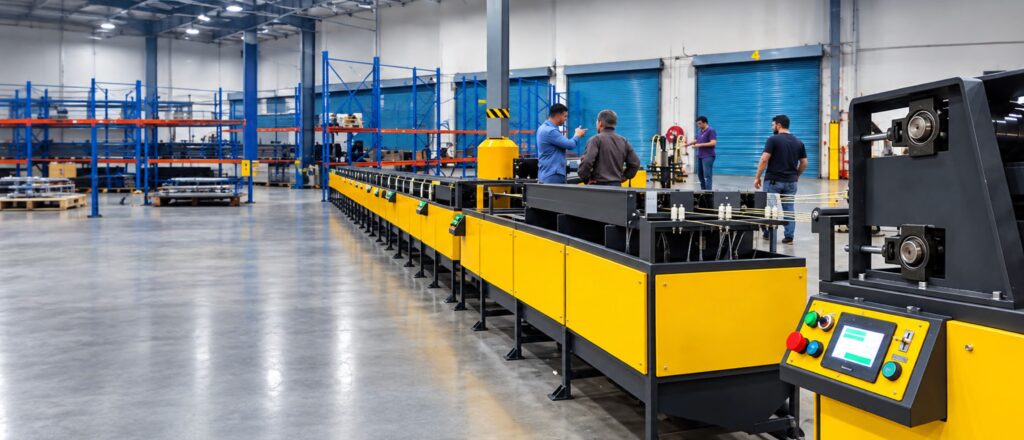
Quick Answer: How Do You Choose a GFRP Rebar Production Line?
To choose a Ligne de production de barres d'armature en PRFV, do not start with the machine price alone. Start with the cost per sellable meter or foot of reinforcement. The right production line should control output, diameter range, fiber feeding, resin impregnation, curing, cooling, rib geometry, pulling speed, cutting, coiling, operator requirement, energy use, quality monitoring and traceability.
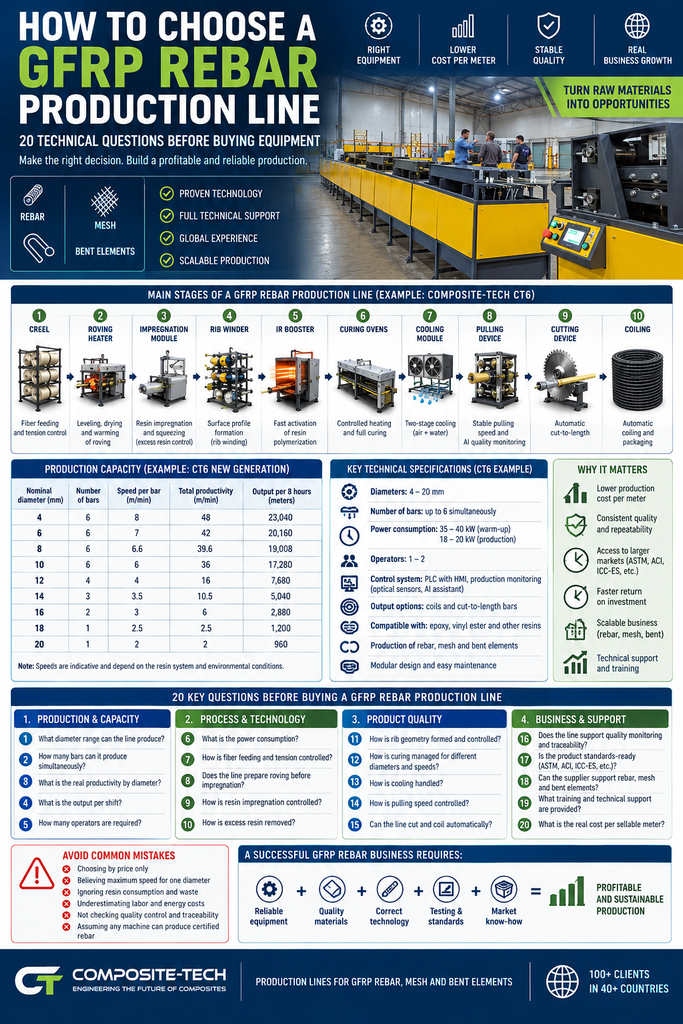
A serious buyer should ask at least 20 technical questions before purchasing equipment:
- How many bars can the line produce at the same time?
- What diameters can it manufacture?
- What is the real productivity by diameter?
- How many operators are required?
- What is the power consumption during warm-up and production?
- How is resin impregnation controlled?
- How does the machine prevent excess resin consumption?
- How is rib geometry formed and controlled?
- How is curing managed for different diameters and speeds?
- How is thermal shock avoided after curing?
- Can the line produce coils and cut-to-length bars?
- Does the system support quality control and traceability?
- Can the equipment help produce products suitable for ASTM, ACI, ICC-ES, EAD or other approval routes?
The cheapest machine is not always the lowest-cost machine. In GFRP manufacturing, a poor line can lose money through resin waste, low productivity, high labor input, unstable quality, rejected batches and weak market acceptance.
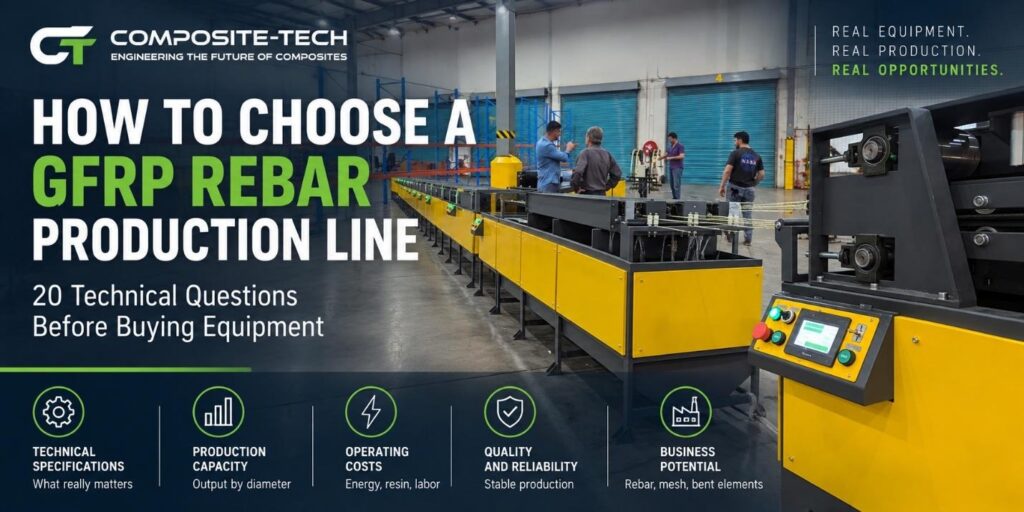
Points clés à retenir
- A GFRP rebar production line should be evaluated by cost per sellable meter, not only purchase price.
- Output by diameter is one of the most important indicators of production economics.
- Multi-bar production can reduce labor, energy and overhead cost per meter.
- CT6 new generation is designed to produce up to 6 barres simultanément en diamètres de 4 mm à 20 mm.
- The CT6 new generation manual lists recommended productivity up to 48 m/min pour 4 mm, 42 m/min pour 6 mm, 39,6 m/min pour 8 mm, et 36 m/min pour 10 mm; the stated speeds are indicative and depend on resin polymerization and environmental parameters.
- Operator requirement matters because labor cost must be divided by sellable output. The CT6 new generation manual states that the machine is controlled by un ou au maximum deux opérateurs.
- Energy should be compared as kWh per meter, not only installed power.
- Resin impregnation and resin squeezing are direct cost and quality factors.
- Rib geometry is a structural parameter because it affects bond with concrete.
- Curing is not just oven temperature; it depends on resin chemistry, residence time, pulling speed and bar diameter.
- Quality monitoring and traceability are becoming necessary for serious engineering markets.
- ASTM D7957/D7957M covers GFRP bars for concrete reinforcement with external surface enhancement, while ASTM D7205/D7205M covers tensile testing of FRP composite bars.
- ACI CODE-440.11-22 provides minimum requirements for materials, design and detailing of structural concrete reinforced with GFRP bars conforming to ASTM D7957-22.
Why Choosing the Right GFRP Rebar Line Matters
Buying a GFRP rebar production line is not like buying a simple cutting machine or packaging machine. The production line determines the technical and commercial identity of the product.
It controls:
| Production Factor | Résultats commerciaux |
|---|---|
| Fiber alignment | Affects tensile performance and consistency |
| Imprégnation de résine | Affects wet-out, durability and material cost |
| Fiber/resin ratio | Affects cost, density and mechanical behavior |
| Géométrie des côtes | Affects bond and market confidence |
| Qualité du durcissement | Affects polymerization and repeatability |
| méthode de refroidissement | Affects surface condition and defect risk |
| Pulling speed | Affects output and curing residence time |
| Cutting and coiling | Affects delivery format and labor |
| Surveillance de la qualité | Affects defect detection and traceability |
| Energy use | Affects operating cost per meter |
| Operator count | Affects labor cost per meter |
A low-cost machine can be expensive in operation if it needs too many operators, wastes resin, runs slowly, produces unstable diameter or cannot support reliable quality documentation.
The correct question is not only:
“How much does the production line cost?”
La question la plus pertinente est :
“What cost per sellable, testable and repeatable meter will this line allow me to achieve?”
1. What Diameter Range Can the Line Produce?
The first technical question is simple: what bar sizes can the equipment manufacture?
A serious GFRP rebar line should cover the diameters required by your target market. Small diameters are often used for mesh, slabs, sidewalks and coils. Medium diameters are used for general reinforcement. Larger diameters may be required for infrastructure or specialized applications.
Composite-Tech’s CT6 new generation manual states that the line is designed for fiberglass reinforcement diameters from 4 mm à 20 mm.
| Diameter Range | Typical Commercial Importance |
|---|---|
| 4–6 mm | Mesh, light reinforcement, coils, slab applications |
| 8–10 mm | Common construction reinforcement and distributor stock |
| 12–16 mm | Structural and infrastructure applications |
| 18–20 mm | Heavier reinforcement, project-specific demand |
A line with a narrow diameter range may limit your sales channels. A line with a broad range allows the factory to serve more applications.
2. How Many Bars Can the Line Produce at the Same Time?
Multi-bar production changes manufacturing economics.
A line producing one bar at a time may be acceptable for testing or very small production. But for a commercial factory, output per hour matters.
CT6 new generation is designed to produce up to 6 bars at the same time.
| Production Format | Commercial Effect |
|---|---|
| 1 bar at a time | Lower output; higher labor and overhead per meter |
| 2–4 bars at a time | Better for small and medium production |
| Up to 6 bars at a time | Higher industrial output for common diameters |
For investors, this is one of the first numbers to check. More simultaneous bars can reduce cost per meter because the same operator, floor area and control system produce more sellable length.
3. What Is the Real Productivity by Diameter?
Many suppliers advertise only one maximum speed. That is not enough.
A buyer should ask for productivity by diameter because thicker bars usually require lower speed or fewer simultaneous bars.
The CT6 new generation manual provides a useful example of diameter-specific productivity. The speeds are stated as indicative and dependent on resin polymerization and environmental parameters.
| Diamètre nominal | Nombre de barres | Vitesse de déjaugeage, jusqu'à | Productivité totale, jusqu'à |
|---|---|---|---|
| 4 mm | 6 | 8 m/min | 48 m/min |
| 6 mm | 6 | 7 m/min | 42 m/min |
| 8 mm | 6 | 6,6 m/min | 39,6 m/min |
| 10 mm | 6 | 6 m/min | 36 m/min |
| 12 mm | 4 | 4 m/min | 16 m/min |
| 14 mm | 3 | 3,5 m/min | 10,5 m/min |
| 16 mm | 2 | 3 m/min | 6 m/min |
| 18 mm | 1 | 2,5 m/min | 2,5 m/min |
| 20 mm | 1 | 2 m/min | 2 m/min |
The strongest machine is not the one with the best brochure number. It is the one with credible output data for the diameters you actually plan to sell.
4. What Is the Output per Shift?
Production speed should be translated into shift output. That is how a factory owner thinks.
For example, based on the CT6 new generation indicated productivity for 10 mm rebar:
36 m/min × 60 minutes × 8 hours = 17,280 m per 8-hour shift
| Diamètre | Productivité | Production par heure | Output per 8-Hour Shift |
|---|---|---|---|
| 4 mm | 48 m/min | 2 880 m/h | 23 040 m |
| 6 mm | 42 m/min | 2 520 m/h | 20 160 m |
| 8 mm | 39,6 m/min | 2 376 m/h | 19 008 m |
| 10 mm | 36 m/min | 2 160 m/h | 17 280 m |
| 12 mm | 16 m/min | 960 m/h | 7 680 m |
| 14 mm | 10,5 m/min | 630 m/h | 5 040 m |
| 16 mm | 6 m/min | 360 m/h | 2 880 m |
| 18 mm | 2,5 m/min | 150 m/h | 1 200 m |
| 20 mm | 2 m/min | 120 m/h | 960 m |
This table is a capacity calculation, not a sales forecast. Real output depends on uptime, resin system, raw material supply, operator discipline, maintenance, quality checks and product changeovers.
Still, it shows why multi-bar production matters.
5. How Many Operators Are Required?
Labor cost is not only a salary question. It is a cost-per-meter question.
Le manuel de la nouvelle génération CT6 indique que la machine est entièrement contrôlée par un ou au maximum deux opérateurs.
For 10 mm rebar, the indicated output is up to 17 280 m par poste de 8 heures. That means labor is spread across a large volume of production.
| Opérateurs | 10 mm Output per 8-Hour Shift | Production par opérateur |
|---|---|---|
| 1 opérateur | 17 280 m | 17 280 m/poste d'opérateur |
| 2 opérateurs | 17 280 m | 8 640 m/poste d'opérateur |
A cheaper line requiring three to five operators may become more expensive over time than a more automated line.
6. What Is the Energy Consumption per Meter?
Do not compare machines only by installed power. Compare them by kWh per meter.
Le manuel de la nouvelle génération du CT6 indique que la consommation d'énergie pendant la phase de préchauffage est de 35–40 kW, and after reaching operating temperature, consumption decreases to 18–20 kW/hour.
Using 20 kW as a conservative operating value:
| Diamètre | Production par heure | Énergie par mètre à 20 kW |
|---|---|---|
| 4 mm | 2 880 m/h | 0,0069 kWh/m |
| 6 mm | 2 520 m/h | 0,0079 kWh/m |
| 8 mm | 2 376 m/h | 0,0084 kWh/m |
| 10 mm | 2 160 m/h | 0,0093 kWh/m |
| 12 mm | 960 m/h | 0,0208 kWh/m |
| 14 mm | 630 m/h | 0,0317 kWh/m |
| 16 mm | 360 m/h | 0,0556 kWh/m |
| 18 mm | 150 m/h | 0,1333 kWh/m |
| 20 mm | 120 m/h | 0,1667 kWh/m |
This calculation excludes warm-up, ventilation, compressors, lighting and other factory systems. But it gives the buyer a useful metric: high output can make energy cost per meter very low.
7. How Is Fiber Feeding Controlled?
GFRP rebar is a directional composite. The fibers must be aligned and distributed correctly.
A production line should control:
| Fiber Feeding Question | Pourquoi c'est important |
|---|---|
| How many creels are included? | Determines raw material feeding capacity |
| How is roving preload created? | Affects tension stability |
| How are threads guided? | Reduces crossing and disorganization |
| Is fiber distribution controlled before impregnation? | Affects wet-out and section consistency |
| Can the operator adjust the system easily? | Reduces setup errors |
The CT6 new generation line includes four creels, and the manual describes the creel as a system for installing roving bobbins and creating preload of roving threads by guide rings.
This is not a minor detail. Good fibers do not help if they enter the process in an unstable condition.
8. Does the Line Prepare the Roving Before Impregnation?
Roving condition affects impregnation.
The CT6 manual describes a roving heater designed to level and dry roving threads by uniformly distributing and warming them, with the goal of supporting full impregnation with polymer binder.
A buyer should ask:
| Roving Preparation Question | Practical Reason |
|---|---|
| Is roving dried or warmed before resin? | Moisture and temperature affect wet-out |
| Is fiber distributed before impregnation? | Reduces internal inconsistency |
| Is crossing of threads minimized? | Improves alignment and bar uniformity |
| Is the process adjustable? | Different fibers and diameters may require different setup |
The production line should not only pull fibers. It should prepare them for stable composite formation.
9. How Is Resin Impregnation Controlled?
Impregnation is one of the most important stages in GFRP rebar production.
Poor impregnation can create:
- dry fibers;
- vides;
- trapped air;
- resin-rich zones;
- unstable density;
- lower repeatability;
- higher rejection risk.
The CT Mesh manual describes the impregnation module as a system for resin impregnation and pressing of roving threads while maintaining binder properties such as fluidity, curing speed and temperature; it also states that the pressing system reduces polymer consumption. The CT6 new generation document also describes resin-impregnated roving passing through a squeegee with adjustable pressure.
A buyer should ask whether the line controls both wet-out and excess resin.
Too little resin is a quality problem. Too much resin is a cost problem.
10. Does the Line Reduce Resin Waste?
Resin is usually more expensive than glass fiber per kilogram. Excess resin can reduce margin quickly.
A buyer should ask:
| Resin-Control Question | Pourquoi c'est important |
|---|---|
| Is there a squeegee or pressing system? | Removes excess resin |
| Can pressure be adjusted? | Different diameters and formulations need control |
| Is resin temperature controlled? | Viscosity affects wet-out |
| Does the system reduce polymer overuse? | Influe directement sur le coût par mètre |
| Can the process be repeated batch after batch? | Affects quality and margin |
A cheap machine that wastes resin may cost more over one year than the price difference between it and a better line.
11. How Is Rib Geometry Formed?
For GFRP rebar, surface profile is not decoration. It is part of the structural behavior because it affects bond with concrete.
The CT Mesh documentation describes a weaving module that can operate in thread winding mode and weaving mode. In winding mode, it forms a periodic rib profile with an exact winding step for each reinforcement size.
For a rebar production line, a buyer should ask:
| Rib Geometry Question | Pourquoi c'est important |
|---|---|
| How is rib pitch controlled? | Affects repeatability |
| Can winding speed be synchronized with pulling speed? | Controls rib spacing |
| Is winding tension controlled? | Affects surface consistency |
| Does the rib system help maintain cylindrical shape? | Affects diameter and bond confidence |
| Is surface profile repeatable across long production runs? | Important for serious buyers |
A bar with good tensile strength but unstable surface geometry may still create engineering concerns.
12. How Is Curing Controlled?
Curing is not only oven temperature.
It depends on:
- resin chemistry;
- temperature profile;
- vitesse de traction ;
- residence time;
- diamètre de la barre ;
- heat transfer through the section;
- ambient conditions.
The CT6 line includes an infrared booster and five furnaces. The infrared booster is described as a system that activates resin polymerization quickly; the manual states that short-wavelength infrared heating allows polymerization to begin from inside the rod and helps prevent top-layer burning and up to 20% strength loss.
The buyer should ask for more than “how many ovens?”
Ask:
| Curing Question | Pourquoi c'est important |
|---|---|
| How many heating zones are used? | More control over polymerization |
| Is pre-curing or IR activation used? | Can affect curing profile |
| How is temperature adjusted by diameter? | Larger bars cure differently |
| How is speed linked to curing time? | Faster pulling means shorter residence time |
| Can the line run different resin systems? | Resin chemistry changes cure behavior |
A process that works for 6 mm does not automatically work for 16 mm. It must be validated.
13. How Is Cooling Managed?
Cooling is often ignored until defects appear.
The CT6 new generation manual describes a cooling module implemented in two parts: air cooling and water cooling. It states that two-stage cooling, first with air and then with water, avoids thermal shock, surface damage and cracking.
| Méthode de refroidissement | Risk / Advantage |
|---|---|
| Refroidissement direct agressif par eau | Higher thermal shock risk |
| Uncontrolled slow cooling | Lower productivity and unstable handling |
| Refroidissement à deux étages par air et eau | Better control of temperature transition |
For a buyer, cooling is not a secondary feature. It affects defect risk and production consistency.
14. How Is Pulling Speed Controlled?
Pulling speed determines output, but it also affects curing time and rib geometry.
The CT6 HMI description states that the main window shows production status, including pull speed, winding speed, length and total produced length. It also includes settings for length scale, pulling speed scale, winding speed scale, cut length and winding ratio.
This matters because rib pitch and curing time are connected to pulling speed.
| Control Function | Pourquoi c'est important |
|---|---|
| Pull speed | Controls output and residence time |
| Winding speed | Controls surface rib formation |
| Winding ratio | Links rib pitch to pulling speed |
| Length counter | Supports cutting accuracy |
| Total counter | Supports production tracking |
A machine without reliable speed control is difficult to scale.
15. Can the Line Cut and Coil Automatically?
Finished product format affects sales.
Some customers want straight bars. Others want coils for smaller diameters. Distributors may prefer coils for transport and storage. Contractors may want cut-to-length orders.
The CT6 new generation line includes a cutting device and two automatic coilers. The CT6 manual describes the cutting device as designed for cutting fiberglass reinforcement to a given length.
| Output Format | Commercial Benefit |
|---|---|
| Cut-to-length bars | Project-specific supply |
| Coils | Easier storage and transport for smaller diameters |
| Automatic cutting | Lower manual labor and better length repeatability |
| Automatic coiling | Faster packaging and less operator burden |
A production line should support the way the market buys product, not only the way the factory makes it.
16. Does the Line Support Quality Monitoring?
Quality cannot be inspected only at the end. It must be controlled during production.
The CT6 pulling device includes optical sensors connected to an AI agent to determine constant bar quality and alert the operator if necessary.
This should be stated responsibly: AI-assisted monitoring does not replace ASTM testing, third-party laboratory reports or engineering approval. But it can help detect visible process deviations earlier.
| Monitoring Area | Pourquoi c'est important |
|---|---|
| Surface continuity | Detects visible defects |
| Bar passage through pulling unit | Helps identify process interruptions |
| Operator alerts | Reduces dependence on constant manual observation |
| Production history | Supports process improvement |
| Quality consistency | Reduces risk of unnoticed defects |
For serious markets, quality monitoring is becoming part of competitiveness.
17. Does the Equipment Help Build Traceability?
A serious GFRP producer needs traceability.
That means the factory should connect:
- raw material batches;
- resin recipe;
- production date;
- line speed;
- curing settings;
- operator shift;
- diamètre de la barre ;
- sample ID;
- tensile test report;
- packaging unit;
- shipment.
| Traceability Question | Pourquoi c'est important |
|---|---|
| Can each production lot be identified? | Supports quality records |
| Are process settings recorded? | Helps explain test results |
| Are samples linked to batches? | Supports product approval |
| Are packaging labels connected to reports? | Helps project documentation |
| Can defects be traced back? | Enables root-cause analysis |
This is where many low-cost factories fail. They can make rebar, but they cannot document it well enough for demanding markets.
18. Is the Product Standards-Ready?
A production line itself is not “ASTM approved.” Standards apply to the product, test method, design and approval route.
However, the machine must help the manufacturer produce a product that can be tested and documented.
ASTM D7957/D7957M-26 covers GFRP bars provided in cut lengths and bent shapes with external surface enhancement for concrete reinforcement. ASTM D7205/D7205M is used to determine quasi-static longitudinal tensile strength and elongation properties of FRP composite bars. ACI CODE-440.11-22 provides minimum requirements for materials, design and detailing of structural concrete reinforced with GFRP bars that conform to ASTM D7957-22. ICC-ES AC454 is an acceptance criterion for FRP bars for internal reinforcement of concrete members.
| Document | What It Means for a Manufacturer |
|---|---|
| ASTM D7957/D7957M | Product specification for GFRP bars |
| ASTM D7205/D7205M | Tensile testing method |
| ASTM D7913/D7913M | Bond testing method |
| ASTM D7617/D7617M | Transverse shear testing |
| Code ACI-440.11-22 | Design and detailing framework |
| ICC-ES AC454 | Evaluation route for FRP bars |
| AASHTO GFRP guide | Bridge-related GFRP design guidance |
A buyer should avoid any supplier who says “our machine automatically produces certified rebar.” That is not how standards work.
The correct statement is:
A good production line helps manufacture repeatable GFRP rebar that can be tested, documented and submitted through the relevant product approval route.
19. Can the Supplier Support Rebar, Mesh and Bent Elements?
A factory that produces only straight bars may be limited. A stronger business model can include straight rebar, FRP mesh, coils, cut-to-length bars and bent elements.
The CT M 2-6 documentation states that the machine is designed to produce fiberglass mesh up to 1 meter wide from rods up to 6 mm, with customizable mesh size. It lists possible diameters from 2–6 mm, cell sizes from 100–200 mm, and recommended mesh production speeds up to 3 m/min for 2 mm mesh with 200×200 mm cells.
| Product Category | Pourquoi c'est important |
|---|---|
| Barres d'armature droites en PRFV | Core reinforcement product |
| Coiled small diameters | Distributor-friendly supply |
| Cut-to-length bars | Contractor-ready orders |
| Maille FRP | High-volume slab and panel applications |
| Éléments pliés | Stirrups, U-bars, hooks and detailing |
| Private-label production | Regional brand opportunity |
When choosing a production line supplier, the buyer should think about the whole product ecosystem, not only one machine.
20. What Is the Real Cost per Sellable Meter?
This is the final question and the most important one.
A machine’s real economic value depends on:
| Facteur de coût | Better Question |
|---|---|
| Machine price | What is the cost per sellable meter? |
| Installed power | What is kWh per meter? |
| Operator count | What is labor cost per meter? |
| Utilisation de la résine | What is resin consumption per meter? |
| vitesse de production | What is monthly sellable output? |
| Scrap rate | How many meters are rejected? |
| Contrôle de qualité | Can the product pass serious testing? |
| Traçabilité | Can batches be documented? |
| Gamme de produits | Can the factory sell rebar, mesh and shapes? |
| Technical support | Can the supplier help during commissioning and scaling? |
The cheapest production line can become the most expensive decision if it produces unstable material.
A professional GFRP rebar line should manufacture:
- meters;
- repeatability;
- traçabilité ;
- technical confidence;
- business margin.
Cheap Machine vs Professional GFRP Rebar Production Line
| Facteur | Low-Cost / Basic Line | Professional Automated Line |
|---|---|---|
| Output | Lower and often less documented | Diameter-specific productivity data |
| Opérateurs | More manual supervision | Lower operator requirement |
| Resin control | Higher waste risk | Squeegee / pressing / process control |
| Fiber preparation | Limité | Controlled feeding, distribution and preparation |
| Géométrie des côtes | Less repeatable | Controlled winding and rib pitch |
| Curing | Basic heating | Diameter- and speed-sensitive curing system |
| Refroidissement | Often simple | Controlled cooling to reduce defect risk |
| Cutting/coiling | Manual or semi-manual | Automated options |
| Surveillance de la qualité | Mainly visual | Sensors and process monitoring |
| Traçabilité | Weak | Can be built into production records |
| Standards readiness | Harder | Easier if product is tested and documented |
| Margin | Instable | More predictable if sales volume exists |
The question is not whether cheap equipment can produce a bar. Sometimes it can.
The question is whether it can produce repeatable, sellable, testable reinforcement at industrial volume.
Buyer Checklist: 20 Questions Before Buying a GFRP Rebar Production Line
| Non. | Question | Pourquoi c'est important |
|---|---|---|
| 1 | What diameters can the line produce? | Defines product range |
| 2 | How many bars can it produce simultaneously? | Determines output |
| 3 | What is productivity by diameter? | Shows real capacity |
| 4 | What is output per 8-hour shift? | Helps build business plan |
| 5 | How many operators are required? | Affects labor cost |
| 6 | What is warm-up and operating power? | Affects energy model |
| 7 | What is kWh per meter? | Shows true energy efficiency |
| 8 | How is fiber fed and tensioned? | Affects alignment |
| 9 | Is roving prepared before impregnation? | Affects wet-out |
| 10 | How is resin impregnation controlled? | Affects quality |
| 11 | How is excess resin removed? | Affects cost |
| 12 | How is rib geometry formed? | Affecte le lien |
| 13 | Is rib pitch synchronized with pulling speed? | Affects repeatability |
| 14 | How is curing controlled? | Affects polymerization |
| 15 | How is cooling managed? | Affects defects |
| 16 | Can the line cut automatically? | Affects labor and accuracy |
| 17 | Can it coil rebar? | Affects packaging and logistics |
| 18 | Does it support quality monitoring? | Reduces defect risk |
| 19 | Can production data be traced by batch? | Supports serious markets |
| 20 | Can the supplier support rebar, mesh and bent elements? | Builds a broader business model |
Common Mistakes When Choosing FRP Rebar Equipment
- The first mistake is buying by machine price only.
- The second is believing a maximum speed without asking for diameter-specific productivity.
- The third is ignoring resin consumption.
- The fourth is underestimating labor cost.
- The fifth is comparing installed power instead of kWh per meter.
- The sixth is treating rib geometry as appearance rather than a bond-related feature.
- The seventh is not checking curing and cooling technology.
- The eighth is forgetting about cutting, coiling and packaging.
- The ninth is ignoring product documentation, standards and traceability.
- The tenth is assuming that any machine that can pull a composite rod can produce serious GFRP rebar for engineering markets.
- It cannot.
Conclusion
Choosing a GFRP rebar production line is not mainly about buying equipment. It is about building a factory that can produce reliable composite reinforcement at a competitive cost per meter or foot.
The best production line is not the cheapest line on paper. It is the line that gives the manufacturer high output, controlled resin use, stable fiber impregnation, repeatable rib geometry, proper curing, controlled cooling, low operator requirement, efficient energy use, automated finishing, quality monitoring and traceable production.
GFRP rebar is already part of a standards-based construction market. ASTM, ACI, ICC-ES and AASHTO frameworks show that serious buyers are not looking only for a low price. They are looking for tested, documented and repeatable products.
That is why equipment choice matters.
A professional GFRP rebar production line does more than make bars.
It creates the production stability, technical documentation and cost structure that allow a manufacturer to compete in real engineering markets.
FAQ: Choosing a GFRP Rebar Production Line
What is the most important factor when choosing a GFRP rebar production line?
The most important factor is not machine price alone. It is the cost per sellable, testable and repeatable meter of GFRP rebar.
How many bars should a professional GFRP line produce at the same time?
It depends on the factory’s target market and capacity plan. For industrial production, multi-bar output is usually more attractive because it reduces labor, energy and overhead cost per meter.
What diameter range should a GFRP rebar line cover?
A practical commercial line should cover common construction diameters. CT6 new generation, for example, is designed for diameters from 4 mm to 20 mm.
Why does productivity by diameter matter?
Because maximum speed for one small diameter does not represent total factory capability. Thicker bars usually require lower pulling speed or fewer simultaneous bars.
How many operators are needed for a GFRP rebar production line?
It depends on the equipment and factory setup. The CT6 new generation manual states that the machine is fully controlled by one or a maximum of two operators.
Why is energy per meter more important than installed power?
Installed power does not show actual operating cost. Energy per meter shows how much electricity is used to produce one sellable meter of reinforcement.
Why is resin impregnation so important?
Resin impregnation affects fiber wet-out, voids, load transfer, durability and product consistency. Poor impregnation can create internal defects even if the bar looks acceptable outside.
Why does resin control affect profit?
Resin is a major cost component. Excess resin increases cost per meter, while insufficient resin or poor wet-out can create rejected product.
Pourquoi la géométrie des côtes est-elle importante ?
Rib geometry affects mechanical interlock and bond with concrete. A tensile test alone does not fully describe how the bar transfers force to concrete.
What standards should a GFRP rebar manufacturer know?
Important documents include ASTM D7957, ASTM D7205, ASTM D7913, ASTM D7617, ACI CODE-440.11-22, ICC-ES AC454 and AASHTO GFRP bridge guidance, depending on the target market.
Does a production line make a product automatically ASTM compliant?
No. The product must be tested and documented according to the relevant standards. A good production line supports repeatable production, but it does not replace testing.
Should a factory produce only straight GFRP rebar?
Not necessarily. A stronger business model may include straight rebar, coiled rebar, FRP mesh, cut-to-length bars and bent elements.
What is the biggest risk of buying cheap FRP rebar equipment?
The biggest risk is hidden operating cost: resin waste, low output, high labor, unstable quality, poor curing, weak surface geometry, rejected batches and difficult market acceptance.
What should a buyer ask before signing a contract for a GFRP rebar line?
The buyer should ask for diameter range, productivity by diameter, number of simultaneous bars, operator requirement, energy consumption, impregnation method, resin control, curing and cooling system, rib formation method, cutting/coiling options, quality monitoring, installation requirements, training and technical support.
Apprendre encore plus: