
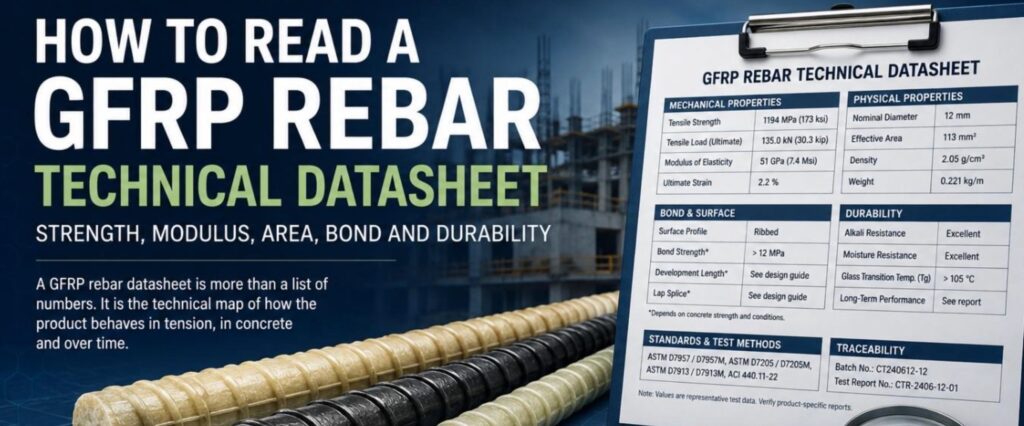
Quick Answer: What Should You Check First in a GFRP Rebar Technical Datasheet?
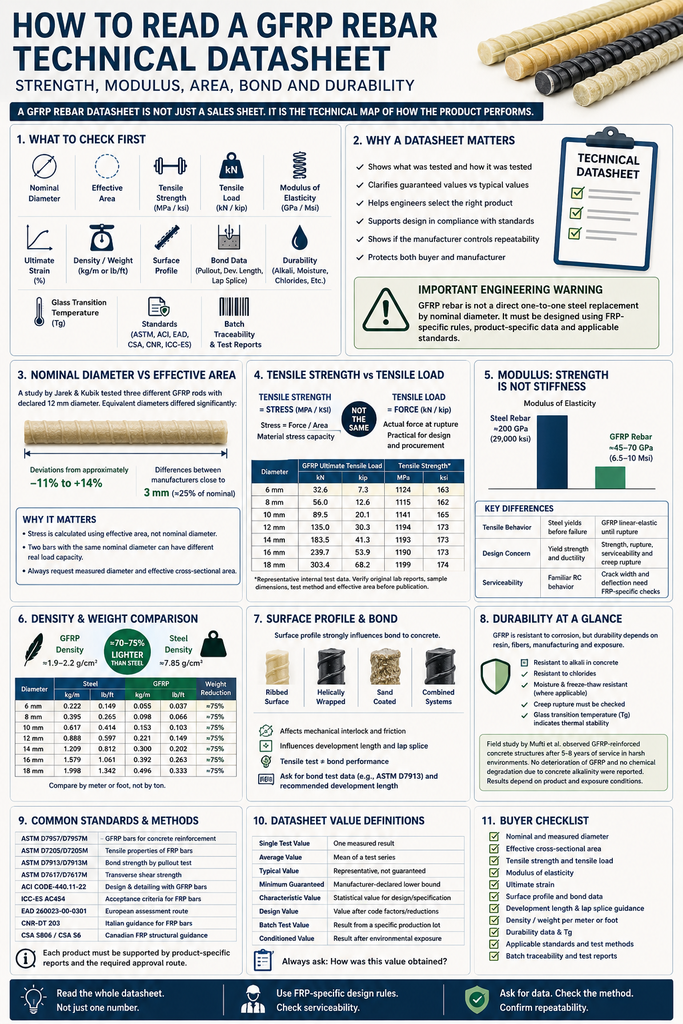
UN GFRP rebar technical datasheet should be read as an engineering document, not as a simple sales sheet. The first values to check are nominal diameter, effective area, tensile strength, tensile load, modulus of elasticity, ultimate strain, density, weight per meter or foot, surface profile, bond data, durability data, glass transition temperature where available, test methods, standards references and batch traceability.
The most common mistake is reading only one number: tensile strength in MPa or ksi. That is not enough. A GFRP bar with high tensile strength may still require careful checks for stiffness, bond, development length, lap splice, crack width and deflection.
GFRP rebar is not a direct one-to-one steel replacement by nominal diameter. It must be designed using FRP-specific rules, product-specific test data and applicable standards.
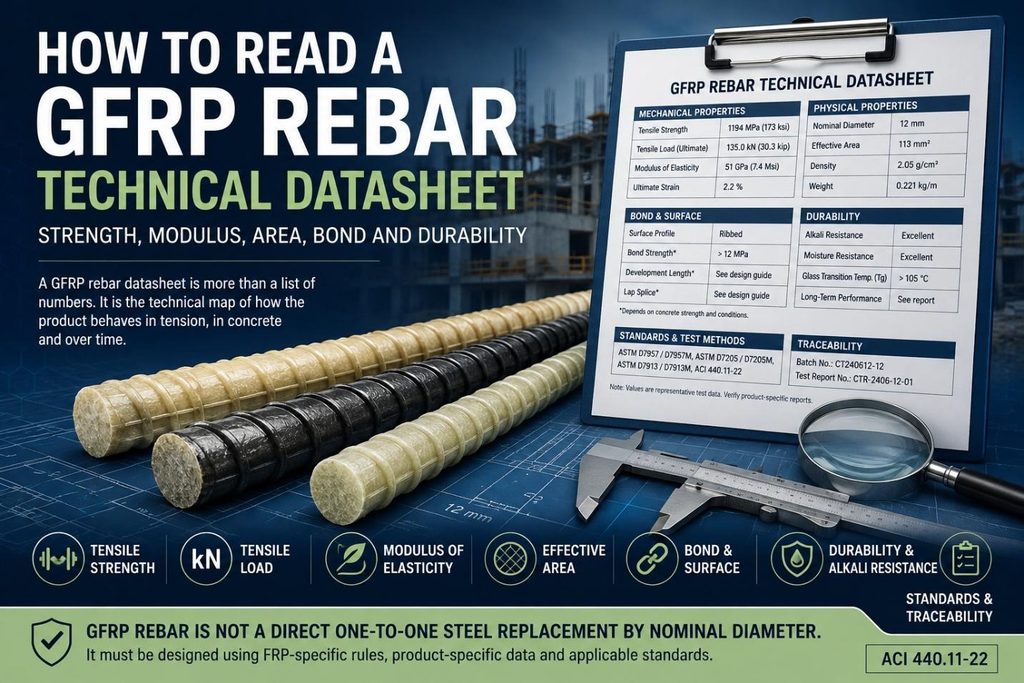
Points clés à retenir
- A GFRP datasheet should show how the product behaves in tension, in concrete, during handling and over time.
- Tensile strength and tensile load are different values. MPa is not the same as kN.
- Effective area matters because stress calculations depend on the real load-carrying section.
- Modulus matters because GFRP is usually less stiff than steel, even when its tensile strength is higher.
- Surface profile is not cosmetic. It affects bond, development length and lap splice behavior.
- Durability data should include information related to alkali resistance, moisture exposure, thermal behavior and long-term performance.
- A product should not be described as “approved” or “meeting all standards” without product-specific reports.
- One excellent test result is not the same as repeatable factory production.
- Buyers should ask for datasheets, test reports, batch traceability and clear test methods.
Why a GFRP Datasheet Matters
A technical datasheet protects both sides: the buyer and the manufacturer.
For the buyer, it answers practical questions: what was tested, how it was tested, what values are typical, what values are guaranteed and whether the product is suitable for the intended application.
For the manufacturer, it defines the technical identity of the product. A serious datasheet makes it easier to speak with engineers, consultants, distributors, infrastructure owners and testing laboratories.
A weak datasheet usually shows only diameter and tensile strength. A strong datasheet explains the product as a system.
| Datasheet Purpose | Pourquoi c'est important |
| Identifies tested properties | Prevents confusion between marketing claims and test data |
| Shows test methods | Allows engineers to understand how values were obtained |
| Gives mechanical values | Supports design review and comparison |
| Gives physical values | Supports logistics, handling and procurement |
| Describes surface profile | Supports bond and detailing evaluation |
| Shows durability data | Supports long-term use in concrete |
| Provides traceability | Connects product batches to quality control |
The best datasheet does not try to impress the reader with one large number. It helps the reader make a correct engineering decision.
Nominal Diameter vs Effective Area
Nominal diameter is the size name of the bar. It is useful, but it is not enough.
For steel rebar, nominal sizes are highly standardized. GFRP bars are different because surface profile, resin content, fiber content and manufacturing method can affect the measured diameter and effective area.
This is not just theory. In a study by Bogusław Jarek and Aleksandra Kubik, GFRP rods from three manufacturers with the same declared 12 mm diameter were tested. The authors reported a large discrepancy between declared and real diameter and stated that the equivalent diameter differed from the nominal diameter by approximately −11% à +14%. The difference between manufacturers was nearly 3 mm, ou à propos de 25% du diamètre nominal.
That example is important because stress is calculated using area. If the area is wrong, the calculated tensile strength can be misleading.
| Terme | Signification | What Buyer Should Ask |
| Diamètre nominal | Commercial or declared size | Is this only a size name or measured value? |
| Measured diameter | Actual measured bar diameter | What method was used? |
| Zone efficace | Area used for stress calculation | Is it stated clearly in the report? |
| Surface-enhanced diameter | Diameter including ribs/coating | Is it separated from load-carrying area? |
| Tolerance | Allowed production variation | What is the acceptable range? |
A buyer should never assume that two bars with the same nominal diameter have identical effective area.
Tensile Strength vs Tensile Load
This is one of the most important distinctions in a GFRP datasheet.
Résistance à la traction is stress. It is usually expressed in MPa or ksi.
Charge de traction, also called breaking force or ultimate tensile force, is actual force. It is usually expressed in kN or kip.
Both values matter.
A bar can show a high tensile strength in MPa, but the actual force capacity also depends on the effective area. For procurement and engineering discussions, tensile load is often easier to understand because it tells how much force the bar carried before rupture.
Representative GFRP values previously used in Composite-Tech technical materials are shown below. These should be presented as representative technical data unless the original test reports, sample dimensions, effective area and test methods are attached to the final datasheet.
| Diamètre | GFRP Ultimate Tensile Load | Résistance à la traction |
| 6 mm | 32.6 kN / 7.3 kip | 1124 MPa / 163 ksi |
| 8 mm | 56.0 kN / 12.6 kip | 1115 MPa / 162 ksi |
| 10 mm | 89,5 kN / 20,1 kip | 1141 MPa / 165 ksi |
| 12 mm | 135.0 kN / 30.3 kip | 1194 MPa / 173 ksi |
| 14 mm | 183.5 kN / 41.3 kip | 1193 MPa / 173 ksi |
| 16 mm | 239.7 kN / 53.9 kip | 1190 MPa / 173 ksi |
| 18 mm | 303.4 kN / 68.2 kip | 1199 MPa / 174 ksi |
Publication note: verify the original laboratory reports, test method, specimen dimensions and effective area before presenting these values as product-specific guarantees.
A good datasheet should make clear whether a tensile value is a single test result, an average, a minimum guaranteed value, a characteristic value or a design value.
Modulus of Elasticity: Strength Is Not Stiffness
A common mistake is to see a GFRP tensile strength above 1000 MPa and conclude that GFRP is simply “stronger steel.”
That is not how reinforced concrete design works.
GFRP can have high ultimate tensile strength, but its modulus of elasticity is lower than steel. Steel modulus is typically around 200 GPa / 29 Msi, while GFRP modulus is commonly product-dependent and often in the range of about 45–70 GPa / 6.5–10 Msi.
Modulus controls stiffness. Stiffness affects deflection and crack width. That is why serviceability can control GFRP-reinforced concrete design even when ultimate tensile strength is high.
| Propriété | Barres d'armature en acier | Barres d'armature en PRFV |
| Tensile behavior | Yielding before failure | Linear-elastic until rupture |
| Module | High, typically ~200 GPa | Lower than steel and product-dependent |
| Design concern | Yield strength and ductility | Strength, rupture, serviceability and creep rupture |
| Serviceability | Familiar RC behavior | Crack width and deflection need FRP-specific checks |
| Failure mode | Ductile yielding possible | Plateau sans fléchissement |
This is why a GFRP datasheet must show modulus, not only tensile strength.
A bar may be strong but not as stiff as steel. That does not make it a bad material. It means it must be designed correctly.
Ultimate Strain
Ultimate strain is the strain at rupture. It tells how much the bar elongates before failure under tensile loading.
For steel, engineers often think in terms of yield. GFRP does not yield like steel. It behaves approximately linear-elastically until rupture. That makes ultimate strain useful, but it must not be confused with allowable design strain.
Design standards apply reduction factors, environmental factors, creep rupture limits and serviceability checks. The datasheet should show the tested ultimate strain and the method used to obtain it.
| Valeur | Ce que cela signifie |
| Souche ultime | Strain at tensile rupture |
| Design strain | Value allowed by design provisions |
| Creep rupture limit | Long-term stress/strain limitation |
| Service strain | Strain under working load conditions |
Ultimate strain should be read together with modulus and tensile strength.
Density and Weight per Meter or Foot
Weight belongs in a GFRP datasheet because GFRP is usually bought, transported and installed by length, not by ton.
At the same nominal diameter, GFRP is typically about Briquet 70–75% than steel. Composite-Tech technical briefing materials compare GFRP density at about 1.9–2.2 g/cm³ with steel density around 7.85 g/cm³, and also emphasize that actual GFRP weight depends on bar designation, fiber content and surface profile.
| Diamètre | Acier kg/m | Acier lb/pi | PRFV kg/m | PRFV lb/pi | Réduction de poids |
| 6 mm | 0.222 | 0.149 | 0.055 | 0.037 | ~75% |
| 8 mm | 0.395 | 0.265 | 0.098 | 0.066 | ~75% |
| 10 mm | 0.617 | 0.414 | 0.153 | 0.103 | ~75% |
| 12 mm | 0.888 | 0.597 | 0.221 | 0.149 | ~75% |
| 14 mm | 1.209 | 0.812 | 0.300 | 0.202 | ~75% |
| 16 mm | 1.579 | 1.061 | 0.392 | 0.263 | ~75% |
| 18 mm | 1.998 | 1.342 | 0.496 | 0.333 | ~75% |
This is why comparing GFRP and steel by ton is misleading. The correct comparison is usually by meter, foot, bar schedule or total reinforcement package.
Low weight is valuable for freight, unloading, handling and installation. It does not replace structural design.
Surface Profile and Bond
Surface profile is not cosmetic. It affects how the bar transfers force into concrete.
A tensile test tells how the bar behaves in direct tension. It does not fully describe development length, lap splice behavior or bond with concrete.
Common GFRP surface systems include ribbed profiles, helically wrapped profiles, sand-coated surfaces and combined systems. Each surface type can produce different bond behavior depending on geometry, manufacturing quality and adhesion to the bar body.
| Surface / Bond Item | Pourquoi c'est important |
| Géométrie des côtes | Affects mechanical interlock |
| Rib spacing / pitch | Affects surface consistency |
| Sand coating | Can improve friction and micro-interlock |
| Helical wrapping | Creates spiral mechanical engagement |
| Adhésion de surface | Weak surface layers can reduce reliability |
| données de test de liaison | Supports development length and lap splice decisions |
The datasheet should describe the surface profile and, where relevant, reference bond testing. ASTM D7913/D7913M is commonly used for bond strength by pullout testing, while ASTM D7205/D7205M addresses tensile testing of FRP bars.
A product with good tensile strength but poor or inconsistent bond behavior may create problems in real concrete members.
Durability and Alkali Resistance
GFRP is often selected because it does not rust, but a serious datasheet should go deeper than that.
The datasheet should help answer durability questions related to concrete alkalinity, moisture exposure, chlorides, freeze-thaw exposure where applicable, resin chemistry, glass transition temperature, creep rupture and long-term strength retention.
A Canadian field study by Mufti et al. examined GFRP-reinforced concrete structures after 5 à 8 ans of service. The work included structures exposed to marine, de-icing salt, wet-dry and freeze-thaw conditions, and used optical microscopy, SEM, EDX, DSC and infrared spectroscopy. The technical briefing summary states that no deterioration of GFRP and no chemical degradation due to concrete alkalinity were reported in the examined field structures.
That is useful evidence, but it should be read responsibly. It does not mean every GFRP product automatically has the same durability. Durability depends on fiber, resin, manufacturing quality, exposure conditions and product-specific testing.
The original durability paper also explains why matrix chemistry matters: resin degradation can reduce the matrix’s ability to transfer stress to the glass fibers and protect them against alkaline attack.
Glass Transition Temperature
Glass transition temperature, usually written as Tg, describes thermal transition behavior of the polymer matrix.
It is not the same as a simple “maximum service temperature.” But it is useful because it gives information about resin cure, thermal stability and matrix behavior.
A datasheet should state:
| Tg Data | Pourquoi c'est important |
| Tg value | Indicates thermal transition behavior |
| Méthode d'essai | Allows comparison between reports |
| Conditioned or unconditioned state | Shows whether exposure affected the matrix |
| Relation to curing | Helps evaluate resin processing quality |
| Pertinence du design | Must be interpreted with applicable code requirements |
Tg is one of the values that separates a serious technical datasheet from a basic sales brochure.
Standards and Test Methods
A datasheet should identify the standards and test methods used. It should not simply say “high quality” or “tested according to international standards” without details.
ASTM D7957/D7957M-25 covers solid round GFRP bars provided in cut lengths and bent shapes with external surface enhancement for concrete reinforcement. ASTM D7205/D7205M-26 determines quasi-static longitudinal tensile strength and elongation properties of FRP composite bars.
Code ACI-440.11-22 provides minimum requirements for materials, design and detailing of structural concrete reinforced with GFRP bars that conform to ASTM D7957-22.
| Document / Norme | Ce que cela permet d'évaluer |
| ASTM D7957 / D7957M | Barres en PRFV pour le renforcement du béton |
| ASTM D7205 / D7205M | Tensile properties of FRP bars |
| ASTM D7913 / D7913M | Résistance de l'adhérence par test d'arrachement |
| ASTM D7617 / D7617M | Résistance au cisaillement transversal |
| Code ACI-440.11-22 | Conception et détails du béton structurel armé de barres en PRFV |
| ICC-ES AC454 | Critères d'acceptation des barres en PRF |
| EAD 260023-00-0301 | European assessment route for FRP bars where applicable |
| CNR-DT 203 | Italian guidance for FRP bars in concrete |
| CSA S806 / CSA S6 | Guide structurel canadien relatif aux PRF |
EOTA lists EAD 260023-00-0301 for carbon, glass, basalt and aramid FRP bars as reinforcement of structural elements, while CNR lists CNR-DT 203 guidance for concrete structures reinforced with FRP bars. CSA S806:26 covers design and construction of building structures with fibre-reinforced polymers.
The material category is covered by recognized standards and guidance, but each product must be supported by product-specific test reports, datasheets, traceability and the required approval route for the intended application.
Typical, Guaranteed, Characteristic and Design Values
Not every number on a datasheet has the same meaning.
A serious datasheet should state whether a value is:
| Type de valeur | Signification |
| Single test value | One measured result |
| Valeur moyenne | Mean value from a test series |
| valeur typique | Valeur indicative, non garantie |
| valeur minimale garantie | limite inférieure déclarée par le fabricant |
| Valeur caractéristique | Statistical value used for design or specification |
| Valeur de conception | Valeur après facteurs de codage et réductions |
| Batch test value | Résultat d'un lot de production spécifique |
| valeur conditionnée | Résultat après exposition environnementale |
This distinction matters.
A buyer should not treat a single high test result as a guaranteed design value. Engineers should know whether the value comes from one specimen, an average, a minimum, an environmental durability test or a full qualification program.
Manufacturing Quality and Repeatability
Raw materials create potential. Manufacturing determines how much of that potential becomes consistent product performance.
Fiber alignment, impregnation, curing, cooling and surface formation all affect the final bar. A manufacturer may produce one excellent specimen, but the real industrial question is whether similar properties can be produced repeatedly across shifts, raw material batches, production speeds and thousands of meters.
Conceptions de Composite-Tech technologie de production for FRP rebar and mesh. From practical factory experience, the most relevant production variables are stable impregnation, controlled curing, repeatable rib geometry, controlled pulling and consistent quality monitoring. The CT6 new generation manual, for example, describes modules for fiber preparation, impregnation, rib winding, curing, cooling, pulling, cutting and coiling, and also describes optical sensors connected to an AI agent for monitoring bar quality and alerting the operator.
This should not be read as a guarantee that equipment alone determines final properties. Mechanical performance still depends on fiber, resin, formulation, fiber fraction, geometry, process parameters, manufacturing quality and testing method.
The point is simpler: a datasheet is only as reliable as the production control behind it.
GFRP Rebar Datasheet Checklist
| Fiche technique | Pourquoi c'est important | What Buyer Should Ask |
| Diamètre | Size reference | Nominal and measured values |
| Zone efficace | calcul des contraintes | Test method and tolerance |
| Charge de traction | Actual force capacity | kN / kip |
| Résistance à la traction | Material stress capacity | MPa / ksi |
| Module | Stiffness and serviceability | GPa / Msi |
| Souche ultime | Rupture behavior | Méthode d'essai |
| Profil de surface | Bond behavior | Ribbed, sand-coated, wrapped or combined |
| Bond data | Development length and lap splice | Test method and concrete strength |
| Density / weight | Logistics and cost | kg/m / lb/ft |
| Durabilité | Long-term behavior | Alkali, moisture, creep, Tg |
| Traçabilité | Contrôle de qualité | Batch number and test reports |
| normes | Acceptance route | Applicable standards and reports |
A supplier that cannot answer these questions may not be ready for serious engineering markets.
Common Mistakes When Reading a GFRP Rebar Datasheet
- The first mistake is comparing only MPa. Tensile strength is useful, but it does not tell the full story.
- The second mistake is ignoring tensile load. For many buyers, kN or kip is more practical than stress alone.
- The third mistake is ignoring modulus. GFRP can have high strength and still require serviceability checks because it is less stiff than steel.
- The fourth mistake is comparing by ton. GFRP should usually be compared by meter, foot or complete project package.
- The fifth mistake is assuming nominal diameter equals effective area.
- The sixth mistake is ignoring surface profile and bond. A direct tensile test does not explain how the bar transfers force to concrete.
- The seventh mistake is ignoring the test method. A number without a method is not a serious engineering value.
- The eighth mistake is assuming one test result represents all production.
- The final mistake is treating GFRP as a direct steel copy. It is not. It is a different reinforcement material and should be designed accordingly.
FAQ: GFRP Rebar Technical Datasheet
Qu'est-ce qu'une fiche technique pour barres d'armature en PRFV ?
Une fiche technique d'armature en PRFV est un document qui décrit les propriétés physiques, mécaniques, d'adhérence, de durabilité et de test d'un produit de renforcement en PRFV spécifique.
Quel est le chiffre le plus important sur la fiche technique d'une armature en PRFV ?
Il n'existe pas de valeur unique plus importante que la valeur absolue. La résistance à la traction, la charge de traction, le module d'Young, la surface utile, le profil de surface, la durabilité et la méthode d'essai doivent être interprétés conjointement.
La résistance à la traction est-elle la même chose que la charge de traction ?
Non. La résistance à la traction est une contrainte, généralement exprimée en MPa ou ksi. La charge de traction est une force, généralement exprimée en kN ou kip.
Pourquoi la surface effective est-elle importante ?
La surface effective sert à calculer la contrainte. Si cette surface est imprécise ou incorrecte, les valeurs de résistance à la traction peuvent être trompeuses.
Quelle est une bonne résistance à la traction pour les barres d'armature en PRFV ?
De nombreux produits en PRFV présentent une résistance à la traction supérieure à la limite d'élasticité de l'acier, mais la valeur exacte doit être déterminée par des essais spécifiques au produit. La conception doit néanmoins respecter les dispositions propres aux PRFV.
Pourquoi le module d'élasticité du PRFV est-il inférieur à celui de l'acier ?
Le PRFV est un matériau composite constitué de fibres et de résine polymère. Sa rigidité dépend du type de fibres, de leur fraction volumique, du système de résine et de la qualité de fabrication. L'acier est beaucoup plus rigide, avec un module typique d'environ 200 GPa.
Les barres d'armature en PRFV peuvent-elles remplacer les barres d'armature en acier à parts égales ?
Non. Le diamètre nominal ne suffit pas à déterminer le diamètre du matériau composite. Les ingénieurs doivent vérifier la section, la résistance à la traction, le module d'élasticité, l'adhérence, la longueur de scellement, le recouvrement, l'ouverture des fissures et la flèche.
Pourquoi le profil de surface est-il important ?
Le profil de surface influe sur l'adhérence au béton. Il détermine la transmission des forces de l'armature au béton et affecte la longueur de scellement et le comportement du recouvrement.
Quelles normes doivent figurer sur une fiche technique en PRFV ?
Les références courantes incluent ASTM D7957, ASTM D7205, ASTM D7913, ASTM D7617, ACI CODE-440.11-22, ICC-ES AC454, EAD 260023-00-0301, CNR-DT 203 et CSA S806 / CSA S6, selon le marché.
À quoi sert la norme ASTM D7205 ?
La norme ASTM D7205/D7205M est utilisée pour déterminer la résistance à la traction longitudinale quasi-statique et les propriétés d'allongement des barres composites FRP.
À quoi sert la norme ASTM D7957 ?
ASTM D7957/D7957M est une spécification pour les barres rondes pleines en PRFV avec amélioration de surface externe pour le renforcement du béton.
Pourquoi les tests de durabilité sont-ils importants ?
Les essais de durabilité permettent d'évaluer comment la barre peut se comporter dans des conditions d'alcalinité du béton, d'humidité, d'exposition aux chlorures, d'exposition au gel-dégel et de charge à long terme.
Que doivent demander les acheteurs à un fournisseur de PRFV ?
Les acheteurs doivent demander une fiche technique, un rapport d'essai de traction, des données sur la surface effective, le module, la charge de traction, une description du profil de surface, des données de liaison, des données de durabilité, la traçabilité des lots et un guide d'installation.
How does manufacturing quality affect datasheet values?
Manufacturing affects fiber alignment, resin impregnation, curing, cooling, surface geometry and repeatability. These variables influence the reliability of the values shown on the datasheet.
Conclusion
A GFRP rebar technical datasheet should not be read as a list of marketing numbers. It should be read as a technical map of how the product behaves in tension, in concrete, during handling and over time.
Tensile strength is important, but it is only one part of the story. Tensile load, modulus, effective area, ultimate strain, density, surface profile, bond, durability, test methods and traceability all matter.
The strongest datasheet is not the one with the largest single number. It is the one that clearly shows what was tested, how it was tested, what the values mean and how consistently the product can be manufactured.
Pour Barres d'armature en PRFV to be trusted in serious construction markets, manufacturers must provide more than claims. They must provide product-specific data, standards-based testing and repeatable production quality.
Apprendre encore plus:
- Documentation technique de Composite-Tech
- Professional FRP Rebar Production Line
- Barres d'armature en PRFV vs barres d'armature en acier : comparaison numérique du poids, de la résistance et des propriétés techniques
- Adhérence des barres d'armature en PRFV au béton : profil de surface, géométrie des nervures et essais
- Quelle est la durée de vie des barres d'armature en PRFV dans le béton ? Durabilité, données de terrain et normes
- GFRP Rebar Development Length and Lap Splices: Anchorage Design Guide
- GFRP Rebar Quality Control: Fiber Content, Resin Impregnation, Tg, Testing and Traceability