Szybka odpowiedź: Czym jest kontrola jakości prętów zbrojeniowych GFRP?
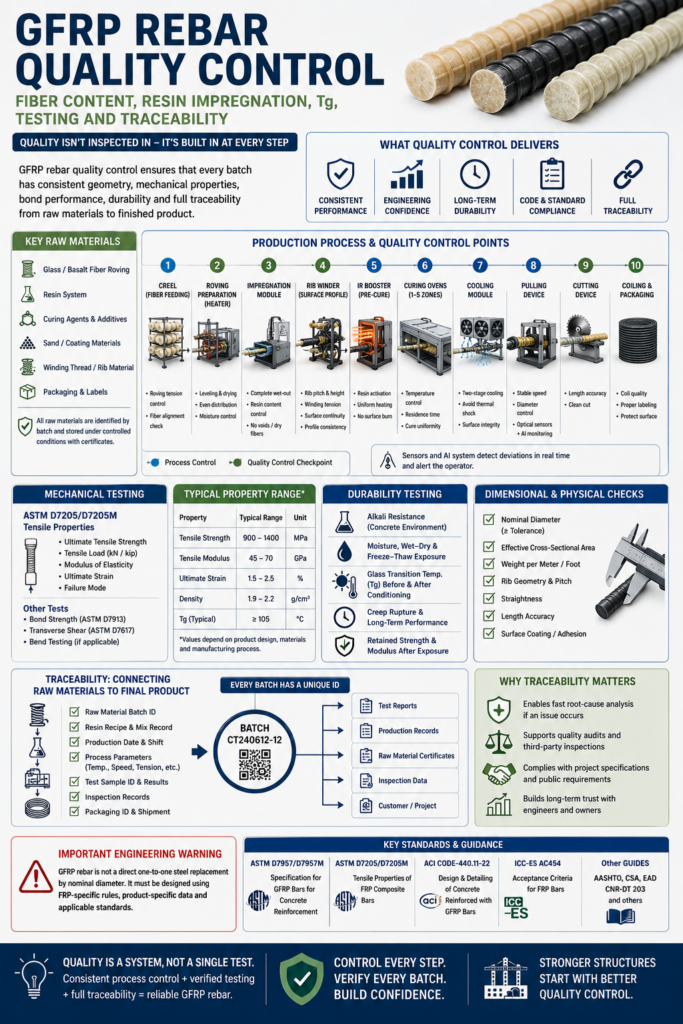
Kontrola jakości prętów zbrojeniowych GFRP to proces weryfikujący, czy każda partia produkcyjna ma spójną geometrię, zawartość włókien, impregnację żywicą, jakość utwardzania, profil powierzchni, właściwości rozciągające, zachowanie wiązania, trwałość i identyfikowalność.
Solidny system kontroli jakości GFRP powinien obejmować:
- kontrola przychodzących surowców;
- identyfikacja partii włókien i żywic;
- kontrola stosunku włókna do żywicy;
- kontrola naprężenia włókien i ich ułożenia;
- kontrola impregnacji żywicą;
- zapisy procesu utwardzania i chłodzenia;
- pomiary średnicy i powierzchni efektywnej;
- badanie wytrzymałości na rozciąganie;
- weryfikacja modułu i odkształcenia granicznego;
- kontrola profilu powierzchni;
- badania wiązania i ścinania poprzecznego, jeśli są wymagane;
- dane dotyczące trwałości i odporności na działanie alkaliów;
- temperatura zeszklenia lub Tg, w stosownych przypadkach;
- znakowanie produktów i śledzenie partii.
Sedno sprawy jest proste: jeden mocny wynik testu to za mało. Poważny producent prętów zbrojeniowych z włókna szklanego (GFRP) musi wykazać powtarzalność w różnych zmianach, partiach surowców, prędkościach produkcji i tysiącach metrów lub stóp zbrojenia.
Najważniejsze wnioski
- Jakość GFRP zależy od surowców i kontroli produkcji.
- Wysokiej jakości włókno szklane i żywica nie gwarantują automatycznie wysokiej jakości prętów zbrojeniowych.
- Pełne zwilżenie włókien i kontrolowana zawartość żywicy są kluczowe dla zapewnienia niezawodnej wytrzymałości na rozciąganie i trwałości.
- Ułożenie włókien i naprężenie włókien wpływają na efektywność przenoszenia przez nie obciążenia wzdłużnego.
- Jakości utwardzania nie można opisać wyłącznie na podstawie temperatury pieca; istotne są również prędkość, średnica pręta, skład chemiczny żywicy i czas przebywania.
- Należy kontrolować profil powierzchni, ponieważ ma on wpływ na wiązanie z betonem.
- Norma ASTM D7205 dotyczy właściwości rozciągających prętów kompozytowych FRP, natomiast norma ASTM D7957 stanowi kluczową specyfikację produktu dla litych, okrągłych prętów GFRP stosowanych do zbrojenia betonu.
- Norma ACI CODE-440.11-22 określa wymagania budowlane dotyczące betonu konstrukcyjnego zbrojonego prętami GFRP.
- W przypadku poważnych rynków inżynieryjnych wymagane są raporty z testów konkretnych produktów, a nie ogólne oświadczenia.
- Śledzenie pozwala połączyć gotowy pręt z surowcami, ustawieniami procesu, wynikami testów i historią partii produkcyjnej.
- Spójność produkcji należy traktować tak samo poważnie, jak maksymalną wytrzymałość na rozciąganie.
Dlaczego kontrola jakości prętów zbrojeniowych GFRP jest ważna
Pręty zbrojeniowe GFRP nie są materiałem masowym w takim samym stopniu jak pręty stalowe. Są produktem kompozytowym wykonanym z włókien ciągłych, żywicy polimerowej i profilu powierzchni formowanego w procesie produkcji.
Oznacza to, że produkt końcowy zależy od współdziałania kilku zmiennych:
| Zmienna jakości | Dlaczego to ma znaczenie |
| Typ włókna | Kontroluje większość wytrzymałości na rozciąganie wzdłużne |
| Zawartość błonnika | Wpływa na wytrzymałość na rozciąganie, moduł i gęstość |
| System żywiczny | Przenosi obciążenie, chroni włókna i kontroluje trwałość matrycy |
| Impregnacja | Określa, czy włókna są całkowicie zwilżone |
| Odnalezienie | Kontroluje polimeryzację i stabilność matrycy |
| Profil powierzchni | Wpływa na wiązanie z betonem |
| Chłodzenie | Może wpływać na stan powierzchni i naprężenia wewnętrzne |
| Prędkość ciągnięcia | Zmienia czas przebywania i historię termiczną |
| Cięcie i zwijanie | Wpływ na obsługę, pakowanie i kontrolę wymiarów |
| Śledzenie | Łączy każdą partię z zapisami produkcji i testów |
Słaby system kontroli jakości może nadal raz wyprodukować dobry batonik. Problem polega na tym, czy będzie on w stanie zapewnić ten sam poziom jakości wielokrotnie.
Dla kupujących, inżynierów i agencji publicznych spójność jest cenniejsza niż pojedyncza imponująca liczba.
Surowce: Jakość zaczyna się przed produkcją
Kontrola jakości rozpoczyna się przed uruchomieniem linii produkcyjnej.
Producent powinien zidentyfikować i udokumentować każdą partię surowca:
- włókno szklane;
- włókna bazaltowe, jeśli są stosowane;
- żywica;
- środki utwardzające;
- dodatki;
- piasek lub materiały do powlekania powierzchni, jeżeli są stosowane;
- nici nawijane lub materiały żebrowane;
- elementy opakowań i oznakowania produktów.
Poważna fabryka GFRP nie powinna traktować surowców jako zamiennych bez weryfikacji. Zmiana dostawcy włókien, składu żywicy lub utwardzacza może zmienić właściwości zwilżania, szybkość utwardzania, jakość powierzchni i właściwości mechaniczne.
| Kontrola surowca | Pytanie praktyczne |
| Partia włókien | Jaka partia włóczki została użyta? |
| Partia żywicy | Która partia żywicy została zmieszana? |
| Przepis na żywicę | Czy formuła była kontrolowana i dokumentowana? |
| Dodatki | Czy kontrolowano ilości przyspieszacza, utwardzacza i wypełniacza? |
| Warunki przechowywania | Czy kontrolowano wilgotność, temperaturę i okres przydatności do spożycia? |
| Certyfikat przychodzący | Czy dokumentacja dostawcy została otrzymana i złożona? |
Sama dokumentacja dotycząca surowców nie czyni produktu dobrym. Ale bez niej późniejsza kontrola jakości staje się domysłem.
Zawartość włókien i stosunek włókien do żywicy
W prętach zbrojeniowych GFRP włókna przenoszą większość obciążenia rozciągającego wzdłużnego. Żywica spaja włókna, przenosi naprężenia między nimi i chroni je przed wpływem środowiska betonu.
Zbyt mała ilość włókien obniża wydajność mechaniczną. Zbyt duża ilość żywicy zwiększa koszty i może prowadzić do powstania sekcji bogatej w żywicę, która nie wykorzystuje w pełni potencjału zbrojenia.
Arkusz danych lub wewnętrzny plan jakości fabryki powinien określać zakresy docelowe dla:
- zawartość błonnika według wagi lub objętości;
- zawartość żywicy;
- gęstość prętów;
- efektywny obszar;
- waga na metr lub stopę;
- dopuszczalna tolerancja wymiarowa.
| Stan | Możliwy wynik |
| Niska zawartość błonnika | Zmniejszona wytrzymałość na rozciąganie i sztywność |
| Nadmiar żywicy | Wyższy koszt i mniej wydajna sekcja zbrojenia |
| Słaba kontrola żywicy | Zmienność między partiami |
| Stabilny stosunek włókien do żywicy | Bardziej przewidywalne dane mechaniczne |
| Udokumentowana zawartość włókien | Lepsze porównywanie produktów i pewność inżynieryjna |
Prawidłowym celem nie jest po prostu użycie mniejszej ilości żywicy. Celem jest osiągnięcie pełnej impregnacji przy kontrolowanej równowadze włókien i żywicy.
Impregnacja żywicą: ukryta część jakości
Pręt GFRP może wyglądać dobrze z zewnątrz, ale mimo to może mieć problemy z wewnętrzną impregnacją.
Do typowych wad zalicza się:
- włókna suche;
- uwięzione powietrze;
- pustki wewnętrzne;
- niepełne zamoczenie;
- nierównomierne rozprowadzenie żywicy;
- lokalne strefy bogate w żywicę;
- niestabilne formowanie się wiązek włókien.
W dokumentacji urządzenia nowej generacji CT6 moduł impregnacji opisano jako system do impregnacji żywicą i prasowania nitek rowingu, zachowując jednocześnie właściwości spoiwa polimerowego, takie jak płynność, szybkość utwardzania i temperatura. W dokumencie stwierdzono również, że kawitacja ultradźwiękowa wspomaga wnikanie żywicy między włókna, a pneumatyczny docisk wyciska pozostałą żywicę, zapobiegając jej nadmiernemu zużyciu.
Należy to rozumieć jako zasadę produkcyjną, a nie jako twierdzenie, że tylko jedna metoda impregnacji może być skuteczna.
Zasada inżynierii jest jasna:
żywica musi całkowicie zwilżyć włókna, nie tworząc przy tym zbędnego nadmiaru żywicy.
| Problem impregnacji | Dlaczego to ma znaczenie |
| Strefy suchych włókien | Niższe przenoszenie obciążenia i słabe punkty |
| Pustki | Obniżona niezawodność mechaniczna |
| Nadmiar żywicy | Wyższe koszty i możliwe kruche strefy bogate w matrycę |
| Niestabilny stosunek żywicy | Niespójne dane dotyczące gęstości i rozciągania |
| Słabe zwilżenie | Niższa trwałość i mniejsze zaufanie do powtarzalności testów |
| Kontrolowana impregnacja | Bardziej stabilna jakość produktu |
Do kontroli jakości sama inspekcja wizualna nie wystarczy. Producent powinien również monitorować gramaturę, gęstość, wyniki prób rozciągania oraz, w razie potrzeby, mikroskopię lub badanie wypalenia/zawartości włókien.
Wyrównanie włókien, naprężenie i rozkład włókien
Pręty zbrojeniowe GFRP to materiał kierunkowy. Najlepsze właściwości rozciągające uzyskuje się, gdy włókna są ułożone wzdłuż osi pręta i równomiernie rozłożone w przekroju.
Produkcja przemysłowa może zakłócić ten stan rzeczy na kilka sposobów:
- zmiany napięcia wędrującego;
- włókna krzyżują się przed impregnacją;
- wiązki przesuwają się wewnątrz przekroju;
- niektóre obszary stają się bogate w błonnik;
- inne obszary stają się bogate w żywicę;
- zmiany naprężenia podczas regulacji prędkości produkcji.
Instrukcja nowej generacji CT6 opisuje nakładkę jako system, który instaluje szpulki nici i tworzy wstępne naprężenie nici nici nici nici nici nici nici nici nici za pomocą pierścieni prowadzących. Opisuje również podgrzewacz nici nici nici nici nici nici nici nici nici nici przed impregnacją.
Te szczegóły mają znaczenie, ponieważ nawet najmocniejsze włókno surowe nie pomoże, jeśli zostanie włożone do pręta w niestabilnym stanie.
| Zmienna procesu | Efekt jakości |
| Napięcie wędrujące | Wpływa na ułożenie i rozmieszczenie włókien |
| Krzyżowanie włókien | Może zakłócić wewnętrzną ścieżkę obciążenia |
| Tworzenie wiązek | Wpływa na geometrię i gęstość pręta |
| Wilgoć | Może mieć wpływ na wiązanie i utwardzanie żywicy |
| Nierównomierny rozkład | Powoduje lokalne zmiany w zachowaniu mechanicznym |
| Stabilne karmienie | Obsługuje powtarzalne właściwości |
Niewielkie odchylenia stają się istotne, gdy produkcja obejmuje tysiące metrów.
Kontrola utwardzania: temperatura to tylko jeden z elementów procesu
Utwardzanie jest jednym z najbardziej niezrozumianych etapów Produkcja prętów zbrojeniowych FRP.
Częstym błędem jest traktowanie utwardzania wyłącznie jako temperatury pieca. W rzeczywistości utwardzanie zależy od:
- chemia żywic;
- temperatura piekarnika;
- średnica pręta;
- prędkość produkcji;
- czas przebywania;
- przenoszenie ciepła przez przekrój;
- warunki otoczenia;
- poprzednie etapy ogrzewania;
- metoda chłodzenia.
Instrukcja obsługi nowej generacji CT6 wymienia wzmacniacz podczerwieni i pięć pieców utwardzających jako część linii, a wzmacniacz podczerwieni opisuje jako system, który szybko aktywuje polimeryzację żywicy. W tym samym dokumencie stwierdza się, że ogrzewanie podczerwienią o krótkiej długości fali umożliwia rozpoczęcie polimeryzacji od wewnątrz pręta i pomaga zapobiegać wypalaniu się warstwy wierzchniej oraz utracie wytrzymałości.
Jeśli chodzi o kontrolę jakości, najważniejsza lekcja jest taka:
Proces, który działa dla jednej średnicy przy jednej prędkości, nie może być automatycznie skopiowany do innej średnicy przy innej prędkości.
| Zmienna utwardzania | Dlaczego należy to kontrolować |
| Temperatura | Wpływa na szybkość polimeryzacji |
| Czas przebywania | Zmiany wraz z prędkością linii |
| Średnica pręta | Zmienia wymianę ciepła przez sekcję |
| Formuła żywicy | Zmiany kinetyki leczenia |
| Stabilność piekarnika | Wpływa na powtarzalność |
| Przegrzanie | Może uszkodzić powierzchnię lub matrycę |
| Podsuszanie | Może zmniejszyć wydajność mechaniczną i trwałość |
Dobra fabryka dokumentuje warunki utwardzania, a nie tylko końcowe wyniki testów.
Chłodzenie i szok termiczny
Chłodzenie jest często traktowane jako etap wtórny. Nie powinno tak być.
Po utwardzeniu pręt pozostawia strefę nagrzania. Zbyt agresywne chłodzenie może wpłynąć na powierzchnię i strukturę wewnętrzną. Zbyt wolne lub niestabilne chłodzenie może spowodować utratę prędkości linii lub uzyskanie niejednorodnego materiału.
Instrukcja nowej generacji CT6 opisuje dwuczęściowy moduł chłodzenia: chłodzenie powietrzem, a następnie chłodzenie wodne. W dokumencie stwierdzono, że dwustopniowe chłodzenie ma na celu uniknięcie nagłych zmian temperatury, szoku termicznego, uszkodzeń powierzchni i pęknięć.
Lekcja kontroli jakości ma charakter praktyczny:
| Problem z chłodzeniem | Możliwe konsekwencje |
| Bezpośredni szok termiczny | Wady powierzchni lub ryzyko pęknięć |
| Niestabilne chłodzenie | Zmienny stan końcowy pręta |
| Niewystarczające chłodzenie | Problemy z obsługą i zwijaniem |
| Kontrolowane chłodzenie etapowe | Lepsza stabilność procesu |
Chłodzenie jest częścią jakości. Powinno być rejestrowane i kontrolowane w ramach procesu produkcyjnego.
Profil powierzchni i kontrola wiązania
Profil powierzchni to nie tylko wygląd. Wpływa on na sposób, w jaki pręt przenosi siłę na beton.
Badanie rozciągania tells pokazuje, jak pręt zachowuje się przy rozciąganiu bezpośrednim. Nie opisuje ono w pełni wiązania, długości rozwinięcia ani zachowania się połączenia zakładkowego.
Instrukcja nowej generacji CT6 opisuje nawijarkę żeber jako system do nawijania okresowego profilu żebra z dokładnym krokiem nawijania dla każdego rozmiaru zbrojenia. Stwierdza również, że kąt i siła nawijania pomagają uzyskać kształt cylindryczny i usunąć powietrze z impregnowanego pręta.
Kontrola jakości powierzchni powinna obejmować:
- podziałka żeber;
- wysokość żebra w miejscu pomiaru;
- napięcie nawijania;
- ciągłość powierzchni;
- przyczepność powłoki, tam gdzie ma to zastosowanie;
- jednorodność powłoki piaskowej, tam gdzie ma to zastosowanie;
- średnica, włączając i wyłączając profil powierzchni, tam gdzie to konieczne;
- testowanie wiązań, jeśli jest to wymagane.
| Element sterowania powierzchnią | Znaczenie inżynieryjne |
| Skok żebra | Wpływa na mechaniczną blokadę |
| Konsystencja żeber | Obsługuje powtarzalne zachowanie wiązania |
| Przyczepność powierzchniowa | Zapobiega uszkodzeniom słabej warstwy powierzchniowej |
| Jednorodność powłoki piaskowej | Wpływa na tarcie i mikrozaczepy |
| Uszkodzenie powierzchni | Może zmniejszyć zaufanie do obligacji |
| Testowanie wiązań | Obsługuje długość rozwoju i ocenę połączeń zakładkowych |
Norma ASTM D7205 wskazuje, że pręty FRP mają zazwyczaj pełne przekroje z pofałdowaną powierzchnią lub powłokami z łączonych cząstek, które ułatwiają mechaniczne zazębianie się z betonem.
Dlatego profil powierzchni jest ważnym elementem kontroli jakości, nie tylko w fotografii produktowej.
Badanie wytrzymałości na rozciąganie: co należy zweryfikować?
Badanie wytrzymałości na rozciąganie jest jednym z najbardziej widocznych narzędzi kontroli jakości prętów zbrojeniowych GFRP.
Norma ASTM D7205/D7205M określa quasi-statyczną wytrzymałość na rozciąganie wzdłużne oraz wydłużenie prętów kompozytowych FRP powszechnie stosowanych jako elementy rozciągane w betonie zbrojonym, sprężanym wstępnie lub sprężanym.
Badanie wytrzymałości na rozciąganie powinno wykazać coś więcej niż tylko “pręt pękł przy dużym obciążeniu”. Powinno ono wykazać:
- średnica nominalna;
- zmierzona średnica lub powierzchnia efektywna;
- długość próbki;
- metoda kotwiczenia;
- norma testowa;
- maksymalna siła rozciągająca;
- wytrzymałość na rozciąganie;
- moduł sprężystości przy rozciąganiu;
- maksymalne obciążenie;
- lokalizacja awarii;
- liczba okazów;
- średnia, minimalna i odchylenie, gdzie ma to zastosowanie.
| Wynik testu rozciągania | Dlaczego to ma znaczenie |
| Maksymalna siła rozciągająca | Rzeczywista nośność siły w kN lub kipach |
| Wytrzymałość na rozciąganie | Wytrzymałość na naprężenia w MPa lub ksi |
| Moduł | Sztywność dla użyteczności |
| Ostateczny szczep | Odkształcenie zerwania |
| Tryb/lokalizacja awarii | Pomaga zinterpretować trafność testu |
| Liczba próbek | Pokazuje, czy wartość jest reprezentatywna |
| Identyfikacja partii | Łączy wynik z partią produkcyjną |
Jeden okaz to informacja. Seria kontrolowanych testów to dowód.
Kontrola wymiarów i powierzchnia efektywna
Kontrola wymiarów jest podstawowa, ale nie trywialna.
Badania Jarka i Kubika przeprowadzone na prętach GFRP o nominalnej średnicy 12 mm od trzech producentów wykazały duże zróżnicowanie mierzonej średnicy i wytrzymałości na rozciąganie. Praktyczne przesłanie jest takie, że należy kontrolować, a nie zakładać, że produkt jest spójny.
Fabryka powinna określić sposób pomiaru:
- średnica nominalna;
- średnica zewnętrzna łącznie z żebrami;
- średnica rdzenia, jeśli ma zastosowanie;
- średnica równoważna;
- effective cross-sectional area;
- waga na metr;
- straightness;
- cut length;
- coil dimensions.
| Measurement | Dlaczego to ma znaczenie |
| Średnica | Product classification |
| Efektywny obszar | Obliczanie naprężeń |
| Weight per meter | Fiber/resin consistency and logistics |
| Długość | Delivery accuracy |
| Geometria żebra | Bond-related consistency |
| Straightness | Obsługa i instalacja |
| Coil quality | Transport and contractor use |
Without dimensional control, tensile strength values become harder to interpret.
Glass Transition Temperature, Tg
Glass transition temperature, or Tg, is a useful indicator of polymer matrix behavior.
Tg is not a simple maximum service temperature. It is a thermal transition range related to the polymer matrix. Still, it matters because the resin matrix protects fibers, transfers stress and contributes to durability.
Tg data can help evaluate:
- resin cure quality;
- matrix stability;
- effect of environmental exposure;
- consistency between batches;
- suitability for specific temperature conditions.
| Tg-Related Item | What to Check |
| Metoda testowa | How Tg was measured |
| Original Tg | Baseline matrix behavior |
| Conditioned Tg | Change after exposure |
| Cure quality | Whether matrix reached expected performance |
| Znaczenie projektu | Must be checked against applicable provisions |
If Tg is listed on a datasheet, the test method should also be listed.
A number without a method has limited value.
Durability and Alkali Resistance Testing
GFRP rebar is used in concrete, so durability testing must consider concrete’s alkaline environment and long-term exposure conditions.
Useful durability-related checks can include:
- alkali resistance;
- moisture exposure;
- retained tensile strength;
- retained modulus;
- glass transition temperature after conditioning;
- creep rupture behavior;
- freeze-thaw exposure where relevant;
- chloride and marine exposure where relevant.
A North American field study summarized in Composite-Tech technical briefing materials examined GFRP-reinforced concrete structures after 5–8 years of service using optical microscopy, SEM, EDX, DSC and infrared spectroscopy; the briefing reports no observed GFRP deterioration or chemical degradation due to concrete alkalinity in the examined structures.
This evidence is useful, but it should not be misused. It does not mean every GFRP product has identical durability. Durability depends on fiber, resin, manufacturing quality, exposure and product-specific validation.
Bond, Shear and Additional Testing
Tensile testing is not the whole quality control system.
Depending on market and application, a technical package may also include:
| Test / Property | Dlaczego to ma znaczenie |
| Siła wiązania | Obsługuje długość rozwoju i pewność połączeń zakładkowych |
| Transverse shear | Relevant to bar handling and structural checks |
| Bent bar testing | Required for factory-made shapes where applicable |
| Odporność na działanie alkaliów | Evaluates durability in concrete environment |
| Creep rupture | Evaluates long-term sustained load behavior |
| Tg | Evaluates resin matrix thermal behavior |
| Dimensional tolerance | Supports repeatability and product classification |
ASTM D7957/D7957M covers solid round GFRP bars supplied in cut lengths and bent shapes with external surface enhancement for concrete reinforcement. ICC-ES AC454 includes evaluation provisions for FRP bar material properties, accelerated environmental exposure, fire exposure and structural design procedures.
A professional manufacturer should know which tests are required for the target market and application.
Factory Production Control and Traceability
Quality control becomes serious when it is connected to traceability.
Traceability means that a finished bar can be connected back to:
- raw material batches;
- resin recipe;
- production date;
- operator or shift;
- line speed;
- curing settings;
- product diameter;
- sample number;
- test result;
- inspection record;
- packaging unit;
- shipment.
| Traceability Record | Dlaczego to ma znaczenie |
| Raw material batch | Allows investigation of supplier variation |
| Resin mix record | Confirms formulation control |
| Prędkość produkcji | Connects curing time to output |
| Temperature settings | Documents thermal process |
| Sample ID | Connects test sample to production lot |
| Test report | Verifies mechanical data |
| Packaging label | Helps site-level identification |
| Shipment record | Supports customer and project documentation |
Traceability is not bureaucracy. It is the memory of the factory.
When a buyer asks for batch records, the manufacturer should be able to provide more than a brochure.
Typical, Minimum and Design Values
A quality control system should distinguish between different types of values.
| Typ wartości | Oznaczający |
| Single test result | One measured value |
| Wartość średnia | Mean result from a sample group |
| Wartość typowa | Wartość reprezentatywna, nie zawsze gwarantowana |
| Minimalna gwarantowana wartość | Dolna granica deklarowana przez producenta |
| Wartość charakterystyczna | Statistical value used for specification or design |
| Wartość projektu | Wartość po współczynnikach kodowych i redukcjach |
| Batch value | Wynik z konkretnej partii produkcyjnej |
| Wartość warunkowa | Wynik po narażeniu na działanie środowiska |
A common mistake is to quote the highest result as if it represents all production.
A better practice is to show average, minimum, variation and test conditions. Engineers do not only need to know how strong the best specimen was. They need to know how reliable the product is.
Standards and Quality Control Documents
A quality control article should not claim that one standard solves everything. Different standards and documents answer different questions.
| Dokument / Standard | Co pomaga ocenić |
| ASTM D7957 / D7957M | Product specification for solid round GFRP bars for concrete reinforcement |
| ASTM D7205 / D7205M | Właściwości rozciągające prętów kompozytowych FRP |
| ASTM D7913 / D7913M | Wytrzymałość wiązania poprzez test wyciągania |
| ASTM D7617 / D7617M | Wytrzymałość na ścinanie poprzeczne |
| KOD ACI-440.11-22 | Projektowanie i szczegółowe opracowanie konstrukcji betonowych zbrojonych prętami GFRP |
| ICC-ES AC454 | Acceptance criteria for FRP bars in concrete members |
| AASHTO GFRP bridge guide | Bridge-related GFRP design guidance |
| EAD / ETA routes | European assessment route where applicable |
| CSA S806 / CSA S6 | Kanadyjskie wytyczne konstrukcyjne dotyczące FRP |
KOD ACI-440.11-22 provides building code requirements for structural concrete reinforced with GFRP bars.
Correct wording matters. It is safer and more accurate to say:
The GFRP material class is covered by recognized standards and guidance, but each product must be supported by product-specific test reports, datasheets, traceability and the applicable approval route for the intended project.
Do not say that every GFRP product is automatically approved everywhere.
Practical GFRP Quality Control Checklist
| QC Item | Minimum Practical Requirement |
| Raw material batch control | Fiber, resin and additive lot numbers recorded |
| Resin mixing record | Recipe, time and batch recorded |
| Karmienie włóknem | Tension and distribution controlled |
| Impregnacja | Wet-out and resin content controlled |
| Średnica | Measured against tolerance |
| Efektywny obszar | Defined for stress calculations |
| Weight per meter / foot | Checked against target range |
| Profil powierzchni | Rib/coating/wrap consistency inspected |
| Odnalezienie | Temperature, speed and residence time recorded |
| Chłodzenie | Stable process, no thermal shock damage |
| Badanie wytrzymałości na rozciąganie | Conducted using applicable method |
| Modulus and strain | Reported where required |
| Bond / shear data | Provided for relevant applications |
| Tg / durability | Tested where required |
| Śledzenie partii | Product linked to records and test reports |
This is the difference between producing composite bars and manufacturing an engineering product.
How Manufacturing Technology Affects Quality Control
Projekty Composite-Tech technologia produkcji for FRP rebar and mesh. In practical manufacturing, the most important lesson is that quality cannot be inspected into the product only at the end. It must be built into the process.
The CT6 new generation documentation describes a full sequence of production modules: creel, roving heater, impregnation module, rib winder, infrared booster, curing ovens, cooling module, pulling device, cutting device, automatic coilers and thread twister.
The same documentation also describes optical sensors connected to an AI agent on the pulling device to determine bar quality and alert the operator when needed.
This should be understood responsibly. AI-assisted monitoring does not replace ASTM testing, laboratory qualification or engineering review. But it can help reduce the risk that visible process deviations continue unnoticed during production.
The larger point is that production quality depends on process control:
| Production Stage | QC Purpose |
| Karmienie włóknem | Stable fiber alignment |
| Roving preparation | Better impregnation conditions |
| Impregnacja | Controlled wet-out and resin ratio |
| Żebrowanie | Repeatable surface geometry |
| Odnalezienie | Stable polymerization |
| Chłodzenie | Reduced thermal shock risk |
| Pulling | Stable speed and geometry |
| Cutting/coiling | Repeatable delivery format |
| Monitoring | Earlier detection of deviations |
The factory that controls these stages can produce more reliable datasheet values.
Common Quality Control Mistakes
- The first mistake is relying only on tensile strength.
- The second is testing one excellent sample and assuming it represents all production.
- The third is ignoring effective area.
- The fourth is failing to record raw material batches.
- The fifth is changing line speed without validating curing.
- The sixth is treating surface profile as appearance rather than bond-related geometry.
- The seventh is quoting standards without product-specific reports.
- The eighth is ignoring Tg, durability and creep rupture where the application requires long-term performance.
- The ninth is having no traceability between production lot and test data.
- The tenth is assuming that good raw materials automatically produce good reinforcement.
- They do not. Processing matters.
FAQ: GFRP Rebar Quality Control
Na czym polega kontrola jakości prętów zbrojeniowych GFRP?
Kontrola jakości prętów zbrojeniowych GFRP to system służący do weryfikacji surowców, procesu produkcyjnego, wymiarów, właściwości mechanicznych, profilu powierzchni, danych dotyczących trwałości i identyfikowalności partii.
Jaki jest najważniejszy test jakości prętów zbrojeniowych GFRP?
Nie ma jednego testu, który dowodziłby wszystkiego. Próba rozciągania jest bardzo ważna, ale średnica, powierzchnia efektywna, moduł sprężystości, profil powierzchni, wiązanie, trwałość i identyfikowalność również mają znaczenie.
Jaką normę stosuje się do badania wytrzymałości na rozciąganie prętów zbrojeniowych GFRP?
Normy ASTM D7205/D7205M są powszechnie stosowane do określania właściwości rozciągających prętów kompozytowych FRP.
Do czego stosuje się normę ASTM D7957?
ASTM D7957/D7957M to specyfikacja produktu dotycząca prętów okrągłych z włókna szklanego wzmocnionych włóknem szklanym (GFRP) z ulepszoną powierzchnią zewnętrzną, stosowanych do zbrojenia betonu.
Dlaczego zawartość błonnika jest ważna?
Zawartość włókien wpływa na wytrzymałość na rozciąganie, moduł sprężystości, gęstość i koszt. Zbyt mała ilość włókien obniża wydajność mechaniczną, a zbyt duża ilość żywicy może zwiększyć koszt i obniżyć bilans kompozytu.
Dlaczego impregnacja żywicą jest ważna?
Impregnacja żywicą zapobiega przesiąkaniu włókien. Niewłaściwa impregnacja może prowadzić do wysuszenia włókien, powstania pustych przestrzeni i osłabienia włókien.
Czym jest Tg w badaniu prętów zbrojeniowych GFRP?
Tg, czyli temperatura zeszklenia, opisuje przemianę cieplną matrycy żywicy. Pomaga ocenić jakość utwardzania i stabilność matrycy.
Czy wytrzymałość na rozciąganie jest wystarczająca, aby zatwierdzić pręty zbrojeniowe GFRP?
Nie. Sama wytrzymałość na rozciąganie nie opisuje modułu, wiązania, długości rozwinięcia, trwałości, pełzania ani identyfikowalności.
Dlaczego profil powierzchni ma znaczenie w kontroli jakości?
Profil powierzchni wpływa na przyczepność do betonu. Żebra, osłony lub powłoki muszą być spójne, ponieważ wpływają na zazębienie mechaniczne i przenoszenie sił.
Jak utwardzanie wpływa na jakość prętów zbrojeniowych GFRP?
Utwardzanie wpływa na polimeryzację matrycy żywicy. Temperatura, szybkość produkcji, czas przebywania, średnica pręta i skład chemiczny żywicy wpływają na produkt końcowy.
Dlaczego możliwość śledzenia jest ważna?
Identyfikowalność łączy każdy gotowy baton lub partię z surowcami, ustawieniami procesu i wynikami testów. Pozwala producentom i nabywcom zweryfikować historię produktu.
Czy monitoring wspomagany sztuczną inteligencją zastępuje badania laboratoryjne?
Nie. Monitorowanie wspomagane sztuczną inteligencją może poprawić stabilność procesu i generować alerty dla operatorów, ale nie zastępuje standardowych testów, raportów stron trzecich ani przeglądu inżynieryjnego.
Czy pręty zbrojeniowe GFRP mogą zastąpić stal w stosunku 1:1, jeśli jakość jest wysoka?
Nie. Nawet wysokiej jakości GFRP musi być projektowany zgodnie ze szczegółowymi zasadami FRP, danymi specyficznymi dla danego produktu i obowiązującymi normami.
Czego kupujący powinien oczekiwać od producenta prętów zbrojeniowych GFRP?
Kupujący powinien poprosić o arkusz danych technicznych, raport z próby rozciągania, dane dotyczące powierzchni efektywnej, moduł, opis profilu powierzchni, dane dotyczące wiązania, informacje o trwałości, odniesienia do norm oraz możliwość śledzenia partii.
Wniosek
GFRP rebar quality control is not only about testing a finished bar. It is about controlling the full path from raw material to finished reinforcement.
Fiber content, resin impregnation, curing, cooling, surface profile, dimensional accuracy, tensile testing, Tg, durability data and traceability all influence whether a GFRP bar can be trusted.
The industry should not judge quality by one peak tensile value alone. The stronger question is whether the manufacturer can produce comparable properties repeatedly, document them clearly and connect them to each production batch.
Dla Pręty zbrojeniowe GFRP to gain wider use in structural concrete, quality control must be visible, measurable and traceable.
That is what turns composite reinforcement from a promising material into a reliable engineering product.