
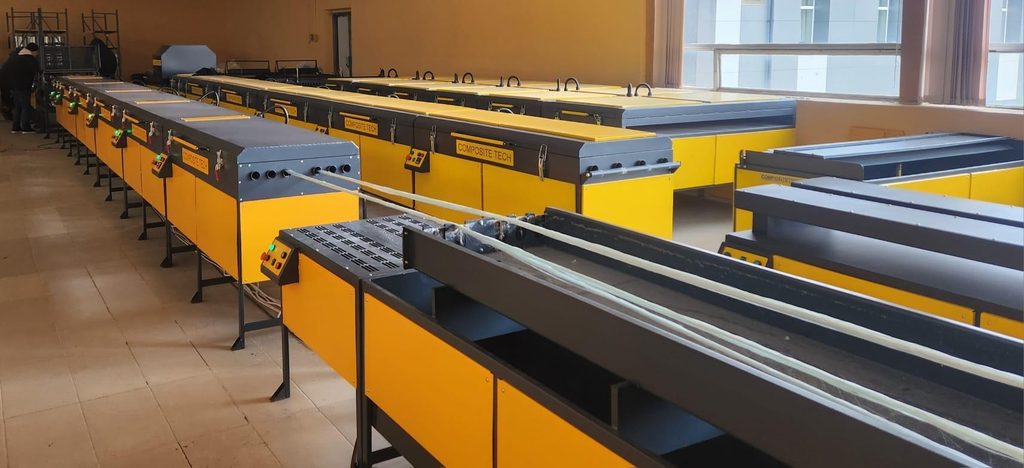
An engineering and investment guide based on actual Composite-Tech production equipment, industrial factory layouts and manufacturing cost calculations.
Starting a manufacturing business is rarely just about buying machinery. A successful factory needs the right equipment, an efficient production layout, reliable raw materials, trained personnel and, above all, a product that customers want to buy.
Glass Fiber Reinforced Polymer (GFRP) rebar manufacturing brings these considerations together in an interesting way.
Unlike many traditional industrial processes, modern GFRP reinforcement production can combine continuous manufacturing, relatively compact production equipment, low direct labor requirements and a product with established applications in construction and infrastructure.
The technology has also changed considerably.
A modern automated production line is not simply a machine that pulls glass fibers through a resin bath. It is an integrated manufacturing system that controls fiber preparation, resin impregnation, surface geometry, polymerization, cooling, pulling, cutting and product handling.
These details determine much more than product quality. They influence how much reinforcement a factory can manufacture per hour, how much electricity it consumes and how much labor is required to operate it.
For entrepreneurs considering a GFRP rebar factory, understanding these relationships is essential.
This guide examines the practical requirements using technical data from Composite-Tech’s CT6 New Generation production line, actual industrial equipment layouts and an illustrative manufacturing financial model.
Quick Answer: What Do You Need to Start a GFRP Rebar Factory?
To start a GFRP rebar manufacturing business, you need an appropriately sized industrial facility, an FRP rebar production line, glass fiber roving, a compatible polymer resin system, electrical power, ventilation, supporting utilities, trained operators and a quality control system.
The factory’s size and staffing depend primarily on the production equipment selected.
For example, Composite-Tech’s CT6 New Generation production line is designed to manufacture up to six GFRP reinforcing bars simultaneously. For 10 mm (approximately 3/8-inch) reinforcement, its documented maximum combined production rate is 36 meters per minute, equivalent to approximately 118 linear feet per minute.
The equipment documentation specifies one or a maximum of two operators for line control, with normal operating electrical power consumption of approximately 18–20 kW after warm-up.
At the indicated maximum production rate, this corresponds to a theoretical output of 17,280 meters, or approximately 56,693 feet, during an uninterrupted eight-hour shift.
Actual output depends on raw materials, resin curing characteristics, operating conditions, equipment utilization and production losses.
This combination of automated manufacturing, multi-bar production and controlled operating costs makes GFRP rebar manufacturing an industrial business worth evaluating.
Key Takeaways
| Question | Practical Answer |
|---|---|
| Is GFRP rebar manufacturing an established industrial process? | Yes. Continuous FRP reinforcement manufacturing uses established composite processing principles. |
| Do you need a very large factory? | Not necessarily. Facility requirements depend on the production configuration and supporting areas. |
| How many bars can CT6 New Generation produce? | Up to six simultaneously, depending on diameter. |
| What diameter range does CT6 support? | 4–20 mm |
| How fast can CT6 produce 10 mm reinforcement? | Up to 36 m/min combined output |
| How many operators control CT6? | One or a maximum of two |
| What is its normal operating power consumption? | Approximately 18–20 kW after warm-up |
| Can one factory manufacture several FRP products? | Yes. Rebar, mesh and bent elements can be produced using dedicated equipment. |
| Can GFRP manufacturing be profitable? | Yes, potentially, when selling prices, production utilization, material costs and operating expenses support a positive margin. |
| What is the biggest equipment purchasing mistake? | Comparing machine prices without comparing the cost per meter of finished, saleable reinforcement. |
The important point is that a factory should be planned around its required output and economic performance, not simply around the dimensions of a machine.
Why GFRP Rebar Manufacturing Is an Attractive Industrial Business
The commercial appeal of GFRP rebar begins with the product itself.
Steel has served the construction industry for generations. It remains an excellent reinforcing material in many applications. However, in aggressive environments, reinforcement corrosion can become an important contributor to concrete deterioration and future maintenance costs.
GFRP reinforcement offers different material characteristics.
It does not experience the conventional electrochemical rusting mechanism of carbon steel, weighs considerably less and can be particularly attractive in applications where corrosion resistance, low weight or non-metallic properties are important.
These include marine construction, bridge decks exposed to de-icing salts, parking structures, wastewater facilities and selected industrial concrete applications.
The material is also supported by recognized technical standards.
ASTM D7957/D7957M-26 establishes requirements for GFRP reinforcing bars, including qualification testing and production quality control. ACI CODE-440.11-22 provides structural design and detailing requirements for concrete reinforced with qualifying GFRP bars.
This is commercially significant.
A new GFRP manufacturer is not necessarily introducing an unknown experimental material. The company can enter an established technical category with recognized testing methods and defined engineering applications.
The challenge is manufacturing a consistent product at a competitive cost.
That is where production technology becomes important.
How Much Space Is Needed for a GFRP Rebar Factory?
One of the first questions potential equipment buyers ask is:
“How large does my factory need to be?”
There is no universal answer.
A small facility operating one production line has very different requirements from an integrated plant manufacturing straight rebar, FRP mesh and bent elements.
The size of the machinery is only one part of the calculation.
A properly planned factory must also accommodate raw material storage, resin preparation, utilities, maintenance access, product handling, inspection and finished-product storage.
Consider three different manufacturing concepts.
Table 1. GFRP Factory Configurations
| Factory Type | Equipment Configuration | Business Objective |
|---|---|---|
| Compact production facility | One CT2 production line | Market entry and regional manufacturing |
| Industrial rebar production | CT4 or CT6 New Generation | Higher output and expanded distribution |
| Integrated reinforcement factory | Rebar lines + FRP mesh lines + CNC bent elements | Complete reinforcement manufacturing and project supply |
The difference is not simply the number of machines.
As factories grow, material flow, storage requirements and production logistics become increasingly important.
A Real Composite-Tech Factory Layout
Composite-Tech has prepared manufacturing layouts for customers planning industrial FRP reinforcement production.
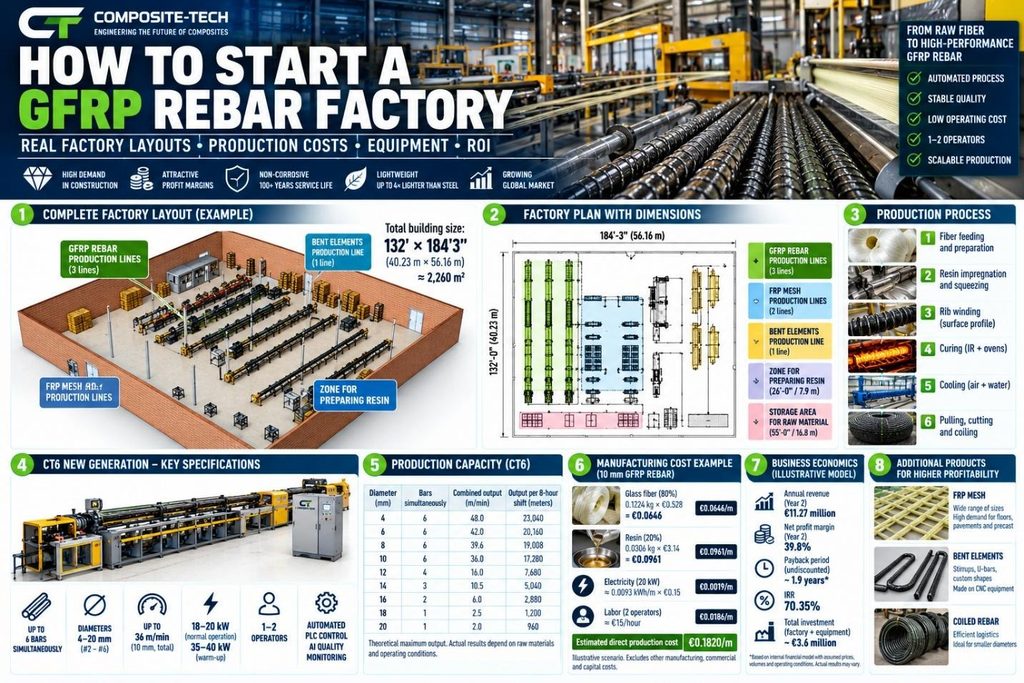
One example uses an industrial building measuring: 132 ft × 184 ft 3 in
In metric units: 40.23 m × 56.16 m
The resulting building footprint is approximately: 2,260 m² / 24,321 ft²
The proposed layout accommodates several distinct production areas, including parallel rebar production lines, mesh manufacturing equipment, a separate bent-element production area and supporting raw material preparation and storage zones.
The drawing shows three long parallel production lines, two central mesh-production arrangements and a separate equipment group for bent reinforcement.
It also includes access routes and space between production groups.
Source: Composite-Tech customer equipment placement drawings, October 2026. The production area dimensions describe the illustrated layout and should not be interpreted as universal machine footprints or mandatory safety clearances.
What makes this example valuable is not the total building size.
It demonstrates how multiple FRP production technologies can operate within a coordinated industrial layout.
The factory is designed as one production system rather than a collection of unrelated machines.
This is an important distinction for investors.
A well-planned manufacturing facility allows raw materials, operators and finished products to move efficiently without unnecessarily interrupting production.
Can You Start GFRP Rebar Manufacturing in a Smaller Building?
Yes.
A manufacturer does not need to begin with a plant containing six or seven production lines.
A smaller operation can begin with one suitable rebar line and expand as demand develops.
For example, the Composite-Tech CT2 installation drawing from 2024 indicates a minimum longitudinal installation dimension of approximately 20.3 meters (66.6 feet) for the specified machine arrangement.
That dimension refers to the installation layout, not the minimum overall building size.
The factory must provide additional room for material loading, operators, maintenance, handling and finished products.
Table 3. What Determines Minimum Factory Space?
| Requirement | Why It Matters |
|---|---|
| Production line length | Accommodates the complete process |
| Raw material creels | Provide space for fiber bobbins and replacement |
| Operator access | Allows safe monitoring and adjustments |
| Resin preparation | Supports controlled preparation of polymer binder |
| Ventilation equipment | Manages process emissions and working conditions |
| Cutting and coiling areas | Allows finished reinforcement to be collected |
| Finished-product storage | Prevents production and shipping conflicts |
| Maintenance clearance | Provides access to equipment components |
| Material handling routes | Allows movement of raw materials and finished goods |
The minimum viable facility therefore depends on the actual equipment arrangement.
For companies entering the market, a practical approach is to develop a preliminary layout before signing a property lease or purchasing a building.
This is one area where an experienced equipment manufacturer can make a substantial difference.
A factory designed around the machinery from the beginning is often easier to operate and expand than a building selected without understanding the manufacturing process.
What Equipment Is Required to Manufacture GFRP Rebar?
Manufacturing GFRP rebar involves several coordinated stages.
The process begins with continuous glass fiber and polymer resin. Those materials must be transformed into reinforcement with controlled diameter, surface geometry, mechanical properties and durability characteristics.
A modern manufacturing line typically performs the following operations:
Fiber feeding → Fiber preparation → Resin impregnation → Surface formation → Polymerization → Cooling → Pulling → Cutting or coiling
Every stage influences the finished product.
Table 4. Main Components of a GFRP Rebar Production Line
| Equipment Module | Main Function |
|---|---|
| Fiber creel | Holds and supplies continuous roving |
| Roving preparation system | Prepares and distributes fibers before impregnation |
| Resin impregnation module | Introduces polymer binder into the fiber bundle |
| Rib winding system | Creates the reinforcement surface profile |
| Infrared polymerization booster | Provides an initial controlled heating stage |
| Curing ovens | Complete the required resin polymerization process |
| Cooling module | Controls the temperature reduction after curing |
| Pulling unit | Maintains continuous movement through the line |
| Cutting system | Produces specified reinforcement lengths |
| Coiling equipment | Produces coils where supported by diameter and configuration |
| Control system | Coordinates production speed and operating parameters |
The CT6 New Generation line includes these functions in an integrated production system.
Its documented configuration includes four creels, a roving heater, impregnation module, rib winder, infrared booster, five curing ovens, cooling module, pulling unit, cutting device, two automatic coilers and a thread twister.
The engineering challenge is not simply assembling these components.
It is making them operate as one synchronized process.
CT6 New Generation: How Much Rebar Can One Production Line Manufacture?
Production capacity is one of the most important variables in the financial performance of a rebar factory.
However, capacity must be interpreted correctly.
A machine producing one bar at 6 meters per minute is not equivalent to a machine producing six bars simultaneously at the same linear speed.
In the second case, the combined output is 36 meters per minute.
Composite-Tech’s CT6 New Generation uses a multi-bar production concept.
Its July 2026 installation and operation manual provides the following indicative production rates.
Table 5. CT6 New Generation Production Capacity
| Rebar Diameter | Bars Produced Simultaneously | Combined Output, up to | Theoretical Output per 8-Hour Shift |
|---|---|---|---|
| 4 mm | 6 | 48 m/min | 23,040 m |
| 6 mm | 6 | 42 m/min | 20,160 m |
| 8 mm | 6 | 39.6 m/min | 19,008 m |
| 10 mm | 6 | 36 m/min | 17,280 m |
| 12 mm | 4 | 16 m/min | 7,680 m |
| 14 mm | 3 | 10.5 m/min | 5,040 m |
| 16 mm | 2 | 6 m/min | 2,880 m |
| 18 mm | 1 | 2.5 m/min | 1,200 m |
| 20 mm | 1 | 2 m/min | 960 m |
Source: Composite-Tech CT6 New Generation, Installation and Operation Manual IME.005, July 2026. All capacities are indicative maximum values under suitable operating conditions.
These figures represent continuous operation without interruptions.
Actual production depends on factors including fiber type, resin formulation, curing characteristics, ambient conditions, equipment availability and product changeovers.
Nevertheless, the table illustrates an important manufacturing principle.
A multi-bar production line distributes operating costs across substantially more finished product.
The operator supervises one integrated manufacturing system rather than several independent single-bar machines.
The same basic principle applies to energy consumption and factory overhead.
This is why production capacity should be evaluated together with power requirements, labor and material consumption.
How Much Electricity Does a GFRP Rebar Production Line Consume?
Industrial electricity costs vary considerably between countries.
A factory in Germany, the United States, India or the Middle East may operate under very different electricity tariffs.
For that reason, comparing machines only by their installed electrical power is not particularly useful.
A better measurement is:
Electricity consumption per meter of finished reinforcement.
The CT6 New Generation technical manual states that electrical power consumption during initial warm-up is approximately 35–40 kW.
After reaching operating temperature, normal power demand decreases to approximately 18–20 kW.
Consider the 10 mm production scenario.
Maximum combined output: 36 m/min × 60 = 2,160 m/hour
Using 20 kW as the operating power: 20 kWh ÷ 2,160 m = 0.00926 kWh/m
That is approximately: 0.0093 kWh per meter of 10 mm GFRP rebar
Or: 9.3 kWh per 1,000 meters
These figures describe the theoretical electricity consumption of the line at the stated operating point. They do not include startup losses or all external factory utilities.
Table 6. Theoretical CT6 Energy Intensity
| Diameter | Combined Output | Approximate Energy per Meter at 20 kW |
|---|---|---|
| 6 mm | 2,520 m/hour | 0.0079 kWh/m |
| 8 mm | 2,376 m/hour | 0.0084 kWh/m |
| 10 mm | 2,160 m/hour | 0.0093 kWh/m |
| 12 mm | 960 m/hour | 0.0208 kWh/m |
| 16 mm | 360 m/hour | 0.0556 kWh/m |
Actual energy consumption per saleable meter will increase if the line operates below its rated output or spends substantial time warming up, changing products or standing idle.
This is still an important result.
At higher production volumes, the electricity required to manufacture each meter of reinforcement can represent a relatively small part of direct production costs.
For manufacturers competing on price, the relationship between productivity and energy intensity deserves particular attention.
How Many Employees Does a GFRP Rebar Factory Need?
Labor is another major operating cost.
In conventional manufacturing, increasing production often requires increasing the number of workers.
Automation changes that relationship.
According to its technical manual, the CT6 New Generation production line can be controlled by one or a maximum of two operators.
This is possible because multiple technological processes are integrated into one continuous system.
The operators supervise production parameters, raw material feeding, resin preparation and the normal operating condition of the line.
But it is important to distinguish machine operators from total factory personnel.
Even a highly automated factory may require additional employees for material preparation, quality control, logistics, maintenance, production management and sales.
Table 7. Example Staffing Structure
| Function | Staffing Consideration |
|---|---|
| Production line operation | 1–2 operators per CT6 line |
| Raw material handling | Depends on factory scale |
| Resin preparation | Depends on production configuration |
| Quality inspection | Dedicated or shared personnel |
| Equipment maintenance | Dedicated or contracted support |
| Warehouse and shipping | Depends on production volume |
| Administration and sales | Depends on business structure |
The economic advantage of automation is not that employees disappear from the manufacturing process.
It is that each production operator can supervise a larger volume of output.
For investors, this improves the relationship between manufacturing capacity and direct labor requirements.
How Much Does It Cost to Produce One Meter of GFRP Rebar?
This is where the economics become particularly interesting.
The manufacturing cost of GFRP rebar depends on several variables, including glass fiber prices, resin formulation, reinforcement diameter, fiber content, production efficiency and factory overhead.
A useful starting point is the cost of the two principal raw materials.
Composite-Tech’s illustrative manufacturing financial model uses the following assumptions:
| Raw Material | Assumed Cost |
|---|---|
| Glass fiber roving | €0.528/kg |
| Polymer resin system | €3.14/kg |
| Fiber share by mass | 80% |
| Resin share by mass | 20% |
These are financial-model assumptions, not verified current supplier quotations or universal recipes for every GFRP product.
For a nominal 10 mm rebar with an assumed weight of 0.153 kg/m, the calculation is straightforward.
Glass fiber per meter: 0.153 × 80% = 0.1224 kg
Resin per meter: 0.153 × 20% = 0.0306 kg
Raw material costs:
Glass fiber: 0.1224 × €0.528 = €0.0646
Resin: 0.0306 × €3.14 = €0.0961
Total: €0.1607 per meter
This figure represents the modeled cost of the principal materials before manufacturing losses and other operating expenses.
Table 8. Illustrative Raw Material Costs by Rebar Diameter
| Diameter | Assumed Weight | Estimated Raw Material Cost |
|---|---|---|
| 6 mm | 0.060 kg/m | €0.063/m |
| 8 mm | 0.100 kg/m | €0.105/m |
| 10 mm | 0.153 kg/m | €0.161/m |
| 12 mm | 0.220 kg/m | €0.231/m |
| 16 mm | 0.392 kg/m | €0.412/m |
Source: Composite-Tech internal manufacturing financial scenario. Values depend on the assumed material composition, weights and input prices.
These figures are interesting, but they are not yet the full production cost.
Electricity, labor, production losses, maintenance, depreciation and other factory expenses must also be considered.
A More Realistic Manufacturing Cost Example
Consider a factory producing 10 mm GFRP rebar on a CT6 New Generation line.
Rather than assuming perfect production, we can construct a conservative operating scenario.
Production Assumptions
| Parameter | Scenario |
|---|---|
| Nominal production capacity | 2,160 m/hour |
| Effective operating utilization | 75% |
| Nonconforming product rate | 0.5% |
| Operators | 2 |
| Assumed labor cost per operator | €15/hour |
| Electricity price | €0.15/kWh |
| Assumed line power consumption | 20 kW |
| Raw material cost before losses | €0.1607/m |
These are illustrative operating assumptions. The wages, electricity tariff, utilization and rejection rate are not guaranteed values or verified conditions for a particular country.
At 75% effective utilization and 0.5% nonconforming output, the resulting production is approximately:
12,895 saleable meters per eight-hour shift.
Table 9. Illustrative Direct Manufacturing Cost
| Cost Component | Estimated Cost per Saleable Meter |
|---|---|
| Glass fiber and resin, adjusted for 0.5% rejects | €0.1615 |
| Direct operator labor | €0.0186 |
| Production-line electricity | €0.0019 |
| Subtotal | €0.1820/m |
The calculated subtotal is approximately: €182 per 1,000 meters of 10 mm GFRP rebar
This example does not include all manufacturing and business costs. Additional expenses may include packaging, startup materials, other consumables, compressed air, ventilation, maintenance, laboratory testing, rent, administration, depreciation, financing, taxes and distribution.
Nevertheless, it demonstrates something important.
Efficient multi-bar production can make electricity and direct line-operation labor relatively small components of the manufacturing cost.
Raw materials remain a major cost driver.
That is why resin consumption control, production yield and fiber utilization have such a strong impact on business economics.
Can GFRP Rebar Manufacturing Be Profitable?
Profitability depends on more than production cost.
A factory must manufacture reinforcement that buyers are prepared to purchase at a price sufficient to cover all costs and generate a reasonable return on invested capital.
To illustrate the relationship, consider the modeled 10 mm GFRP rebar cost calculated above.
Suppose the manufacturer achieves a hypothetical selling price of €0.31 per meter.
Table 10. Illustrative Unit Economics
| Financial Indicator | Per Meter |
|---|---|
| Assumed selling price | €0.310 |
| Estimated principal raw materials, adjusted for rejects | €0.162 |
| Estimated direct operator labor | €0.019 |
| Estimated production-line electricity | €0.002 |
| Remaining contribution before other costs | €0.128 |
The example produces approximately €0.128 per meter available to cover the other manufacturing and commercial expenses and, potentially, generate operating profit.
That is about 41% of the assumed selling price.
It is not a net profit margin.
The selling price is an illustrative business-model assumption, not a verified market quotation. Actual profitability will depend on customer demand, achieved prices, material procurement, manufacturing efficiency, capital costs and other expenses.
Still, the calculation illustrates why efficient manufacturing equipment matters.
A production line that consumes more resin, requires additional operators or produces substantially less saleable output can have a very different cost structure.
Conversely, when a factory combines high output, efficient material use and stable quality, its cost position can improve.
This is one of the central reasons why equipment selection is a strategic business decision.
Why Production Technology Has Such a Strong Effect on Profit Margins
Two factories can purchase similar glass fiber and resin, produce bars of the same nominal diameter and sell into the same market.
Their financial results can still be very different.
The reason is that manufacturing economics depend on how efficiently raw materials are converted into saleable reinforcement.
Table 11. Production Efficiency and Business Economics
| Manufacturing Factor | Influence on Business Performance |
|---|---|
| Number of simultaneously produced bars | Determines output per machine |
| Resin impregnation efficiency | Affects material use and product consistency |
| Fiber alignment | Influences mechanical performance |
| Curing stability | Affects production speed and quality |
| Automated rib formation | Supports repeatable surface geometry |
| Cooling process | Influences product quality and production stability |
| Pulling system | Maintains continuous production |
| Automatic cutting and coiling | Reduces manual handling |
| Quality monitoring | Supports earlier detection of production deviations |
| Operator requirements | Affects direct labor cost |
Composite-Tech’s CT6 New Generation incorporates several technological solutions intended to improve these aspects of production.
For example, its impregnation system uses controlled resin application and adjustable squeezing to manage excess polymer binder.
The machine also incorporates an infrared heating stage before conventional curing ovens.
Its cooling module uses air cooling followed by water cooling.
The purpose of these systems is to control key manufacturing variables and support consistent production.
The equipment also incorporates optical monitoring connected to an AI-assisted system designed to help identify visible quality deviations during manufacturing.
This does not replace standardized laboratory testing. It provides an additional production-monitoring capability.
Taken together, these features are relevant not only to product quality but also to operating efficiency.
For a manufacturer, fewer interruptions, stable curing and controlled material consumption can translate into better use of production capacity.
However, the actual financial benefit must be confirmed from operating records, comparable production trials and product quality results.
Why Factory Layout Affects Production Efficiency
Equipment performance is not determined only by the machinery.
The factory itself can either support efficient production or create unnecessary operating difficulties.
Consider the logistics of glass fiber.
A factory producing thousands of meters of reinforcement each shift must have reliable access to raw material bobbins.
If the storage area is too far from the creels, employees spend more time transporting materials.
If resin preparation is poorly located, supply and handling become more complicated.
If cutting and coiling stations obstruct internal transport routes, finished products accumulate in working areas.
These are not dramatic technical problems. They are everyday manufacturing inefficiencies.
Over time, they can become expensive.
The Importance of Production Flow
An efficient factory should aim for a logical material flow:
Raw Material Receiving → Storage → Fiber Preparation → Production → Quality Control → Packaging → Finished Goods → Dispatch
The actual layout may differ depending on the equipment configuration.
For example, Composite-Tech’s October 2026 customer layout incorporates a separate resin preparation area and a designated raw material storage zone adjacent to the production area.
The drawings also demonstrate how multiple production lines can be installed in parallel while allowing for circulation and equipment access.
This type of planning supports industrial operation and future expansion.
For new investors, the lesson is simple: Design the material flow before finalizing the building layout.
Why a Complete FRP Reinforcement Factory Can Be More Attractive Than Rebar Production Alone
A factory producing straight GFRP rebar has access to several construction markets.
But construction projects do not use only straight reinforcement.
Many customers also need mesh, stirrups, U-shaped elements and reinforcement prepared to specific dimensions.
This creates an opportunity to develop a broader manufacturing business.
Composite-Tech offers equipment for three complementary product categories:
FRP Rebar — FRP Mesh — Bent Composite Reinforcement
Each addresses different customer requirements.
Table 12. Building a Complete FRP Manufacturing Business
| Product | Principal Commercial Opportunity |
|---|---|
| Straight GFRP rebar | General reinforcement supply |
| Coiled GFRP rebar | Efficient distribution of suitable smaller diameters |
| FRP reinforcement mesh | Slabs, floors, pavements and precast applications |
| Factory-made bent elements | Project-specific reinforcement shapes |
| Cut-to-length reinforcement | Contractor-ready supply |
| Complete reinforcement packages | Multiple products supplied to one project |
There is an important business advantage here.
A company selling only straight bars depends on the demand for those bars.
A manufacturer that also offers mesh and bent elements has access to additional customers, project types and purchasing requirements.
The broader product portfolio can also create opportunities for repeat business.
For example, a precast producer may need straight bars for one product and mesh for another.
A contractor may require reinforcement bars and factory-manufactured bent elements for the same project.
A distributor may prefer dealing with one manufacturer capable of supplying several reinforcement categories.
This is why a complete manufacturing platform deserves serious consideration.
FRP Mesh Manufacturing: An Additional Revenue Opportunity
FRP mesh is particularly interesting from a business perspective.
Unlike straight reinforcing bars, mesh is frequently sold by area rather than linear length.
Customers purchase it in square meters or square feet, often for repetitive concrete applications.
This makes product selection, quotation and ordering relatively straightforward.
Composite-Tech manufactures dedicated equipment for fiberglass and basalt fiber reinforcement mesh, with configurations designed for different product widths and reinforcement geometries.
A factory combining rebar and mesh manufacturing may serve:
- industrial flooring contractors;
- precast concrete producers;
- road and pavement contractors;
- construction material distributors;
- coastal construction companies;
- agricultural and industrial concrete projects.
Importantly, a mesh product must still be supported by appropriate technical data and engineering evaluation for its intended application.
Its geometry, rod properties and intersection performance all matter.
From a commercial perspective, however, the advantage is clear.
One factory can address both linear reinforcement demand and area-based reinforcement demand.
This broadens the business beyond a single product category.
What Does a Complete GFRP Rebar Factory Cost?
The capital required to establish a GFRP rebar factory depends on the scale of the project.
A small plant equipped with one production line has very different financial requirements from a multi-line factory.
The total investment usually includes more than the machinery itself.
Table 13. Main Investment Categories
| Investment Category | What It Includes |
|---|---|
| Production equipment | Rebar, mesh or bent-element lines |
| Building or industrial premises | Purchase, lease or construction |
| Electrical installation | Distribution systems and power connections |
| Ventilation and utilities | Production-area ventilation and supporting systems |
| Raw material inventory | Glass fiber, resin and other production materials |
| Quality control equipment | Testing and inspection systems |
| Material handling | Forklifts, storage racks and lifting equipment |
| Installation and commissioning | Equipment assembly, setup and testing |
| Training | Operator and maintenance preparation |
| Working capital | Cash required before customer payments cover expenses |
To illustrate the importance of scale, one Composite-Tech financial planning scenario describes an integrated factory with four rebar lines, two mesh lines and one bent-element production line.
That model includes a proposed industrial building measuring 48 × 36 meters, equivalent to 1,728 m².
The investment worksheet assumes total initial requirements of approximately €3.61 million, including equipment, construction-related costs, laboratory facilities, raw materials and other investment items.
This is a specific financial scenario, not a standard quotation or a validated universal factory budget. Building dimensions, equipment configuration, installation requirements and financial assumptions must be checked for each project.
The larger lesson is that factory investments should be evaluated together with expected output, operating costs and sales potential.
Buying fewer or cheaper machines does not necessarily produce the best financial result.
The equipment configuration must fit the intended business model.
How Should Investors Calculate the Return on a GFRP Manufacturing Business?
Return on investment cannot be determined by production capacity alone.
A machine may be capable of producing thousands of meters per shift, but those meters only create revenue when customers purchase them.
A realistic financial model should therefore include three different calculations.
Manufacturing Economics
How much does it cost to manufacture one meter of saleable reinforcement?
Commercial Economics
What selling price can the company achieve in its target market, and what volume can it realistically sell?
Investment Economics
How much capital is required to build the facility, and how long will it take for operating cash flows to recover that investment?
These are connected questions, but they are not interchangeable.
Table 14. Financial Metrics Every Investor Should Evaluate
| Financial Metric | Why It Matters |
|---|---|
| Cost per saleable meter | Measures manufacturing competitiveness |
| Gross contribution per meter | Indicates funds available to cover other expenses |
| Production utilization | Shows how much installed capacity is used |
| Monthly sales volume | Determines actual revenue |
| EBITDA | Measures operating performance before specified non-cash and financing costs |
| Working capital | Funds inventory and customer payment cycles |
| Cash flow | Determines ability to sustain operations and repay investment |
| Payback period | Estimates time required to recover invested capital |
| NPV | Evaluates discounted future cash flows |
| IRR | Measures the modeled investment return |
A useful model should test several operating scenarios.
For example, what happens if the factory sells only 50% of its potential output during the first year?
What happens if resin prices increase by 20%?
What happens if the achievable selling price is lower than expected?
A strong business should remain understandable under these conditions.
For prospective investors, the objective is not to produce the highest possible forecast.
It is to identify a manufacturing configuration that can remain financially competitive under realistic market conditions.
Choosing the Right Equipment Supplier Is Part of the Investment Decision
Many first-time investors concentrate on the purchase price of manufacturing equipment.
That is understandable. Machinery is a visible and significant investment.
But the price of the machine is only one part of its economic impact.
Consider two hypothetical production lines.
One has a lower purchase price but produces fewer saleable meters per hour, requires more manual work and consumes more resin than necessary.
The other requires a larger initial investment but offers higher throughput and lower operating cost per unit.
Without comparing the long-term production economics, it is impossible to know which machine is actually the better investment.
The relevant questions are therefore practical.
- How much product can the line manufacture?
- How much electricity does it consume per meter?
- How many operators are required?
- How does the equipment control resin use?
- How stable is the curing process?
- Can the line manufacture different diameters?
- Can it produce straight bars and coils?
- How is product quality monitored?
- What technical support is available during commissioning and operation?
These questions influence the performance of the entire business.
The Composite-Tech Approach
Composite-Tech develops equipment specifically for industrial composite reinforcement manufacturing.
Its product range includes straight FRP rebar production lines, reinforcement mesh equipment and machinery for factory-made bent composite elements.
For manufacturers entering this market, the objective is to provide a manufacturing system that combines output, repeatability and controlled resource consumption.
The CT6 New Generation represents the company’s current high-capacity rebar production concept.
Its multi-bar configuration, automated process control, resin management and curing systems are intended to support industrial-scale manufacturing with relatively low direct operating labor.
The company also provides equipment installation, commissioning and operator training services.
For an investor, these services are relevant because equipment performance must be translated into reliable factory operation.
The ultimate goal is not simply to purchase a production line.
It is to establish a manufacturing business capable of producing consistent reinforcement, meeting customer requirements and generating sustainable sales.
How to Plan a GFRP Rebar Factory: A Practical Startup Roadmap
Every project is different, but the planning process should follow a logical sequence.
Table 15. GFRP Factory Development Roadmap
| Stage | Main Objective | Expected Result |
|---|---|---|
| 1. Market evaluation | Identify target customers and applications | Initial sales strategy |
| 2. Product selection | Define diameters, mesh sizes and product formats | Product portfolio |
| 3. Equipment configuration | Choose production line capacity | Equipment specification |
| 4. Factory planning | Prepare equipment placement and material flow | Preliminary layout |
| 5. Utility engineering | Calculate power, ventilation and supporting requirements | Infrastructure specification |
| 6. Financial modeling | Estimate investment and operating economics | Business case |
| 7. Equipment procurement | Agree technical and commercial conditions | Manufacturing contract |
| 8. Installation | Position and commission equipment | Operational production line |
| 9. Product qualification | Verify finished reinforcement properties | Technical documentation |
| 10. Commercial production | Establish repeatable output and distribution | Revenue-generating factory |
This approach avoids one of the most common industrial investment mistakes: purchasing machinery before defining the business it needs to support.
Quality Control and Standards: Preparing Products for Serious Construction Markets
A production line is only the beginning.
The finished reinforcement must meet the technical requirements of the intended market.
In the United States, ASTM D7957/D7957M provides a recognized product specification for qualifying GFRP reinforcing bars.
The current 2026 edition addresses geometric, mechanical and physical property requirements as well as qualification and production-lot acceptance testing.
ACI CODE-440.11-22 provides a design framework for structural concrete using GFRP bars conforming to the specified ASTM D7957-22 requirements.
For new manufacturers, this has important practical implications.
The factory must be capable of producing a consistent material supported by testing and quality documentation.
Relevant information may include tensile strength, tensile modulus, ultimate tensile force, effective cross-sectional area, surface profile, bond performance and durability characteristics.
Production traceability is also important.
A manufacturer should be able to connect product batches with raw materials, production conditions and test results.
However, purchasing a production line does not automatically certify the reinforcement manufactured on it.
Compliance and product acceptance depend on testing, documentation and the applicable regulatory and engineering requirements.
Manufacturing quality must therefore be built into the process from the beginning.
Is Starting a GFRP Rebar Factory Worth Considering?
For the right investor, the answer can be yes.
GFRP rebar manufacturing combines several attractive industrial characteristics.
It produces a technical construction material with defined applications.
Production can be highly automated.
Multi-bar manufacturing allows substantial output from a single line.
Direct line-operation labor and electricity consumption can be relatively low when equipment operates efficiently.
And the business can expand beyond straight bars into composite mesh, bent elements and complete reinforcement packages.
But these advantages do not guarantee commercial success.
A successful manufacturer still needs access to competitively priced raw materials, appropriate product testing, reliable equipment, technical support and customers prepared to purchase the finished reinforcement.
The most important decision is therefore not simply whether to manufacture GFRP rebar.
It is how to establish a factory that can produce high-quality reinforcement efficiently enough to compete.
That decision begins with production technology and factory planning.
Planning to Start a GFRP Rebar Factory?
A successful composite reinforcement business begins with the right manufacturing plan.
Composite-Tech develops industrial production equipment for GFRP rebar, FRP reinforcement mesh and factory-made bent composite elements.
Whether you are planning a compact regional production facility or an integrated reinforcement manufacturing plant, equipment configuration should be based on your target products, building dimensions, required output and investment objectives.
Contact Composite-Tech to request a preliminary factory layout, recommended equipment configuration and production cost assessment for your project.
Explore our manufacturing technologies:
- Professional FRP Rebar Production Lines
- FRP Mesh Production Equipment
- Composite-Tech Technical Documentation
Conclusion
The economics of GFRP rebar manufacturing have changed as production technology has developed.
Modern multi-bar production lines, controlled resin impregnation, automated process synchronization and efficient curing systems make it possible to manufacture substantial volumes of composite reinforcement with relatively limited direct labor and electrical energy requirements.
Composite-Tech’s CT6 New Generation demonstrates this approach through simultaneous production of multiple bars, documented diameter-specific capacity and integrated production control.
But machinery is only part of the opportunity.
A competitive GFRP factory needs an appropriate layout, reliable raw materials, repeatable quality, technical documentation and an effective sales strategy.
For manufacturers seeking to expand their business, the combination of straight rebar, reinforcement mesh and factory-made bent elements creates additional commercial opportunities.
The real opportunity is not simply to manufacture fiberglass rebar. It is to build an efficient, scalable composite reinforcement business capable of serving an established and evolving construction market.
And that begins with choosing the right production technology.
Frequently Asked Questions About Starting a GFRP Rebar Factory
How much space is needed for a GFRP rebar production line?
The required space depends on the equipment model and production configuration. A CT2 installation drawing, for example, shows a minimum longitudinal installation dimension of approximately 20.3 meters. The factory must also accommodate raw materials, utilities, maintenance access and finished-product handling. Multi-line plants require considerably more space.
How much electricity does a GFRP rebar production line use?
Electricity consumption depends on the machine, diameter and operating speed. The CT6 New Generation documentation specifies approximately 18–20 kW in normal operation after warm-up. At a combined 10 mm production rate of 36 m/min, this corresponds to roughly 0.0093 kWh per meter under continuous rated operation.
How many operators are needed to run a GFRP rebar machine?
Operator requirements depend on automation. Composite-Tech’s CT6 New Generation is designed to be controlled by one or a maximum of two operators. Other factory functions may require additional personnel.
What raw materials are required for GFRP rebar production?
The principal materials are continuous glass fiber roving and a compatible polymer resin system. Additional materials may be required for curing, surface formation and other processing functions, depending on the product specification.
How much does it cost to manufacture GFRP rebar?
Manufacturing cost depends on diameter, fiber and resin prices, material content, electricity, labor, productivity, production losses and overhead. In an illustrative Composite-Tech financial scenario, principal raw materials for 10 mm reinforcement cost approximately €0.161 per meter under the stated assumptions.
Is GFRP rebar manufacturing profitable?
It can be profitable when the manufacturer achieves sufficient sales volume and selling prices above total costs. Equipment efficiency, raw material prices, production utilization and product quality are major factors. Profitability should be evaluated using a complete cash flow model rather than equipment output alone.
What is the advantage of a six-bar GFRP rebar production line?
A multi-bar line can manufacture several reinforcing bars simultaneously using one integrated control and production system. This can increase total output and distribute labor, energy and other operating costs across more saleable product.
Can one factory produce GFRP rebar and FRP mesh?
Yes. An integrated plant can operate dedicated rebar and mesh production lines. Additional equipment can support factory-made bent elements and project-specific reinforcement shapes.
Can a GFRP factory manufacture basalt rebar?
Some FRP production systems can be configured for different reinforcement fibers, including glass and basalt. However, fiber compatibility, resin formulation, operating parameters and finished-product performance must be validated for each material.
Is GFRP rebar accepted in the United States?
GFRP reinforcing bars are covered by recognized ASTM specifications, and ACI CODE-440.11-22 establishes structural design requirements for qualifying GFRP-reinforced concrete. Acceptance of a particular product or application still depends on applicable codes, product documentation and project requirements.
How long does it take to start a GFRP rebar factory?
The timeline depends on equipment manufacturing, facility readiness, infrastructure installation, shipping, commissioning, training and product qualification. A realistic schedule should be developed for the specific project.
What is the best GFRP rebar production line for a new business?
The best line depends on expected sales volume, target diameters, available capital, labor costs and future expansion plans. The decision should be based on cost per saleable meter, production quality and technical support rather than purchase price alone.