
Quick Answer
- Market Opportunity: The global GFRP rebar market is projected to reach $1.68 billion by 2035 with a CAGR of 12.1%, driven by government mandates for corrosion-resistant infrastructure.
- Investment (CAPEX): Initial investment for a professional automated facility starts at approximately $125,000 (with single line prices starting at $95,000).
- Production Costs: The cost to manufacture 10mm GFRP rebar is approximately $0.152/meter (raw materials + energy).
- Profitability: With market prices ranging from $0.45 to $0.65/meter, net annual profit for one CT6 line can reach $280,000–$570,000.
- Payback Period: High automation levels in Composite-Tech equipment allow for a break-even point in just 5–8 months under 2-shift operations.
- Key Advantage: Total cost of ownership (TCO) is reduced by 60% compared to manual lines due to labor savings and 98%+ yield rates.
For institutional investors and construction business owners, 2026 represents a pivotal entry point into the composite industry. Traditional steel reinforcement is increasingly scrutinized due to the $2.5 trillion annual global cost of corrosion. New building codes, such as ACI 440.11-22 in the US, have transitioned GFRP from an “alternative” to a “standard” material, opening doors to massive government infrastructure tenders. By investing in Composite-Tech’s automated production lines, manufacturers gain a defensible market position backed by over 100 patents, ensuring their product meets the most stringent international quality standards (ASTM/ISO) while maintaining the lowest production costs in the industry.
Market Analysis and Product Diversification Strategy
A successful manufacturing venture in 2026 requires more than just volume; it requires a diversified portfolio of specialized equipment to capture different market niches.
1. High-Volume Segment: Straight Rebar (CT6 Line)
The backbone of any factory is the production of straight bars (4mm to 20mm). These are essential for bridge decks, highway barriers, and flatwork.
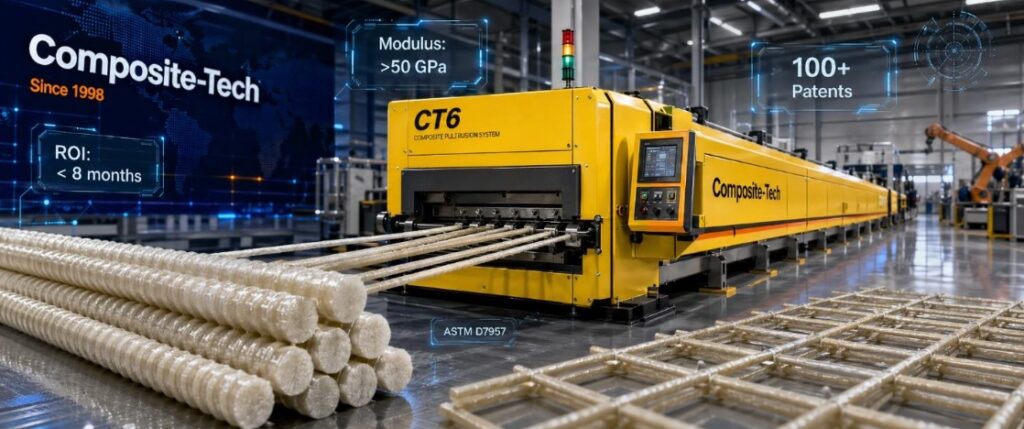
- Equipment: The CT6 line produces up to 6 bars simultaneously at speeds of up to 48 meters per minute (157 FPM).
2. Premium Segment: Structural Mesh (CT Mesh 2-6
GFRP mesh demand is growing faster than standard rebar (CAGR 12.8%) due to its performance in industrial floors, parking garages, and sea walls.
- Equipment: The CT Mesh 2-6 line automates the weaving process, eliminating expensive manual labor and ensuring consistent cell geometry.
3. Specialized Elements: CNC Bent Forms (BENT Line)
Under ACI 440.11 code, GFRP cannot be bent on-site; it must be factory-made. Owning a BENT line provides a regional monopoly on stirrups, hooks, and complex shapes.
- Equipment: The BENT CNC line is the industry’s only programmable system for high-precision forming of elements up to 20mm in diameter.
Why this matters for manufacturers: Operating all three specialized lines allows you to act as a “one-stop-shop” for general contractors, increasing the likelihood of securing 100% of a project’s reinforcement package.
Financial Model: Operating Expenses (OPEX) and Revenue
The economics of a Composite-Tech facility are driven by high material efficiency and minimal labor requirements.
Cost Structure Breakdown (Per 1 meter of 10mm / #3 Rebar)
| Expense Item | Value (USD) | Technical Detail |
|---|---|---|
| Raw Materials (80% Glass / 20% Resin) | $0.1500 | Based on E-glass and Vinyl Ester/Epoxy resin prices. |
| Electricity (at 20 kW/h) | $0.0016 | High efficiency due to zoned IR heating systems. |
| Labor (Per meter) | $0.0400 | Optimized through 1-operator-per-line automation. |
| Overhead (Rent, Logistics) | $0.0400 | Averaged for industrial park settings. |
| TOTAL Cost of Production | $0.2316 | ~ $0.23 – $0.27 depending on regional energy rates. |
Revenue Potential
- Retail Selling Price: $0.45 – $0.65 per meter ($0.14 – $0.20 per foot).
- Daily Capacity (CT6): 17,000 meters (Ø10mm) per 24 hours.
- Monthly Gross Revenue: $168,000 – $242,000 (22 working days).
- Net Monthly Profit: $35,000 – $55,000 (after tax and all deductions).
Why this matters for business owners: The Return on Invested Capital (ROIC) for a Composite-Tech facility ranges from 45% to 60% in year one, significantly outperforming traditional manufacturing or commercial real estate investments.
Comparative Table: Composite-Tech vs. Generic Competitors
Investors must look beyond the initial purchase price to the Total Cost of Ownership (TCO).
| Performance Metric | Composite-Tech (CT Series) | Basic/Manual FRP Lines | Business Impact |
|---|---|---|---|
| Scrap Rate | < 2% | 7–12% | Saves up to $15,000/year in wasted materials. |
| Operators Required | 1 person per line | 2–3 persons per line | Reduces monthly payroll by 60%. |
| Impregnation System | 3-Stage (Ultrasonic/Pressure) | Open Bath | Zero voids = ASTM D7957 certification. |
| Energy Consumption | Zonal IR Heating (25% saving) | Standard Heaters | Lower utility bills and smaller carbon footprint. |
| IoT Connectivity | Standard (PLC Samkoon + HMI) | None | Remote production monitoring and predictive alerts. |
Return on Investment (ROI) Calculator
Use this logic to calculate your specific payback period:
Formula:
Example for a CT6 Line:
- Turnkey CAPEX (Machine + Shipping + Install + Raw Material Start): $150,000.
- Monthly Net Profit (at 70% utilization): $22,000.
- Result: 6.8 Months to break even.
If you add a CT Mesh or BENT line to your factory, the ROI is typically even faster (5–6 months) due to the higher premiums charged for specialized reinforcement products.
Practical Checklist: 10 Steps to Factory Launch
- Demand Audit: Map large-scale bridge and sea wall projects within a 300-mile radius.
- Facility Selection: Secure 2,000 sq. ft. of space with 10 ft+ ceilings.
- Utility Prep: Ensure 3-phase 380V power (40–50 kW buffer per line).
- Equipment Order: Manufacturing lead times at Composite-Tech are 45–60 days.
- Raw Material Sourcing: Use Composite-Tech’s list of verified global suppliers (Owens Corning, Jushi).
- Installation: On-site commissioning by our engineers takes 7–10 days.
- Staff Training: Comprehensive 1-week program for your operators.
- Certification: Submit initial batches for ASTM D7957 testing to qualify for government bids.
- B2B Marketing: Focus on project engineers and DOT specifiers to get your rebar into project drawings.
- Scale-up: Add a second line once the first reaches 80% capacity to lower per-unit overhead.
FAQ: Investor Questions about FRP Production
How hard is it to find skilled operators?
The equipment is fully automated. We provide a 5-day training program that enables a worker with average technical skills to operate the line effectively.
What is the lifespan of the equipment?
With proper maintenance, Composite-Tech machines are designed for a service life of 15+ years using industrial-grade components (Delta, Samkoon).
Can I use recycled materials?
While some additives can be recycled, structural codes (ASTM D7957) require virgin glass and resin to guarantee structural integrity.
What do I do with production waste?
Our scrap rate is < 2%. Cured waste can be ground into fiber filler for non-structural concrete applications.
Are the machines compatible with Basalt fiber (BFRP)?
Yes. All Composite-Tech lines are universal and can switch between glass, basalt, or carbon fiber without hardware modifications.
How is your technology protected?
We hold 100+ patents on core modules like the 3-stage impregnation and CNC-bending units, ensuring your investment is protected from low-quality clones.
How much space is needed for inventory?
Since GFRP is 4x lighter than steel, you can store 4x the structural capacity in the same vertical space. A 500 sq. ft. area can hold a month’s production.
Does AI assist in the manufacturing process?
In 2026, our lines integrate predictive analytics and machine vision for real-time defect detection, maximizing yield and reducing human error.
Can I produce different diameters on one line?
Yes, changing the dies and tensioning settings takes between 1 to 2 hours.
Do you provide business plan support for bank loans?
Yes, we provide detailed technical-economic feasibility studies and performance data for financing applications.
Conclusion
GFRP rebar production is one of the rare sectors in 2026 where high technology meets heavy industry to provide rapid returns. By selecting Composite-Tech equipment, you are not just buying a machine; you are adopting a 25-year legacy of engineering excellence and patented automation that minimizes your operational risk.
The global shift away from corroding steel is accelerating. Become the leader of this transformation in your region.
Ready to see the financial model for your specific city? Request a personalized ROI calculation and a custom equipment specification (Rebar + Mesh + Bent elements) today.
Learn more: