
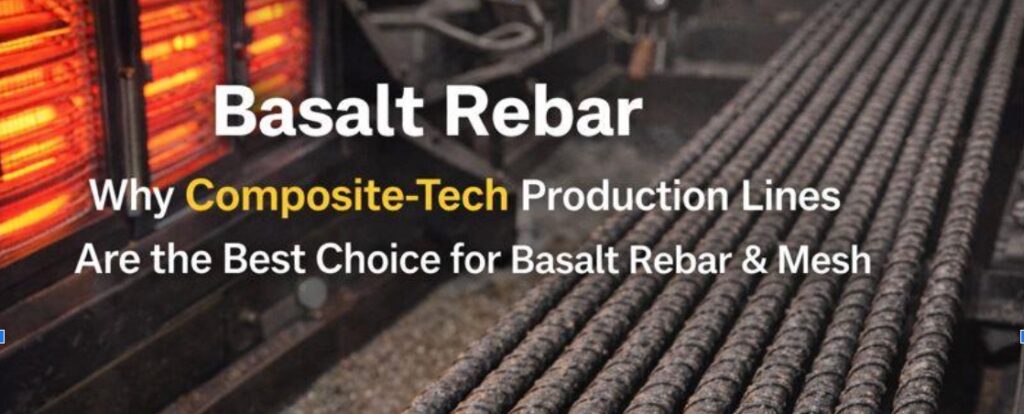
Basalt rebar has moved from a niche material to one of the most discussed alternatives to steel and even glass-fiber rebar. Made from volcanic rock, basalt fiber offers high tensile strength, corrosion resistance and excellent thermal stability, which makes it especially attractive for aggressive environments and long-life infrastructure.
Yet many producers discover a hard truth: getting the full benefit of basalt fiber is only possible when the production line is specifically engineered for BFRP, not just “glass rebar equipment with a few tweaks.”
In this article we’ll look at:
- what makes basalt rebar different from steel and glass-fiber rebar,
- why process control is even more critical for BFRP,
- and how Composite-Tech’s patented technologies (pre-heating, triple impregnation, short-wave IR curing, two-stage cooling and high-tension pulling) make our lines the best option for manufacturing basalt rebar and mesh.
What Is Basalt Rebar (BFRP)?
Basalt fiber rebar (BFRP) is a composite reinforcement bar made from continuous basalt fibers embedded in a polymer matrix, usually epoxy or vinyl-ester. Basalt fibers are produced by melting natural basalt rock at around 1400–1600 °C and pulling it into continuous filaments.
This simple raw-material base is one of the material’s strengths: no complex mixture of minerals and additives, no toxic by-products – just volcanic rock and controlled melting.
Key material advantages of basalt rebar
Independent producers and technical brochures typically report the following performance characteristics:
- High tensile strength:
- basalt composite rebar: ~850–1200 MPa
- typical steel rebar: ~500–700 MPa
- Low density:
- basalt rebar: ~1.9–2.1 g/cm³
- steel rebar: ~7.8 g/cm³
→ up to 4× lighter than steel at the same diameter
- Corrosion resistance:
- non-corrosive in saltwater, chlorides, alkalis and many chemicals
- Excellent thermal stability:
- higher temperature resistance than glass fiber, with stable properties at elevated temperatures
- Long service life:
- service life expectations of 100+ years in concrete structures are commonly cited for BFRP in aggressive environments.
For designers, this means lighter structures, longer life cycles and better performance in marine, coastal, road and high-temperature applications.
Basalt Rebar vs Steel and GFRP
Basalt rebar vs steel
Compared with traditional steel reinforcement, basalt rebar offers:
- 3× higher tensile strength (typical values 850–1200 MPa vs 500–700 MPa for steel)
- 4× lower weight at the same diameter
- Zero corrosion, even in seawater or de-icing salt environments
- Non-magnetic and electrically non-conductive behavior, which is critical in MRI rooms, high-voltage stations and certain industrial floors
- Reduced CO₂ footprint, because less concrete cover and fewer repairs are needed over the life of the structure
In practice, lighter bars mean easier transport and installation, while corrosion immunity removes one of the main failure mechanisms of reinforced concrete.
Basalt rebar vs glass-fiber GFRP
Basalt and glass FRP are often grouped together, but research shows important differences:
- Basalt fibers exhibit higher tensile strength and better chemical resistance than standard E-glass fibers.
- Basalt fiber production generally requires less energy and fewer additives than S-glass, which improves sustainability.
- Basalt has higher thermal stability, making it attractive for applications with elevated temperature cycles.
For these reasons, many engineers see basalt rebar as a “second-generation” FRP – especially suitable for:
- bridge decks and coastal structures,
- road slabs and industrial floors with de-icing salts,
- high-temperature or fire-exposed elements (with appropriate resin systems),
- and infrastructures where a 100-year design life is required.
Why Manufacturing Quality Matters Even More for Basalt
If basalt is so strong, why doesn’t every FRP factory simply switch to it? The answer is simple: basalt fiber is less forgiving than glass.
Basalt fibers have:
- high tensile strength, but
- relatively low elongation at break compared to steel,
- and a dark color that absorbs heat very efficiently.
This combination means that any mistakes in tensioning, impregnation or curing are quickly punished:
- uneven fiber tension leads to local over-stress and filament breakage,
- poor resin wet-out leaves dry zones that act as cracks,
- uncontrolled surface over-heating can damage the outer fiber layer,
- thermal shock during cooling can initiate micro-cracks that are hard to see but show up in long-term durability tests.
That is why a generic “budget” FRP line is usually not enough for serious basalt rebar producers. To truly benefit from BFRP, you need equipment engineered specifically for it.
How Composite-Tech Lines Unlock the Full Potential of Basalt Fiber
Composite-Tech has spent years refining and patenting production solutions for FRP rebar and FRP mesh. These solutions are implemented on our CT-series lines and are particularly valuable for basalt fiber, where process control directly determines final performance.
Below are the key elements that make our equipment the best choice for basalt rebar and mesh.
High-Tension Fiber Handling: Using the Full Strength of Basalt
Basalt’s mechanical advantage only appears when the fibers are:
- perfectly aligned,
- evenly tensioned,
- and locked into the matrix without micro-waviness.
Composite-Tech lines use a multi-stage pulling and guiding system that maintains stable tension on each roving from creel to curing ovens. The result:
- straight, densely packed fiber bundles,
- minimal filament buckling,
- higher effective tensile strength in the finished bar.
For basalt, this is crucial: properly tensioned fibers allow you to exploit the material’s 3× strength advantage instead of losing it to process defects.
Patented Pre-Heating: Removing Moisture and Silane from the Roving
Most rovings are delivered with silane sizings and some residual moisture. If they go straight into the resin bath, the silane layer can block deep wet-out, and water can generate voids and poor bond.
Composite-Tech addresses this with a dedicated pre-heating module as the first block of the line:
- each roving passes through a controlled-temperature oven,
- moisture and silane residues are evaporated and decomposed,
- fibers exit clean and ready for perfect resin penetration.
For basalt fibers, which have excellent chemical resistance but need intimate contact with the matrix, this step is especially valuable. It prepares the surface for long-term bond without damaging the fiber.
Triple-Action Resin Impregnation: Ultrasonic + Mechanical + Micro-Squeeze
The heart of any FRP line is the impregnation bath. Composite-Tech’s patented module combines three impregnation mechanisms in one compact unit:
- Ultrasonic activation
High-frequency vibrations break up micro-air pockets and help resin penetrate into the tight bundles of basalt filaments. - Pneumatic / mechanical pressing
Specially designed guides and rollers physically press resin into the fiber bundle, ensuring high fiber volume fraction without dry zones. - Precision micro-squeezing
At the outlet, the bar passes through carefully calibrated squeezing elements that remove excess resin while keeping enough matrix to protect fibers and transfer loads.
For basalt rebar and mesh, this triple-action approach is the difference between:
- a bar with scattered voids and weak bond, and
- a dense, uniform composite that passes demanding tensile, shear and bond tests.
Adjustable Rib Winding for Optimal Bond
Basalt rebar is usually produced with a wrapped or ribbed surface. Bond behavior in concrete depends heavily on rib geometry. Different markets and applications require different surface profiles.
On Composite-Tech CT-4 and CT-6 lines, the rib winding module:
- allows continuous adjustment of rib angle, pitch and pattern,
- maintains stable geometry even at high line speeds,
- can be tuned for straight bars and for mesh rods.
This flexibility lets producers match local codes and job-site practices without changing machines – for example, more aggressive ribs for industrial floors, or specific patterns for bridge decks and slabs.
Short-Wave IR “Booster”: Starting Polymerization from the Inside
Basalt’s dark fibers absorb infrared radiation very effectively. Composite-Tech uses this to your advantage with a short-wave IR booster oven as the first curing stage:
- short-wave IR penetrates through the bar cross-section,
- polymerization starts from the inside rather than burning the surface,
- temperature gradients are reduced, leading to a more uniform modulus and better fatigue behavior.
For basalt bars, where thermal stability is excellent but surface overheating can damage fibers, this inside-out curing is a major advantage over simple “hot tunnel” ovens.
Secondary Curing and Two-Stage Cooling: No Thermal Shock, No Micro-Cracks
After the IR booster, the bar enters a secondary curing oven with a gentler regime to complete polymerization and stabilize dimensions.
When the bar leaves the ovens, its core temperature can exceed 200 °C. Plunging it directly into cold water – a common practice on basic lines – creates thermal shock and surface micro-cracks.
Composite-Tech prevents this with a patented two-stage cooling system:
- Intensive air cooling
- removes peak heat,
- reduces temperature to a safe level.
- Water bath cooling
- finalizes cooling and stops polymerization,
- stabilizes dimensions and surface.
For basalt rebar and mesh, this approach protects the outer fiber layer and significantly improves long-term durability, especially under cyclic loading and freeze-thaw conditions.
Premium Components and Global Support
Composite-Tech lines are built with European, American and Japanese components for drives, control systems, sensors and power electronics. This ensures:
- stable operation at high speeds,
- easy access to spare parts,
- and compatibility with strict industrial safety and quality standards.
Combined with remote diagnostics and training, this makes our basalt rebar and mesh lines a reliable long-term investment, not just a cheap machine for first experiments.
Basalt Rebar and Mesh: Where the Market Is Growing
Globally, the FRP rebar market is expanding fast, with projections from USD 0.69 billion in 2025 to around USD 1.19 billion by 2030 – a compound annual growth rate of about 11.5 %. Basalt FRP is one of the most dynamic segments within this market thanks to its combination of strength, low weight and durability.
Typical high-value applications for basalt rebar and mesh
- Marine and coastal structures: seawalls, piers, jetties, port infrastructure
- Road and bridge projects: decks, barriers, slabs, approach slabs
- Industrial floors and slabs-on-grade: zones with aggressive chemicals, de-icing salts or alkalis
- Water and wastewater facilities: tanks, treatment plants, reservoirs
- High-temperature and fire-exposed elements: with appropriate design and resin systems
For investors and manufacturers, this means stable demand in segments where owners care about life-cycle cost, not just initial price.
Why Composite-Tech Is the Best Choice for Basalt Rebar Production
Putting everything together, Composite-Tech lines are not just “compatible with basalt fiber” – they are engineered to unlock its full potential.
Our patented technologies give you:
- Maximum use of basalt’s tensile strength through precise tensioning and alignment
- Deep, void-free impregnation thanks to pre-heating and triple-action resin wet-out
- Uniform curing without surface burns via short-wave IR booster ovens
- Crack-free surfaces and superior fatigue life with two-stage air + water cooling
- Optimized bond to concrete with adjustable rib winding for different markets
- Reliability and productivity through high-quality components and automation
Only producers who use such equipment can consistently deliver BFRP rebar and mesh capable of meeting strict specifications and winning demanding infrastructure projects.
Planning to Start or Upgrade Basalt Rebar Production?
If you are considering:
- launching a basalt rebar plant from scratch,
- adding BFRP to an existing GFRP operation, or
- upgrading outdated lines that cannot meet modern quality requirements,
it makes sense to start from the technology, not from raw material prices alone.
Composite-Tech offers:
- complete basalt rebar and mesh production lines (CT-4, CT-6 and mesh systems),
- technology transfer and recipes adapted to basalt fibers and local resins,
- assistance with testing and certification under relevant standards,
- and business-plan support for investors targeting high-value infrastructure segments.
Basalt rebar is already proving that concrete can be lighter, more durable and more sustainable. With the right production equipment, it can also be a highly profitable business.
If you want to use basalt fiber not just as a buzzword, but as a real competitive advantage, start with machines that were designed for it.
That’s where Composite-Tech comes in.
Learn more: