
Risposta rapida
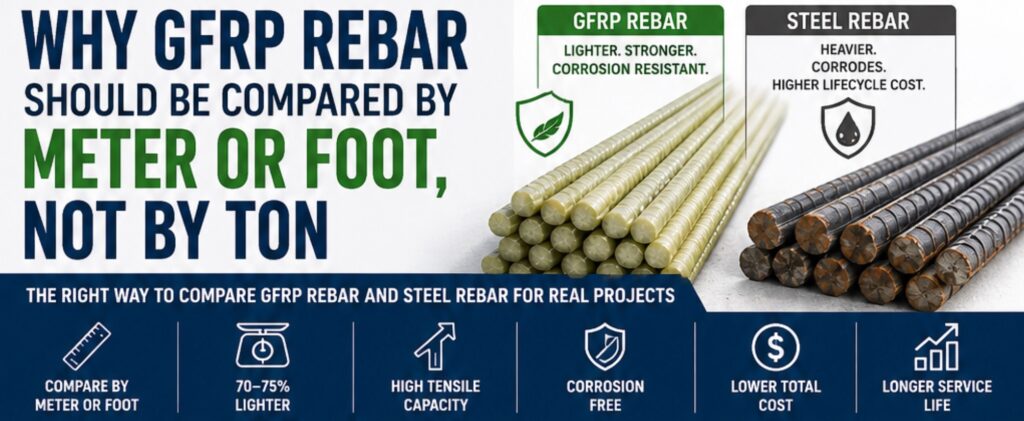
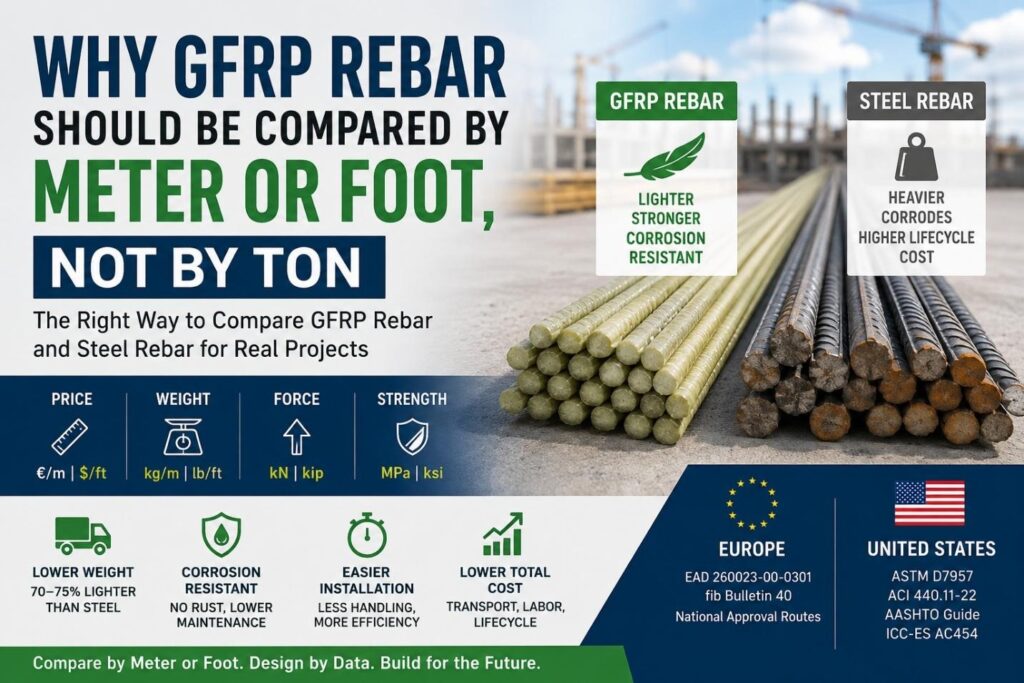
Le barre di rinforzo in GFRP dovrebbero essere confrontate al metro o al piede, non alla tonnellata, perché in genere sono circa 70-75 tonnellate più leggere delle barre di rinforzo in acciaio. Un confronto basato sulle tonnellate fa apparire il GFRP artificialmente costoso perché una tonnellata di GFRP contiene un rinforzo lineare molto maggiore rispetto a una tonnellata di acciaio.
Per un vero e proprio appalto, il confronto corretto è:
- prezzo al metro o prezzo al piede;
- costo totale del pacchetto di rinforzo;
- peso di trasporto;
- costi di scarico e movimentazione;
- tempo di installazione;
- rischio di corrosione durante la manutenzione;
- durata di servizio;
- requisiti di progettazione specifici del progetto.
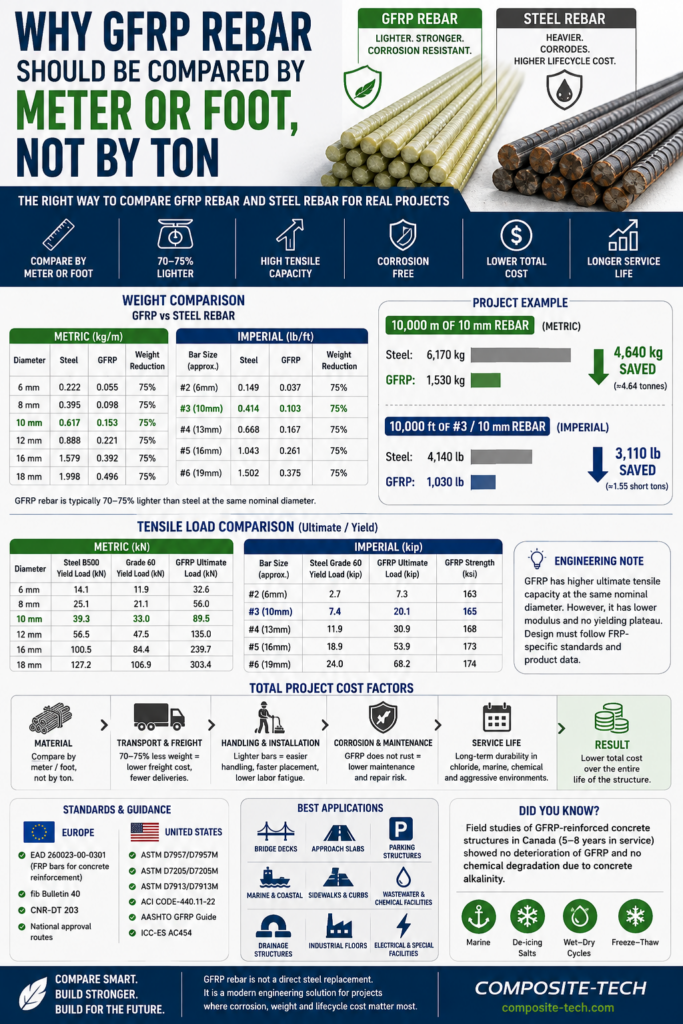
Per esempio, 10.000 metri di barre d'acciaio per cemento armato da 10 mm pesano circa 6.170 kg, Mentre 10.000 metri di barre d'armatura in GFRP da 10 mm pesano circa 1.530 kg. Ciò significa approssimativamente tely 4.640 kg di peso di rinforzo vengono eliminati dalla logistica e dalla movimentazione in cantiere..
In unità statunitensi, 10.000 piedi di barre d'armatura in acciaio tely #3 / 10 mm pesano circa 4.140 libbre, mentre la lunghezza equivalente di GFRP pesa circa 1.030 libbre. Ciò rappresenta un risparmio di circa 3.110 libbre, o circa 1,55 tonnellate corte statunitensi.
Il GFRP non è una copia esatta dell'acciaio e non dovrebbe essere sostituito solo in base al diametro. Tuttavia, se progettato correttamente, può offrire un notevole vantaggio commerciale nelle strutture in calcestruzzo soggette a corrosione.
Punti chiave
- Le barre d'armatura in GFRP non dovrebbero essere valutate solo in base al prezzo per tonnellata.
- Per l'Europa, il confronto commerciale corretto è €/m, kg/m, kN, MPa e il costo del pacchetto di progetto.
- Per gli Stati Uniti, il confronto corretto è $/ft, libbre/piedi, kip, ksi e il costo del pacchetto di progetto.
- Il GFRP è in genere circa accendino 70–75% rispetto all'acciaio allo stesso diametro nominale.
- Il peso ridotto diminuisce i costi di trasporto, scarico, movimentazione in loco e installazione.
- Il GFRP non arrugginisce, eliminando così il meccanismo interno di corrosione ed espansione dell'acciaio presente all'interno del calcestruzzo.
- I carichi di trazione ultimi testati sui materiali compositi in fibra di vetro (GFRP) possono superare i carichi di snervamento dell'acciaio a parità di diametro nominale.
- I materiali compositi in fibra di vetro (GFRP) devono comunque essere progettati seguendo regole specifiche per i FRP, e non copiando i dettagli costruttivi dell'acciaio.
- Negli Stati Uniti, barre di rinforzo in GFRP è coperto da ASTM D7957, ASTM D7205, CODICE ACI-440.11-22, linee guida AASHTO per ponti in GFRP e ICC-ES AC454. ASTM D7957/D7957M-25 riguarda le barre tonde piene in GFRP per il rinforzo del calcestruzzo, comprese le lunghezze tagliate e le forme piegate con miglioramento della superficie esterna.
- In Europa, le barre in FRP sono disciplinate da valutazioni tecniche e linee guida di progettazione come la norma EAD 260023-00-0301, il bollettino fib 40 e i documenti guida nazionali. L'EOTA elenca la norma EAD 260023-00-0301 per le barre in FRP di carbonio, vetro, basalto e aramide come rinforzo di elementi strutturali.
Il più grande errore negli acquisti: confrontare GFRP e acciaio in tonnellate
Il rinforzo in acciaio viene tradizionalmente acquistato a peso. In Europa, l'acciaio viene comunemente quotato in chilogrammi o tonnellate. Negli Stati Uniti, si parla comunemente di libbre, quintali o tonnellate, a seconda del fornitore e del progetto.
Questa logica funziona per l'acciaio perché è denso, metallico e standardizzato in base alla massa.
Ma il GFRP è diverso.
Le barre di rinforzo in GFRP sono un materiale composito costituito da fibre di vetro continue e resina polimerica. La sua densità è molto inferiore a quella dell'acciaio. Il documento tecnico di vendita di Composite-Tech utilizza valori rappresentativi del GFRP che mostrano approssimativamente 70–75% massa inferiore rispetto all'acciaio con gli stessi diametri nominali.
Ciò significa che l'acquirente chiede solo:
“Qual è il prezzo per tonnellata?”
sta ponendo la domanda sbagliata.
La domanda corretta è:
“Qual è il costo del pacchetto di rinforzo necessario per questo progetto?”
Tale pacchetto dovrebbe essere calcolato come segue:
- metri lineari o piedi lineari;
- diametro o dimensione della barra US;
- spaziatura delle armature;
- requisito di progettazione;
- peso della merce;
- costi di scarico;
- tempo di installazione;
- esposizione alla corrosione;
- manutenzione del ciclo di vita.
Riferimento alle dimensioni metriche e imperiali
Gli acquirenti europei di solito ragionano in millimetri. Gli acquirenti statunitensi di solito ragionano in barre e pollici.
La tabella seguente aiuta a collegare i due sistemi.
| Diametro metrico | Diametro approssimativo in pollici | Dimensioni della barra statunitense più vicine | Nota importante |
|---|---|---|---|
| 6 mm | 0,24 pollici | vicino a #2 | Non sempre si tratta di un equivalente commerciale diretto |
| 8 mm | 0,31 pollici | tra #2 e #3 | Controlla l'area specifica del prodotto |
| 10 millimetri | 0,39 pollici | vicino a #3 / 3/8 pollici | Dimensione di confronto comune |
| 12 mm | 0,47 pollici | vicino a #4 / 1/2 pollice | Area di verifica efficace |
| 14 mm | 0,55 pollici | tra #4 e #5 | Non è un numero di autorizzazione diretto per l'esercizio della professione forense negli Stati Uniti. |
| 16 mm | 0,63 pollici | vicino a #5 / 5/8 pollici | dimensione strutturale comune |
| 18 mm | 0,71 pollici | vicino a #6 / 3/4 pollici | Verifica i dati di progettazione |
| 20 mm | 0,79 pollici | vicino a #6 | Non sempre intercambiabili |
Importante: I numeri delle barre statunitensi e i diametri metrici non sono equivalenti perfetti. Per il GFRP, gli acquirenti dovrebbero richiedere area efficace, diametro nominale, peso al metro/piede, carico di trazione, modulo, E dati del profilo superficiale.
Che cos'è una barra d'armatura in GFRP?
GFRP significa Polimero rinforzato con fibra di vetro. Non si tratta di una barra di plastica. È un materiale composito strutturale di rinforzo.
| Componente | Funzione | Perché è importante |
|---|---|---|
| Fibre di vetro | Sopportano la maggior parte del carico di trazione longitudinale | Controlla gran parte della capacità di trazione |
| resina polimerica | Lega e protegge le fibre | Controlla l'impregnazione, la durabilità e il comportamento della matrice. |
| Profilo superficiale | Crea un incastro meccanico con il calcestruzzo | Influisce sul legame, sulla lunghezza di sviluppo e sulla giunzione a sovrapposizione |
| processo di produzione | Controlla la coerenza | Determina la ripetibilità e l'affidabilità del prodotto |
Le barre di rinforzo in GFRP sono un materiale ingegneristico diverso dall'acciaio. Hanno un'elevata resistenza alla trazione, bassa densità, non sono soggette a corrosione metallica e non presentano un plateau di snervamento. Devono essere progettate come GFRP, non come una copia esatta dell'acciaio.
Uno studio condotto da Jarek e Kubik ha testato barre in GFRP di tre produttori con diametro dichiarato di 12 mm, evidenziando notevoli discrepanze tra il diametro dichiarato e quello reale, che potrebbero impedire una semplice conversione dall'armatura in acciaio all'armatura composita.
Confronto di peso: barre d'armatura in acciaio vs barre in GFRP in unità metriche e imperiali
La differenza di peso è il primo dato che ogni acquirente dovrebbe comprendere.
| Diametro | Acciaio kg/m | Acciaio lb/ft | GFRP kg/m | GFRP lb/ft | Weight Reduction |
|---|---|---|---|---|---|
| 6 mm | 0.222 | 0.149 | 0.055 | 0.037 | ~75% |
| 8 mm | 0.395 | 0.265 | 0.098 | 0.066 | ~75% |
| 10 millimetri | 0.617 | 0.414 | 0.153 | 0.103 | ~75% |
| 12 mm | 0.888 | 0.597 | 0.221 | 0.149 | ~75% |
| 14 mm | 1.209 | 0.812 | 0.300 | 0.202 | ~75% |
| 16 mm | 1.579 | 1.061 | 0.392 | 0.263 | ~75% |
| 18 mm | 1.998 | 1.342 | 0.496 | 0.333 | ~75% |
Riepilogo: At the same nominal diameter, GFRP rebar can reduce reinforcement mass by approximately 70–75%. This affects transport, warehouse handling, unloading, carrying, installation speed and worker fatigue.
Project Example in Metric Units: 10,000 m of 10 mm Rebar
| Materiale | Weight per Meter | Peso totale per 10.000 m |
|---|---|---|
| tondino d'acciaio | 0,617 kg/m | 6.170 kg |
| Barre di rinforzo in GFRP | 0,153 kg/m | 1.530 kg |
| Peso risparmiato | — | 4.640 kg |
This means a project using 10,000 m of 10 mm reinforcement can remove about 4.64 metric tons from transport and site handling.
Project Example in U.S. Units: 10,000 ft of Approx. #3 / 10 mm Rebar
| Materiale | Weight per Foot | Total Weight for 10,000 ft |
|---|---|---|
| tondino d'acciaio | 0,414 lb/ft | 4,140 lb |
| Barre di rinforzo in GFRP | 0,103 lb/ft | 1.030 libbre |
| Peso risparmiato | — | 3.110 libbre |
This means a U.S. project using 10,000 ft of approximately #3 / 10 mm reinforcement can remove about 3.110 libbre, or approximately 1,55 tonnellate corte statunitensi, from logistics and handling.
This is why the buyer should not ask only for “price per ton.” The more relevant question is:
How much reinforcement length do I get, how much does it weigh, and how much does it cost to deliver and install?
Tensile Load Comparison: Rebar Should Be Compared by Force, Not by Weight
Rebar is not used because it is heavy. It is used because it carries tensile force.
That is why a serious comparison should include tensile load, not only weight.
The table below compares:
- European-type steel reference: B500-type yield strength, 500 MPa;
- U.S. steel reference: Grade 60 yield strength, approximately 420 MPa / 60 ksi;
- Representative tested GFRP ultimate tensile load from Composite-Tech reference data.
| Diametro | Steel B500 Yield Load, kN | Grade 60 Yield Load, kN / kip | GFRP Ultimate Load, kN / kip | GFRP Strength, MPa / ksi |
|---|---|---|---|---|
| 6 mm | 14.1 | 11.9 / 2.7 | 32.6 / 7.3 | 1124 / 163 |
| 8 mm | 25.1 | 21.1 / 4.7 | 56.0 / 12.6 | 1115 / 162 |
| 10 millimetri | 39.3 | 33.0 / 7.4 | 89.5 / 20.1 | 1141 / 165 |
| 12 mm | 56.5 | 47.5 / 10.7 | 135.0 / 30.3 | 1194 / 173 |
| 14 mm | 77.0 | 64.7 / 14.5 | 183.5 / 41.3 | 1193 / 173 |
| 16 mm | 100.5 | 84.4 / 19.0 | 239.7 / 53.9 | 1190 / 173 |
| 18 mm | 127.2 | 106.9 / 24.0 | 303.4 / 68.2 | 1199 / 174 |
Important engineering note: This table does not mean automatic one-to-one substitution. Steel yield load and GFRP ultimate tensile load are not the same design concept. GFRP has lower modulus, no yielding plateau, different bond behavior and FRP-specific serviceability checks. Final design must follow applicable FRP standards and product-specific test data.
But the table shows one essential point:
GFRP is not valuable because it is light only. It is valuable because it combines low weight with high tensile capacity.
Why Price per Ton Is Misleading
A ton-based comparison punishes GFRP for being lightweight.
For example, if a buyer compares only material price per ton, GFRP may look expensive because one ton of GFRP contains much more linear reinforcement than one ton of steel.
Il confronto corretto è:
| Comparison Method | Europa | Stati Uniti | Correct Logic |
|---|---|---|---|
| Price per ton | €/t | $/ton | Misleading for lightweight composite material |
| Price per kg / lb | €/kg | $/lb | Still incomplete |
| Prezzo al metro/piede | €/m | $/ft | Better for reinforcement planning |
| Project package price | Full BOQ | Full rebar schedule | Best commercial comparison |
| Peso | kg/m and total tonnes | lb/ft and short tons | Shows freight and handling advantage |
| Tensile force | kN | kip | Shows engineering capacity |
| Forza | MPa | ksi | Useful for datasheets and design |
| Costo del ciclo di vita | corrosion maintenance | corrosion maintenance | Critical in aggressive environments |
If the GFRP supplier provides a competitive price per meter or foot, GFRP can be commercially attractive at procurement. Even when the initial material price is similar or slightly higher, the total project economics may still favor GFRP because of logistics, installation and corrosion-free service life.
Where GFRP Can Be Cheaper Than Steel in a Real Project
GFRP should not be sold as “cheap plastic rebar.” That is the wrong message.
It should be sold as a modern engineering material that can reduce total project cost in the right applications.
| Cost Area | barre d'acciaio | Barre di rinforzo in GFRP |
|---|---|---|
| Material purchase | Familiar and widely available | Should be quoted by meter, foot or package |
| Trasporti | Pesante | About 70–75% less mass |
| Unloading | Requires more handling effort | Easier manual handling |
| Installazione | Higher worker fatigue | Lighter placement |
| Protezione dalla corrosione | Depends on cover, exposure and coatings | Non-metallic; does not rust |
| Manutenzione | Can require repair in chloride / marine zones | Lower rust-driven repair risk |
| Service disruption | Repair closures may be costly | Durability can reduce intervention risk |
The economic advantage is strongest where corrosion is expensive.
The Steel Corrosion Problem
Steel is strong, familiar and widely accepted. But inside concrete, steel has one major weakness: corrosion.
In chloride, marine, de-icing salt, wastewater or chemical exposure, steel corrosion can lead to:
- rust expansion;
- fessurazioni del calcestruzzo;
- cover spalling;
- loss of bond;
- loss of steel section;
- repeated repairs;
- traffic disruption;
- higher lifecycle cost.
GFRP rebar removes the steel rust mechanism because it is non-metallic. It does not eliminate the need for good concrete design, but it removes one of the most expensive failure mechanisms in reinforced concrete.
European Market: How to Explain GFRP Rebar
For European engineers and buyers, the article should speak in metric units and recognize European approval logic.
| Topic | European Positioning |
|---|---|
| Commercial unit | €/m, €/project package, kg/m |
| Engineering units | MPa, GPa, kN, mm |
| Procurement logic | Compare by meter, not by ton |
| Design conversation | FRP-specific design, not steel substitution |
| Assessment route | Product-specific technical documentation, ETA/EAD route where applicable |
| Technical guidance | EAD 260023-00-0301, fib Bulletin 40, CNR-DT 203, national engineering rules |
EOTA lists EAD 260023-00-0301 for carbon, glass, basalt and aramid FRP bars as reinforcement of structural elements, and there are already European Technical Assessments for GFRP rebar products under that EAD route.
fib Bulletin 40 deals mainly with FRP bars as internal reinforcement for concrete structures and notes that FRP reinforcement requires engineers to rethink several traditional RC design principles.
Correct wording for Europe:
“The FRP bar material class has European technical assessment and design guidance routes, but a specific product must be supported by its own technical documentation, test reports, ETA / national approval route where required, and project-specific engineering design.”
U.S. Market: How to Explain GFRP Rebar
For U.S. readers, the article must include imperial units and U.S. standards language.
| Topic | U.S. Positioning |
|---|---|
| Commercial unit | $/ft, $/project package, lb/ft |
| Engineering units | ksi, Msi, kip, inch |
| Procurement logic | Compare by foot, not by ton |
| Design conversation | ASTM / ACI / AASHTO / ICC-ES |
| Transportation market | bridge decks, approach slabs, sidewalks, coastal infrastructure |
| Approval logic | Product-specific test reports and agency acceptance |
ASTM D7957/D7957M-25 is the U.S. product specification for solid round GFRP bars for concrete reinforcement. ACI CODE-440.11-22 provides building code requirements for structural concrete reinforced with GFRP bars, including material, design and detailing provisions. AASHTO’s second edition GFRP guide expanded the title beyond bridge decks and traffic railings to reflect broader bridge applications.
Correct wording for the U.S.:
“The GFRP rebar material class is already covered by U.S. standards and technical guidance. A specific product must be supported by product-specific test reports, datasheet, traceability and acceptance under the applicable project, state DOT or building-code procedure.”
U.S. and European Standards / Guidance Comparison
| Region | Document / Organization | What It Covers | Commercial Meaning |
|---|---|---|---|
| U.S. | ASTM D7957/D7957M | GFRP bars for concrete reinforcement | Product specification language |
| U.S. | ASTM D7205/D7205M | Proprietà di trazione delle barre composite in FRP | Standard tensile testing |
| U.S. | ASTM D7913/D7913M | Resistenza dell'adesione mediante prova di estrazione | Bond evaluation |
| U.S. | CODICE ACI-440.11-22 | GFRP-reinforced concrete design and detailing | Building code framework |
| U.S. | AASHTO GFRP Guide | Bridge design guidance | Transportation infrastructure route |
| U.S. | ICC-ES AC454 | Acceptance criteria for FRP bars | Evaluation report route |
| Europa | EAD 260023-00-0301 | FRP bars as reinforcement of structural elements | ETA / assessment route |
| Europa | fib Bulletin 40 | FRP reinforcement in RC structures | International design guidance |
| Europa | CNR-DT 203 | Italian guide for FRP bars in concrete | National technical guidance |
| Canada / International | CSA S806 / CSA S6 | FRP structures and bridges | Useful North American reference |
Durability Evidence: Why Corrosion Resistance Matters
One of the strongest arguments for GFRP is durability in concrete exposure.
A field study by Mufti et al. investigated cores removed from five GFRP-reinforced concrete structures in Canada after 5–8 years of service. The study used optical microscopy, SEM, EDX, DSC and infrared spectroscopy. The synopsis reports no deterioration of GFRP in the field structures and no chemical degradation due to concrete alkalinity.
The structures included marine, de-icing salt, wet-dry and freeze-thaw exposure conditions. This makes the study useful for both U.S. and European audiences because those exposure risks are central in:
- ponti di comando;
- coastal concrete;
- parking structures;
- sidewalks and curbs;
- drainage structures;
- impianti di trattamento delle acque reflue;
- marine assets;
- de-icing salt regions.
Best Applications for GFRP Rebar in Europe and the U.S.
GFRP does not need to replace steel everywhere. It should be used where its advantages create clear project value.
| Applicazione | Europa | Stati Uniti | Why GFRP Fits |
|---|---|---|---|
| impalcati dei ponti | road bridges, coastal bridges | DOT bridge decks | de-icing salts, chloride exposure |
| Approach slabs | highway and bridge approaches | DOT standard applications | low-risk corrosion-critical use |
| Coastal structures | ports, seawalls, marine works | seawalls, piers, bulkheads | saltwater exposure |
| Parking structures | multi-storey parking | garages, slabs, ramps | water and chloride exposure |
| Sidewalks and curbs | urban infrastructure | sidewalks, curbs, medians | lightweight and corrosion resistant |
| Drainage structures | culverts, channels | drainage and stormwater assets | water exposure |
| Impianti di trattamento delle acque reflue | water treatment plants | wastewater and chemical zones | aggressive environment |
| Pavimenti industriali | warehouses, factories | industrial slabs | chemical exposure |
| Impianti elettrici | power infrastructure | energy, MRI, special facilities | non conduttivo e non magnetico |
This is where the commercial message becomes simple:
Use GFRP where steel loses value because it rusts, weighs too much or creates maintenance risk.
Why Product Quality Matters
Not all GFRP rebar is the same.
The Jarek and Kubik study found that rods from three manufacturers with the same declared 12 mm diameter had equivalent diameters ranging from approximately −11% to +14% relative to the declared diameter. The difference between manufacturers was nearly 3 mm, o circa 25% of the nominal diameter.
That is why buyers should not purchase GFRP only by color, appearance or nominal diameter.
| Datasheet Item | Perché è importante |
|---|---|
| Nominal diameter | Needed for reference |
| Effective diameter / area | Needed for stress and force calculations |
| Resistenza alla trazione | Shows ultimate material capacity |
| Tensile load | Shows actual force capacity |
| Modulo di elasticità | Controls deflection and crack behavior |
| Ceppo definitivo | Shows strain capacity before rupture |
| Density / kg/m / lb/ft | Controls logistics and cost comparison |
| Profilo superficiale | Controls bond to concrete |
| Bond test data | Supporta la lunghezza di sviluppo e la sicurezza della giunzione a sovrapposizione |
| Resistenza agli alcali | Important for concrete environment |
| Temperatura di transizione vetrosa | Shows resin thermal performance |
| Tracciabilità del lotto | Needed for procurement and approval |
A serious GFRP supplier should provide more than a brochure. Buyers should ask for test reports.
Why Manufacturing Technology Matters
GFRP rebar performance is controlled by production quality.
A professional production line must control:
- alimentazione a base di fibre;
- fiber tension;
- impregnazione con resina;
- fiber wet-out;
- rib profile;
- surface geometry;
- curing;
- raffreddamento;
- forza di trazione;
- cutting;
- coiling;
- controllo qualità.
The final product must be consistent from batch to batch. Engineers need predictable diameter, surface profile, tensile capacity, bond behavior and traceability.
Linee di produzione Composite-Tech are designed to support this type of industrial repeatability. For manufacturers, this is critical because the market does not accept theoretical values. It accepts tested, repeatable and documented product performance.
How to Make a Correct Commercial Comparison
A buyer should compare steel and GFRP using a project-based method.
Step 1: Compare required linear meters or feet
Do not begin with tons. Begin with the reinforcement schedule.
Step 2: Compare price per meter or foot
For Europe, ask for €/m.
For the U.S., ask for $/ft.
Step 3: Compare total weight
Use kg/m or lb/ft by diameter and calculate total project mass.
Step 4: Compare freight and unloading
Lower weight can reduce transport and handling burden.
Step 5: Compare installation effort
Lighter material can simplify manual handling and reduce site fatigue.
Step 6: Compare corrosion exposure
If the structure is exposed to chlorides, marine environment, wastewater or chemicals, lifecycle cost matters.
Step 7: Confirm design requirements
Check modulus, crack width, deflection, bond, development length, lap splice, fire exposure and product-specific test data.
Honest Engineering Limitations
A strong article must not claim that GFRP is perfect for every application.
GFRP has limitations that must be handled correctly.
| Problema | Correct Engineering Response |
|---|---|
| Modulo di elasticità inferiore a quello dell'acciaio. | Verificare l'ampiezza e la deflessione della fessura. |
| Nessun plateau di cedimento | Utilizzare le disposizioni di progettazione specifiche per i materiali FRP. |
| Comportamento diverso dei legami | Use surface and bond test data |
| Durata dello sviluppo | Must be calculated for GFRP |
| Giunzione a sovrapposizione | Must follow FRP-specific detailing |
| Curvatura del campo | Do not bend after curing; use factory-made shapes |
| Fuoco / temperatura | Check code provisions and concrete cover |
| Variazione del prodotto | Require test reports and traceability |
| Regional approval | Use product-specific approval route |
This honesty does not weaken the sales message. It makes it more credible.
Why GFRP Is a Strong Material for the Future of Concrete
The future of concrete reinforcement is not only about replacing one material with another. It is about selecting the right reinforcement for the right exposure condition.
Steel remains useful. But in corrosion-critical environments, GFRP solves a problem that steel cannot solve by itself: internal rust.
GFRP rebar offers:
- low weight;
- high tensile capacity;
- resistenza alla corrosione;
- non-metallic behavior;
- easier logistics;
- easier handling;
- lower maintenance exposure;
- standards-based design pathways;
- strong value in aggressive environments.
This is why GFRP should be evaluated early in the project, not after the structure has already been designed around steel.
FAQ: GFRP Rebar Price, Weight and Cost Comparison
Is GFRP rebar cheaper than steel rebar?
GFRP can be cheaper or commercially stronger than steel when compared by meter, foot, project package, logistics, installation and lifecycle cost. Comparing only price per ton is misleading because GFRP is much lighter than steel.
Why should GFRP rebar not be compared by ton?
Because GFRP is approximately 70–75% lighter than steel. One ton of GFRP contains far more linear meters or feet than one ton of steel.
How much lighter is GFRP rebar than steel?
At the same nominal diameter, GFRP rebar is typically about four times lighter than steel. In many practical comparisons, the weight reduction is about 70–75%.
What is the weight of 10 mm GFRP rebar?
Representative 10 mm GFRP rebar weight is about 0,153 kg/m, o circa 0,103 lb/ft. By comparison, 10 mm steel rebar weighs about 0,617 kg/m, o circa 0,414 lb/ft.
How much weight can be saved on 10,000 meters of 10 mm rebar?
For 10,000 meters of 10 mm reinforcement, steel weighs about 6.170 kg, while GFRP weighs about 1.530 kg. The approximate weight saving is 4.640 kg.
How much weight can be saved on 10,000 feet of approx. #3 / 10 mm rebar?
For 10,000 ft, steel weighs about 4,140 lb, while GFRP weighs about 1.030 libbre. The approximate weight saving is 3.110 libbre, o circa 1,55 tonnellate corte statunitensi.
Is GFRP stronger than steel?
GFRP can have higher ultimate tensile strength than steel, but it behaves differently. Steel yields; GFRP is linear-elastic until failure. Therefore, design must follow FRP-specific provisions.
Can GFRP replace steel one-to-one?
No. GFRP should not be substituted by diameter alone. It must be designed using product-specific data and applicable FRP standards.
What standards cover GFRP rebar in the United States?
Important U.S. documents include ACI CODE-440.11-22, ASTM D7957, ASTM D7205, ASTM D7913, AASHTO GFRP bridge guide specifications and ICC-ES AC454.
What technical routes exist in Europe?
European discussion can reference EAD 260023-00-0301, ETA routes where applicable, fib Bulletin 40, CNR-DT 203 and national engineering approval requirements. A specific product still needs product-specific documentation and approval for the intended application.
Where does GFRP rebar make the most economic sense?
GFRP is strongest commercially in corrosion-critical applications: bridge decks, approach slabs, sidewalks, parking structures, marine works, seawalls, wastewater structures, drainage, industrial floors and coastal concrete.
What should a buyer request before purchasing GFRP rebar?
A buyer should request a product datasheet, tensile test report, diameter and area data, weight per meter or foot, modulus, surface profile, bond data, durability data, batch traceability and installation guidance.
Conclusione
GFRP rebar should not be evaluated by price per ton. That method belongs to steel procurement and does not reflect the economics of lightweight composite reinforcement.
The correct comparison is by:
- meter or foot;
- project package;
- peso della merce;
- installation labor;
- durability;
- durata di servizio;
- regional standards and approval route.
GFRP rebar offers a clear value proposition: much lower weight, high tensile capacity, corrosion resistance and recognized technical pathways in both the U.S. and Europe. It is not a direct steel clone, and it must be designed correctly. But in the right applications, especially where corrosion creates long-term cost, GFRP can be a more rational reinforcement choice.
For contractors, distributors, engineers and infrastructure owners, the key question is not:
“How much does it cost per ton?”
La domanda corretta è:
“How much does the complete reinforcement solution cost to buy, transport, install and maintain over the life of the structure?”
That is where GFRP rebar becomes a serious material, not just an alternative.
Saperne di più:
- FRP Machinery & GFRP Rebar Production Lines, USA
- Perché Composite-Tech e FRP Institute stanno definendo gli standard globali per i compositi
- Come installare barre d'armatura in fibra di vetro (GFRP) nelle solette di cemento | Composite-Tech
- Perché le aziende statunitensi scelgono le linee di barre e reti in FRP di Composite-Tech
- Controllo qualità delle barre di rinforzo in GFRP: contenuto di fibre, impregnazione con resina, Tg, prove e tracciabilità.