
إجابة سريعة
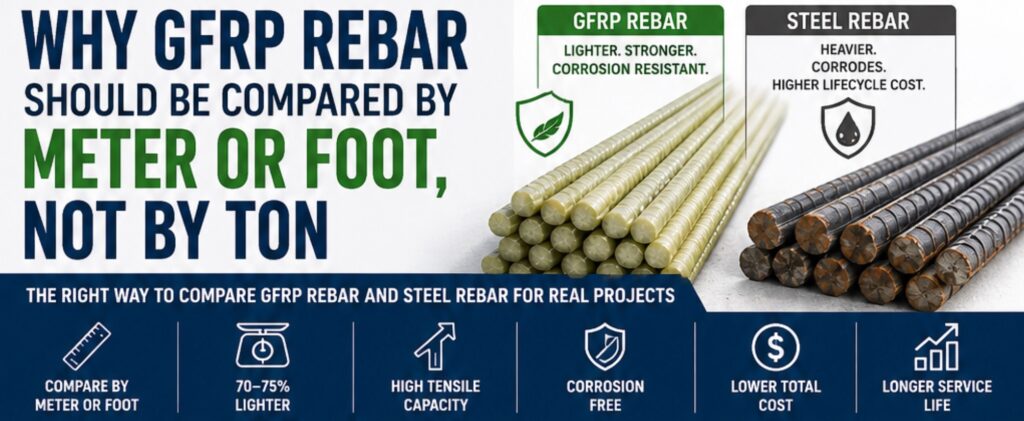
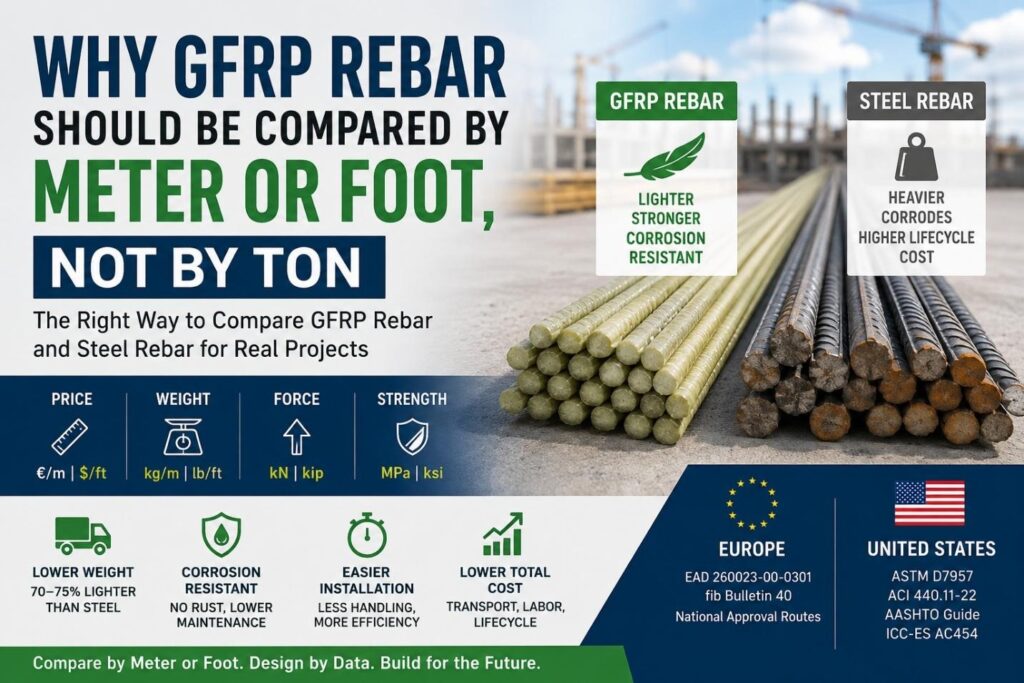
ينبغي مقارنة حديد التسليح المصنوع من الألياف الزجاجية المقواة بالبوليمر بالمتر أو القدم، وليس بالطن، لأنه عادة ما يكون أخف وزناً بحوالي 70-75% من حديد التسليح الفولاذي. A ton-based comparison makes GFRP look artificially expensive because one ton of GFRP contains much more linear reinforcement than one ton of steel.
For real procurement, the correct comparison is:
- price per meter or price per foot;
- total reinforcement package cost;
- transport weight;
- unloading and handling cost;
- installation time;
- corrosion maintenance risk;
- service life;
- project-specific design requirements.
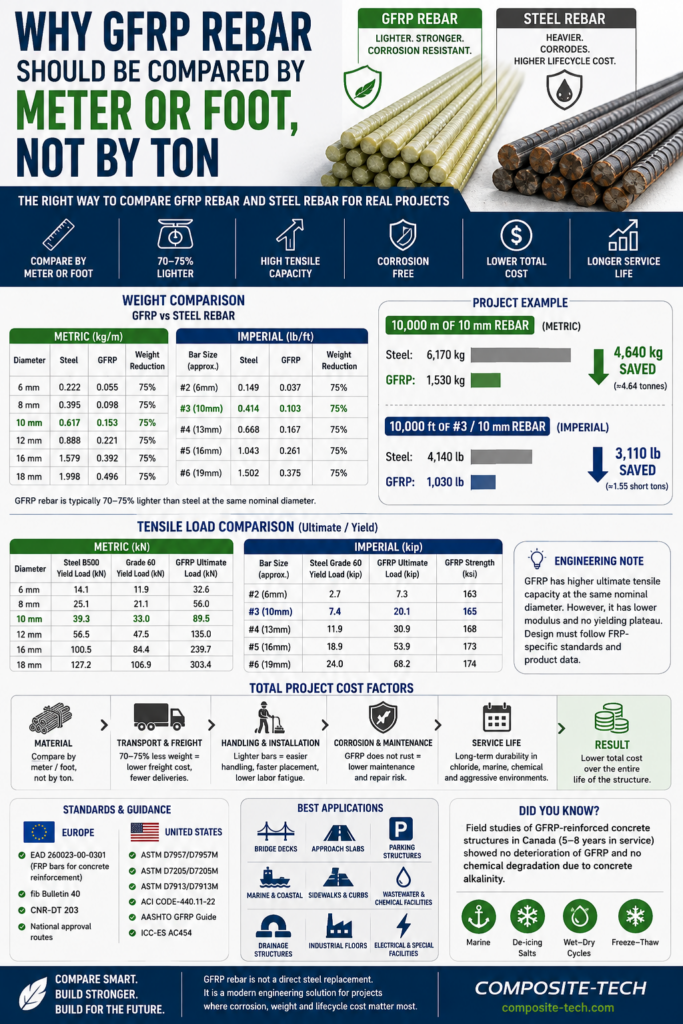
For example, 10,000 meters of 10 mm steel rebar weighs about 6,170 kg, while 10,000 meters of 10 mm GFRP rebar weighs about 1,530 kg. That means approximately 4,640 kg of reinforcement weight is removed from logistics and site handling.
In U.S. units, 10,000 ft of approximately #3 / 10 mm steel rebar weighs about 4,140 lb, while the equivalent length of GFRP weighs about 1,030 lb. That is a saving of roughly 3,110 lb, أو حول 1.55 U.S. short tons.
GFRP is not a direct steel copy and should not be substituted by diameter alone. But when designed correctly, it can provide a strong commercial advantage in corrosion-critical concrete structures.
النقاط الرئيسية
- GFRP rebar should not be evaluated by price per ton only.
- For Europe, the correct commercial comparison is €/m, kg/m, kN, MPa and project package cost.
- For the U.S., the correct comparison is $/ft, lb/ft, kip, ksi and project package cost.
- GFRP is typically about 70–75% أخف وزنًا than steel at the same nominal diameter.
- Lower weight reduces freight, unloading, site handling and installation effort.
- GFRP does not rust, so it removes the internal steel corrosion-expansion mechanism inside concrete.
- Tested GFRP ultimate tensile loads can exceed steel yield loads at the same nominal diameter.
- GFRP must still be designed using FRP-specific rules, not copied from steel detailing.
- In the U.S., GFRP rebar is covered by ASTM D7957, ASTM D7205, رمز ACI-440.11-22, AASHTO GFRP bridge guidance and ICC-ES AC454. ASTM D7957/D7957M-25 covers solid round GFRP bars for concrete reinforcement, including cut lengths and bent shapes with external surface enhancement.
- In Europe, FRP bars are addressed through technical assessment and design guidance such as EAD 260023-00-0301, fib Bulletin 40 and national guidance documents. EOTA lists EAD 260023-00-0301 for carbon, glass, basalt and aramid FRP bars as reinforcement of structural elements.
The Biggest Procurement Mistake: Comparing GFRP and Steel by Ton
Steel reinforcement is traditionally bought by weight. In Europe, steel is commonly quoted by kilogram or ton. In the U.S., it is commonly discussed by pound, hundredweight, or ton depending on the supplier and project.
That logic works for steel because steel is dense, metallic and standardized by mass.
But GFRP is different.
GFRP rebar is a composite material made from continuous glass fibers and polymer resin. Its density is much lower than steel. Composite-Tech’s sales technical document uses representative GFRP values showing roughly 70–75% lower mass compared with steel at the same nominal diameters.
That means a buyer who asks only:
“What is the price per ton?”
is asking the wrong question.
The correct question is:
“What is the cost of the reinforcement package required for this project?”
That package should be calculated by:
- linear meters or linear feet;
- diameter or U.S. bar size;
- reinforcement spacing;
- design requirement;
- freight weight;
- unloading cost;
- installation time;
- التعرض للتآكل؛;
- lifecycle maintenance.
Metric and Imperial Size Reference
European buyers usually think in millimeters. U.S. buyers usually think in bar numbers and inches.
The table below helps connect both systems.
| Metric Diameter | Approx. Inch Diameter | Nearest U.S. Bar Size | Important Note |
|---|---|---|---|
| 6 مم | 0.24 in | near #2 | Not always a direct commercial equivalent |
| 8 مم | 0.31 in | between #2 and #3 | Check product-specific area |
| 10 مم | 0.39 in | near #3 / 3/8 in | Common comparison size |
| 12 مم | 0.47 in | near #4 / 1/2 in | Check effective area |
| 14 مم | 0.55 in | between #4 and #5 | Not a direct U.S. bar number |
| 16 مم | 0.63 in | near #5 / 5/8 in | Common structural size |
| 18 مم | 0.71 in | near #6 / 3/4 in | Check design data |
| 20 مم | 0.79 in | near #6 | Not always interchangeable |
مهم: U.S. bar numbers and metric diameters are not perfect equivalents. For GFRP, buyers should request effective area, nominal diameter, weight per meter / foot, tensile load, modulus، و surface profile data.
What GFRP Rebar Is
GFRP means Glass Fiber Reinforced Polymer. It is not a plastic rod. It is a structural composite reinforcement material.
| Component | وظيفة | لماذا يهم ذلك |
|---|---|---|
| Glass fibers | Carry most of the longitudinal tensile load | Controls much of the tensile capacity |
| راتنج بوليمر | Binds and protects fibers | Controls impregnation, durability and matrix behavior |
| المظهر السطحي | Creates mechanical interlock with concrete | Affects bond, development length and lap splice |
| Manufacturing process | Controls consistency | Determines product repeatability and trust |
GFRP rebar is a different engineering material from steel. It has high tensile capacity, low density, no metallic corrosion and no yielding plateau. It should be designed as GFRP, not as a direct steel clone.
A study by Jarek and Kubik tested GFRP rods from three manufacturers with declared 12 mm diameter and emphasized major discrepancies between declared and real diameter, which may prevent simple conversion from steel reinforcement to composite reinforcement.
Weight Comparison: Steel vs GFRP Rebar in Metric and Imperial Units
The weight difference is the first number every buyer should understand.
| القطر | كتلة الفولاذ كجم/م | فولاذ رطل/قدم | GFRP كجم/م | GFRP رطل/قدم | إنقاص الوزن |
|---|---|---|---|---|---|
| 6 مم | 0.222 | 0.149 | 0.055 | 0.037 | ~75% |
| 8 مم | 0.395 | 0.265 | 0.098 | 0.066 | ~75% |
| 10 مم | 0.617 | 0.414 | 0.153 | 0.103 | ~75% |
| 12 مم | 0.888 | 0.597 | 0.221 | 0.149 | ~75% |
| 14 مم | 1.209 | 0.812 | 0.300 | 0.202 | ~75% |
| 16 مم | 1.579 | 1.061 | 0.392 | 0.263 | ~75% |
| 18 مم | 1.998 | 1.342 | 0.496 | 0.333 | ~75% |
ملخص: At the same nominal diameter, GFRP rebar can reduce reinforcement mass by approximately 70–75%. This affects transport, warehouse handling, unloading, carrying, installation speed and worker fatigue.
Project Example in Metric Units: 10,000 m of 10 mm Rebar
| مادة | Weight per Meter | الوزن الإجمالي لمسافة 10000 متر |
|---|---|---|
| قضبان التسليح الفولاذية | 0.617 كجم/م | 6170 كجم |
| حديد التسليح المصنوع من البلاستيك المقوى بألياف زجاجية | 0.153 كجم/م | 1530 كجم |
| توفير الوزن | — | 4640 كجم |
This means a project using 10,000 m of 10 mm reinforcement can remove about 4.64 metric tons from transport and site handling.
Project Example in U.S. Units: 10,000 ft of Approx. #3 / 10 mm Rebar
| مادة | Weight per Foot | Total Weight for 10,000 ft |
|---|---|---|
| قضبان التسليح الفولاذية | 0.414 رطل/قدم | 4,140 lb |
| حديد التسليح المصنوع من البلاستيك المقوى بألياف زجاجية | 0.103 رطل/قدم | 1,030 lb |
| توفير الوزن | — | 3,110 lb |
This means a U.S. project using 10,000 ft of approximately #3 / 10 mm reinforcement can remove about 3,110 lb, or approximately 1.55 U.S. short tons, from logistics and handling.
This is why the buyer should not ask only for “price per ton.” The more relevant question is:
How much reinforcement length do I get, how much does it weigh, and how much does it cost to deliver and install?
Tensile Load Comparison: Rebar Should Be Compared by Force, Not by Weight
Rebar is not used because it is heavy. It is used because it carries tensile force.
That is why a serious comparison should include tensile load, not only weight.
The table below compares:
- European-type steel reference: B500-type yield strength, 500 MPa;
- U.S. steel reference: Grade 60 yield strength, approximately 420 MPa / 60 ksi;
- Representative tested GFRP ultimate tensile load from Composite-Tech reference data.
| القطر | Steel B500 Yield Load, kN | Grade 60 Yield Load, kN / kip | GFRP Ultimate Load, kN / kip | GFRP Strength, MPa / ksi |
|---|---|---|---|---|
| 6 مم | 14.1 | 11.9 / 2.7 | 32.6 / 7.3 | 1124 / 163 |
| 8 مم | 25.1 | 21.1 / 4.7 | 56.0 / 12.6 | 1115 / 162 |
| 10 مم | 39.3 | 33.0 / 7.4 | 89.5 / 20.1 | 1141 / 165 |
| 12 مم | 56.5 | 47.5 / 10.7 | 135.0 / 30.3 | 1194 / 173 |
| 14 مم | 77.0 | 64.7 / 14.5 | 183.5 / 41.3 | 1193 / 173 |
| 16 مم | 100.5 | 84.4 / 19.0 | 239.7 / 53.9 | 1190 / 173 |
| 18 مم | 127.2 | 106.9 / 24.0 | 303.4 / 68.2 | 1199 / 174 |
Important engineering note: This table does not mean automatic one-to-one substitution. Steel yield load and GFRP ultimate tensile load are not the same design concept. GFRP has lower modulus, no yielding plateau, different bond behavior and FRP-specific serviceability checks. Final design must follow applicable FRP standards and product-specific test data.
But the table shows one essential point:
GFRP is not valuable because it is light only. It is valuable because it combines low weight with high tensile capacity.
Why Price per Ton Is Misleading
A ton-based comparison punishes GFRP for being lightweight.
For example, if a buyer compares only material price per ton, GFRP may look expensive because one ton of GFRP contains much more linear reinforcement than one ton of steel.
المقارنة الصحيحة هي:
| Comparison Method | أوروبا | United States | Correct Logic |
|---|---|---|---|
| Price per ton | €/t | $/ton | Misleading for lightweight composite material |
| Price per kg / lb | €/kg | $/lb | Still incomplete |
| السعر للمتر/القدم | €/m | $/ft | Better for reinforcement planning |
| Project package price | Full BOQ | Full rebar schedule | Best commercial comparison |
| وزن | kg/m and total tonnes | lb/ft and short tons | Shows freight and handling advantage |
| Tensile force | kN | kip | Shows engineering capacity |
| قوة | MPa | ksi | Useful for datasheets and design |
| تكلفة دورة الحياة | corrosion maintenance | corrosion maintenance | Critical in aggressive environments |
If the GFRP supplier provides a competitive price per meter or foot, GFRP can be commercially attractive at procurement. Even when the initial material price is similar or slightly higher, the total project economics may still favor GFRP because of logistics, installation and corrosion-free service life.
Where GFRP Can Be Cheaper Than Steel in a Real Project
GFRP should not be sold as “cheap plastic rebar.” That is the wrong message.
It should be sold as a modern engineering material that can reduce total project cost in the right applications.
| Cost Area | حديد التسليح | حديد التسليح المقوى بألياف زجاجية |
|---|---|---|
| Material purchase | Familiar and widely available | Should be quoted by meter, foot or package |
| مواصلات | ثقيل | About 70–75% less mass |
| Unloading | Requires more handling effort | Easier manual handling |
| تثبيت | Higher worker fatigue | Lighter placement |
| الحماية من التآكل | Depends on cover, exposure and coatings | Non-metallic; does not rust |
| صيانة | Can require repair in chloride / marine zones | Lower rust-driven repair risk |
| Service disruption | Repair closures may be costly | Durability can reduce intervention risk |
The economic advantage is strongest where corrosion is expensive.
The Steel Corrosion Problem
Steel is strong, familiar and widely accepted. But inside concrete, steel has one major weakness: corrosion.
In chloride, marine, de-icing salt, wastewater or chemical exposure, steel corrosion can lead to:
- rust expansion;
- تشقق الخرسانة؛;
- cover spalling;
- فقدان السند؛;
- loss of steel section;
- repeated repairs;
- traffic disruption;
- higher lifecycle cost.
GFRP rebar removes the steel rust mechanism because it is non-metallic. It does not eliminate the need for good concrete design, but it removes one of the most expensive failure mechanisms in reinforced concrete.
European Market: How to Explain GFRP Rebar
For European engineers and buyers, the article should speak in metric units and recognize European approval logic.
| Topic | European Positioning |
|---|---|
| Commercial unit | €/m, €/project package, kg/m |
| Engineering units | MPa, GPa, kN, mm |
| Procurement logic | Compare by meter, not by ton |
| Design conversation | FRP-specific design, not steel substitution |
| Assessment route | Product-specific technical documentation, ETA/EAD route where applicable |
| Technical guidance | EAD 260023-00-0301, fib Bulletin 40, CNR-DT 203, national engineering rules |
EOTA lists EAD 260023-00-0301 for carbon, glass, basalt and aramid FRP bars as reinforcement of structural elements, and there are already European Technical Assessments for GFRP rebar products under that EAD route.
fib Bulletin 40 deals mainly with FRP bars as internal reinforcement for concrete structures and notes that FRP reinforcement requires engineers to rethink several traditional RC design principles.
Correct wording for Europe:
“The FRP bar material class has European technical assessment and design guidance routes, but a specific product must be supported by its own technical documentation, test reports, ETA / national approval route where required, and project-specific engineering design.”
U.S. Market: How to Explain GFRP Rebar
For U.S. readers, the article must include imperial units and U.S. standards language.
| Topic | U.S. Positioning |
|---|---|
| Commercial unit | $/ft, $/project package, lb/ft |
| Engineering units | ksi, Msi, kip, inch |
| Procurement logic | Compare by foot, not by ton |
| Design conversation | ASTM / ACI / AASHTO / ICC-ES |
| Transportation market | bridge decks, approach slabs, sidewalks, coastal infrastructure |
| Approval logic | Product-specific test reports and agency acceptance |
ASTM D7957/D7957M-25 is the U.S. product specification for solid round GFRP bars for concrete reinforcement. ACI CODE-440.11-22 provides building code requirements for structural concrete reinforced with GFRP bars, including material, design and detailing provisions. AASHTO’s second edition GFRP guide expanded the title beyond bridge decks and traffic railings to reflect broader bridge applications.
Correct wording for the U.S.:
“The GFRP rebar material class is already covered by U.S. standards and technical guidance. A specific product must be supported by product-specific test reports, datasheet, traceability and acceptance under the applicable project, state DOT or building-code procedure.”
U.S. and European Standards / Guidance Comparison
| Region | Document / Organization | What It Covers | Commercial Meaning |
|---|---|---|---|
| U.S. | ASTM D7957/D7957M | قضبان GFRP لتقوية الخرسانة | Product specification language |
| U.S. | ASTM D7205/D7205M | خصائص الشد لقضبان مركبة من الألياف البوليمرية المقواة | Standard tensile testing |
| U.S. | ASTM D7913/D7913M | قوة الترابط عن طريق اختبار السحب | Bond evaluation |
| U.S. | رمز ACI-440.11-22 | GFRP-reinforced concrete design and detailing | Building code framework |
| U.S. | AASHTO GFRP Guide | Bridge design guidance | Transportation infrastructure route |
| U.S. | ICC-ES AC454 | معايير قبول قضبان الألياف الزجاجية المقواة بالبلاستيك | Evaluation report route |
| أوروبا | EAD 260023-00-0301 | FRP bars as reinforcement of structural elements | ETA / assessment route |
| أوروبا | fib Bulletin 40 | FRP reinforcement in RC structures | International design guidance |
| أوروبا | CNR-DT 203 | Italian guide for FRP bars in concrete | National technical guidance |
| Canada / International | CSA S806 / CSA S6 | FRP structures and bridges | Useful North American reference |
Durability Evidence: Why Corrosion Resistance Matters
One of the strongest arguments for GFRP is durability in concrete exposure.
A field study by Mufti et al. investigated cores removed from five GFRP-reinforced concrete structures in Canada after 5-8 سنوات of service. The study used optical microscopy, SEM, EDX, DSC and infrared spectroscopy. The synopsis reports no deterioration of GFRP in the field structures and no chemical degradation due to concrete alkalinity.
The structures included marine, de-icing salt, wet-dry and freeze-thaw exposure conditions. This makes the study useful for both U.S. and European audiences because those exposure risks are central in:
- أسطح الجسور؛;
- coastal concrete;
- مواقف السيارات؛;
- sidewalks and curbs;
- drainage structures;
- wastewater facilities;
- marine assets;
- de-icing salt regions.
Best Applications for GFRP Rebar in Europe and the U.S.
GFRP does not need to replace steel everywhere. It should be used where its advantages create clear project value.
| طلب | أوروبا | United States | Why GFRP Fits |
|---|---|---|---|
| أسطح الجسور | road bridges, coastal bridges | DOT bridge decks | de-icing salts, chloride exposure |
| Approach slabs | highway and bridge approaches | DOT standard applications | low-risk corrosion-critical use |
| Coastal structures | ports, seawalls, marine works | seawalls, piers, bulkheads | saltwater exposure |
| Parking structures | multi-storey parking | garages, slabs, ramps | water and chloride exposure |
| Sidewalks and curbs | urban infrastructure | sidewalks, curbs, medians | lightweight and corrosion resistant |
| Drainage structures | culverts, channels | drainage and stormwater assets | water exposure |
| Wastewater facilities | water treatment plants | wastewater and chemical zones | aggressive environment |
| أرضيات صناعية | warehouses, factories | industrial slabs | chemical exposure |
| المرافق الكهربائية | power infrastructure | energy, MRI, special facilities | غير موصل وغير مغناطيسي |
This is where the commercial message becomes simple:
Use GFRP where steel loses value because it rusts, weighs too much or creates maintenance risk.
Why Product Quality Matters
Not all GFRP rebar is the same.
The Jarek and Kubik study found that rods from three manufacturers with the same declared 12 mm diameter had equivalent diameters ranging from approximately من -11% إلى +14% relative to the declared diameter. The difference between manufacturers was nearly 3 مم, أو حول 25% من القطر الاسمي.
That is why buyers should not purchase GFRP only by color, appearance or nominal diameter.
| بيانات المنتج | لماذا يهم ذلك |
|---|---|
| القطر الاسمي | Needed for reference |
| Effective diameter / area | Needed for stress and force calculations |
| قوة الشد | Shows ultimate material capacity |
| الحمل الشدّي | Shows actual force capacity |
| معامل المرونة | Controls deflection and crack behavior |
| السلالة النهائية | Shows strain capacity before rupture |
| Density / kg/m / lb/ft | Controls logistics and cost comparison |
| المظهر السطحي | Controls bond to concrete |
| بيانات اختبار الترابط | يدعم طول التطوير وثقة وصلة التداخل |
| مقاومة القلويات | Important for concrete environment |
| درجة حرارة التحول الزجاجي | Shows resin thermal performance |
| إمكانية تتبع الدفعات | Needed for procurement and approval |
A serious GFRP supplier should provide more than a brochure. Buyers should ask for test reports.
Why Manufacturing Technology Matters
GFRP rebar performance is controlled by production quality.
A professional production line must control:
- التغذية بالألياف؛;
- fiber tension;
- تشريب الراتنج؛;
- fiber wet-out;
- rib profile;
- surface geometry;
- curing;
- تبريد؛;
- قوة السحب؛;
- cutting;
- coiling;
- ضبط الجودة.
The final product must be consistent from batch to batch. Engineers need predictable diameter, surface profile, tensile capacity, bond behavior and traceability.
خطوط إنتاج كومبوزيت-تك are designed to support this type of industrial repeatability. For manufacturers, this is critical because the market does not accept theoretical values. It accepts tested, repeatable and documented product performance.
How to Make a Correct Commercial Comparison
A buyer should compare steel and GFRP using a project-based method.
Step 1: Compare required linear meters or feet
Do not begin with tons. Begin with the reinforcement schedule.
Step 2: Compare price per meter or foot
For Europe, ask for €/m.
For the U.S., ask for $/ft.
Step 3: Compare total weight
Use kg/m or lb/ft by diameter and calculate total project mass.
Step 4: Compare freight and unloading
Lower weight can reduce transport and handling burden.
Step 5: Compare installation effort
Lighter material can simplify manual handling and reduce site fatigue.
Step 6: Compare corrosion exposure
If the structure is exposed to chlorides, marine environment, wastewater or chemicals, lifecycle cost matters.
Step 7: Confirm design requirements
Check modulus, crack width, deflection, bond, development length, lap splice, fire exposure and product-specific test data.
Honest Engineering Limitations
A strong article must not claim that GFRP is perfect for every application.
GFRP has limitations that must be handled correctly.
| مشكلة | Correct Engineering Response |
|---|---|
| معامل المرونة أقل من الفولاذ | تحقق من عرض الشق وانحرافه |
| لا يوجد مستوى هضبة قابل للانثناء | استخدم أحكام التصميم الخاصة بالألياف البلاستيكية المقواة بالبوليمر. |
| سلوك الروابط المختلفة | Use surface and bond test data |
| Development length | Must be calculated for GFRP |
| Lap splice | Must follow FRP-specific detailing |
| انحناء الحقل | Do not bend after curing; use factory-made shapes |
| حريق / درجة الحرارة | Check code provisions and concrete cover |
| تنوع المنتج | Require test reports and traceability |
| Regional approval | Use product-specific approval route |
This honesty does not weaken the sales message. It makes it more credible.
Why GFRP Is a Strong Material for the Future of Concrete
The future of concrete reinforcement is not only about replacing one material with another. It is about selecting the right reinforcement for the right exposure condition.
Steel remains useful. But in corrosion-critical environments, GFRP solves a problem that steel cannot solve by itself: internal rust.
GFRP rebar offers:
- وزن خفيف؛;
- high tensile capacity;
- مقاومة التآكل؛;
- non-metallic behavior;
- easier logistics;
- easier handling;
- lower maintenance exposure;
- standards-based design pathways;
- strong value in aggressive environments.
This is why GFRP should be evaluated early in the project, not after the structure has already been designed around steel.
FAQ: GFRP Rebar Price, Weight and Cost Comparison
Is GFRP rebar cheaper than steel rebar?
GFRP can be cheaper or commercially stronger than steel when compared by meter, foot, project package, logistics, installation and lifecycle cost. Comparing only price per ton is misleading because GFRP is much lighter than steel.
Why should GFRP rebar not be compared by ton?
Because GFRP is approximately 70–75% lighter than steel. One ton of GFRP contains far more linear meters or feet than one ton of steel.
How much lighter is GFRP rebar than steel?
At the same nominal diameter, GFRP rebar is typically about four times lighter than steel. In many practical comparisons, the weight reduction is about 70–75%.
What is the weight of 10 mm GFRP rebar?
Representative 10 mm GFRP rebar weight is about 0.153 كجم/م, أو حول 0.103 رطل/قدم. By comparison, 10 mm steel rebar weighs about 0.617 كجم/م, أو حول 0.414 رطل/قدم.
How much weight can be saved on 10,000 meters of 10 mm rebar?
For 10,000 meters of 10 mm reinforcement, steel weighs about 6170 كجم, while GFRP weighs about 1530 كجم. The approximate weight saving is 4640 كجم.
How much weight can be saved on 10,000 feet of approx. #3 / 10 mm rebar?
For 10,000 ft, steel weighs about 4,140 lb, while GFRP weighs about 1,030 lb. The approximate weight saving is 3,110 lb, أو حول 1.55 U.S. short tons.
Is GFRP stronger than steel?
GFRP can have higher ultimate tensile strength than steel, but it behaves differently. Steel yields; GFRP is linear-elastic until failure. Therefore, design must follow FRP-specific provisions.
Can GFRP replace steel one-to-one?
No. GFRP should not be substituted by diameter alone. It must be designed using product-specific data and applicable FRP standards.
What standards cover GFRP rebar in the United States?
Important U.S. documents include ACI CODE-440.11-22, ASTM D7957, ASTM D7205, ASTM D7913, AASHTO GFRP bridge guide specifications and ICC-ES AC454.
What technical routes exist in Europe?
European discussion can reference EAD 260023-00-0301, ETA routes where applicable, fib Bulletin 40, CNR-DT 203 and national engineering approval requirements. A specific product still needs product-specific documentation and approval for the intended application.
Where does GFRP rebar make the most economic sense?
GFRP is strongest commercially in corrosion-critical applications: bridge decks, approach slabs, sidewalks, parking structures, marine works, seawalls, wastewater structures, drainage, industrial floors and coastal concrete.
What should a buyer request before purchasing GFRP rebar?
A buyer should request a product datasheet, tensile test report, diameter and area data, weight per meter or foot, modulus, surface profile, bond data, durability data, batch traceability and installation guidance.
خاتمة
GFRP rebar should not be evaluated by price per ton. That method belongs to steel procurement and does not reflect the economics of lightweight composite reinforcement.
The correct comparison is by:
- meter or foot;
- project package;
- freight weight;
- installation labor;
- durability;
- service life;
- regional standards and approval route.
GFRP rebar offers a clear value proposition: much lower weight, high tensile capacity, corrosion resistance and recognized technical pathways in both the U.S. and Europe. It is not a direct steel clone, and it must be designed correctly. But in the right applications, especially where corrosion creates long-term cost, GFRP can be a more rational reinforcement choice.
For contractors, distributors, engineers and infrastructure owners, the key question is not:
“How much does it cost per ton?”
The correct question is:
“How much does the complete reinforcement solution cost to buy, transport, install and maintain over the life of the structure?”
That is where GFRP rebar becomes a serious material, not just an alternative.
يتعلم أكثر:
- FRP Machinery & GFRP Rebar Production Lines, USA
- لماذا تُحدد شركة Composite-Tech ومعهد FRP المعايير العالمية للمركبات؟
- كيفية تركيب حديد التسليح المصنوع من الألياف الزجاجية (GFRP) في ألواح الخرسانة | كومبوزيت-تك
- لماذا تختار الشركات الأمريكية خطوط حديد التسليح والشبكات المصنوعة من الألياف الزجاجية المقواة بالبلاستيك من شركة كومبوزيت-تك؟
- مراقبة جودة حديد التسليح المصنوع من الألياف الزجاجية المقواة بالبلاستيك: محتوى الألياف، تشريب الراتنج، درجة حرارة التحول الزجاجي، الاختبار والتتبع