
Resposta rápida
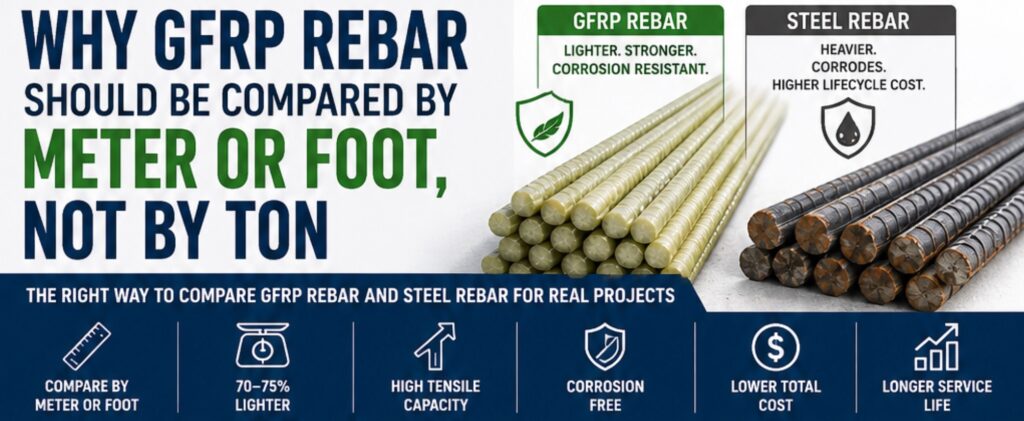
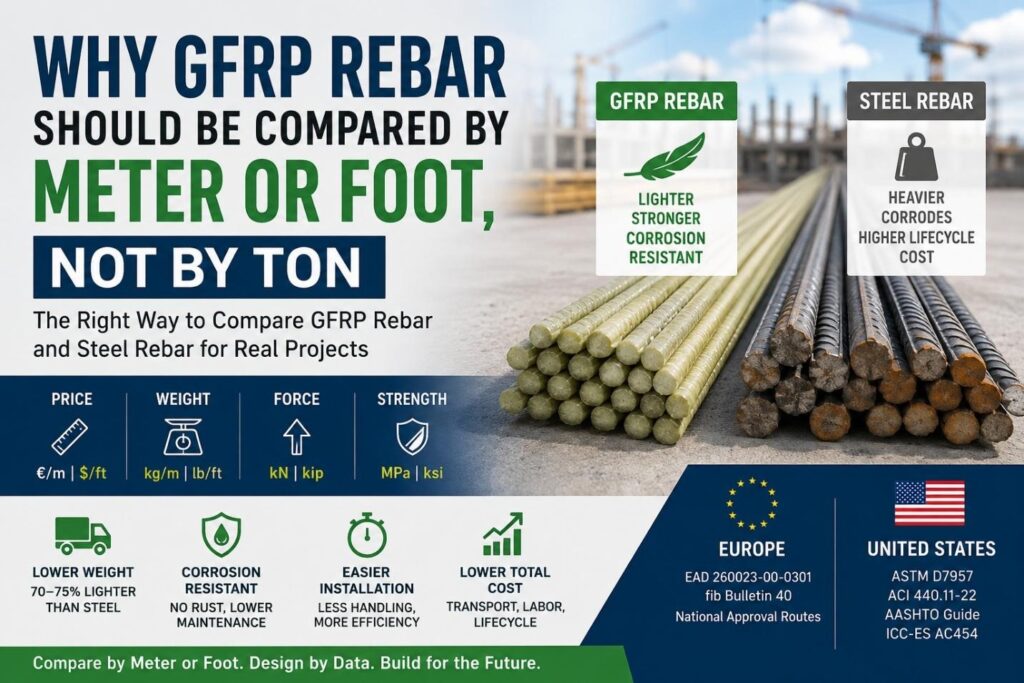
As barras de reforço de GFRP devem ser comparadas por metro ou pé, não por tonelada, porque normalmente são cerca de 70 a 75 toneladas mais leves do que as barras de reforço de aço. Uma comparação baseada em toneladas faz com que o GFRP pareça artificialmente caro, porque uma tonelada de GFRP contém muito mais reforço linear do que uma tonelada de aço.
Para compras reais, a comparação correta é:
- Preço por metro ou preço por pé;
- custo total do pacote de reforço;
- peso de transporte;
- custo de descarga e manuseio;
- tempo de instalação;
- risco de manutenção por corrosão;
- vida útil;
- Requisitos de projeto específicos do projeto.
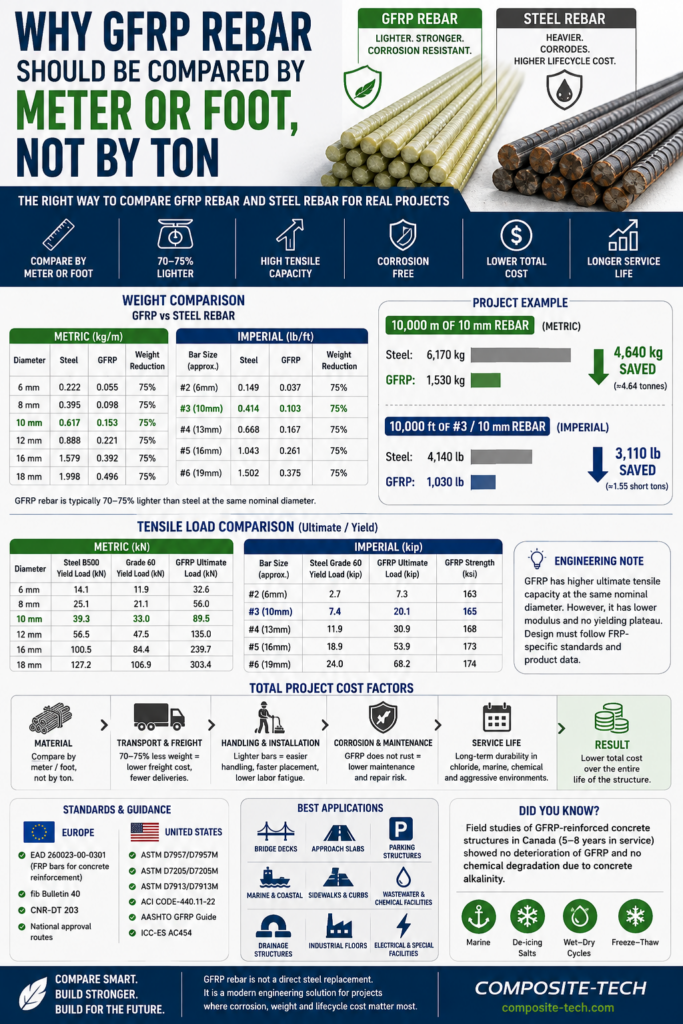
Por exemplo, 10.000 metros de vergalhão de aço de 10 mm pesam cerca de 6.170 kg., enquanto 10.000 metros de vergalhão de GFRP de 10 mm pesam cerca de 1.530 kg.. Isso significa approximately 4.640 kg de peso de reforço são removidos da logística e do manuseio no local..
Em unidades americanas, 10.000 pés de vergalhão de aço de aproximadamente 10 mm pesam cerca de 4.140 libras., enquanto o comprimento equivalente de GFRP pesa cerca de 1.030 libras. Isso representa uma economia de aproximadamente 3.110 libras, ou sobre 1,55 toneladas curtas americanas.
O PRFV (Polímero Reforçado com Fibra de Vidro) não é uma cópia direta do aço e não deve ser substituído apenas pelo diâmetro. No entanto, quando projetado corretamente, pode proporcionar uma grande vantagem comercial em estruturas de concreto sujeitas à corrosão.
Principais conclusões
- A avaliação de vergalhões de GFRP não deve se basear apenas no preço por tonelada.
- Para a Europa, a comparação comercial correta é €/m, kg/m, kN, MPa e o custo do pacote do projeto.
- Para os EUA, a comparação correta é $/pé, lb/pé, soneca, ksi e o custo do pacote do projeto.
- O GFRP é tipicamente sobre Isqueiro 70–75% do que o aço com o mesmo diâmetro nominal.
- O menor peso reduz o custo do frete, do descarregamento, do manuseio no local e o esforço de instalação.
- O GFRP não enferruja, eliminando assim o mecanismo interno de corrosão-expansão do aço dentro do concreto.
- Os testes de resistência à tração máxima em GFRP podem exceder os limites de escoamento do aço com o mesmo diâmetro nominal.
- O projeto em GFRP deve continuar a exigir o uso de regras específicas para FRP, e não ser copiado de detalhamentos de aço.
- Nos EUA, a armadura de PRFV (polímero reforçado com fibra de vidro) está coberto pelas normas ASTM D7957 e ASTM D7205., CÓDIGO ACI-440.11-22, As diretrizes da AASHTO para pontes em GFRP e a norma ICC-ES AC454 também são relevantes. A norma ASTM D7957/D7957M-25 abrange barras maciças redondas de GFRP para reforço de concreto, incluindo comprimentos cortados e formatos dobrados com acabamento superficial externo.
- Na Europa, as barras de PRFV são abordadas por meio de avaliações técnicas e diretrizes de projeto, como a norma EAD 260023-00-0301, o Boletim 40 da fib e documentos de orientação nacionais. A EOTA lista a norma EAD 260023-00-0301 para barras de PRFV de carbono, vidro, basalto e aramida como reforço de elementos estruturais.
O maior erro de aquisição: comparar GFRP e aço por tonelada
Tradicionalmente, o aço para reforço é comprado por peso. Na Europa, o aço é geralmente cotado por quilograma ou tonelada. Nos EUA, é comum discutir o preço por libra, quintal ou tonelada, dependendo do fornecedor e do projeto.
Essa lógica funciona para o aço porque o aço é denso, metálico e padronizado por massa.
Mas o GFRP é diferente.
A armadura de GFRP é um material compósito feito de fibras de vidro contínuas e resina polimérica. Sua densidade é muito menor que a do aço. O documento técnico de vendas da Composite-Tech utiliza valores representativos de GFRP, mostrando aproximadamente 70–75% massa inferior em comparação com o aço nos mesmos diâmetros nominais.
Isso significa um comprador que pede apenas:
“Qual é o preço por tonelada?”
Está fazendo a pergunta errada.
A pergunta correta é:
“Qual o custo do pacote de reforço necessário para este projeto?”
Esse pacote deve ser calculado da seguinte forma:
- metros lineares ou pés lineares;
- diâmetro ou tamanho da barra americana;
- espaçamento do reforço;
- requisito de projeto;
- peso da carga;
- custo de descarregamento;
- tempo de instalação;
- exposição à corrosão;
- Manutenção do ciclo de vida.
Referência de Tamanhos Métricos e Imperiais
Os compradores europeus geralmente pensam em milímetros. Os compradores americanos geralmente pensam em barras e polegadas.
A tabela abaixo ajuda a conectar os dois sistemas.
| Diâmetro métrico | Diâmetro aproximado em polegadas | Tamanho de barra americano mais próximo | Nota importante |
|---|---|---|---|
| 6 mm | 0,24 polegadas | próximo a #2 | Nem sempre há equivalência comercial direta. |
| 8 mm | 0,31 polegadas | entre #2 e #3 | Verifique a área específica do produto |
| 10 mm | 0,39 polegadas | próximo a #3 / 3/8 em | Tamanho de comparação comum |
| 12 mm | 0,47 polegadas | próximo a #4 / 1/2 polegada | Verifique a área efetiva |
| 14 mm | 0,55 polegadas | entre #4 e #5 | Não é um número de barras direto dos EUA. |
| 16 mm | 0,63 polegadas | próximo a #5 / 5/8 em | Dimensão estrutural comum |
| 18 mm | 0,71 polegadas | próximo a #6 / 3/4 pol. | Verificar dados de projeto |
| 20 mm | 0,79 polegadas | próximo a #6 | Nem sempre intercambiáveis |
Importante: As medidas de barras americanas e os diâmetros métricos não são equivalentes perfeitos. Para PRFV (Plástico Reforçado com Fibra de Vidro), os compradores devem solicitar área efetiva, diâmetro nominal, peso por metro/pé, carga de tração, módulo, e dados de perfil de superfície.
O que é uma barra de reforço de GFRP?
GFRP significa Polímero reforçado com fibra de vidro. Não se trata de uma haste de plástico. É um material estrutural composto de reforço.
| Componente | Função | Por que isso importa |
|---|---|---|
| Fibras de vidro | Suportam a maior parte da carga de tração longitudinal. | Controla grande parte da capacidade de tração. |
| Resina polimérica | Une e protege as fibras. | Controla a impregnação, a durabilidade e o comportamento da matriz. |
| Perfil da superfície | Cria um encaixe mecânico com o concreto. | Afeta a adesão, o comprimento de desenvolvimento e a emenda por sobreposição. |
| Processo de fabricação | Consistência dos controles | Determina a repetibilidade e a confiabilidade do produto. |
A armadura de GFRP é um material de engenharia diferente do aço. Possui alta capacidade de tração, baixa densidade, não sofre corrosão metálica e não apresenta patamar de escoamento. Deve ser projetada como GFRP, e não como uma réplica direta do aço.
Um estudo realizado por Jarek e Kubik testou barras de GFRP de três fabricantes com diâmetro declarado de 12 mm e enfatizou discrepâncias significativas entre o diâmetro declarado e o real, o que pode impedir uma conversão simples de reforço de aço para reforço composto.
Comparação de peso: vergalhões de aço versus vergalhões de GFRP em unidades métricas e imperiais
A diferença de peso é o primeiro número que todo comprador deve entender.
| Diâmetro | Aço kg/m | Aço lb/pé | GFRP kg/m | GFRP lb/pé | Redução de Peso |
|---|---|---|---|---|---|
| 6 mm | 0.222 | 0.149 | 0.055 | 0.037 | ~75% |
| 8 mm | 0.395 | 0.265 | 0.098 | 0.066 | ~75% |
| 10 mm | 0.617 | 0.414 | 0.153 | 0.103 | ~75% |
| 12 mm | 0.888 | 0.597 | 0.221 | 0.149 | ~75% |
| 14 mm | 1.209 | 0.812 | 0.300 | 0.202 | ~75% |
| 16 mm | 1.579 | 1.061 | 0.392 | 0.263 | ~75% |
| 18 mm | 1.998 | 1.342 | 0.496 | 0.333 | ~75% |
Resumo: Com o mesmo diâmetro nominal, as barras de reforço de GFRP podem reduzir a massa de reforço em aproximadamente tely 70–75%. Isso afeta o transporte, a movimentação em armazém, o descarregamento, o carregamento, a velocidade de instalação e a fadiga do trabalhador.
Exemplo de projeto em unidades métricas: 10.000 m de vergalhão de 10 mm
| Material | Peso por metro | Peso total para 10.000 m |
|---|---|---|
| Barra de aço | 0,617 kg/m | 6.170 kg |
| Vergalhões de PRFV | 0,153 kg/m | 1.530 kg |
| Peso economizado | — | 4.640 kg |
Isso significa que um projeto que utilize 10.000 m de reforço de 10 mm pode remover cerca de 4,64 toneladas métricas do transporte e manuseio no local.
Exemplo de projeto em unidades americanas: aproximadamente 10.000 pés de vergalhão #3 / 10 mm.
| Material | Peso por pé | Peso total para 10.000 pés |
|---|---|---|
| Barra de aço | 0,414 lb/pé | 4.140 libras |
| Vergalhões de PRFV | 0,103 lb/pé | 1.030 libras |
| Peso economizado | — | 3.110 libras |
Isso significa que um projeto nos EUA usando aproximadamente 10.000 pés de reforço de 10 mm (tely #3) pode remover cerca de 3.110 libras, ou aproximadamentetely 1,55 toneladas curtas americanas, desde logística e manuseio.
Por isso, o comprador não deve perguntar apenas o “preço por tonelada”. A pergunta mais relevante é:
Qual o comprimento do reforço que recebo, qual o seu peso e qual o custo de entrega e instalação?
Comparação de carga de tração: as barras de aço devem ser comparadas pela força, não pelo peso.
A armadura de aço não é usada por ser pesada, mas sim por suportar a força de tração.
Por isso, uma comparação séria deve incluir a carga de tração, e não apenas o peso.
A tabela abaixo compara:
- Referência de aço tipo europeu: Limite de escoamento do tipo B500: 500 MPa;
- Referência do aço americano: Resistência ao escoamento do grau 60, aproximadamente 420 MPa / 60 ksi;
- Carga de tração máxima representativa testada em GFRP a partir de dados de referência da Composite-Tech.
| Diâmetro | Carga de escoamento do aço B500, kN | Carga de escoamento do grau 60, kN/kip | Carga máxima em GFRP, kN / kip | Resistência do GFRP, MPa / ksi |
|---|---|---|---|---|
| 6 mm | 14.1 | 11.9 / 2.7 | 32.6 / 7.3 | 1124 / 163 |
| 8 mm | 25.1 | 21.1 / 4.7 | 56.0 / 12.6 | 1115 / 162 |
| 10 mm | 39.3 | 33.0 / 7.4 | 89.5 / 20.1 | 1141 / 165 |
| 12 mm | 56.5 | 47.5 / 10.7 | 135.0 / 30.3 | 1194 / 173 |
| 14 mm | 77.0 | 64.7 / 14.5 | 183.5 / 41.3 | 1193 / 173 |
| 16 mm | 100.5 | 84.4 / 19.0 | 239.7 / 53.9 | 1190 / 173 |
| 18 mm | 127.2 | 106.9 / 24.0 | 303.4 / 68.2 | 1199 / 174 |
Nota importante de engenharia: Esta tabela não implica uma substituição automática de um para um. A carga de escoamento do aço e a carga de tração máxima do PRFV não são o mesmo conceito de projeto. O PRFV tem um módulo de elasticidade inferior, não apresenta patamar de escoamento, possui comportamento de aderência diferente e requer verificações de serviço específicas para PRFV. O projeto final deve seguir as normas aplicáveis a PRFV e os dados de ensaio específicos do produto.
Mas a tabela mostra um ponto essencial:
O GFRP não é valioso apenas por ser leve. Seu valor reside na combinação de baixo peso com alta capacidade de tração.
Por que o preço por tonelada é enganoso
Uma comparação baseada em toneladas penaliza o GFRP por ser leve.
Por exemplo, se um comprador comparar apenas o preço do material por tonelada, o GFRP pode parecer caro porque uma tonelada de GFRP contém muito mais reforço linear do que uma tonelada de aço.
A comparação correta é:
| Método de comparação | Europa | Estados Unidos | Lógica correta |
|---|---|---|---|
| Preço por tonelada | €/t | $/tonelada | Enganoso para um material compósito leve. |
| Preço por kg / lb | €/kg | $/lb | Ainda incompleto |
| Preço por metro/pé | €/m | $/pé | Melhor para planejamento de reforço |
| Preço do pacote do projeto | Lista completa de quantidades | Tabela completa de vergalhões | Melhor comparação comercial |
| Peso | kg/m e toneladas totais | lb/pé e toneladas curtas | Demonstra vantagem no transporte e manuseio de carga |
| Força de tração | kN | soneca | Demonstra capacidade de engenharia |
| Força | MPa | ksi | Útil para fichas técnicas e projetos. |
| Custo do ciclo de vida | manutenção de corrosão | manutenção de corrosão | Essencial em ambientes agressivos |
Se o fornecedor de PRFV (Plástico Reforçado com Fibra de Vidro) oferecer um preço competitivo por metro ou pé, o PRFV pode ser comercialmente atrativo no momento da aquisição. Mesmo quando o preço inicial do material for semelhante ou ligeiramente superior, a economia total do projeto ainda pode favorecer o PRFV devido à logística, instalação e vida útil livre de corrosão.
Em projetos reais, o PRFV (Plástico Reforçado com Fibra de Vidro) pode ser mais barato que o aço.
O GFRP não deve ser vendido como "vergalhão de plástico barato". Essa é a mensagem errada.
Deveria ser comercializado como um material de engenharia moderno que pode reduzir o custo total do projeto nas aplicações adequadas.
| Área de custo | Barra de aço | Vergalhões de PRFV |
|---|---|---|
| Compra de material | Familiar e amplamente disponível | Deve ser cotado por metro, pé ou pacote. |
| Transporte | Pesado | Aproximadamente 70–75% menos massa |
| Descarregando | Requer maior esforço de manuseio | Manuseio manual mais fácil |
| Instalação | Maior fadiga do trabalhador | posicionamento mais leve |
| Proteção contra corrosão | Depende da cobertura, da exposição e dos revestimentos. | Não metálico; não enferruja. |
| Manutenção | Pode necessitar de reparos em zonas marinhas/com cloretos. | Menor risco de reparos causados pela ferrugem |
| Interrupção do serviço | Os fechamentos para reparos podem ser dispendiosos. | A durabilidade pode reduzir o risco de intervenção. |
A vantagem econômica é mais acentuada onde a corrosão é dispendiosa.
O problema da corrosão do aço
O aço é forte, familiar e amplamente aceito. Mas, dentro do concreto, o aço tem uma grande fragilidade: a corrosão.
Em ambientes com cloreto, água do mar, sal de degelo, águas residuais ou produtos químicos, a corrosão do aço pode levar a:
- expansão da ferrugem;
- rachaduras no concreto;
- descascamento da cobertura;
- perda de vínculo;
- perda de seção transversal do aço;
- reparos repetidos;
- interrupção do trânsito;
- custo de ciclo de vida mais elevado.
A armadura de PRFV (Polímero Reforçado com Fibra de Vidro) elimina o mecanismo de corrosão do aço por ser não metálica. Isso não elimina a necessidade de um bom projeto de concreto, mas elimina um dos mecanismos de falha mais dispendiosos no concreto armado.
Mercado Europeu: Como Explicar a Armadura de PRFV (Plástico Reforçado com Fibra de Vidro)
Para engenheiros e compradores europeus, o artigo deve utilizar unidades métricas e levar em consideração a lógica de homologação europeia.
| Tópico | Posicionamento Europeu |
|---|---|
| Unidade comercial | €/m, €/pacote de projeto, kg/m |
| Unidades de engenharia | MPa, GPa, kN, mm |
| Lógica de aquisição | Compare por metro, não por tonelada. |
| Conversa sobre design | Projeto específico para PRFV (Plástico Reforçado com Fibra de Vidro), não substituição do aço. |
| Rota de avaliação | Documentação técnica específica do produto, rota ETA/EAD quando aplicável. |
| Orientação técnica | EAD 260023-00-0301, Boletim fib 40, CNR-DT 203, normas nacionais de engenharia |
Listas EOTA EAD 260023-00-0301 para barras de PRFV (polímero reforçado com fibra de carbono, vidro, basalto e aramida) como reforço de elementos estruturais, e já existem Avaliações Técnicas Europeias para produtos de vergalhões de PRFV sob essa rota EAD.
O Boletim 40 da fib trata principalmente de barras de FRP como reforço interno para estruturas de concreto e observa que o reforço com FRP exige que os engenheiros repensem vários princípios tradicionais de projeto de concreto armado.
Redação correta para a Europa:
“A classe de materiais de barras de PRFV possui vias de avaliação técnica e diretrizes de projeto europeias, mas um produto específico deve ser respaldado por sua própria documentação técnica, relatórios de ensaio, via de aprovação ETA/nacional, quando necessário, e projeto de engenharia específico para o projeto.”
Mercado dos EUA: Como explicar o vergalhão de GFRP
Para leitores dos EUA, o artigo deve incluir unidades imperiais e a linguagem dos padrões americanos.
| Tópico | Posicionamento dos EUA |
|---|---|
| Unidade comercial | $/pé, $/pacote de projeto, lb/pé |
| Unidades de engenharia | ksi, Msi, kip, polegada |
| Lógica de aquisição | Compare por metro, não por tonelada. |
| Conversa sobre design | ASTM / ACI / AASHTO / ICC-ES |
| Mercado de transporte | tabuleiros de pontes, lajes de acesso, calçadas, infraestrutura costeira |
| Lógica de aprovação | Relatórios de testes específicos do produto e aprovação da agência. |
A norma ASTM D7957/D7957M-25 é a especificação de produto americana para barras maciças redondas de GFRP (polímero reforçado com fibra de vidro) para reforço de concreto. O código ACI CODE-440.11-22 fornece os requisitos do código de construção para concreto estrutural reforçado com barras de GFRP, incluindo disposições sobre materiais, projeto e detalhamento. A segunda edição do guia de GFRP da AASHTO expandiu o escopo do título para além de tabuleiros de pontes e guarda-corpos de tráfego, abrangendo aplicações mais amplas em pontes.
Redação correta para os EUA:
“A classe de materiais para vergalhões de GFRP já está contemplada pelas normas e orientações técnicas dos EUA. Um produto específico deve ser respaldado por relatórios de testes específicos do produto, ficha técnica, rastreabilidade e aceitação de acordo com o projeto aplicável, o departamento de transporte estadual ou o código de construção.”
Comparação de normas/diretrizes dos EUA e da Europa
| Região | Documento/Organização | O que abrange | Significado comercial |
|---|---|---|---|
| NÓS. | ASTM D7957/D7957M | Barras de PRFV (Polímero Reforçado com Fibra de Vidro) para reforço de concreto | Linguagem de especificação do produto |
| NÓS. | ASTM D7205/D7205M | Propriedades de tração de barras compostas de FRP | Ensaio de tração padrão |
| NÓS. | ASTM D7913/D7913M | Resistência da ligação por teste de arrancamento | Avaliação de títulos |
| NÓS. | CÓDIGO ACI-440.11-22 | Projeto e detalhamento de concreto armado com GFRP | Estrutura de código de construção |
| NÓS. | Guia AASHTO GFRP | Diretrizes para projeto de pontes | Rota de infraestrutura de transporte |
| NÓS. | ICC-ES AC454 | Critérios de aceitação para barras de PRFV (Plástico Reforçado com Fibra de Vidro). | Rota do relatório de avaliação |
| Europa | EAD 260023-00-0301 | Barras de PRFV como reforço de elementos estruturais | ETA / rota de avaliação |
| Europa | Boletim fib 40 | Reforço com FRP em estruturas de concreto armado | Diretrizes internacionais de design |
| Europa | CNR-DT 203 | Guia italiano para barras de PRFV em concreto | Diretrizes técnicas nacionais |
| Canadá / Internacional | CSA S806 / CSA S6 | Estruturas e pontes de PRFV (Plástico Reforçado com Fibra de Vidro) | Referência útil para a América do Norte |
Evidências de durabilidade: por que a resistência à corrosão é importante.
Um dos argumentos mais fortes a favor do GFRP é a sua durabilidade em contato com o concreto.
Um estudo de campo realizado por Mufti et al. investigou núcleos removidos de cinco estruturas de concreto armado com GFRP no Canadá após 5 a 8 anos de serviço. O estudo utilizou microscopia óptica, MEV, EDX, DSC e espectroscopia infravermelha. O relatório de sinopse Não houve deterioração do GFRP. nas estruturas de campo e sem degradação química devido à alcalinidade do concreto.
As estruturas incluíam condições de exposição marinha, sal de degelo, ciclos de umidade e seca e ciclos de congelamento e descongelamento. Isso torna o estudo útil tanto para o público americano quanto para o europeu, pois esses riscos de exposição são fundamentais em:
- tabuleiros de pontes;
- concreto costeiro;
- estruturas de estacionamento;
- calçadas e meio-fios;
- estruturas de drenagem;
- instalações de tratamento de águas residuais;
- ativos marítimos;
- regiões de sal para degelo.
Melhores aplicações para vergalhões de GFRP na Europa e nos EUA.
O PRFV (Plástico Reforçado com Fibra de Vidro) não precisa substituir o aço em todos os lugares. Ele deve ser usado onde suas vantagens agregam valor evidente ao projeto.
| Aplicativo | Europa | Estados Unidos | Por que o GFRP é adequado? |
|---|---|---|---|
| Tabuleiros de pontes | pontes rodoviárias, pontes costeiras | tabuleiros de ponte DOT | sais de degelo, exposição ao cloreto |
| Placas de aproximação | acessos a rodovias e pontes | aplicações padrão DOT | uso crítico de baixo risco de corrosão |
| Estruturas costeiras | portos, quebra-mares, obras marítimas | paredões, cais, quebra-mares | exposição à água salgada |
| Estruturas de estacionamento | estacionamento de vários andares | garagens, lajes, rampas | exposição à água e ao cloreto |
| Calçadas e meio-fios | infraestrutura urbana | calçadas, meio-fios, canteiros centrais | Leve e resistente à corrosão. |
| Estruturas de drenagem | bueiros, canais | ativos de drenagem e águas pluviais | exposição à água |
| Instalações de tratamento de águas residuais | estações de tratamento de água | zonas de águas residuais e químicas | ambiente agressivo |
| Pisos industriais | armazéns, fábricas | placas industriais | exposição a produtos químicos |
| Instalações elétricas | infraestrutura de energia | energia, ressonância magnética, instalações especiais | não condutor e não magnético |
É aqui que a mensagem comercial se torna simples:
Utilize PRFV (Plástico Reforçado com Fibra de Vidro) onde o aço perde valor por enferrujar, ser muito pesado ou apresentar riscos de manutenção.
Por que a qualidade do produto é importante
Nem todas as barras de reforço de GFRP são iguais.
O estudo de Jarek e Kubik descobriu que hastes de três fabricantes com o mesmo diâmetro declarado de 12 mm tinham diâmetros equivalentes que variavam de aproximadamente tely −11% a +14% em relação ao diâmetro declarado. A diferença entre os fabricantes era quase 3 mm, ou sobre 25% do diâmetro nominal.
Por isso, os compradores não devem adquirir GFRP apenas pela cor, aparência ou diâmetro nominal.
| Ficha técnica do produto | Por que isso importa |
|---|---|
| Diâmetro nominal | Necessário para referência |
| Diâmetro/área efetiva | Necessário para cálculos de tensão e força. |
| Resistência à tracção | Mostra a capacidade máxima do material |
| Carga de tração | Mostra a capacidade de força real |
| Módulo de elasticidade | Controla a deflexão e o comportamento das fissuras. |
| tensão máxima | Mostra a capacidade de deformação antes da ruptura. |
| Densidade / kg/m³ / lb/ft³ | Controles logísticos e comparação de custos |
| Perfil da superfície | Controla a aderência ao concreto |
| Dados do teste de ligação | Suporta o comprimento de desenvolvimento e a confiabilidade da emenda por sobreposição. |
| Resistência a álcalis | Importante para o ambiente concreto |
| temperatura de transição vítrea | Mostra o desempenho térmico da resina. |
| Rastreabilidade de lotes | Necessário para aquisição e aprovação. |
Um fornecedor sério de PRFV (Plástico Reforçado com Fibra de Vidro) deve oferecer mais do que um folheto informativo. Os compradores devem solicitar relatórios de testes.
Por que a tecnologia de fabricação é importante
O desempenho das barras de reforço de GFRP é controlado pela qualidade da produção.
Uma linha de produção profissional deve controlar:
- alimentação com fibras;
- tensão da fibra;
- Impregnação com resina;
- umedecimento de fibras;
- Perfil das costelas;
- geometria da superfície;
- cura;
- resfriamento;
- força de tração;
- corte;
- enrolando;
- controle de qualidade.
O produto final deve ser consistente de lote para lote. Os engenheiros precisam de diâmetro, perfil de superfície, resistência à tração, comportamento de adesão e rastreabilidade previsíveis.
Linhas de produção da Composite-Tech são projetados para suportar esse tipo de repetibilidade industrial. Para os fabricantes, isso é crucial, pois o mercado não aceita valores teóricos. Ele aceita desempenho de produto testado, repetível e documentado.
Como fazer uma comparação comercial correta
O comprador deve comparar o aço e o PRFV (Plástico Reforçado com Fibra de Vidro) utilizando uma metodologia baseada em projetos.
Passo 1: Compare os metros ou pés lineares necessários.
Não comece com toneladas. Comece com o cronograma de reforço.
Passo 2: Compare o preço por metro ou pé.
Para a Europa, pergunte em €/m.
Para os EUA, solicite $/pé.
Etapa 3: Compare o peso total
Utilize kg/m ou lb/ft pelo diâmetro e calcule a massa total do projeto.
Etapa 4: Compare o frete e o descarregamento
Um peso menor pode reduzir o esforço de transporte e manuseio.
Etapa 5: Compare o esforço de instalação
Materiais mais leves podem simplificar o manuseio manual e reduzir a fadiga no local de trabalho.
Etapa 6: Compare a exposição à corrosão
Se a estrutura estiver exposta a cloretos, ambiente marinho, águas residuais ou produtos químicos, o custo do ciclo de vida torna-se relevante.
Etapa 7: Confirmar os requisitos do projeto
Verificar módulo, largura da fissura, deflexão, aderência, comprimento de ancoragem, emenda por sobreposição, exposição ao fogo e dados de teste específicos do produto.
Limitações honestas da engenharia
Um bom artigo não deve afirmar que o GFRP é perfeito para todas as aplicações.
O GFRP possui limitações que devem ser tratadas corretamente.
| Emitir | Resposta correta de engenharia |
|---|---|
| Módulo de elasticidade inferior ao do aço. | Verificar a largura e a deflexão da fissura. |
| Sem platô de rendição | Utilize as disposições de projeto específicas para PRFV (Plástico Reforçado com Fibra de Vidro). |
| Comportamento de ligação diferente | Utilize dados de testes de superfície e de adesão. |
| Duração do desenvolvimento | Deve ser calculado para PRFV (Plástico Reforçado com Fibra de Vidro). |
| Emenda sobreposta | Deve seguir os detalhes específicos para PRFV (Plástico Reforçado com Fibra de Vidro). |
| Dobra de campo | Não dobre após a cura; utilize os formatos originais de fábrica. |
| Fogo / temperatura | Verifique as normas e a cobertura de concreto. |
| Variação do produto | Exigir relatórios de testes e rastreabilidade. |
| Aprovação regional | Utilize o processo de aprovação específico do produto. |
Essa honestidade não enfraquece a mensagem de vendas. Pelo contrário, a torna mais credível.
Por que o GFRP é um material resistente para o futuro do concreto?
O futuro do reforço do concreto não se resume apenas a substituir um material por outro. Trata-se de selecionar o reforço adequado para as condições de exposição corretas.
O aço continua sendo útil. Mas em ambientes críticos à corrosão, o PRFV (Plástico Reforçado com Fibra de Vidro) resolve um problema que o aço sozinho não consegue solucionar: a ferrugem interna.
As barras de reforço de GFRP oferecem:
- baixo peso;
- alta capacidade de tração;
- resistência à corrosão;
- comportamento não metálico;
- logística mais fácil;
- manuseio mais fácil;
- menor exposição à manutenção;
- caminhos de projeto baseados em padrões;
- Grande valor em ambientes agressivos.
Por isso, o GFRP deve ser avaliado no início do projeto, e não depois que a estrutura já tiver sido projetada em aço.
Perguntas frequentes: Comparação de preços, pesos e custos de vergalhões de GFRP
A armadura de GFRP é mais barata que a armadura de aço?
O PRFV (Plástico Reforçado com Fibra de Vidro) pode ser mais barato ou comercialmente mais resistente que o aço quando comparado em termos de metro, pé, pacote de projeto, logística, instalação e custo do ciclo de vida. Comparar apenas o preço por tonelada é enganoso, pois o PRFV é muito mais leve que o aço.
Por que as barras de reforço de GFRP não devem ser comparadas por tonelada?
Porque o GFRP é aproximadamente 70–75 toneladas mais leve que o aço. Uma tonelada de GFRP contém muito mais metros lineares do que uma tonelada de aço.
Qual a diferença de peso entre as barras de reforço de GFRP e as de aço?
Com o mesmo diâmetro nominal, a barra de reforço de GFRP é tipicamente cerca de quatro vezes mais leve que o aço. Em muitas comparações práticas, a redução de peso é de cerca de 70–75%.
Qual o peso de uma barra de reforço de GFRP de 10 mm?
O peso representativo de uma barra de reforço de GFRP de 10 mm é de aproximadamente 0,153 kg/m, ou sobre 0,103 lb/pé. Em comparação, uma barra de aço de 10 mm pesa cerca de 0,617 kg/m, ou sobre 0,414 lb/pé.
Qual a economia de peso que pode ser obtida em 10.000 metros de vergalhão de 10 mm?
Para 10.000 metros de aço de reforço com 10 mm de espessura, o peso aproximado é de cerca de 6.170 kg, enquanto o GFRP pesa cerca de 1.530 kg. A economia de peso aproximada é 4.640 kg.
Qual a economia de peso que pode ser obtida em 10.000 pés de vergalhão de aproximadamente #3 / 10 mm?
Para 10.000 pés, o aço pesa cerca de 4.140 libras, enquanto o GFRP pesa cerca de 1.030 libras. A economia de peso aproximada é 3.110 libras, ou sobre 1,55 toneladas curtas americanas.
O GFRP é mais resistente que o aço?
O PRFV (Polímero Reforçado com Fibra de Vidro) pode ter uma resistência à tração máxima superior à do aço, mas seu comportamento é diferente. O aço sofre deformação plástica; o PRFV apresenta comportamento linear-elástico até a ruptura. Portanto, o projeto deve seguir as normas específicas para PRFV.
O PRFV (Plástico Reforçado com Fibra de Vidro) pode substituir o aço na mesma proporção?
Não. O GFRP não deve ser substituído apenas pelo diâmetro. Ele deve ser projetado usando dados específicos do produto e as normas de FRP aplicáveis.
Quais são as normas que regem as barras de reforço de GFRP nos Estados Unidos?
Documentos importantes dos EUA incluem ACI CODE-440.11-22, ASTM D7957, ASTM D7205, ASTM D7913, especificações de guia de ponte AASHTO GFRP e ICC-ES AC454.
Que rotas técnicas existem na Europa?
As discussões europeias podem fazer referência ao EAD 260023-00-0301, às rotas ETA (quando aplicável), ao Boletim 40 da fib, ao CNR-DT 203 e aos requisitos nacionais de aprovação de engenharia. Um produto específico ainda precisa de documentação e aprovação específicas para a aplicação pretendida.
Em que situações a armadura de GFRP faz mais sentido do ponto de vista econômico?
O GFRP (polímero reforçado com fibra de vidro) é comercialmente mais resistente em aplicações críticas contra corrosão: tabuleiros de pontes, lajes de acesso, calçadas, estruturas de estacionamento, obras marítimas, muros de contenção, estruturas de tratamento de águas residuais, drenagem, pisos industriais e concreto costeiro.
O que um comprador deve perguntar antes de comprar vergalhões de GFRP?
O comprador deve solicitar a ficha técnica do produto, o relatório do ensaio de tração, os dados de diâmetro e área, o peso por metro ou pé, o módulo de elasticidade, o perfil da superfície, os dados de aderência, os dados de durabilidade, a rastreabilidade do lote e as orientações de instalação.
Conclusão
A avaliação de vergalhões de GFRP não deve ser feita com base no preço por tonelada. Esse método é próprio da aquisição de aço e não reflete a viabilidade econômica do reforço compósito leve.
A comparação correta é feita por:
- metro ou pé;
- pacote do projeto;
- peso da carga;
- mão de obra para instalação;
- durabilidade;
- vida útil;
- normas regionais e processo de aprovação.
A armadura de PRFV (Polímero Reforçado com Fibra de Vidro) oferece uma proposta de valor clara: peso muito menor, alta capacidade de tração, resistência à corrosão e caminhos técnicos reconhecidos tanto nos EUA quanto na Europa. Não é um substituto direto do aço e deve ser projetada corretamente. Mas, em aplicações adequadas, especialmente onde a corrosão gera custos a longo prazo, o PRFV pode ser uma escolha de reforço mais racional.
Para empreiteiros, distribuidores, engenheiros e proprietários de infraestrutura, a questão fundamental não é:
“Qual o preço por tonelada?”
A pergunta correta é:
“Qual o custo total da solução de reforço, incluindo compra, transporte, instalação e manutenção ao longo da vida útil da estrutura?”
É aí que a armadura de GFRP se torna um material sério, e não apenas uma alternativa.
Saber mais:
- Máquinas de PRFV e linhas de produção de vergalhões de PRFV, EUA
- Por que a Composite-Tech e o FRP Institute estão definindo os padrões globais para compósitos?
- Como instalar vergalhões de fibra de vidro (GFRP) em lajes de concreto | Composite-Tech
- Por que as empresas americanas escolhem as linhas de vergalhões e telas de PRFV da Composite-Tech?
- GFRP Rebar Quality Control: Fiber Content, Resin Impregnation, Tg, Testing and Traceability