
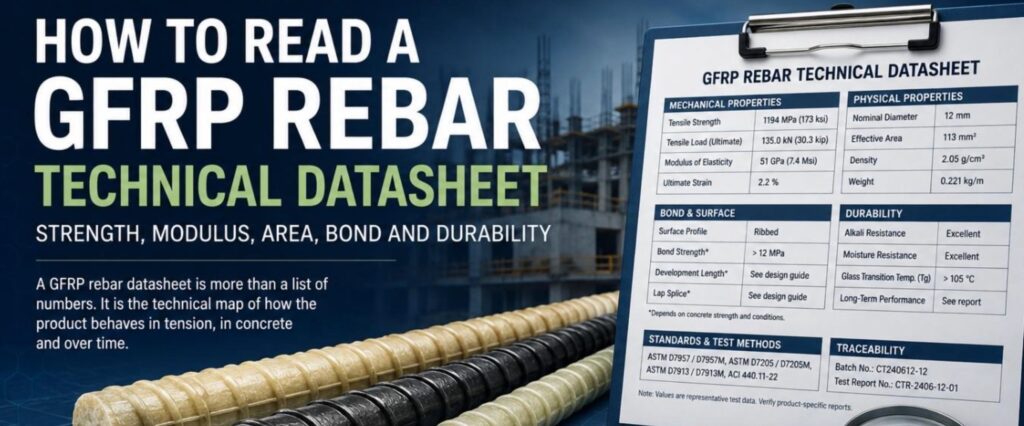
Respuesta rápida: ¿Qué es lo primero que se debe comprobar en la ficha técnica de una barra de refuerzo de PRFV?
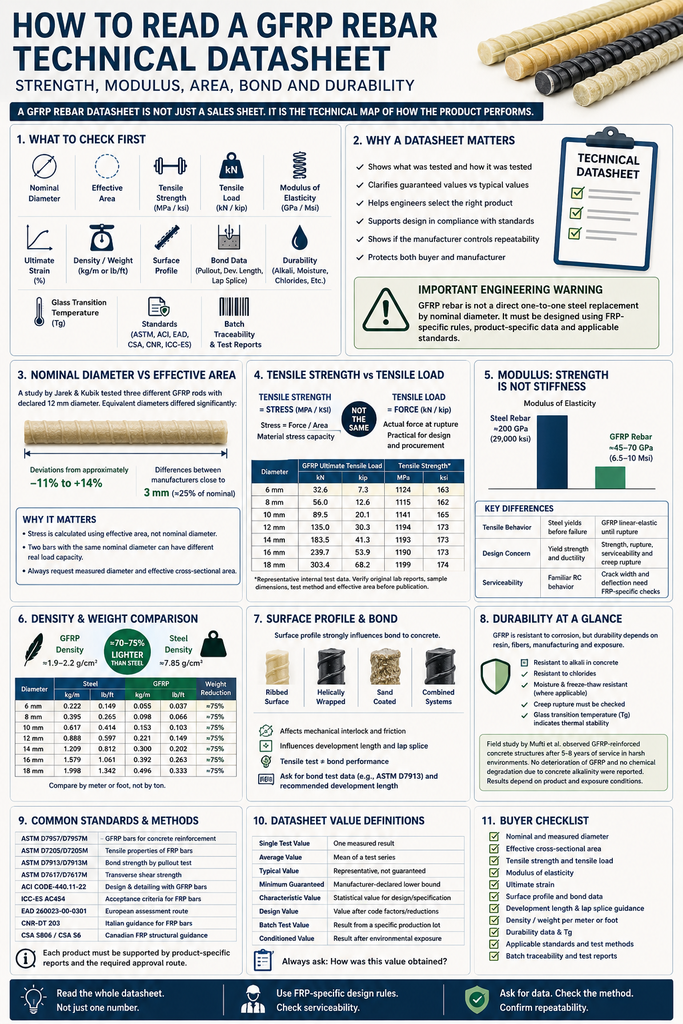
A Ficha técnica de las barras de refuerzo de GFRP Debe leerse como un documento de ingeniería, no como una simple hoja de ventas. Los primeros valores a verificar son el diámetro nominal, el área efectiva, la resistencia a la tracción, la carga de tracción, el módulo de elasticidad, la deformación máxima, la densidad, el peso por metro o pie, el perfil de la superficie, los datos de adherencia, los datos de durabilidad, la temperatura de transición vítrea (cuando esté disponible), los métodos de ensayo, las referencias a normas y la trazabilidad del lote.
El error más común es fijarse únicamente en un valor: la resistencia a la tracción en MPa o ksi. Esto no es suficiente. Una barra de GFRP con alta resistencia a la tracción aún puede requerir comprobaciones minuciosas de rigidez, adherencia, longitud de desarrollo, empalme por solape, ancho de fisura y deflexión.
Las barras de refuerzo de PRFV no son un sustituto directo del acero en proporción 1:1 en cuanto a diámetro nominal. Deben diseñarse siguiendo las normas específicas para PRFV, los datos de ensayo específicos del producto y las normas aplicables.
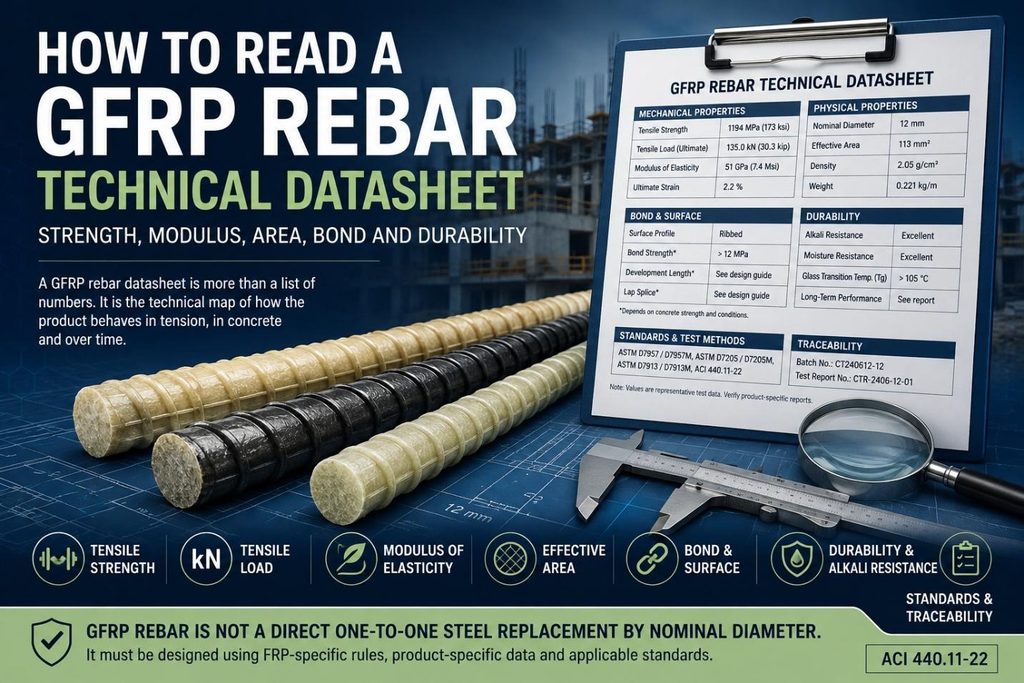
Conclusiones clave
- La ficha técnica de un producto de PRFV (plástico reforzado con fibra de vidrio) debe mostrar cómo se comporta el producto bajo tensión, en el hormigón, durante su manipulación y a lo largo del tiempo.
- La resistencia a la tracción y la carga de tracción son valores diferentes. MPa no es lo mismo que kN.
- El área efectiva es importante porque los cálculos de tensión dependen de la sección transversal real que soporta la carga.
- El módulo de elasticidad es importante porque el GFRP suele ser menos rígido que el acero, incluso cuando su resistencia a la tracción es mayor.
- El perfil de la superficie no es meramente estético. Afecta a la unión, la longitud de desarrollo y el comportamiento del empalme por solape.
- Los datos de durabilidad deben incluir información relacionada con la resistencia a los álcalis, la exposición a la humedad, el comportamiento térmico y el rendimiento a largo plazo.
- Un producto no debe describirse como "aprobado" o "que cumple con todos los estándares" sin informes específicos del producto.
- Un resultado excelente en una prueba no es lo mismo que una producción en fábrica reproducible.
- Los compradores deben solicitar fichas técnicas, informes de pruebas, trazabilidad de lotes y métodos de prueba claros.
Por qué es importante una ficha técnica de GFRP
Una ficha técnica protege a ambas partes: al comprador y al fabricante.
Para el comprador, responde a preguntas prácticas: qué se probó, cómo se probó, qué valores son típicos, qué valores están garantizados y si el producto es adecuado para la aplicación prevista.
Para el fabricante, define la identidad técnica del producto. Una ficha técnica rigurosa facilita la comunicación con ingenieros, consultores, distribuidores, propietarios de infraestructuras y laboratorios de ensayo.
Una ficha técnica deficiente generalmente solo muestra el diámetro y la resistencia a la tracción. Una ficha técnica completa explica el producto como un sistema.
| Propósito de la hoja de datos | Por qué es importante |
| Identifica las propiedades probadas | Evita confusiones entre las afirmaciones de marketing y los datos de las pruebas. |
| Muestra los métodos de prueba | Permite a los ingenieros comprender cómo se obtuvieron los valores. |
| Proporciona valores mecánicos | Permite la revisión y comparación del diseño. |
| Da valores físicos | Brinda soporte en logística, manipulación y adquisiciones. |
| Describe el perfil de la superficie | Admite la evaluación de bonos y detalles. |
| Muestra datos de durabilidad | Permite un uso prolongado en hormigón. |
| Proporciona trazabilidad | Conecta los lotes de productos con el control de calidad. |
La mejor hoja de datos no intenta impresionar al lector con una cifra elevada. Ayuda al lector a tomar una decisión de ingeniería correcta.
Diámetro nominal frente a área efectiva
El diámetro nominal es la denominación del tamaño de la barra. Es útil, pero no suficiente.
En el caso de las barras de acero corrugado, las dimensiones nominales están altamente estandarizadas. Las barras de PRFV son diferentes, ya que el perfil de la superficie, el contenido de resina, el contenido de fibra y el método de fabricación pueden afectar el diámetro medido y el área efectiva.
Esto no es solo teoría. En un estudio realizado por Bogusław Jarek y Aleksandra Kubik, se probaron varillas de GFRP de tres fabricantes con el mismo diámetro declarado de 12 mm. Los autores informaron una gran discrepancia entre el diámetro declarado y el real, y afirmaron que el diámetro equivalente difería del diámetro nominal en aproximadamente tely. −11% a +14%. La diferencia entre fabricantes era casi 3 mm, o sobre 25% del diámetro nominal.
Ese ejemplo es importante porque la tensión se calcula utilizando el área. Si el área es incorrecta, la resistencia a la tracción calculada puede ser engañosa.
| Término | Significado | ¿Qué debe preguntar el comprador? |
| Diámetro nominal | Tamaño comercial o declarado | ¿Se trata solo de una denominación de tamaño o de un valor medido? |
| Diámetro medido | Diámetro real de la barra medido | ¿Qué método se utilizó? |
| Área efectiva | Área utilizada para el cálculo de tensiones | ¿Está claramente indicado en el informe? |
| Diámetro mejorado en la superficie | Diámetro incluyendo nervaduras/revestimiento | ¿Está separada de la zona de carga? |
| Tolerancia | Variación de producción permitida | ¿Cuál es el rango aceptable? |
Un comprador nunca debe asumir que dos barras con el mismo diámetro nominal tienen la misma área efectiva.
Resistencia a la tracción frente a carga de tracción
Esta es una de las distinciones más importantes en una hoja de datos de GFRP.
Resistencia a la tracción es la tensión. Generalmente se expresa en MPa o ksi.
carga de tracción, La fuerza de rotura, también llamada fuerza máxima de tracción, es la fuerza real. Generalmente se expresa en kN o kip.
Ambos valores importan.
Una barra puede mostrar una alta resistencia a la tracción en MPa, pero la capacidad de fuerza real también depende del área efectiva. Para discusiones sobre adquisiciones e ingeniería, la carga de tracción suele ser más fácil de entender porque indica cuánta fuerza soportó la barra antes de romperse.
A continuación se muestran valores representativos de GFRP utilizados previamente en los materiales técnicos de Composite-Tech. Estos deben presentarse como datos técnicos representativos, a menos que los informes de ensayo originales, las dimensiones de las muestras, el área efectiva y los métodos de ensayo se adjunten a la ficha técnica final.
| Diámetro | Carga de tracción máxima de GFRP | Resistencia a la tracción |
| 6 mm | 32,6 kN / 7,3 kip | 1124 MPa / 163 ksi |
| 8 mm | 56,0 kN / 12,6 kip | 1115 MPa / 162 ksi |
| 10 milímetros | 89,5 kN / 20,1 kip | 1141 MPa / 165 ksi |
| 12 mm | 135,0 kN / 30,3 kip | 1194 MPa / 173 ksi |
| 14 mm | 183,5 kN / 41,3 kip | 1193 MPa / 173 ksi |
| 16 mm | 239,7 kN / 53,9 kip | 1190 MPa / 173 ksi |
| 18 mm | 303,4 kN / 68,2 kip | 1199 MPa / 174 ksi |
Nota de publicación: Verifique los informes de laboratorio originales, el método de prueba, las dimensiones de la muestra y el área efectiva antes de presentar estos valores como garantías específicas del producto.
Una buena ficha técnica debe indicar claramente si un valor de tracción es el resultado de una sola prueba, un promedio, un valor mínimo garantizado, un valor característico o un valor de diseño.
Módulo de elasticidad: la resistencia no es rigidez.
Un error común es observar una resistencia a la tracción del GFRP superior a 1000 MPa y concluir que el GFRP es simplemente "acero más resistente".“
Así no es como funciona el diseño de hormigón armado.
El GFRP puede tener una alta resistencia a la tracción máxima, pero su módulo de elasticidad es menor que el del acero. El módulo del acero suele estar alrededor de 200 GPa / 29 Msi, mientras que el módulo de GFRP suele depender del producto y a menudo se encuentra en el rango de aproximadamente 45–70 GPa / 6,5–10 Msi.
El módulo de elasticidad controla la rigidez. La rigidez afecta la deflexión y el ancho de las fisuras. Por eso, la funcionalidad puede controlar el diseño del hormigón reforzado con GFRP incluso cuando la resistencia a la tracción última es alta.
| Propiedad | varillas de acero corrugado | varillas de refuerzo de PRFV |
| Comportamiento de tracción | Ceder antes de fracasar | Elástico lineal hasta la ruptura |
| Módulo | Alta, típicamente ~200 GPa | Más bajo que el acero y dependiente del producto. |
| Preocupación por el diseño | Límite elástico y ductilidad | Resistencia, rotura, funcionalidad y rotura por fluencia |
| Utilidad | Comportamiento RC familiar | El ancho de la grieta y la deflexión requieren comprobaciones específicas para FRP. |
| Modo de fallo | Posibilidad de deformación dúctil | No hay meseta de cesión |
Por eso, la ficha técnica de un GFRP debe mostrar el módulo de elasticidad, no solo la resistencia a la tracción.
Una barra puede ser resistente, pero no tan rígida como el acero. Eso no significa que sea un mal material; simplemente requiere un diseño adecuado.
La cepa definitiva
La deformación máxima es la deformación en el punto de ruptura. Indica cuánto se alarga la barra antes de romperse bajo carga de tracción.
En el caso del acero, los ingenieros suelen pensar en términos de límite elástico. El GFRP no se comporta como el acero. Su comportamiento es aproximadamente lineal-elástico hasta la rotura. Esto hace que la deformación máxima sea útil, pero no debe confundirse con la deformación de diseño admisible.
Las normas de diseño aplican factores de reducción, factores ambientales, límites de rotura por fluencia y comprobaciones de aptitud para el servicio. La ficha técnica debe indicar la deformación última ensayada y el método utilizado para obtenerla.
| Valor | Qué significa |
| Cepa definitiva | Deformación en el punto de ruptura por tracción |
| Tensión de diseño | Valor permitido por las disposiciones de diseño |
| Límite de ruptura por fluencia | Limitación de tensión/deformación a largo plazo |
| Línea de servicio | Deformación bajo condiciones de carga de trabajo |
La deformación máxima debe interpretarse junto con el módulo de elasticidad y la resistencia a la tracción.
Densidad y peso por metro o pie
El peso debe figurar en la ficha técnica del PRFV porque este material se suele comprar, transportar e instalar por longitud, no por tonelada.
Con el mismo diámetro nominal, el GFRP suele tener aproximadamente Encendedor 70–75% que el acero. Los materiales informativos técnicos de Composite-Tech comparan la densidad del GFRP en aproximadamente 1,9–2,2 g/cm³ con una densidad de acero de alrededor 7,85 g/cm³, y también destacar que el peso real del GFRP depende de la designación de la barra, el contenido de fibra y el perfil de la superficie.
| Diámetro | Acero kg/m | Acero lb/pie | GFRP kg/m | GFRP lb/pie | Reducción de peso |
| 6 mm | 0.222 | 0.149 | 0.055 | 0.037 | ~75% |
| 8 mm | 0.395 | 0.265 | 0.098 | 0.066 | ~75% |
| 10 milímetros | 0.617 | 0.414 | 0.153 | 0.103 | ~75% |
| 12 mm | 0.888 | 0.597 | 0.221 | 0.149 | ~75% |
| 14 mm | 1.209 | 0.812 | 0.300 | 0.202 | ~75% |
| 16 mm | 1.579 | 1.061 | 0.392 | 0.263 | ~75% |
| 18 mm | 1.998 | 1.342 | 0.496 | 0.333 | ~75% |
Por eso, comparar el GFRP y el acero por toneladas resulta engañoso. La comparación correcta suele hacerse por metros, pies, programa de barras o paquete de refuerzo total.
El bajo peso es valioso para el transporte, la descarga, la manipulación y la instalación. No sustituye el diseño estructural.
Perfil de superficie y unión
El perfil de la superficie no es estético. Afecta a la forma en que la barra transfiere la fuerza al hormigón.
Un ensayo de tracción (tells) muestra cómo se comporta la barra bajo tensión directa. No describe completamente la longitud de desarrollo, el comportamiento del empalme por solape ni la adherencia con el hormigón.
Los sistemas de superficie de PRFV más comunes incluyen perfiles acanalados, perfiles enrollados helicoidalmente, superficies con recubrimiento de arena y sistemas combinados. Cada tipo de superficie puede generar un comportamiento de adherencia diferente según la geometría, la calidad de fabricación y la adhesión al cuerpo de la barra.
| Elemento de superficie/ficha | Por qué es importante |
| Geometría de las nervaduras | Afecta al enclavamiento mecánico |
| Espacio entre nervaduras / paso | Afecta la consistencia de la superficie |
| Recubrimiento de arena | Puede mejorar la fricción y el microenclavamiento. |
| Envoltura helicoidal | Crea un acoplamiento mecánico en espiral. |
| Adhesión superficial | Las capas superficiales débiles pueden reducir la fiabilidad. |
| Datos de la prueba de Bond | Admite decisiones sobre la longitud de desarrollo y el empalme por solapamiento. |
La ficha técnica debe describir el perfil de la superficie y, cuando corresponda, hacer referencia a las pruebas de adherencia. La norma ASTM D7913/D7913M se utiliza habitualmente para determinar la resistencia de la adherencia mediante pruebas de extracción, mientras que la norma ASTM D7205/D7205M se refiere a las pruebas de tracción de barras de FRP.
Un producto con buena resistencia a la tracción pero con un comportamiento de adherencia deficiente o inconsistente puede generar problemas en elementos de hormigón reales.
Durabilidad y resistencia a los álcalis
El PRFV se suele elegir porque no se oxida, pero una ficha técnica seria debería ir más allá.
La ficha técnica debería ayudar a responder preguntas sobre durabilidad relacionadas con la alcalinidad del hormigón, la exposición a la humedad, los cloruros, la exposición a ciclos de congelación y descongelación (cuando corresponda), la química de la resina, la temperatura de transición vítrea, la rotura por fluencia y la retención de la resistencia a largo plazo.
Un estudio de campo canadiense realizado por Mufti et al. examinó estructuras de hormigón reforzado con GFRP después de 5–8 años de servicio. El trabajo incluyó estructuras expuestas a condiciones marinas, de sal descongelante, de humedad-sequedad y de congelación-descongelación, y se utilizaron microscopía óptica, SEM, EDX, DSC y espectroscopia infrarroja. El resumen del informe técnico indica que no se reportó deterioro del GFRP ni degradación química debido a la alcalinidad del hormigón en las estructuras examinadas.
Esta información es útil, pero debe interpretarse con responsabilidad. No significa que todos los productos de PRFV tengan automáticamente la misma durabilidad. La durabilidad depende de la fibra, la resina, la calidad de fabricación, las condiciones de exposición y las pruebas específicas del producto.
El documento original sobre durabilidad también explica por qué es importante la química de la matriz: la degradación de la resina puede reducir la capacidad de la matriz para transferir la tensión a las fibras de vidrio y protegerlas contra el ataque alcalino.
Temperatura de transición vítrea
Temperatura de transición vítrea, generalmente escrita como Tg, describe el comportamiento de transición térmica de la matriz polimérica.
No es lo mismo que una simple "temperatura máxima de servicio". Pero resulta útil porque proporciona información sobre el curado de la resina, la estabilidad térmica y el comportamiento de la matriz.
Una hoja de datos debe indicar:
| Datos Tg | Por qué es importante |
| Valor Tg | Indica comportamiento de transición térmica |
| Método de prueba | Permite la comparación entre informes |
| Estado condicionado o no condicionado | Muestra si la exposición afectó la matriz. |
| Relación con la curación | Ayuda a evaluar la calidad del procesamiento de la resina. |
| Relevancia del diseño | Debe interpretarse de acuerdo con los requisitos del código aplicable. |
Tg es uno de los valores que distingue una ficha técnica seria de un folleto de ventas básico.
Normas y métodos de ensayo
Una ficha técnica debe identificar las normas y los métodos de ensayo utilizados. No debe limitarse a decir "alta calidad" o "probado según normas internacionales" sin dar más detalles.
La norma ASTM D7957/D7957M-25 abarca las barras redondas sólidas de GFRP suministradas en longitudes cortadas y formas dobladas con mejora de la superficie externa para refuerzo de hormigón. La norma ASTM D7205/D7205M-26 determina la resistencia a la tracción longitudinal cuasiestática y las propiedades de elongación de las barras compuestas de FRP.
CÓDIGO ACI-440.11-22 Establece los requisitos mínimos para los materiales, el diseño y los detalles del hormigón estructural reforzado con barras de GFRP que cumplen con la norma ASTM D7957-22.
| Documento / Norma | ¿Qué ayuda a evaluar? |
| ASTM D7957 / D7957M | Barras de GFRP para refuerzo de hormigón |
| ASTM D7205 / D7205M | Propiedades de tracción de las barras de FRP |
| ASTM D7913 / D7913M | Resistencia de la unión mediante ensayo de extracción |
| ASTM D7617 / D7617M | resistencia al corte transversal |
| CÓDIGO ACI-440.11-22 | Diseño y detallado de estructuras de hormigón armado con barras de GFRP |
| ICC-ES AC454 | Criterios de aceptación para barras de FRP |
| EAD 260023-00-0301 | Ruta de evaluación europea para barras de FRP cuando corresponda. |
| CNR-DT 203 | Guía italiana para barras de FRP en hormigón |
| CSA S806 / CSA S6 | Guía estructural canadiense relacionada con los FRP |
EOTA incluye la norma EAD 260023-00-0301 para barras de FRP de carbono, vidrio, basalto y aramida como refuerzo de elementos estructurales, mientras que CNR incluye la guía CNR-DT 203 para estructuras de hormigón reforzadas con barras de FRP. La norma CSA S806:26 abarca el diseño y la construcción de estructuras de edificios con polímeros reforzados con fibra.
La categoría de materiales está cubierta por normas y directrices reconocidas, pero cada producto debe estar respaldado por informes de pruebas específicos del producto, hojas de datos, trazabilidad y el proceso de aprobación requerido para la aplicación prevista.
Valores típicos, garantizados, característicos y de diseño
No todos los números de una hoja de datos tienen el mismo significado.
Una hoja de datos seria debería indicar si un valor es:
| Tipo de valor | Significado |
| Valor de prueba único | Un resultado medido |
| Valor promedio | Valor medio de una serie de pruebas |
| Valor típico | Valor representativo, no siempre garantizado. |
| Valor mínimo garantizado | Límite inferior declarado por el fabricante |
| Valor característico | Valor estadístico utilizado para el diseño o la especificación. |
| Valor de diseño | Valor después de aplicar factores de codificación y reducciones |
| Valor de prueba por lotes | Resultado de un lote de producción específico |
| Valor condicionado | Resultado tras la exposición ambiental |
Esta distinción es importante.
Un comprador no debe considerar un único resultado alto en una prueba como un valor de diseño garantizado. Los ingenieros deben saber si el valor proviene de una sola muestra, un promedio, un mínimo, una prueba de durabilidad ambiental o un programa de calificación completo.
Calidad y repetibilidad de la fabricación
Las materias primas generan potencial. La fabricación determina cuánto de ese potencial se traduce en un rendimiento constante del producto.
La alineación de las fibras, la impregnación, el curado, el enfriamiento y la formación de la superficie influyen en la barra final. Un fabricante puede producir una muestra excelente, pero la verdadera cuestión industrial es si se pueden obtener propiedades similares de forma repetida a lo largo de diferentes turnos, lotes de materia prima, velocidades de producción y miles de metros.
Diseños de Composite-Tech tecnología de producción Para barras y mallas de FRP. Según la experiencia práctica en fábrica, las variables de producción más relevantes son la impregnación estable, el curado controlado, la geometría de las nervaduras repetible, el estirado controlado y el monitoreo constante de la calidad. El manual de la nueva generación CT6, por ejemplo, describe módulos para la preparación de la fibra, la impregnación, el bobinado de las nervaduras, el curado, el enfriamiento, el estirado, el corte y el enrollado, y también describe sensores ópticos conectados a un agente de IA para monitorear la calidad de las barras y alertar al operador.
Esto no debe interpretarse como una garantía de que el equipo por sí solo determine las propiedades finales. El rendimiento mecánico sigue dependiendo de la fibra, la resina, la formulación, la fracción de fibra, la geometría, los parámetros del proceso, la calidad de fabricación y el método de ensayo.
La cuestión es más sencilla: una hoja de datos es tan fiable como el control de producción que la respalda.
Lista de verificación de la hoja de datos de las barras de refuerzo de GFRP
| Elemento de la hoja de datos | Por qué es importante | ¿Qué debe preguntar el comprador? |
| Diámetro | Referencia de tamaño | Valores nominales y medidos |
| Área efectiva | Cálculo de tensiones | Método de ensayo y tolerancia |
| carga de tracción | Capacidad de fuerza real | kN / kip |
| Resistencia a la tracción | Capacidad de tensión del material | MPa / ksi |
| Módulo | Rigidez y funcionalidad | GPa / Msi |
| Cepa definitiva | Comportamiento de ruptura | Método de prueba |
| Perfil de superficie | Comportamiento del vínculo | Acanalado, recubierto de arena, envuelto o combinado |
| Datos de bonos | Longitud de desarrollo y empalme por solape | Test method and concrete strength |
| Density / weight | Logistics and cost | kg/m / lb/ft |
| Durabilidad | Long-term behavior | Alkali, moisture, creep, Tg |
| Trazabilidad | Control de calidad | Batch number and test reports |
| Standards | Acceptance route | Applicable standards and reports |
A supplier that cannot answer these questions may not be ready for serious engineering markets.
Common Mistakes When Reading a GFRP Rebar Datasheet
- The first mistake is comparing only MPa. Tensile strength is useful, but it does not tell the full story.
- The second mistake is ignoring tensile load. For many buyers, kN or kip is more practical than stress alone.
- The third mistake is ignoring modulus. GFRP can have high strength and still require serviceability checks because it is less stiff than steel.
- The fourth mistake is comparing by ton. GFRP should usually be compared by meter, foot or complete project package.
- The fifth mistake is assuming nominal diameter equals effective area.
- The sixth mistake is ignoring surface profile and bond. A direct tensile test does not explain how the bar transfers force to concrete.
- The seventh mistake is ignoring the test method. A number without a method is not a serious engineering value.
- The eighth mistake is assuming one test result represents all production.
- The final mistake is treating GFRP as a direct steel copy. It is not. It is a different reinforcement material and should be designed accordingly.
FAQ: GFRP Rebar Technical Datasheet
¿Qué es una ficha técnica de barras de refuerzo de GFRP?
La ficha técnica de una barra de refuerzo de GFRP es un documento que describe las propiedades físicas, mecánicas, de adherencia, de durabilidad y de ensayo de un producto de refuerzo de GFRP específico.
¿Cuál es el número más importante en la ficha técnica de una barra de refuerzo de GFRP?
No existe un único valor que sea el más importante. La resistencia a la tracción, la carga de tracción, el módulo, el área efectiva, el perfil de la superficie, la durabilidad y el método de ensayo deben considerarse en conjunto.
¿La resistencia a la tracción es lo mismo que la carga de tracción?
No. La resistencia a la tracción es la tensión, generalmente en MPa o ksi. La carga de tracción es la fuerza, generalmente en kN o kip.
¿Por qué importa el área efectiva?
El área efectiva se utiliza para calcular la tensión. Si el área no está clara o es incorrecta, los valores de resistencia a la tracción pueden resultar engañosos.
¿Cuál es una buena resistencia a la tracción para las barras de refuerzo de GFRP?
Muchos productos de PRFV (plástico reforzado con fibra de vidrio) presentan resistencias a la tracción superiores al límite elástico del acero, pero el valor exacto debe determinarse mediante ensayos específicos del producto. El diseño debe seguir las especificaciones propias del PRFV.
¿Por qué el módulo de elasticidad del GFRP es inferior al del acero?
El GFRP es un material compuesto formado por fibras y resina polimérica. Su rigidez depende del tipo de fibra, la fracción de fibra, el sistema de resina y la calidad de fabricación. El acero es mucho más rígido, con un módulo típico de alrededor de 200 GPa.
¿Pueden las barras de refuerzo de PRFV sustituir a las barras de refuerzo de acero en una proporción de uno a uno?
No. El GFRP no debe sustituirse únicamente por el diámetro nominal. Los ingenieros deben verificar el área, la resistencia a la tracción, el módulo, la adherencia, la longitud de desarrollo, el solape, el ancho de la fisura y la deflexión.
¿Por qué importa el perfil de la superficie?
El perfil de la superficie afecta la adherencia con el hormigón. Influye en cómo se transfiere la fuerza de la barra al hormigón y afecta la longitud de anclaje y el comportamiento del solape.
¿Qué normas deben figurar en la ficha técnica de un PRFV?
Las referencias comunes incluyen ASTM D7957, ASTM D7205, ASTM D7913, ASTM D7617, ACI CODE-440.11-22, ICC-ES AC454, EAD 260023-00-0301, CNR-DT 203 y CSA S806 / CSA S6, según el mercado.
¿Para qué se utiliza la norma ASTM D7205?
La norma ASTM D7205/D7205M se utiliza para determinar la resistencia a la tracción longitudinal cuasiestática y las propiedades de elongación de las barras compuestas de FRP.
¿Para qué se utiliza la norma ASTM D7957?
ASTM D7957/D7957M es una especificación para barras redondas macizas de GFRP con mejora de la superficie externa para refuerzo de hormigón.
¿Por qué son importantes las pruebas de durabilidad?
Las pruebas de durabilidad ayudan a evaluar cómo se comporta la barra en condiciones de alcalinidad del hormigón, humedad, exposición a cloruros, ciclos de congelación y descongelación, y cargas a largo plazo.
¿Qué deben solicitar los compradores a un proveedor de PRFV?
Los compradores deben solicitar una ficha técnica, un informe de ensayo de tracción, datos de superficie efectiva, módulo de elasticidad, carga de tracción, descripción del perfil de la superficie, datos de adherencia, datos de durabilidad, trazabilidad del lote e instrucciones de instalación.
¿Cómo afecta la calidad de fabricación a los valores de la hoja de datos?
El proceso de fabricación afecta la alineación de las fibras, la impregnación de la resina, el curado, el enfriamiento, la geometría de la superficie y la repetibilidad. Estas variables influyen en la fiabilidad de los valores mostrados en la ficha técnica.
Conclusión
A GFRP rebar technical datasheet should not be read as a list of marketing numbers. It should be read as a technical map of how the product behaves in tension, in concrete, during handling and over time.
Tensile strength is important, but it is only one part of the story. Tensile load, modulus, effective area, ultimate strain, density, surface profile, bond, durability, test methods and traceability all matter.
The strongest datasheet is not the one with the largest single number. It is the one that clearly shows what was tested, how it was tested, what the values mean and how consistently the product can be manufactured.
Para varillas de refuerzo de PRFV to be trusted in serious construction markets, manufacturers must provide more than claims. They must provide product-specific data, standards-based testing and repeatable production quality.
Más información:
- Documentación técnica de Composite-Tech
- Línea de producción profesional de barras de refuerzo de FRP
- Barras de refuerzo de GFRP frente a barras de refuerzo de acero: comparación numérica por peso, resistencia y propiedades de ingeniería.
- Adherencia de las barras de refuerzo de GFRP al hormigón: perfil de superficie, geometría de las nervaduras y ensayos.
- ¿Cuánto dura el refuerzo de PRFV en el hormigón? Durabilidad, evidencia en campo y normas.
- GFRP Rebar Development Length and Lap Splices: Anchorage Design Guide
- GFRP Rebar Quality Control: Fiber Content, Resin Impregnation, Tg, Testing and Traceability