
La fin de l'ère de l'acier dans les infrastructures
Pendant près d'un siècle, les barres d'armature en acier ont dominé la construction d'infrastructures aux États-Unis. Des ponts et autoroutes aux ouvrages maritimes et tunnels, l'acier a façonné l'Amérique moderne.
Mais le temps et la science ont révélé la faiblesse irréversible de l'acier : la corrosion.
Aujourd'hui, les défaillances liées à la corrosion coûtent à l'économie américaine plus de 16 000 milliards de dollars par an, selon la Federal Highway Administration.
L’exposition à l’eau salée, les cycles de gel-dégel, les produits chimiques contenus dans le béton et les conditions environnementales attaquent progressivement l’acier, affaiblissant les structures de l’intérieur.
Alors que l’Amérique lance le plus important plan de dépenses d’infrastructure de l’histoire moderne — plus de 1 600 milliards de dollars dans le cadre de la loi sur l’investissement dans les infrastructures et la création d’emplois —, les ingénieurs et les promoteurs sont confrontés à une question cruciale :
Pourquoi continuer à construire l'avenir avec des matériaux conçus pour le passé ?
L'essor des PRF — Une nouvelle ère de renforcement intelligent
Qu'est-ce que les barres d'armature FRP ?
Les barres d'armature en PRF (polymère renforcé de fibres) — principalement en PRFV (polymère renforcé de fibres de verre) — sont un renforcement composite anticorrosion à haute résistance conçu pour remplacer l'acier dans les structures en béton.
Principaux avantages en matière de performance
| Propriété | Acier | Barres d'armature en PRFV |
| Résistance à la corrosion | Corrode | 100% résistant à la corrosion |
| Résistance à la traction | ~60 ksi | 120–200 ksi (2–3 fois plus résistant) |
| Poids | Lourd | 4 fois plus léger |
| Conductivité thermique | Conducteur | Non conducteur (sans danger pour les interférences électromagnétiques) |
| Interférences magnétiques | Oui | Aucun — Compatible IRM et radar |
| Durée de vie | 20 à 50 ans | Jusqu'à plus de 100 ans |
Résultat: Moins d'entretien, durée de vie plus longue, structures plus sûres, coût total de possession réduit.
Pourquoi l'Amérique a besoin de FRP maintenant
Infrastructures côtières et marines
De la Floride à la Californie, l'exposition au sel détruit le béton armé.
Le PRV ne rouille jamais.
- Ponts côtiers
- digues et ports
- stations d'épuration
- Installations de dessalement
Transports et ponts
Le ministère américain des Transports rapporte Plus de 42 000 ponts structurellement déficients.
Les matériaux composites à fibres de verre (FRP) prolongent la durée de vie et réduisent les coûts de remise en état.
Structures militaires et de défense critiques
Le FRP est non conducteur et non magnétique — indispensables pour les systèmes radar, les centres de données et les installations de défense.
Infrastructure pour énergies propres et véhicules électriques
Les usines de batteries de nouvelle génération, les installations d'hydrogène et les pôles énergétiques nécessitent renfort non corrosif et non conducteur.
Conformité aux normes d'ingénierie américaines
Les barres d'armature modernes en PRFV sont conformes aux principales normes américaines :
| Standard | Description |
| ACI 440.11-22 | Code de conception des barres d'armature en PRF |
| ASTM D7957 | Spécifications standard pour le PRFV |
| Approbation du FDOT | Pour la construction en Floride |
| CSA S806 | Code de conception nord-américain |
Équipement Composite-Tech est conçu pour fabriquer Produits FRP qui répondent à ces spécifications, voire les dépassent.
Analyse des coûts : Acier vs PRV
Conversation traditionnelle :
« L’acier est moins cher à la tonne. »
Réalité moderne :
Coût total sur la durée de vie > Coût d'achat.
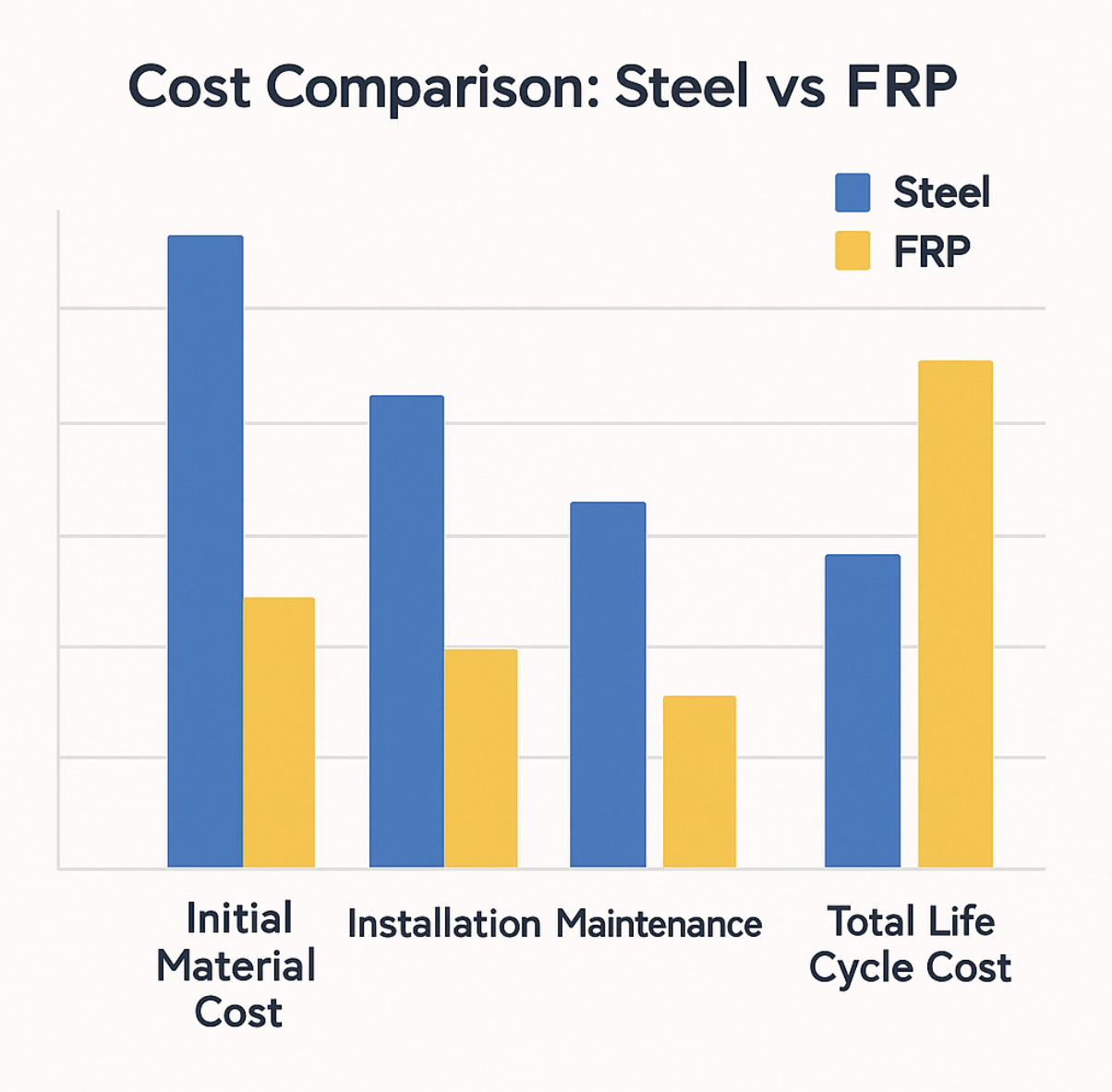
| Catégorie de coût | Acier | PRV |
| Coût initial des matériaux | Inférieur | Légèrement plus élevé |
| Installation | Nécessite du matériel lourd | Léger = plus rapide et moins cher |
| Entretien | Haut (réparation de la corrosion) | Quasi zéro |
| Durée de vie | 20 à 50 ans | 80 à 100 ans et plus |
| Coût total du cycle de vie | Haut | Le plus bas |
Conclusion: FRP l'emporte sur le plan de l'économie du cycle de vie — l'indicateur le plus important pour les projets gouvernementaux et les grands promoteurs d'infrastructures.
Pourquoi les fabricants choisissent Composite-Tech
L'adoption moderne des PRV aux États-Unis n'est pas seulement dictée par la demande, elle l'est aussi. axé sur la technologie.
Les équipements Composite-Tech garantissent :
- Qualité conforme aux normes ACI/ASTM
- Production automatisée (fonctionnement 24h/24 et 7j/7)
- Alignement précis des fibres
- Imprégnation de résine homogène
- Contrôle parfait du durcissement
- Calibrage stable du diamètre
Et surtout ?
Paramètres de production garantis et testés pour répondre aux normes américaines.
Des histoires de réussite dans le monde réel
Floride, États-Unis — Usine de PRV côtière
- région d'exposition extrême au sel
- Le PRV a été choisi pour remplacer l'acier dans les infrastructures marines.
- Les lignes Composite-Tech produisent Barres d'armature à haut volume 24h/24 et 7j/7
Inde — Expansion à grande échelle des PRV
- Le gouvernement fait pression pour des infrastructures résistantes à la corrosion
- Les systèmes Composite-Tech ont été choisis pour leur évolutivité et leur précision.
- Desservant les autoroutes, les tunnels de métro et les projets industriels
Ingénieurs Choisissez-nous non seulement pour la performance, mais aussi pour le partenariat, la formation et le soutien aux normes.
Perspectives d'avenir — PRV renforcé au graphène
Composite-Tech fait évoluer le PRFV vers la prochaine génération :
Barres d'armature composites renforcées au graphène.
Avantages:
- résistance à la traction accrue
- Capacité de pontage des fissures
- Durabilité accrue
- Applications émergentes du contrôle de la conductivité
Cette innovation positionne le PRV comme technologie de renforcement ultime pour le prochain siècle des infrastructures américaines.
Conclusion
L'acier a servi le monde pendant un siècle. Les PRV alimenteront le prochain.
Les États-Unis entrent dans une nouvelle ère d'infrastructures : plus intelligentes, plus durables et respectueuses de l'environnement.
Le PRV n'est pas seulement un meilleur matériau, c'est la nouvelle norme.
Composite-Tech fournit des solutions de production clés en main, Assistance à l'installation, à la formation et à la certification.
Demandez votre plan de retour sur investissement pour usine FRP
Planifiez une consultation technique
Apprendre encore plus:
- Pourquoi les entreprises américaines choisissent Composite-Tech pour la production de barres d'armature et de treillis en fibre de verre et en basalte
- Comment installer des barres d'armature en fibre de verre (PRFV) dans des dalles de béton
- Armatures en fibre de verre pour allées : espacement, couverture, coût et conseils pratiques
- De la Floride à l'Inde : comment les machines Composite-Tech donnent les moyens aux leaders mondiaux du secteur des PRV
- Pourquoi Composite-Tech et le FRP Institute définissent les normes mondiales pour les composites
- Explication de la norme ACI 440.11-22 : Conception du béton avec des barres d'armature en PRFV aux États-Unis
- Comprendre la norme ACI 440.11-22 pour les fabricants d'armatures en PRFV
- Le graphène dans la production de barres d'armature en PRFV : une révolution dans le renforcement du béton
- Barres d'armature en fibre de verre #3 (3/8 po) : prix, poids et cas d'utilisation réels aux États-Unis
- Pourquoi Composite-Tech est le leader mondial des équipements de production GFRP
- Barres d'armature en PRFV vs acier : coût, résistance et avantages à long terme dans la construction moderne
- Barres d'armature en PRFV vs barres d'armature en acier : une comparaison technique complète
- Armatures en PRFV vs armatures en acier : coût, résistance, durabilité et applications concrètes
- Barres d'armature en PRFV vs barres d'armature en acier : comparaison numérique du poids, de la résistance et des propriétés techniques
- Les barres d'armature en fibre de verre peuvent-elles remplacer l'acier dans les fondations et les allées ?
- Armatures en basalte ou armatures en PRFV : laquelle choisir ?
- Quand les barres d'armature en PRFV sont-elles meilleures que les barres d'armature en acier ? Applications, limites et preuves