
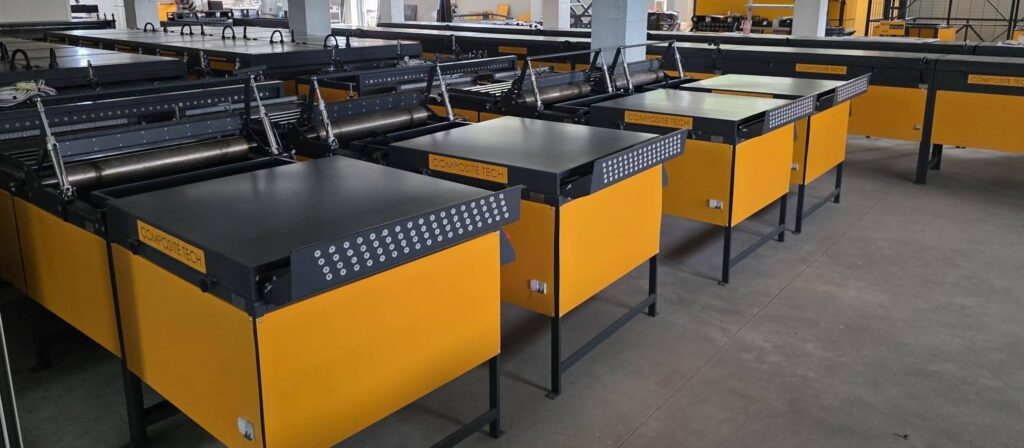
Choosing the right GFRP rebar production line is one of the most important decisions when starting or expanding a composite reinforcement manufacturing business. The equipment you select will influence your production capacity, operating costs, workforce requirements, product quality and ability to compete in the market for years to come.
For entrepreneurs entering the fiberglass rebar industry, the challenge is not simply finding a machine that can manufacture composite reinforcement. It is finding an industrial production system capable of producing consistent quality at a competitive cost, with minimal labor requirements and reliable performance during extended production shifts.
This is precisely what Composite-Tech’s CT2, CT4 and CT6 production lines are designed to achieve.
Although all three models manufacture glass fiber reinforced polymer (GFRP) rebar, they serve different business strategies.
O CT2 provides a practical entry point for smaller production facilities. The CT4 offers a balance between production capacity and investment. The CT6 is designed for manufacturers planning larger-scale industrial production and long-term business expansion.
Understanding these differences can help investors avoid expensive mistakes and build a manufacturing operation that is both competitive and scalable.
Quick Comparison: CT2 vs CT4 vs CT6
Composite-Tech manufactures industrial Equipamentos de produção de vergalhões de PRFV for businesses operating at different production volumes.
| Recurso | CT2 | CT4 | CT6 |
| Production category | Compact industrial | Medium-capacity industrial | High-capacity industrial |
| Simultaneous production | Up to 2 bars | Up to 4 bars | Up to 6 bars |
| Primary business application | Market entry and smaller factories | Regional manufacturing | Large-scale manufacturing |
| Main advantage | Lower initial investment | Balanced capacity and investment | High production capacity |
| Production process | Continuous | Continuous | Continuous |
| Industrial design | Sim | Sim | Sim |
| Automated production systems | Sim | Sim | Sim |
| Recommended production workforce | Typically 1–2 operators* | Typically 1–2 operators* | Typically 1–2 operators* |
| Business expansion potential | Moderado | Alto | Muito alto |
Operator requirements depend on the selected configuration, production workflow, packaging arrangements and factory organization. The indicated staffing refers to normal line operation, not all personnel required to manage a factory.
Each machine offers a different level of production capacity, but all three are developed around the same fundamental principle:
Industrial manufacturing equipment should help a business produce more efficiently, control operating expenses and maintain consistent product quality.
That principle becomes increasingly important as production volumes grow.
Why the Right Production Equipment Matters More Than the Initial Machine Price
When investors first investigate the GFRP rebar manufacturing business, equipment price is often their primary concern. This is understandable. Purchasing a production line represents a significant capital investment. However, the lowest equipment price does not necessarily result in the lowest manufacturing cost. A production machine generates value only when it is operating, producing acceptable products and fulfilling customer orders.
Consider two hypothetical GFRP rebar factories.
- The first purchases inexpensive equipment but experiences frequent interruptions, inconsistent product dimensions and high manual labor requirements.
- The second invests in industrial equipment designed for continuous production, controlled processing and efficient operation.
Even if the second factory initially spends more on machinery, it may achieve better financial results through higher productive uptime, lower labor costs per meter and more consistent product quality. Over several years, these differences can become more important than the original purchase price.
This is why professional investors should evaluate the total cost of ownership of GFRP rebar manufacturing equipment, rather than focusing exclusively on the initial investment.
The most important factors include:
- Production capacity and actual productive operating hours.
- Electrical energy consumption per meter of finished rebar.
- Number of operators required during normal production.
- Raw material consumption and production waste.
- Maintenance requirements and equipment reliability.
- Finished product quality and dimensional consistency.
- Ability to manufacture different reinforcement diameters.
- Technical support and availability of replacement components.
For a successful GFRP rebar factory, profitability depends on the combination of these factors.
CT2: A Practical Starting Point for a GFRP Rebar Manufacturing Business
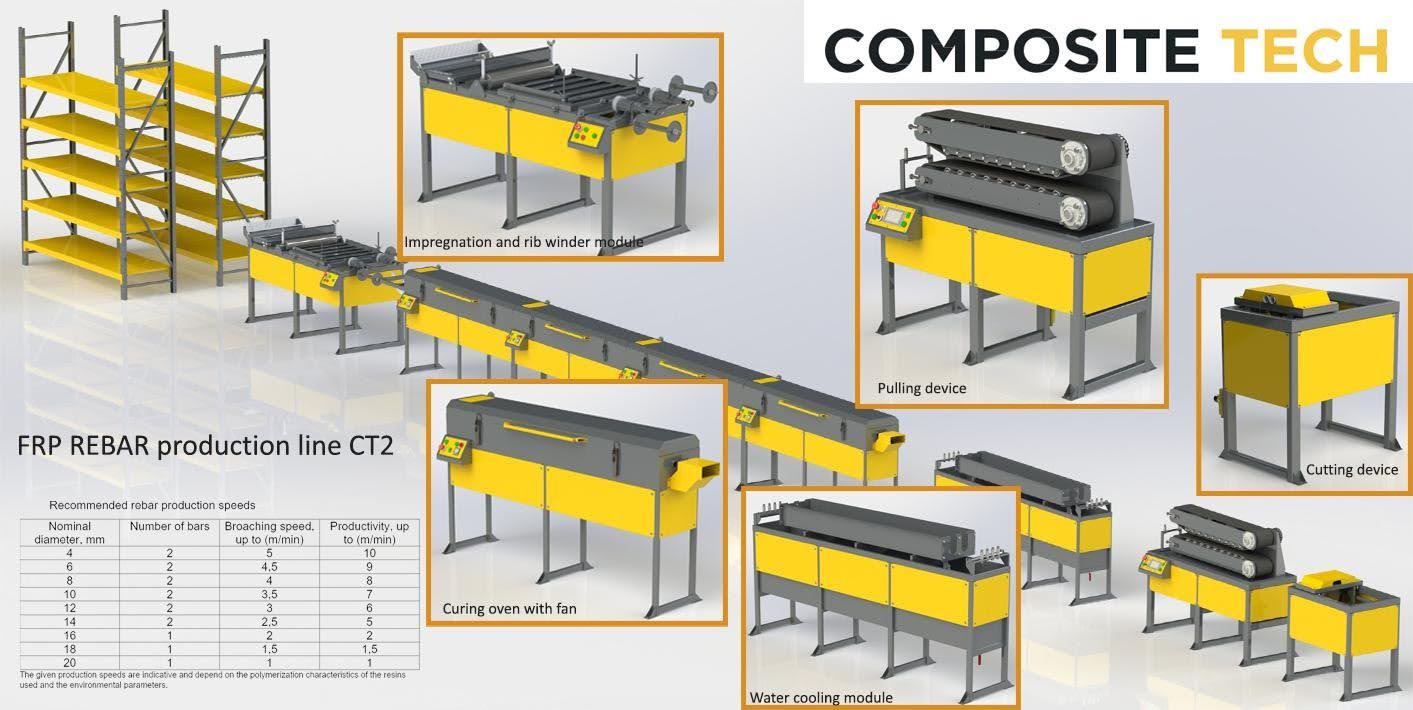
O Tecnologia composta CT2 is designed for entrepreneurs and companies looking to establish a compact industrial production facility. It allows manufacturers to enter the GFRP reinforcement market without immediately investing in a higher-capacity production system. Unlike a small experimental machine, the CT2 is developed as a continuous production line incorporating the essential stages required for industrial composite rebar manufacturing. These include fiber feeding, resin impregnation, polymerization, cooling, pulling and cutting.
Who Should Consider the CT2?
The CT2 can be particularly attractive for:
- Entrepreneurs starting their first GFRP rebar factory.
- Construction material distributors planning to manufacture their own products.
- Companies entering markets where composite reinforcement is still relatively new.
- Manufacturers requiring smaller production batches.
- Businesses developing a regional customer network.
The CT2 provides an opportunity to establish production, gain experience with matérias-primas e processos de fabricação, and gradually develop distribution channels. An important advantage is that a compact production system can reduce the initial financial commitment required to enter the industry. However, investors should consider future demand. If the business expects to supply major infrastructure projects or large distributors, choosing a higher-capacity machine from the beginning may provide better long-term economics.
Business recommendation: Choose CT2 when your priority is entering the market with a smaller investment while retaining the advantages of continuous industrial production.
CT4: Industrial Production with a Balance Between Investment and Capacity
For many manufacturers, the Composite-Tech CT4 represents an attractive balance between equipment investment and production capacity. The line is designed to manufacture multiple GFRP reinforcement bars simultaneously, providing higher throughput than a compact two-bar production system. This additional capacity can be particularly valuable for companies planning to establish regular supply relationships with construction contractors, concrete product manufacturers and regional distributors.
Why Production Capacity Matters
One of the most important characteristics of continuous GFRP manufacturing equipment is the number of reinforcement bars produced simultaneously. When several bars are manufactured during the same production cycle, the factory can distribute certain operating expenses across a larger quantity of finished products.
These expenses may include:
- Operator labor.
- Factory overhead.
- Equipment supervision.
- Certain shared machine operations.
- Production administration.
This creates an opportunity to reduce manufacturing costs per meter, particularly when the equipment operates at a high utilization rate.The CT4 is designed to provide this advantage while maintaining a manageable industrial production setup.
A Suitable Platform for Regional Manufacturers
The CT4 can be particularly well suited to companies that already have access to construction industry customers. For example, a construction materials distributor may already supply cement, steel reinforcement, waterproofing systems or concrete accessories. Adding locally manufactured GFRP rebar allows the company to introduce another product category without building an entirely new customer network. The existing relationships with contractors and construction companies can help accelerate market entry. For these businesses, production capacity becomes a commercial advantage. A manufacturer capable of producing larger quantities can respond more effectively to recurring orders and establish stronger relationships with distributors.
Business recommendation: Choose CT4 when you want to build a serious regional manufacturing operation with a balance between capital investment and industrial output.
CT6: Designed for High-Capacity Industrial Manufacturing
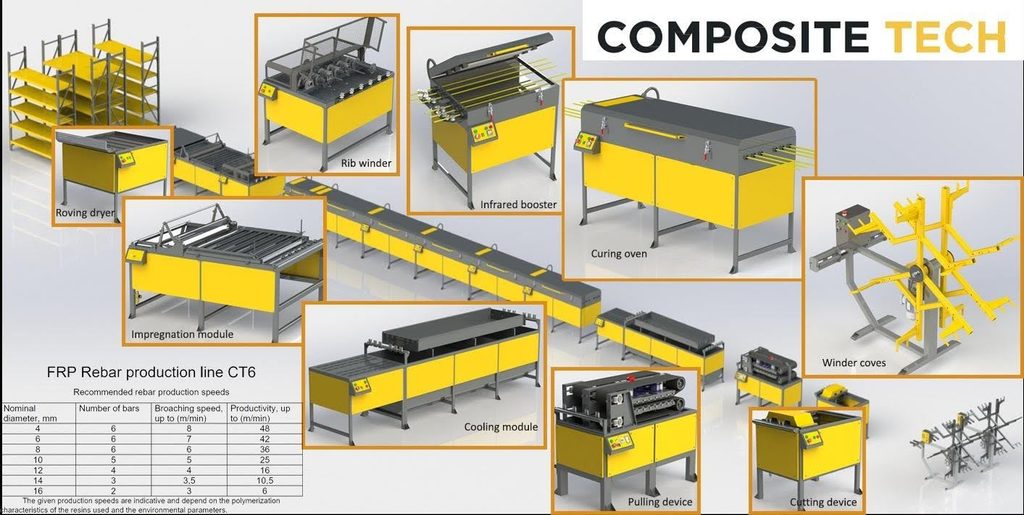
For businesses planning to establish a large GFRP rebar factory, production capacity becomes one of the most important competitive factors. The Composite-Tech CT6 is developed specifically for this category of manufacturer. Depending on reinforcement diameter and production configuration, the line can manufacture up to six bars simultaneously. This makes the CT6 particularly relevant for companies targeting large construction material distributors, infrastructure contractors and export markets.
Higher Output Without Proportionally Higher Labor Requirements
One of the important economic advantages of automated multi-bar production equipment is that higher output does not necessarily require a proportional increase in the number of operators. With an appropriately organized production process, Composite-Tech industrial lines can typically be operated by one or two trained operators during normal production. That means a manufacturer can increase production capacity without multiplying labor requirements at the same rate.
For businesses operating in countries with high labor costs, this can represent a significant long-term advantage. However, operating personnel should not be confused with total factory staffing. Quality control, maintenance, logistics and administration must also be considered when developing a business plan.
Industrial Equipment for Extended Production Shifts
A GFRP rebar factory becomes more profitable when equipment operates consistently and productive downtime is minimized. The CT6 is engineered for industrial manufacturing, with integrated modules designed to work together during extended production shifts.
The production process incorporates:
- Controlled fiber feeding: Glass fiber rovings are supplied through organized creel systems designed to maintain stable feeding conditions.
- Resin impregnation: The impregnation module is designed to saturate the reinforcement fibers while controlling excess resin.
- Rib formation: The winding system produces the reinforcement surface profile required for mechanical interaction with concrete.
- Controlled polymerization: Heating and curing systems transform the impregnated fiber bundles into solid composite reinforcement.
- Cooling and pulling: These modules maintain continuous material movement and support the dimensional stability of the finished product.
- Final processing: Cutting and coiling equipment prepares the reinforcement for storage and delivery.
The goal is to create a coordinated industrial process rather than a collection of independently operated machines. For manufacturers planning multiple production shifts, this approach is especially important.
Why CT6 Can Offer Better Manufacturing Economics
A high-capacity GFRP rebar production line creates several potential economic advantages. First, it allows greater output from a single production system. Second, certain fixed operating expenses can be distributed across more finished products. Third, higher production capacity makes it easier to fulfill larger orders within shorter manufacturing periods. Finally, the manufacturer can potentially improve its competitive position by lowering unit production costs while maintaining quality.
These advantages depend on actual utilization, raw material costs, production settings and market demand. Nevertheless, for a company planning a substantial GFRP manufacturing operation, CT6 offers a strong platform for long-term industrial development.
Business recommendation: Choose CT6 when your business strategy involves large production volumes, established distribution channels, infrastructure supply or future international expansion.
Energy Efficiency: An Important Factor in GFRP Rebar Production
Electricity consumption is an operating expense that investors should examine carefully before purchasing composite rebar manufacturing equipment.
A GFRP production line requires energy for several processes, including resin preparation, heating, polymerization, cooling, pulling and auxiliary equipment. However, the most useful measurement is not simply the machine’s total electrical power. It is the amount of electricity required to manufacture one meter of acceptable finished reinforcement.
This can be expressed as: Energy consumption per meter = Total electricity consumed during production ÷ Total meters of acceptable rebar produced.
For example, if two production systems consume similar amounts of electricity but one produces considerably more acceptable reinforcement during the same period, the higher-output system will have a lower energy cost per meter. This is one reason why production capacity and energy efficiency should be evaluated together.
Composite-Tech develops its equipment with attention to coordinated industrial processing and efficient utilization of energy-intensive modules. The objective is to achieve stable manufacturing conditions without unnecessary energy consumption.
For buyers comparing GFRP rebar machines, Composite-Tech recommends evaluating actual energy consumption under defined production conditions, including reinforcement diameter, output speed and resin system. A meaningful comparison should always be based on the same measurement conditions.
Automation and Labor Efficiency: Why One or Two Operators Can Make a Difference
Labor expenses can significantly influence the profitability of a manufacturing business. This is particularly relevant in developed markets, where qualified industrial workers represent a substantial operating cost.
Linhas de produção da Composite-Tech are designed to reduce the amount of manual intervention required during normal manufacturing. Automated and synchronized production processes allow operators to supervise several manufacturing stages rather than manually controlling every operation.
For a properly configured production line, one or two trained operators are typically sufficient for routine line operation. Their main responsibilities include monitoring production parameters, supervising material feeding, checking finished product quality and responding to operational requirements.
Consider a manufacturer planning two production shifts per day. If one production system requires several workers per shift while another can operate with fewer personnel, the difference in annual labor expenses may become substantial.
The advantage becomes even more significant when the production facility expands. However, equipment automation should not be mistaken for the elimination of quality control or preventive maintenance. A successful factory still requires disciplined operating procedures and trained personnel.
The real advantage of automation is not simply employing fewer people. It is producing more acceptable finished material per labor hour.
Continuous Production: Why Industrial Engineering Matters
The ability to manufacture GFRP reinforcement continuously is one of the defining characteristics of professional industrial equipment. In continuous production, glass fiber roving enters the manufacturing process and finished reinforcement exits without requiring the production cycle to restart for every bar. This approach offers important operational advantages. It can reduce interruptions between production stages, improve process consistency and enable larger manufacturing volumes.
However, continuous production requires careful coordination. Fiber feeding speed, resin impregnation, rib winding, curing temperature, pulling speed and final processing must operate together. If one stage becomes unstable, the entire manufacturing process may be affected.
Composite-Tech designs its production lines around integrated process control and coordinated operation of the main manufacturing modules. The equipment is intended for demanding industrial environments where production consistency matters. For a business owner, this engineering approach has a direct commercial purpose:
Reduce avoidable interruptions, improve manufacturing consistency and protect the factory’s productive capacity.
Product Quality Is a Business Advantage
Manufacturing large quantities of composite reinforcement is valuable only when the finished products meet customer requirements. Vergalhões de PRFV is used in applications where engineers and contractors expect documented mechanical properties and reliable performance. Therefore, quality consistency should be considered an essential part of the manufacturing business.
Several manufacturing parameters directly influence finished product quality. These include fiber distribution, resin impregnation, reinforcement geometry, polymerization conditions and surface profile. Research into the bond behavior of GFRP reinforcement has demonstrated that surface characteristics can significantly influence the interaction between composite bars and concrete. For this reason, manufacturers should pay attention not only to tensile strength but also to the consistency of the reinforcement surface and its mechanical interaction with concrete.
Composite-Tech production equipment is designed to provide controlled manufacturing conditions that support repeatable production quality. This is particularly important for companies planning to supply professional construction markets. A manufacturer capable of delivering consistent products, maintaining production records and supporting independent testing is in a stronger position to develop long-term customer relationships. For many construction companies, dependable supply and predictable product quality are more valuable than the lowest possible purchase price.
How to Calculate the Production Capacity Your Business Actually Needs
Before selecting CT2, CT4 or CT6, an investor should estimate the quantity of GFRP reinforcement the business expects to sell. The starting point is not the machine’s maximum theoretical production capacity. It is the realistic sales volume.
For example, a manufacturer expecting to sell relatively small quantities to local contractors may not initially require the same equipment capacity as a business supplying several national distributors.
However, future growth should also be considered. A production line that satisfies current requirements but becomes insufficient after a short period may require additional investment sooner than expected.
A practical capacity calculation should consider:
Required annual production = Expected annual sales volume ÷ Planned proportion of acceptable production available for sale.
The calculation should then account for operating hours, planned maintenance, changeovers, quality control and realistic utilization. Investors should also consider the diameter mix. Production capacity can vary considerably depending on whether a factory manufactures smaller reinforcement diameters or larger bars. For this reason, the same machine may have different output figures under different production conditions.
Composite-Tech can help prospective customers evaluate the appropriate production configuration based on their intended product range and sales strategy.
Can a GFRP Rebar Factory Become a Profitable Business?
Yes. GFRP rebar manufacturing can be an attractive industrial business when equipment efficiency, production quality and market demand are properly aligned. Several characteristics make the industry interesting to investors. GFRP reinforcement offers corrosion resistance, low weight and high tensile strength in the fiber direction. These characteristics create opportunities in construction applications where conventional steel reinforcement faces durability challenges.
Potential markets include:
- Bridge decks and infrastructure exposed to de-icing salts.
- Marine and coastal construction.
- Wastewater treatment facilities.
- Industrial concrete structures.
- Selected precast concrete products.
- Roads and concrete slabs.
- Projects requiring non-metallic reinforcement.
Actual suitability depends on structural design requirements, relevant standards and project specifications. From a business perspective, local manufacturing can also offer commercial advantages. A producer may be able to reduce dependence on imported finished reinforcement, shorten delivery times and respond more quickly to customer requirements. In addition, a local manufacturer can develop relationships with contractors and distributors who prefer reliable regional suppliers.
Nevertheless, business profitability is not automatic. A successful operation requires competitive production costs, consistent quality, sufficient demand and effective distribution. This is where the choice of equipment becomes especially important.
A well-designed industrial production line provides the foundation for a manufacturing business capable of competing on more than price alone.
Why Invest in Composite-Tech Manufacturing Equipment?
Composite-Tech specializes in developing and manufacturing equipment for fiber-reinforced polymer products. Its portfolio includes machinery for GFRP rebar, composite reinforcement mesh, bent elements and other composite products. This specialized focus allows the company to develop equipment around the practical requirements of composite manufacturing.
Rather than treating GFRP production as a secondary application, Composite-Tech designs dedicated systems for the processing of reinforcing fibers and polymer resins. The company’s engineering approach emphasizes several priorities.
1. Equipment Developed for Industrial Production
Composite-Tech machines are intended for professional manufacturing environments. Their design focuses on coordinated operation, repeatable production and the requirements of extended industrial shifts.
2. Automation That Supports Lower Operating Costs
Automated manufacturing stages help reduce routine manual intervention. For properly organized production, one or two operators can typically supervise the line during normal operation. This can offer substantial advantages in markets where industrial labor is expensive.
3. Attention to Energy Consumption
Composite-Tech develops production systems with an emphasis on efficient processing and energy utilization. The most relevant performance indicator is electricity consumption per meter of acceptable finished reinforcement.
4. Controlled Composite Manufacturing Processes
Fiber feeding, impregnation, rib winding, polymerization, cooling and pulling are integrated into a coordinated production system. This supports manufacturing consistency and quality control.
5. Different Production Capacities for Different Business Strategies
With CT2, CT4 and CT6, investors can select equipment according to their current requirements and future production ambitions.
6. Opportunities for Product Diversification
A GFRP rebar manufacturing business can eventually expand into related composite reinforcement products. Composite-Tech also develops production equipment for FRP mesh and bent elements, allowing manufacturers to consider a broader industrial product portfolio.
7. Technical Support and Production Experience
Purchasing industrial equipment involves more than acquiring machinery. Installation, operator training, process understanding and technical support are also important parts of establishing a successful manufacturing operation.
Composite-Tech supports customers during equipment installation and production startup. For investors entering the composite reinforcement industry, working with a specialized equipment manufacturer can help reduce the technical uncertainty associated with launching a new production facility.
Which GFRP Rebar Production Line Should You Buy?
The answer depends on your business objectives.
If you are entering the market with a smaller investment and expect limited initial demand, CT2 may provide the most practical starting point.
If you want to establish a competitive regional production facility with a balance between investment and capacity, CT4 deserves serious consideration.
If your objective is to build a large industrial manufacturing business, supply major distributors or develop export sales, CT6 is the stronger candidate.
For investors expecting substantial future demand, purchasing a higher-capacity system from the beginning can sometimes be more economical than starting with undersized equipment and expanding shortly afterward.
The important question is not simply: Which machine costs less?
It is: Which machine will allow my business to manufacture the required quantity of high-quality GFRP rebar at the most competitive total cost?
That is the question every serious investor should answer before purchasing production equipment.
Start Your GFRP Rebar Manufacturing Business with Composite-Tech
Building a successful GFRP rebar manufacturing business begins with choosing the right industrial equipment. Whether you are entering the composite reinforcement market for the first time or expanding an established manufacturing operation, Composite-Tech offers production solutions designed around efficiency, industrial reliability and scalable output. From the compact CT2 to the high-capacity CT6, the objective remains the same: help manufacturers establish competitive production facilities with controlled operating costs and consistent product quality.
Planning to launch a GFRP rebar factory?
Contact Composite-Tech to discuss your target production capacity, reinforcement diameters, factory requirements and investment plans. Our team can help you compare equipment configurations and select a production system that matches your business strategy.
| Explore Composite-Tech GFRP Rebar Production Equipment | Contact Composite-Tech to Request a Production Line Proposal |
Frequently Asked Questions
Qual é a melhor linha de produção de vergalhões de GFRP para uma nova empresa?
The CT2 is suitable for businesses entering the market with smaller production requirements. However, companies expecting substantial demand may benefit from considering CT4 or CT6 from the beginning.
How many operators are needed for a Composite-Tech production line?
During normal production, Composite-Tech industrial lines can typically be operated by one or two trained operators, depending on configuration and workflow. Additional personnel may be required for maintenance, quality control, packaging and other factory operations.
Can a GFRP rebar production line operate continuously?
Composite-Tech production lines are designed for continuous industrial manufacturing. Actual operating schedules depend on maintenance requirements, raw material supply, production conditions and factory organization.
Which production line is best for large-scale GFRP manufacturing?
CT6 is designed for higher-capacity industrial production and can manufacture up to six reinforcement bars simultaneously, depending on diameter and configuration.
Is electricity consumption important in GFRP rebar manufacturing?
Yes. Electricity is an important operating expense. Manufacturers should evaluate energy consumption per meter of acceptable finished reinforcement rather than comparing machine power ratings alone.
Can the same factory manufacture GFRP rebar, mesh and bent elements?
Yes. A factory can incorporate separate production equipment for straight reinforcement, mesh and bent elements. This allows manufacturers to diversify their product range and serve additional construction applications.
How can I estimate the profitability of a GFRP rebar factory?
Profitability depends on equipment investment, raw material prices, electricity, labor, production utilization, sales prices, quality requirements and market demand. A realistic business plan should calculate these variables using the intended product diameter mix and production schedule.