
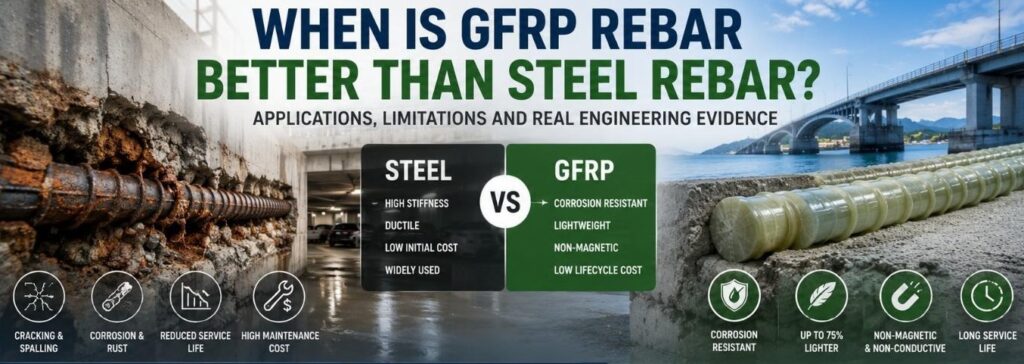
Quick Answer: When Is GFRP Rebar Better Than Steel Rebar?
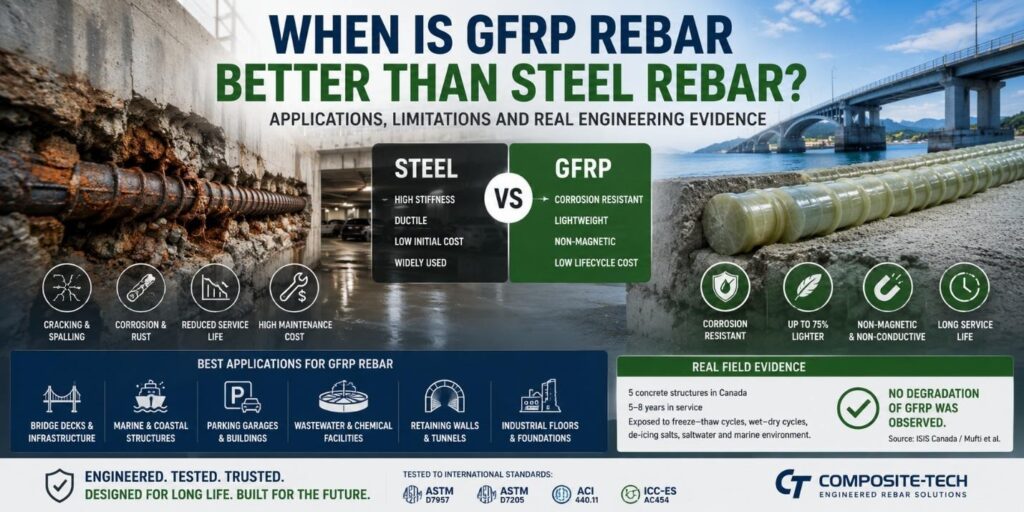
GFRP rebar is usually better than steel rebar when corrosion resistance, low weight, non-magnetic behavior, electrical insulation or long service life are more important than the lowest initial material cost. The strongest applications are bridge decks, marine structures, coastal construction, parking garages, wastewater treatment plants, chemical facilities, tunnels, retaining walls, industrial floors and concrete exposed to de-icing salts or chlorides.
Steel rebar is still a practical choice for many conventional reinforced concrete structures where corrosion exposure is low, stiffness is critical, on-site bending is required, and the lowest initial material cost is the main priority.
The correct question is not simply “Is GFRP better than steel?” The correct question is: What problem does the reinforcement need to solve over the full life of the structure?
Punti chiave
- GFRP rebar is not better than steel in every project, but it is often better in corrosion-critical environments.
- Steel rebar is strong, stiff, familiar and economical, but it can corrode when exposed to chlorides, moisture, de-icing salts or marine environments.
- GFRP rebar does not rust, is lightweight, non-magnetic and electrically non-conductive.
- GFRP rebar can reduce lifecycle maintenance risk in bridges, marine structures, parking garages, wastewater plants and coastal infrastructure.
- Steel has a higher modulus of elasticity and ductile yielding behavior; GFRP has lower stiffness and linear-elastic behavior until failure.
- GFRP rebar should not be used as a simple one-to-one replacement for steel by diameter without engineering design.
- U.S. standards such as ASTM D7957, ASTM D7205 and ACI 440.11 are important for product qualification, testing, design and market acceptance.
- The quality of GFRP rebar depends heavily on manufacturing technology, resin impregnation, surface profile, curing, cooling and quality control.
- Linee di produzione Composite-Tech are designed to help manufacturers produce consistent industrial-quality GFRP rebar for professional markets.
The Wrong Question: “Is GFRP Rebar Better Than Steel?”
Many online comparisons try to declare one winner:
- GFRP is better.
- Steel is better.
- GFRP is stronger.
- Steel is cheaper.
This is too simple.
GFRP rebar and steel rebar are different engineering materials. They behave differently, they are designed differently, and they solve different problems.
Steel rebar is a metallic reinforcement with high stiffness, ductile yielding and a long history of use in reinforced concrete. GFRP rebar is a composite reinforcement made from continuous glass fibers embedded in a polymer resin matrix. It has high tensile strength in the fiber direction, low weight and excellent corrosion resistance, but it does not yield like steel and has a lower modulus of elasticity.
So the right question is:
When does the project benefit more from corrosion resistance, low weight and long service life than from steel’s higher stiffness, ductility and lower initial price?
That is where GFRP rebar becomes a powerful solution.
The Main Reason to Use GFRP Rebar: Corrosion
The biggest weakness of conventional black steel rebar is corrosion.
Steel corrosion can lead to:
- cracking of concrete;
- sfaldamento;
- loss of bond;
- riduzione della sezione trasversale dell'acciaio;
- expensive repairs;
- reduced service life;
- safety and maintenance problems.
This is especially important in structures exposed to:
- saltwater;
- coastal air;
- sali disgelanti;
- chloride contamination;
- wastewater;
- industrial chemicals;
- cicli di bagnatura e asciugatura;
- freeze-thaw cycles.
GFRP rebar does not rust because it is not made of steel. This single fact changes the economics of many concrete structures.
Table 1: Corrosion Risk — GFRP Rebar vs Steel Rebar
| Exposure Condition | barre d'acciaio | Barre di rinforzo in GFRP | Scelta migliore |
| Dry indoor concrete | Low corrosion risk | No rust | Steel or GFRP depending on design |
| Coastal environment | Elevato rischio di corrosione | No rust | GFRP |
| Marine structure | Very high corrosion risk | No rust | GFRP |
| Bridge deck with de-icing salts | Elevato rischio di corrosione | No rust | GFRP |
| Parking garage | High chloride exposure | No rust | GFRP |
| Wastewater plant | Chemically aggressive | Elevata resistenza | GFRP |
| Chemical facility | Corrosion risk depends on exposure | Elevata resistenza | Often GFRP |
| Standard low-exposure building | Usually acceptable | Technically possible | L'acciaio potrebbe essere sufficiente |
Riepilogo: Maggiore è il rischio di corrosione, più convincente è la necessità di utilizzare barre di rinforzo in GFRP.
Real Field Evidence: GFRP in Concrete After Years of Service
One of the strongest arguments for GFRP rebar is not theoretical. It is field performance.
A Canadian durability study examined GFRP-reinforced concrete cores removed from five real field structures. These structures had been exposed to natural environmental conditions for 5 to 8 years, including combinations of:
- cicli di congelamento e scongelamento;
- cicli di bagnatura e asciugatura;
- sali disgelanti;
- saltwater;
- marine exposure;
- carico termico;
- ambiente di calcestruzzo alcalino.
The study used advanced analysis methods such as optical microscopy, scanning electron microscopy, energy dispersive X-ray analysis, differential scanning calorimetry and infrared spectroscopy.
The conclusion was clear: no degradation of GFRP was observed in the concrete structures studied.
This is important because many buyers still ask whether GFRP can survive inside concrete. Field evidence shows that properly manufactured GFRP can perform well in real concrete environments.
When GFRP Rebar Is Better Than Steel Rebar
Table 2: Best Applications for GFRP Rebar
| Applicazione | Why GFRP Rebar Is Better |
| impalcati dei ponti | De-icing salts and moisture can corrode steel; GFRP does not rust |
| Strutture marine | Saltwater exposure makes corrosion resistance critical |
| Edifici costieri | Salt-rich air and humidity create long-term corrosion risk |
| Parcheggi | Vehicles bring chlorides and de-icing salts into concrete |
| Wastewater treatment plants | Concrete can be exposed to aggressive chemical environments |
| impianti chimici | Non-metallic reinforcement reduces corrosion risk |
| Pavimenti industriali | Lightweight handling and corrosion resistance can be valuable |
| muri di contenimento | Soil chemistry and moisture can accelerate steel corrosion |
| Gallerie | GFRP can be useful in corrosion-sensitive and non-magnetic applications |
| Infrastruttura elettrica | GFRP is electrically non-conductive |
| MRI facilities and laboratories | GFRP is non-magnetic |
| Temporary tunnel soft-eyes | GFRP can be cut more easily by tunnel boring machines than steel |
The best GFRP projects are those where the owner cares about lifecycle performance, not only initial material cost.
When Steel Rebar Still Makes Sense
A serious technical article should not pretend that GFRP is always the best choice.
Steel rebar can still be the better option when:
- corrosion exposure is low;
- the project is highly cost-sensitive;
- local engineers and contractors are not ready to use FRP design rules;
- high stiffness is essential;
- ductile yielding behavior is important;
- on-site bending is required;
- fire exposure requirements are difficult to satisfy with FRP;
- the project code or approval pathway does not yet support GFRP.
Table 3: When Steel May Still Be the Better Choice
| Condizioni del progetto | Why Steel May Be Preferred |
| Low corrosion exposure | Steel durability risk is lower |
| Il costo iniziale più basso è l'unica priorità | Black steel is usually cheaper upfront |
| High stiffness is required | Steel has much higher modulus of elasticity |
| Ductile yielding is required | Steel yields; GFRP does not |
| On-site bending is needed | Steel can be bent on site |
| Local code acceptance is limited | Steel is universally accepted |
| Fire performance is the controlling issue | Steel may be easier to specify |
| Standard conventional building | Steel may be sufficient and familiar |
Riepilogo: GFRP is not a universal replacement for steel. It is a high-value reinforcement solution for the right conditions.
Initial Cost vs Lifecycle Cost
Many buyers compare GFRP and steel by the price per meter or price per foot. That is understandable, but it is often incomplete.
Steel may be cheaper at the purchase stage. But if corrosion causes repair, downtime or early rehabilitation, the real cost can become much higher.
GFRP rebar can be more attractive when the owner cares about:
- longer service life;
- fewer corrosion-related repairs;
- lower maintenance risk;
- reduced concrete damage;
- lower lifecycle cost;
- lower transportation and handling weight;
- less need for corrosion protection systems.
Table 4: Initial Cost vs Lifecycle Value
| Fattore di costo | barre d'acciaio | Barre di rinforzo in GFRP |
|---|---|---|
| Costo iniziale dei materiali | Solitamente più basso | Spesso più alto |
| Transport and handling | Heavier | Much lighter |
| Protezione dalla corrosione | May require coatings, inhibitors, stainless steel or extra cover | Not needed for rust prevention |
| Rischio di manutenzione | Higher in aggressive environments | Lower corrosion-related risk |
| Repair cost | Can be high if corrosion occurs | Lower corrosion-related repair risk |
| Valore del ciclo di vita | Good in low-exposure environments | Strong in corrosion-critical projects |
The main financial mistake is to compare only material price and ignore maintenance, service life and corrosion risk.
Engineering Behavior: GFRP Is Not “Steel Without Rust”
GFRP rebar is not simply steel that does not rust. It behaves differently.
Steel rebar has:
- high modulus of elasticity;
- yielding behavior;
- ductility;
- well-known design rules;
- easy on-site bending.
GFRP rebar has:
- high tensile strength in fiber direction;
- lower modulus of elasticity;
- linear-elastic behavior until failure;
- no yielding plateau;
- no corrosion;
- low weight;
- non-magnetic and non-conductive properties.
Table 5: Engineering Behavior Comparison
| Proprietà | barre d'acciaio | Barre di rinforzo in GFRP |
|---|---|---|
| Comportamento di trazione | elastico-plastico con cedimento | Elastico lineare fino alla rottura |
| Modulo di elasticità | Alto | Inferiore |
| Duttilità | Alto | Nessuna cessione |
| Resistenza alla corrosione | Può corrodere | Non arrugginisce |
| Peso | Pesante | Leggero |
| Conduttività elettrica | Conduttivo | Non conduttivo |
| comportamento magnetico | Magnetico | Non magnetico |
| Piegatura in loco | Possibile | Non raccomandato dopo la polimerizzazione |
| Metodo di progettazione | Progettazione convenzionale in cemento armato | FRP-specific design required |
This is why GFRP must be designed using proper FRP standards and not by simple diameter substitution.
Standards Matter: ASTM, ACI and Quality Control
For GFRP rebar to become a serious engineering material, it must be tested and documented.
Important U.S. standards and documents include:
- ASTM D7957/D7957M — specification for solid round GFRP bars for concrete reinforcement;
- ASTM D7205/D7205M — tensile test method for FRP composite bars;
- ASTM D7617/D7617M — transverse shear strength testing;
- ASTM D7913/D7913M — bond strength by pullout testing;
- CODICE ACI-440.11-22 — building code requirements for structural concrete reinforced with GFRP bars;
- ACI SPEC-440.5-22 — construction specification for GFRP reinforcing bars;
- ICC-ES AC454 — acceptance criteria for GFRP bars used as internal reinforcement.
These standards are important because GFRP quality cannot be proven by appearance. It must be proven by measurable properties.
Table 6: Key Properties Required for Standards-Based GFRP Rebar
| Proprietà | Perché è importante |
|---|---|
| Resistenza alla trazione | Main load-carrying property in tension |
| Modulo di trazione | Controls stiffness, crack width and deflection |
| Ceppo definitivo | Shows strain capacity before failure |
| Area operativa | Required for engineering calculations |
| resistenza al taglio trasversale | Important for shear-related behavior |
| forza di adesione | Controls load transfer between bar and concrete |
| Contenuto di fibre | Strongly affects strength and stiffness |
| Temperatura di transizione vetrosa | Indicates thermal stability of resin matrix |
| Grado di guarigione | Shows polymerization quality |
| Resistenza alcalina | Fondamentale per l'ambiente concreto |
| assorbimento di umidità | Relativo alla durabilità |
| Marking and traceability | Required for quality control and certification |
For manufacturers, this means that the production line must be designed for consistency, not just speed.
Why Manufacturing Quality Determines GFRP Performance
Not all GFRP rebar is equal.
Independent testing of GFRP rods with the same declared nominal diameter has shown that real diameter, tensile strength and modulus can vary significantly between manufacturers. This is not surprising because GFRP is a composite material. Its performance depends on raw materials and production technology.
Important manufacturing factors include:
- glass fiber quality;
- resin type;
- rapporto fibra-resina;
- qualità dell'impregnazione;
- rib winding or surface profile;
- temperatura di polimerizzazione;
- grado di polimerizzazione;
- metodo di raffreddamento;
- stabilità di trazione;
- batch quality control.
A GFRP bar that looks good visually may still have weak impregnation, unstable geometry, poor curing or inconsistent surface profile.
This is why professional production equipment is essential.
Composite-Tech Production Technology: Why It Matters
Composite-Tech manufactures professional FRP rebar production lines designed to support stable industrial production.
The line is not only a machine. It is a controlled production system.
Key production stages include:
- alimentazione a base di fibre;
- preparazione itinerante;
- impregnazione con resina;
- formatura di barre;
- avvolgimento delle nervature controllato da computer;
- polimerizzazione;
- controlled curing;
- two-stage cooling;
- high-force pulling;
- taglio o avvolgimento;
- controllo qualità.
Tecnologia Composite-Tech is designed to help manufacturers produce Barre di rinforzo in GFRP with stable diameter, consistent rib geometry, controlled curing and repeatable mechanical performance.
That is especially important for customers who want to sell into markets where engineers require technical data, test results and standards-based documentation.
Practical Decision Guide: GFRP or Steel?
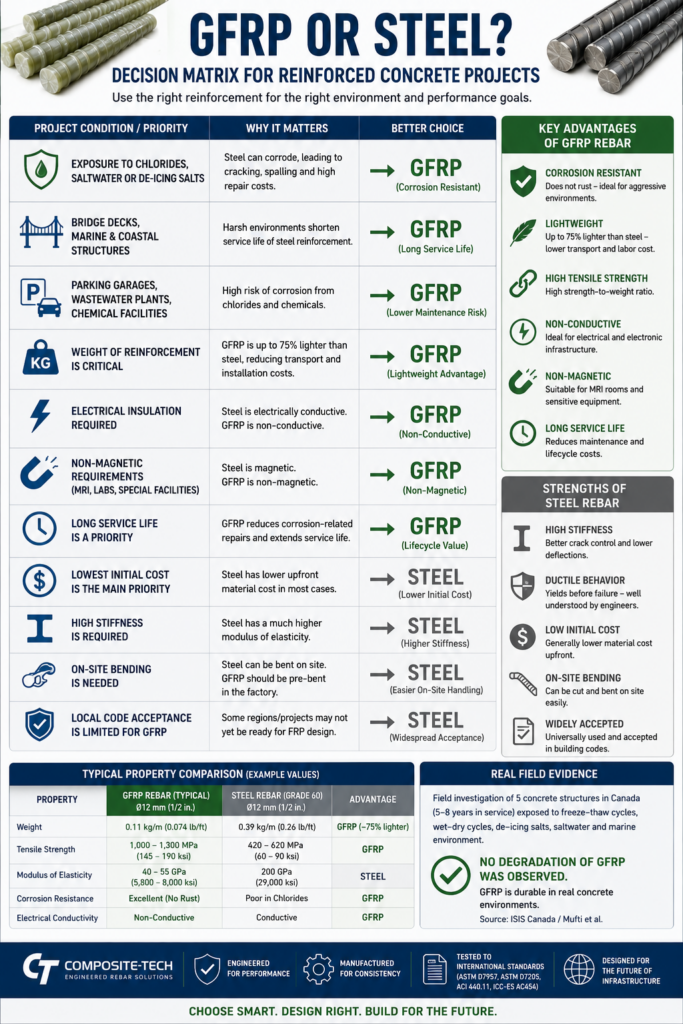
Table 7: Decision Matrix for Choosing GFRP Rebar or Steel Rebar
| Domanda | If Yes | Recommended Direction |
|---|---|---|
| Is the structure exposed to chlorides, saltwater or de-icing salts? | SÌ | Strong case for GFRP |
| Is long service life a priority? | SÌ | Strong case for GFRP |
| Is the owner trying to reduce corrosion-related maintenance? | SÌ | Strong case for GFRP |
| Is electrical insulation required? | SÌ | GFRP |
| Is non-magnetic reinforcement required? | SÌ | GFRP |
| Is the project extremely cost-sensitive upfront? | SÌ | L'acciaio potrebbe essere preferibile |
| Is high stiffness the controlling design issue? | SÌ | Steel or careful FRP design review |
| Is on-site bending required? | SÌ | Steel or factory-made GFRP bent elements |
| Is the local code environment ready for GFRP? | No | Additional engineering approval may be needed |
| Is the project a conventional low-exposure structure? | SÌ | L'acciaio potrebbe essere sufficiente |
This decision matrix is not a substitute for engineering design, but it helps owners and buyers understand when GFRP should be considered seriously.
Best GFRP Rebar Applications by Industry
Infrastructure
GFRP rebar is especially attractive for infrastructure because owners often care about long-term performance, not only initial cost.
Best uses:
- ponti di comando;
- bridge barriers;
- muri di contenimento;
- road slabs;
- gallerie;
- marine infrastructure;
- ports;
- dighe frangiflutti;
- dam and water structures.
Industrial Construction
Industrial environments can expose concrete to chemicals, moisture and corrosion risk.
Best uses:
- pavimenti industriali;
- chemical plants;
- wastewater plants;
- petrochemical facilities;
- cooling towers;
- mining facilities;
- power infrastructure.
Commercial and Residential Construction
GFRP is not needed in every building, but it can be valuable in specific areas.
Best uses:
- edifici costieri;
- parking structures;
- slabs exposed to moisture;
- swimming pool structures;
- balconies and exterior concrete elements;
- foundations in aggressive soil conditions.
Special Applications
GFRP has properties steel cannot provide.
Best uses:
- MRI rooms;
- laboratori;
- electrical substations;
- rail infrastructure;
- telecommunications structures;
- temporary tunnel soft-eyes.
Common Mistakes When Comparing GFRP and Steel
Mistake 1: Comparing Only Price per Meter
The cheapest material is not always the cheapest structure. Corrosion repair can dominate lifecycle cost.
Mistake 2: Assuming Direct Diameter Replacement
GFRP and steel have different stiffness and design behavior. Replacement must be designed, not guessed.
Mistake 3: Ignoring Standards
GFRP should be specified with ASTM, ACI, CSA, CNR or other relevant standards and testing methods.
Mistake 4: Ignoring Product Quality
Two GFRP bars with the same nominal diameter may not have the same performance.
Mistake 5: Selling GFRP Only as “Lighter Than Steel”
Low weight is useful, but corrosion resistance and lifecycle durability are usually stronger selling points.
Mistake 6: Forgetting Serviceability
Because GFRP has lower modulus than steel, crack width and deflection checks are important.
What Engineers Should Ask Before Using GFRP Rebar
Before specifying GFRP rebar, engineers should ask:
- What standard does the product conform to?
- Qual è la resistenza alla trazione?
- Cos'è il modulo di elasticità a trazione?
- What is the effective area?
- What is the surface profile?
- What bond data is available?
- What durability data is available?
- Qual è la temperatura di transizione vetrosa?
- What is the alkaline resistance?
- È disponibile la tracciabilità dei lotti?
- Can bent elements be supplied if required?
- What design code or guideline will be used?
These questions help separate professional GFRP reinforcement from low-quality products.
Cosa devono capire i produttori
For manufacturers, the market opportunity is not just “make cheaper rebar.”
The real opportunity is to produce a technically credible reinforcement product for markets where steel corrosion is expensive.
Successful GFRP manufacturers need:
- reliable production equipment;
- controlled raw materials;
- diametro ripetibile;
- consistent surface profile;
- stable curing;
- controllo qualità;
- testing documentation;
- sales education;
- engineering support;
- standards awareness.
Composite-Tech production lines are designed for this professional manufacturing model.
FAQ: When Is GFRP Rebar Better Than Steel Rebar?
Is GFRP rebar better than steel rebar?
GFRP rebar is better than steel rebar in corrosion-critical environments, such as bridges, marine structures, coastal construction, parking garages and wastewater facilities. Steel may still be better in low-exposure structures where low initial cost, high stiffness and ductility are the main priorities.
Dove è opportuno utilizzare barre d'armatura in GFRP?
GFRP rebar is best used in bridge decks, marine structures, coastal buildings, parking garages, wastewater treatment plants, chemical facilities, tunnels, retaining walls, industrial floors, electrical infrastructure and non-magnetic applications.
Where should steel rebar still be used?
Steel rebar is still suitable for many conventional structures with low corrosion exposure, where high stiffness, ductility, on-site bending and the lowest upfront material cost are important.
Le barre di rinforzo in GFRP arrugginiscono?
No. Le barre di rinforzo in GFRP non arrugginiscono perché sono realizzate in fibre di vetro e resina polimerica, non in acciaio.
Is GFRP rebar cheaper than steel?
GFRP rebar is often more expensive upfront than black steel rebar. However, in corrosion-critical structures, it can offer better lifecycle value by reducing corrosion-related maintenance and repair risk.
Can GFRP rebar replace steel directly?
No. GFRP rebar should not be used as a direct one-to-one replacement for steel by diameter without engineering design. It has different stiffness, bond behavior and failure mode.
Why does GFRP rebar need special design rules?
GFRP has lower modulus than steel and behaves linearly until failure without yielding. Engineers must check deflection, crack width, development length, bond, durability and serviceability according to FRP-specific standards.
What U.S. standards apply to GFRP rebar?
Important U.S. documents include ASTM D7957 for GFRP bar specification, ASTM D7205 for tensile testing and ACI CODE-440.11-22 for structural concrete reinforced with GFRP bars.
Is GFRP rebar good for bridges?
Yes. GFRP rebar is especially attractive for bridge decks and barriers exposed to de-icing salts and moisture, where steel corrosion can shorten service life.
Is GFRP rebar good for marine structures?
Yes. Marine structures are one of the strongest applications for GFRP rebar because saltwater exposure creates high corrosion risk for steel.
È possibile piegare in loco le barre di rinforzo in GFRP?
No. GFRP rebar should not be bent on site after curing. Bent shapes should be manufactured under controlled factory conditions.
What makes high-quality GFRP rebar different?
High-quality GFRP rebar has controlled fiber content, proper resin impregnation, stable diameter, consistent surface profile, proper curing, documented test data and batch traceability.
Why does production equipment matter?
Production equipment controls fiber feeding, impregnation, rib winding, curing, cooling and pulling. These factors directly affect diameter consistency, tensile strength, surface profile, bond behavior and durability.
Conclusione
GFRP rebar is not automatically better than steel in every project. But in the right applications, it can solve problems that steel cannot solve economically.
When corrosion, long service life, low maintenance, low weight, electrical insulation or non-magnetic behavior matter, GFRP rebar can be the better reinforcement choice. When low exposure, high stiffness, ductility, on-site bending and low upfront cost dominate, steel may still be the practical solution.
The strongest strategy is not to replace steel everywhere. The strongest strategy is to use GFRP where its properties create real lifecycle value.
For manufacturers, this creates a major opportunity. As more engineers, contractors and infrastructure owners understand where GFRP works best, demand for high-quality composite reinforcement will grow.
Composite-Tech manufactures professional FRP rebar production lines designed to help producers manufacture consistent, standards-ready GFRP rebar for serious construction markets.
Saperne di più:
- Barre di rinforzo in GFRP contro barre di rinforzo in acciaio: confronto numerico
- Barre di rinforzo in GFRP contro barre di rinforzo in acciaio: costi, resistenza, durata e applicazioni reali
- Limitazioni e migliori applicazioni delle barre di rinforzo in GFRP: dove le barre in fibra di vetro funzionano meglio dell'acciaio.
- Linea di produzione professionale di barre d'armatura in GFRP
- Come avviare un'attività di produzione di barre d'armatura in GFRP
- Linea di produzione di barre d'armatura FRP CT2
- Linea di produzione di barre d'armatura piegate in GFRP