
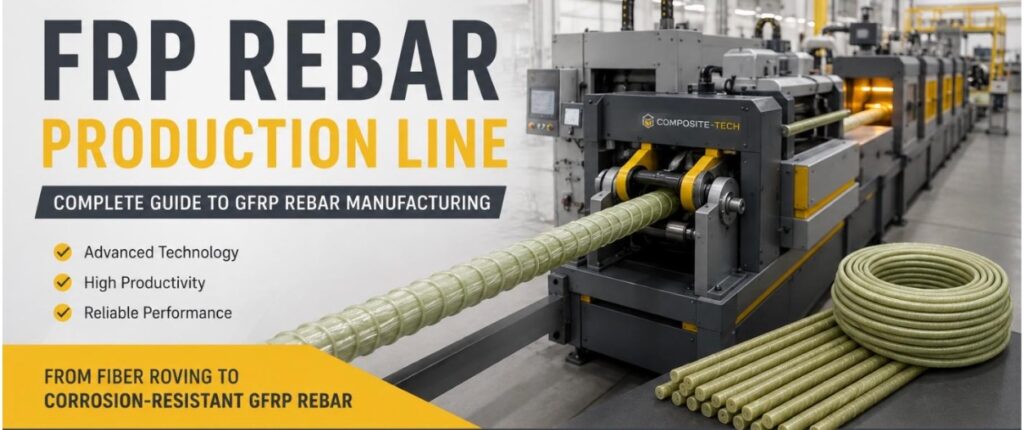
Risposta rapida: Cos'è una linea di produzione di barre d'armatura in FRP?
UN Linea di produzione di barre d'armatura in FRP è un'attrezzatura industriale progettata per fabbricare barre di rinforzo composite in fibra di vetro o basalto combinando roving di fibre continue con una matrice di resina polimerica. In un professionista processo di produzione di barre d'armatura in GFRP, Le fibre vengono guidate dai telai, riscaldate e asciugate, impregnate di resina, modellate in una bacchetta, avvolte con un profilo a coste, polimerizzate in forni, raffreddate, tirate in modo continuo, tagliate a misura o avvolte in bobine.
Composite-Tech produce prodotti professionali Linee di produzione di barre d'armatura in FRP Per la produzione industriale di rinforzi in GFRP e BFRP, inclusi modelli compatti e ad alta capacità per diversi diametri, livelli di produzione e obiettivi aziendali.
Scopri di più su Attrezzature Composite-Tech
Punti chiave
- Una linea di produzione professionale di barre d'armatura in FRP trasforma roving di fibra di vetro e resina polimerica in un rinforzo composito resistente alla corrosione.
- Le fasi principali sono: alimentazione delle fibre, riscaldamento del roving, impregnazione con resina, avvolgimento delle nervature, polimerizzazione, raffreddamento, stiratura, taglio e avvolgimento in bobina.
- Composite-Tech utilizza un sistema di avvolgimento delle nervature controllato da computer che consente una regolazione precisa dell'angolo delle nervature per diversi diametri e requisiti di prodotto.
- Composite-Tech applica una tecnologia di polimerizzazione brevettata con un booster a infrarossi a onde corte seguito da forni di polimerizzazione con elementi riscaldanti in acciaio inossidabile.
- Il sistema di raffreddamento a due stadi brevettato da Composite-Tech rimuove prima il calore massimo tramite aria e poi raffredda le barre in acqua, contribuendo a prevenire shock termici e microfratture superficiali.
- L'unità di trazione utilizza cinghie di gomma resistenti agli agenti chimici e fornisce una forza di trazione superiore a 7 tonnellate per una produzione industriale stabile.
- Le barre di rinforzo in GFRP sono utilizzate principalmente laddove sono importanti la resistenza alla corrosione, il peso ridotto, la trasparenza elettromagnetica e la lunga durata.
- La qualità della barra d'armatura finale dipende dalla tensione delle fibre, dall'impregnazione con resina, dal controllo della polimerizzazione, dalla geometria delle nervature, dal metodo di raffreddamento e dalla stabilità di trazione.
- Per gli investitori, una linea di produzione professionale di barre d'armatura in FRP può diventare il fulcro di un'attività manifatturiera redditizia nel mercato in crescita dei rinforzi compositi.
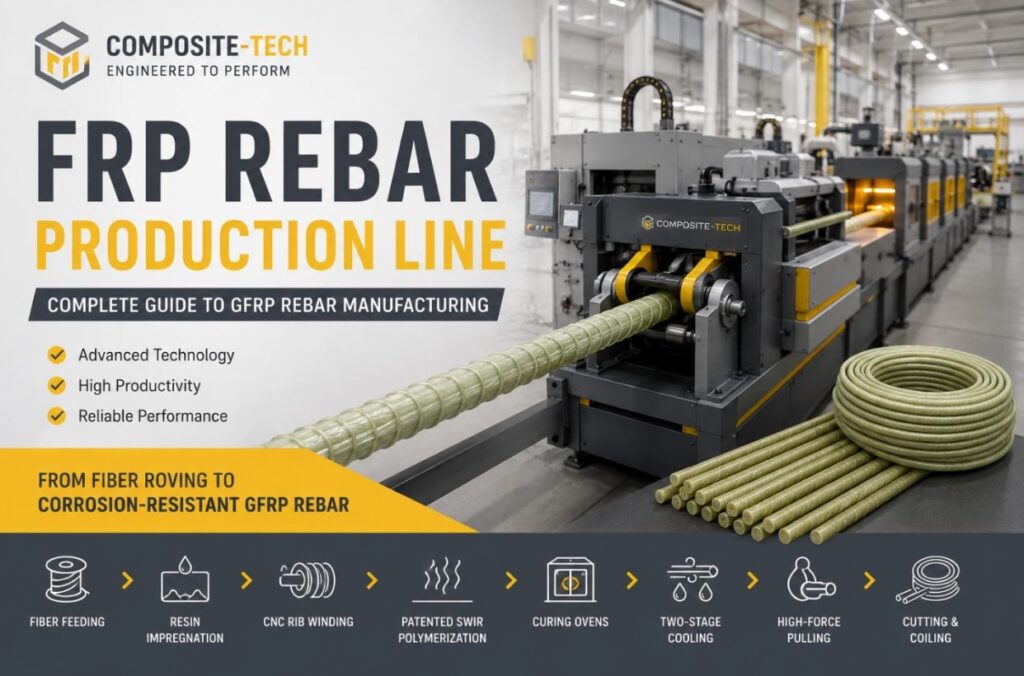
Che cosa sono le barre d'armatura in GFRP?
Barre di rinforzo in GFRP, Le barre di rinforzo in polimero rinforzato con fibra di vetro (GFRP) sono barre di rinforzo non metalliche composte da fibre di vetro continue incorporate in una matrice di resina polimerica. A differenza delle barre di rinforzo in acciaio, le barre in GFRP non arrugginiscono, sono leggere, non magnetiche e resistenti a molti ambienti aggressivi.
Questo materiale è ampiamente utilizzato nelle strutture in calcestruzzo dove le tradizionali armature in acciaio possono subire corrosione, tra cui:
- ponti e impalcati dei ponti;
- strutture marine e costiere;
- gallerie;
- pavimenti industriali;
- fondazioni;
- impianti di depurazione delle acque reflue;
- impianti chimici;
- parcheggi multipiano;
- infrastrutture stradali;
- lastre di cemento esposte a sali disgelanti;
- strutture che richiedono neutralità elettromagnetica.
Nel settore edile, le barre di rinforzo in GFRP non rappresentano solo una tendenza in termini di materiali. Fanno parte di un cambiamento più ampio verso infrastrutture più durevoli, resistenti alla corrosione e che richiedono una manutenzione ridotta.
Come funziona una linea di produzione di barre d'armatura in FRP?
Una linea di produzione professionale di barre d'armatura in FRP è un sistema di produzione continuo. Invece di produrre le barre una per una manualmente, la linea funziona come un processo sincronizzato in cui le materie prime entrano da un'estremità ed escono le barre d'armatura composite finite dall'altra.
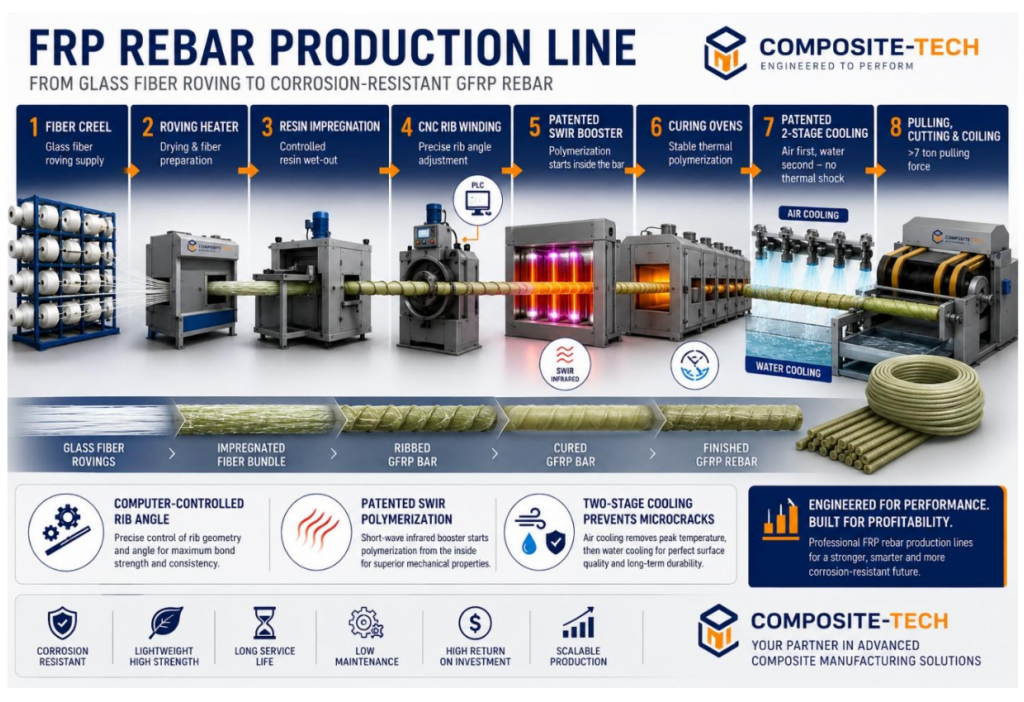
Il processo generale comprende:
- fornitura di filati di fibra
- Riscaldamento e asciugatura a rotazione
- Impregnazione della resina
- Controllo dell'eccesso di resina
- Formazione di barre
- Avvolgimento delle nervature controllato da computer
- polimerizzazione potenziata a infrarossi a onde corte
- Polimerizzazione termica in forni
- Raffreddamento ad aria e acqua a due stadi
- Trazione ad alta forza
- Taglio o avvolgimento
Ogni fase influisce sulla qualità finale delle barre d'armatura. Una scarsa impregnazione, una velocità di trazione instabile, un controllo inadeguato della stagionatura, un avvolgimento impreciso delle nervature o un raffreddamento aggressivo possono ridurre la resistenza alla trazione, la tenuta, la qualità della superficie e la redditività della produzione.
Ecco perché la qualità della linea di produzione è altrettanto importante quanto la qualità del materie prime.
Componenti principali di una linea di produzione professionale di barre d'armatura in FRP
Una linea completa di produzione di barre d'armatura in GFRP comprende diversi moduli che lavorano insieme come un unico sistema industriale integrato.
1. Sistema di ceste
Il porta-bobine contiene più rocchetti di fibra di vetro o di fibra di basalto. La sua funzione è quella di organizzare l'alimentazione della fibra e garantire un flusso stabile nella linea di produzione.
Un buon sistema di cestini contribuisce a garantire:
- tensione stabile dello roving;
- Distribuzione di fibre pulite;
- meno rotture delle fibre;
- struttura delle barre coerente;
- Produzione più fluida a velocità maggiore.
La tensione delle fibre è importante perché il rinforzo composito è anisotropo: la maggior parte della sua resistenza alla trazione deriva dalle fibre allineate lungo la barra. Se l'alimentazione delle fibre è instabile, la qualità finale della barra risulterà instabile.
2. Riscaldatore rotante
Il riscaldatore a roving riscalda e asciuga le fibre prima dell'impregnazione. Questa fase migliora la stabilità del processo di impregnazione della resina e contribuisce a rimuovere l'umidità dal fascio di fibre.
L'umidità è nemica della qualità dei materiali compositi. Se le fibre entrano nel bagno di resina con un eccesso di umidità, il legame tra fibra e matrice polimerica potrebbe indebolirsi. Una fase di riscaldamento controllata contribuisce a creare un processo produttivo più pulito e stabile.
Il riscaldatore a roving contribuisce inoltre a preparare le fibre per un'impregnazione più completa all'interno del modulo di impregnazione. Ciò è particolarmente importante quando il produttore desidera ottenere proprietà meccaniche stabili per lunghi cicli di produzione.
3. Modulo di impregnazione della resina
Il modulo di impregnazione è una delle parti più importanti dell'intera linea. Qui, il fascio di fibre passa attraverso il sistema di resina. L'obiettivo è quello di bagnare completamente le fibre con la giusta quantità di legante polimerico.
L'impregnazione professionale deve raggiungere tre obiettivi:
- completa impregnazione delle fibre;
- contenuto di resina stabile;
- rimozione controllata della resina in eccesso.
Una quantità insufficiente di resina può ridurre l'adesione e la durata. Un eccesso di resina, al contrario, aumenta i costi e può rendere la barra più pesante senza migliorarne le prestazioni meccaniche. Poiché la resina è solitamente una delle materie prime più costose, un'impregnazione precisa incide direttamente sulla redditività dello stabilimento.
Un sistema di impregnazione professionale dovrebbe preservare le proprietà fondamentali del legante polimerico, tra cui fluidità, comportamento di indurimento e stabilità termica. Dovrebbe inoltre contribuire a ridurre il consumo superfluo di polimero senza compromettere la qualità meccanica delle barre d'armatura finite.
4. Sistema di avvolgimento delle nervature controllato da computer
Il sistema di avvolgimento delle nervature forma il profilo periodico esterno dell'armatura. Questo profilo è fondamentale perché il calcestruzzo deve trasferire il carico all'armatura tramite aderenza.
Composite-Tech equipaggia il sistema di avvolgimento delle nervature con regolazione precisa controllata dal computer, Ciò consente all'operatore di impostare e mantenere praticamente qualsiasi angolo di avvolgimento delle nervature richiesto con elevata precisione. Questo è importante perché l'angolo delle nervature, il passo di avvolgimento e la forza di avvolgimento influenzano direttamente la geometria della barra, la stabilità del profilo esterno e il comportamento di aderenza tra le barre di rinforzo in GFRP e il calcestruzzo.
Un sistema professionale di avvolgimento delle nervature non deve limitarsi a creare una nervatura visibile, ma deve anche garantire un profilo ripetibile e controllato lungo tutta la lunghezza della barra. Se l'angolo della nervatura varia durante la produzione, il prodotto finale potrebbe presentare caratteristiche di legame instabili e una geometria non uniforme.
La tecnologia di avvolgimento delle nervature controllata da computer di Composite-Tech consente ai produttori di:
- regolare con precisione l'angolo di avvolgimento delle nervature;
- mantenere una geometria stabile delle nervature durante la produzione continua;
- adattare il profilo a diversi diametri di barra;
- migliorare la ripetibilità da lotto a lotto;
- ridurre gli errori dell'operatore;
- produrre una superficie di rinforzo più stabile;
- migliorare le prestazioni di adesione del calcestruzzo.
Le barre di rinforzo in GFRP non si comportano esattamente come quelle in acciaio. Le loro prestazioni di aderenza dipendono fortemente dalla geometria della superficie, dalla struttura delle nervature, dal rivestimento di sabbia, dal profilo di avvolgimento, dal diametro della barra e dal copriferro. Un profilo delle nervature ben progettato migliora l'interblocco meccanico con il calcestruzzo e contribuisce a far sì che la barra agisca come un vero e proprio rinforzo, anziché come una semplice barra liscia.
Le linee di produzione Composite-Tech sono progettate per creare un profilo periodico stabile e controllato, adatto ad applicazioni professionali di rinforzo per materiali compositi.
5. Potenziatore a infrarossi a onde corte e forni di polimerizzazione brevettati
Dopo l'impregnazione e l'avvolgimento delle nervature, la barra deve essere polimerizzata. La polimerizzazione trasforma la resina da uno stato liquido o semiliquido in una matrice polimerica solida che fissa le fibre in posizione.
Composite-Tech utilizza il suo tecnologia di polimerizzazione brevettata, dove il processo di stagionatura inizia con un booster a infrarossi a onde corte prima che la barra entri nei forni di stagionatura principali.
La prima fase è una amplificatore a infrarossi a onde corte Dotato di lampade a infrarossi a onde corte. A differenza del riscaldamento superficiale convenzionale, l'energia a infrarossi a onde corte contribuisce ad avviare la polimerizzazione in modo più efficace all'interno della barra, supportando il processo di indurimento dall'interno della struttura composita anziché solo dalla superficie esterna.
Dopo il trattamento con il booster a infrarossi, la barra passa attraverso forni di polimerizzazione dotati di elementi riscaldanti standard in acciaio inox. Questa combinazione consente alle linee Composite-Tech di ottenere un processo di polimerizzazione più controllato e stabile.
Questo approccio di stagionatura a fasi contribuisce a migliorare:
- controllo della polimerizzazione della resina;
- stabilità della polimerizzazione;
- velocità di produzione;
- uniformità qualitativa;
- struttura interna della barra composita;
- riduzione dei difetti legati al processo di polimerizzazione;
- ripetibilità tra i lotti di produzione.
La polimerizzazione professionale non si limita al semplice "riscaldamento della barra". Richiede il controllo della temperatura del forno, della velocità di estrazione, del tempo di reazione della resina, del diametro della barra, dell'efficienza energetica e del grado di polimerizzazione finale.
Se la polimerizzazione è incompleta, la barra potrebbe non raggiungere le prestazioni meccaniche previste. Se la polimerizzazione è troppo aggressiva, può creare tensioni interne, difetti superficiali o instabilità del processo.
La configurazione di polimerizzazione brevettata di Composite-Tech è progettata per avviare la polimerizzazione in modo efficiente con energia infrarossa a onde corte e quindi completare il processo attraverso una polimerizzazione termica controllata nei forni principali.
6. Modulo di raffreddamento ad aria e acqua a due stadi brevettato
Dopo la stagionatura, le barre di rinforzo escono dai forni a una temperatura molto elevata. In molti processi produttivi, le barre composite possono lasciare la zona di stagionatura a temperature vicine a 200°C. Se una barra così calda viene immediatamente immersa in acqua, la sua superficie può subire uno shock termico.
Lo shock termico può provocare microfratture sulla superficie della barra. Anche se queste microfratture non sono visibili a prima vista, possono ridurre la qualità del prodotto, comprometterne la durata e creare rischi per le prestazioni a lungo termine.
Composite-Tech utilizza il suo tecnologia di raffreddamento brevettata a due stadi per risolvere questo problema.
Il processo di raffreddamento è suddiviso in due fasi:
- stadio di raffreddamento ad aria — la temperatura massima viene prima ridotta dall'aria.
- stadio di raffreddamento ad acqua — una volta eliminato il picco di carico termico, le barre vengono immerse in acqua per un raffreddamento finale efficiente.
Questo metodo a due fasi evita il brusco calo di temperatura che può verificarsi quando una barra composita molto calda viene immersa direttamente nell'acqua.
Il risultato è un processo di raffreddamento più sicuro e controllato che contribuisce a proteggere la qualità superficiale delle barre d'armatura.
Il sistema di raffreddamento ad aria e acqua a due stadi di Composite-Tech aiuta a:
- ridurre lo shock termico;
- prevenire la formazione di microfratture superficiali;
- migliorare la qualità della superficie del bancone;
- stabilizzare la geometria del prodotto;
- proteggere la matrice polimerica reticolata;
- garantire prestazioni meccaniche costanti;
- Aumentare la fiducia nella durabilità a lungo termine.
Il raffreddamento può sembrare una semplice fase della linea di produzione, ma nella produzione professionale di barre d'armatura in GFRP rappresenta una fase critica per il controllo qualità. Molti sistemi semplificati raffreddano la barra direttamente in acqua, il che può ridurre la complessità della macchina ma può creare inutili stress termici. Composite-Tech ha sviluppato e brevettato il suo approccio di raffreddamento a due stadi per migliorare la qualità del prodotto ed evitare i difetti che possono insorgere quando le barre composite calde vengono raffreddate in modo troppo brusco.
7. Dispositivo di trazione ad alta forza
Il dispositivo di trazione sposta la barra in modo continuo lungo la linea di produzione. La velocità di trazione deve essere sincronizzata con l'impregnazione, l'avvolgimento delle nervature, la stagionatura e il raffreddamento.
Il sistema di trazione di Composite-Tech è progettato per il funzionamento industriale e utilizza cinghie realizzate in gomma resistente agli agenti chimici. Questo è importante perché l'unità di trazione opera in un ambiente di produzione dove può essere esposta a residui di resina, calore, polvere, sostanze chimiche di processo e carico meccanico continuo.
In tali condizioni, le cinghie standard possono usurarsi rapidamente. Le cinghie in gomma resistenti agli agenti chimici contribuiscono a prolungarne la durata, a ridurre la frequenza di manutenzione e a mantenere stabile il processo di trazione per periodi più lunghi.
Il dispositivo di trazione di Composite-Tech fornisce anche una forza di trazione di più di 7 tonnellate, conferendo alla linea potenza e stabilità sufficienti per una produzione continua professionale.
Un sistema di trazione potente e stabile aiuta a:
- mantenere una velocità di produzione costante;
- ridurre lo slittamento;
- gestire carichi di linea più elevati;
- migliorare la stabilità dimensionale;
- supportare diametri maggiori e produzione multibarra;
- ridurre i tempi di inattività;
- prolungare la durata di servizio della cinghia;
- migliorare l'affidabilità complessiva della produzione.
Per gli investitori, la stabilità del sistema di trazione è di fondamentale importanza. Influisce sulla produzione, sulla qualità e sul tasso di scarto. Un'unità di trazione professionale riduce le interruzioni di produzione e contribuisce a mantenere una produttività prevedibile.
Nella produzione di barre d'armatura in GFRP, i sistemi di trazione deboli possono diventare un collo di bottiglia. Se il dispositivo di trazione non riesce a mantenere una trazione stabile, l'intera linea diventa instabile. L'unità di trazione ad alta forza di Composite-Tech, dotata di cinghie in gomma resistenti agli agenti chimici, è progettata per supportare la produzione industriale a lungo termine, non per brevi lotti dimostrativi.
8. Dispositivo di taglio o avvolgitore
Al termine della linea, le barre di rinforzo in FRP finite possono essere:
- tagliati in barre dritte;
- avvolti in spirali;
- preparato per il confezionamento;
- trasferito per l'ulteriore elaborazione.
Le barre d'armatura in rotoli sono comode per il trasporto e per i progetti di costruzione su larga scala. Le barre dritte sono spesso necessarie per progetti con lunghezze, standard o requisiti ingegneristici specifici.
Il sistema di movimentazione finale deve essere sincronizzato con la velocità della linea di produzione. Una buona soluzione di taglio o avvolgimento riduce gli sprechi, migliora l'efficienza dell'imballaggio e aiuta il produttore a offrire ai clienti un prodotto più professionale.
Modelli di linee di produzione di barre d'armatura in FRP Composite-Tech
Composite-Tech produce diverse configurazioni di linee di produzione di barre d'armatura in FRP, adatte a diverse capacità produttive e modelli di business.
Linea di produzione di barre d'armatura FRP CT2
IL Linea di produzione di barre d'armatura FRP CT2 È una soluzione compatta per le aziende che desiderano entrare nel mercato della produzione di barre d'armatura in GFRP con investimenti ridotti e una capacità produttiva inferiore.
È adatto per:
- startup;
- produttori regionali;
- produzione pilota;
- barre di rinforzo di piccolo diametro;
- imprese che testano la domanda del mercato locale;
- produttori che desiderano una linea compatta ed efficiente.
Linea di produzione di barre d'armatura in FRP CT4
IL CT4 Questo modello è progettato per una maggiore produttività industriale. Può produrre più barre contemporaneamente ed è adatto ad aziende che già conoscono le esigenze del mercato e desiderano una capacità produttiva più consistente.
È un'ottima opzione per:
- produttori regionali;
- fornitori di materiali edili;
- Distributori di acciaio che entrano nel settore del rinforzo composito;
- aziende che si rivolgono ai mercati delle infrastrutture e del rinforzo del calcestruzzo.
Linea di produzione di barre d'armatura in FRP CT6
IL CT6 Questo modello è una linea di produzione professionale ad alta capacità, progettata per la produzione su scala industriale. È adatta ai produttori che desiderano realizzare grandi volumi di barre d'armatura in GFRP e rifornire appaltatori, distributori, progetti infrastrutturali e mercati di esportazione.
CT6 è particolarmente rilevante per i mercati in cui la domanda di barre d'armatura in GFRP è in rapida crescita, tra cui Stati Uniti, Canada, India, Medio Oriente, Europa e regioni costiere con gravi problemi di corrosione.
CT2 vs CT4 vs CT6: quale linea di barre d'armatura in FRP scegliere?
| Linea di produzione | Ideale per | Obiettivo aziendale tipico |
| CT2 | Produzione di base o compatta | Avvia un'attività di produzione di barre d'armatura in GFRP con un investimento ridotto |
| CT4 | Produzione industriale media | Costruire un impianto di produzione regionale serio |
| CT6 | Produzione industriale ad alta capacità | Fornitura di grandi progetti, distributori e mercati di esportazione. |
La scelta migliore dipende da:
- dimensione del mercato di riferimento;
- investimenti disponibili;
- intervallo di diametro della barra richiesto;
- produzione mensile prevista;
- spazio disponibile in fabbrica;
- costi del lavoro;
- approvvigionamento di materie prime;
- strategia di vendita;
- Norme locali e requisiti di certificazione.
Per molte aziende, la strategia migliore è iniziare con una linea professionale che soddisfi le attuali esigenze di mercato, ma che consenta anche una futura espansione nel settore delle reti in FRP, degli elementi curvati e di altri prodotti di rinforzo in materiale composito.
Scopri altri prodotti Composite-Tech: Linee di produzione in FRP negli Stati Uniti
Processo di produzione di barre d'armatura in FRP passo dopo passo
Fase 1: Preparazione delle materie prime
Le principali materie prime per la produzione di barre d'armatura in GFRP sono:
- roving in fibra di vetro;
- resina polimerica;
- indurenti o agenti indurenti;
- additivi;
- materiale per l'avvolgimento delle nervature;
- Materiale di rivestimento in sabbia opzionale;
- materiali di imballaggio.
I due fattori che incidono maggiormente sui costi sono la fibra e la resina. La loro qualità influisce direttamente sulla resistenza alla trazione, sulla qualità della superficie, sulla stabilità della produzione e sulla redditività.
Fase 2: Alimentazione con fibre
Il nastro di fibra di vetro viene posizionato sul portarotolo e guidato nella linea di produzione. Le fibre devono essere disposte correttamente per evitare torsioni, rotture o una distribuzione non uniforme.
Fase 3: Riscaldamento e asciugatura
Il riscaldatore a roving rimuove l'umidità in eccesso e prepara le fibre per l'impregnazione. Questa fase migliora l'interfaccia tra fibra e resina.
Fase 4: Impregnazione con resina
Le fibre passano attraverso il bagno di resina o il sistema di impregnazione. La resina deve penetrare il fascio di fibre nel modo più completo possibile. Le linee professionali controllano il consumo di resina e rimuovono il legante in eccesso.
Fase 5: Formatura delle barre
Il fascio di fibre impregnate viene modellato in una barra rotonda del diametro richiesto.
Fase 6: Avvolgimento delle nervature controllato dal computer
Il profilo esterno delle nervature viene formato mediante un sistema di avvolgimento controllato da computer. L'operatore può regolare con precisione l'angolo delle nervature e i parametri di avvolgimento in base al diametro della barra e alla geometria del prodotto desiderata.
Fase 7: Polimerizzazione del booster a infrarossi a onde corte
La barra entra nel booster a infrarossi a onde corte, dove la polimerizzazione inizia in modo efficiente grazie all'energia infrarossa. Questo favorisce l'indurimento dall'interno della struttura della barra e prepara il prodotto per la fase principale di polimerizzazione termica.
Fase 8: Polimerizzazione termica in forno
La barra passa attraverso forni di polimerizzazione dotati di elementi riscaldanti in acciaio inox. Questo completa la polimerizzazione della resina e crea una matrice composita stabile.
Fase 9: Raffreddamento a due stadi
La barra viene prima raffreddata ad aria per eliminare i picchi di temperatura. Successivamente, viene raffreddata in acqua. Questo processo controllato in due fasi contribuisce a evitare shock termici e microfratture superficiali.
Passaggio 10: Tirare
L'unità di trazione ad alta forza mantiene un movimento continuo lungo tutta la linea. Il sistema di trazione di Composite-Tech utilizza cinghie in gomma resistenti agli agenti chimici e fornisce una forza di trazione superiore a 7 tonnellate.
Passaggio 11: Taglio o avvolgimento
Il prodotto finale viene tagliato a misura o avvolto in bobine a seconda delle esigenze del cliente.
Perché la qualità della linea di produzione è importante
Non tutte le macchine per barre d'armatura in FRP producono la stessa qualità. Una macchina a basso costo può sembrare allettante a prima vista, ma può comportare costi nascosti a causa di diametro instabile, scarso controllo della resina, geometria delle nervature debole, shock termico durante il raffreddamento, elevato tasso di scarto, resistenza alla trazione non costante, frequenti fermi macchina e problemi di certificazione.
Nel settore delle barre d'armatura in GFRP, la qualità non è un'opzione, ma una necessità. Imprese edili, ingegneri e distributori necessitano di rinforzi costanti in grado di soddisfare i requisiti di progetto.
Una linea di produzione professionale per barre di rinforzo in FRP dovrebbe fornire:
- apporto stabile di fibre;
- impregnazione controllata della resina;
- angolo di avvolgimento delle nervature controllato da computer;
- profilo delle costole accurato e ripetibile;
- polimerizzazione a stadi mediante l'utilizzo di un booster a infrarossi e di forni di polimerizzazione;
- Raffreddamento controllato a due stadi per evitare shock termici;
- potente forza di trazione;
- cinghie di trazione resistenti agli agenti chimici;
- diametro ripetibile;
- basso impatto ambientale;
- funzionamento semplice;
- durabilità a lungo termine;
- documentazione tecnica;
- Formazione e supporto per gli operatori.
Composite-Tech progetta le sue attrezzature per la produzione industriale continua, non per dimostrazioni di laboratorio. Le tecnologie brevettate dell'azienda in materia di polimerizzazione e raffreddamento, combinate con un avvolgimento preciso delle nervature e un potente sistema di trazione, aiutano i produttori a realizzare rinforzi compositi di qualità superiore con parametri di produzione più stabili.
Visualizza i materiali tecnici: Documentazione tecnica Composite-Tech
Quali norme si applicano alle barre d'armatura in GFRP?
La produzione di barre d'armatura in GFRP è sempre più legata agli standard internazionali e ai codici di ingegneria. Due riferimenti importanti sono:
ACI 440.11-22
La norma ACI CODE-440.11-22 definisce i requisiti del codice edilizio per il calcestruzzo strutturale rinforzato con barre in GFRP. Si tratta di uno dei documenti più importanti per ingegneri e autorità di regolamentazione nei mercati che adottano la progettazione basata sulle norme ACI.
Scopri di più su ACI 440.11-22
ASTM D7957/D7957M
La norma ASTM D7957/D7957M riguarda le barre tonde in GFRP (polimero rinforzato con fibra di vetro) per il rinforzo del calcestruzzo, comprese le barre fornite in lunghezze tagliate e in forme curve con trattamento superficiale esterno.
Scopri di più su ASTM D7957
Per i produttori, gli standard non sono solo documenti tecnici. Influenzano:
- test del prodotto;
- market acceptance;
- distributor trust;
- government project eligibility;
- engineering specifications;
- export potential;
- quality control systems.
A serious GFRP rebar manufacturer should think about standards from the first day of production planning.
What Makes a Good GFRP Rebar?
A high-quality GFRP rebar should have:
- diametro stabile;
- high tensile strength;
- controlled fiber content;
- strong fiber-resin bonding;
- proper curing;
- consistent rib profile;
- good concrete bond behavior;
- low void content;
- clean surface;
- controlled cooling history;
- surface free from thermal-shock microcracking;
- predictable mechanical properties.
Because FRP rebar is a composite material, performance depends on both material chemistry and production process. Even with good raw materials, poor equipment can produce poor rebar.
The production line must create stable conditions where every meter of rebar is manufactured under controlled parameters.
FRP Rebar vs Steel Rebar: Why the Market Is Growing
Steel rebar has been the dominant concrete reinforcement material for more than a century. However, steel has one major weakness: corrosion.
When steel corrodes inside concrete, it can expand, crack the concrete cover and reduce structural durability. This creates high maintenance costs in bridges, marine structures, parking garages and infrastructure exposed to salts, moisture and chemicals.
GFRP rebar solves many of these problems because it is:
- corrosion-resistant;
- leggero;
- non magnetico;
- non conduttivo elettricamente;
- easier to transport;
- suitable for aggressive environments;
- useful in structures requiring long service life.
This does not mean GFRP replaces steel everywhere. GFRP has different mechanical behavior and must be designed correctly. But in the right applications, it offers major durability and lifecycle advantages.
Recommended related article: GFRP Rebar Price per Foot and per Kg in the USA
Can GFRP Rebar Be Bent?
GFRP rebar cannot be bent on site like steel after curing. Once the polymer matrix is cured, the bar becomes a solid composite material. Bending must be done during manufacturing using dedicated equipment and controlled production methods.
That is why serious composite reinforcement producers often need not only straight rebar production lines, but also equipment for:
- bent elements;
- stirrups;
- U-shapes;
- L-shapes;
- custom reinforcement shapes;
- curved composite elements.
Composite-Tech manufactures equipment for both straight FRP rebar and bent composite reinforcement elements.
Saperne di più: Linea di produzione di barre d'armatura piegate in GFRP
How Much Space Is Needed for an FRP Rebar Production Line?
Factory space depends on the line model, configuration, raw material storage, packaging area and production flow.
A professional production facility should include:
- production line area;
- stoccaggio delle materie prime;
- resin preparation area;
- finished goods storage;
- cutting and packaging zone;
- ventilation system;
- compressed air system;
- electrical supply;
- quality control area;
- operator workspace;
- loading and shipping area.
Even a compact production line should be installed on a flat industrial floor with proper electrical grounding, ventilation and safe access around the equipment.
What Utilities Are Required?
A typical FRP rebar production line may require:
- three-phase electrical supply;
- aria compressa;
- ventilazione;
- stable temperature conditions;
- resin handling area;
- safe storage for chemicals;
- packaging equipment;
- lifting or handling tools.
The exact requirements depend on the line configuration, number of bars, oven system, automation level and target productivity.
Is FRP Rebar Production Profitable?
FRP rebar production can be profitable when three conditions are met:
- The production line is efficient and stable.
- Raw material consumption is controlled.
- The company has a clear sales strategy.
Profitability depends on:
- local steel prices;
- local GFRP rebar market price;
- raw material cost;
- electricity cost;
- labor cost;
- production capacity;
- waste rate;
- certification requirements;
- sales volume;
- project demand.
The best markets are usually regions where corrosion is a serious problem or where infrastructure owners understand lifecycle cost savings.
Strong target markets include:
- coastal regions;
- bridge construction markets;
- marine infrastructure;
- infrastrutture stradali;
- industrial concrete floors;
- impianti di depurazione delle acque reflue;
- chemical plants;
- countries with high steel import costs;
- regions promoting durable infrastructure.
Recommended related article: GFRP Rebar Factory Business Plan 2026: ROI & Costs
How to Choose the Right FRP Rebar Machine
Before buying an FRP rebar machine, investors should ask these questions:
1. What diameters do I need to produce?
Different markets require different diameters. Common sizes include 4 mm, 6 mm, 8 mm, 10 mm, 12 mm, 14 mm, 16 mm and higher.
2. Do I need coils, straight bars or both?
Coils are convenient for logistics and certain construction applications. Straight bars are often required for standard reinforcement supply.
3. What production capacity do I need?
A small producer may start with a compact line. A large manufacturer may need a multi-bar industrial line.
4. What standards will my market require?
If you target the USA, Canada, Europe or government projects, standards and testing become very important.
5. Will I produce only rebar or also mesh and bent elements?
The most profitable business model may include several product categories:
- straight GFRP rebar;
- GFRP mesh;
- bent elements and stirrups;
- custom composite reinforcement.
6. Does the machine use advanced curing and cooling technology?
This is one of the most important technical questions. A simplified machine may produce rebar, but it may not provide controlled polymerization or proper cooling. Composite-Tech’s patented short-wave infrared booster and two-stage cooling technology are designed to improve production stability and final product quality.
Composite-Tech can help build a complete composite reinforcement production system, not just a single machine.
Perché scegliere Composite-Tech?
Composite-Tech is a specialized manufacturer of equipment for composite reinforcement production. The company develops and supplies machinery for:
- FRP rebar production;
- GFRP mesh production;
- FRP bent elements;
- composite profiles;
- other FRP production technologies.
Composite-Tech’s advantage is practical industrial experience. The equipment is designed for real production environments where customers need output, reliability, stable quality and long-term business performance.
Key advantages of Composite-Tech FRP rebar production lines include:
- professional multi-stage production process;
- computer-controlled rib winding system;
- polimerizzazione potenziata a infrarossi a onde corte brevettata;
- Forni di stagionatura con elementi riscaldanti in acciaio inox;
- Sistema di raffreddamento ad aria e acqua a due stadi brevettato;
- reduced risk of thermal shock and surface microcracks;
- pulling unit with more than 7 tons of pulling force;
- chemically resistant rubber pulling belts;
- industrial design for continuous production;
- technical documentation and operator training.
With Composite-Tech, customers can receive:
- production line engineering;
- equipment manufacturing;
- documentazione tecnica;
- installation support;
- operator training;
- process recommendations;
- business guidance for FRP production;
- expansion options into mesh and bent elements.
FAQ: FRP Rebar Poduction Line
What is an FRP rebar production line?
An FRP rebar production line is industrial equipment that manufactures fiberglass or basalt composite reinforcement bars by impregnating continuous fiber roving with polymer resin, forming the bar, creating a rib profile, curing it, cooling it and cutting or coiling the finished rebar.
What raw materials are used to produce GFRP rebar?
The main raw materials are glass fiber roving, polymer resin, hardener or curing agent, additives, rib winding material and optional sand coating material.
How is GFRP rebar manufactured?
GFRP rebar is manufactured through a continuous process: fiber feeding, heating, resin impregnation, forming, computer-controlled rib winding, infrared booster polymerization, thermal curing, two-stage cooling, pulling, cutting or coiling.
What equipment is needed to produce FRP rebar?
A complete line normally includes creels, roving heater, impregnation module, rib winding system, infrared booster, curing ovens, cooling module, pulling device and cutting or coiling equipment.
Why is computer-controlled rib winding important?
Computer-controlled rib winding allows the operator to precisely set and maintain the rib angle, pitch and profile geometry. This improves repeatability and helps create a stable external surface for better concrete bond behavior.
Why does Composite-Tech use a short-wave infrared booster?
Composite-Tech uses a patented short-wave infrared booster to start polymerization more efficiently through the body of the bar before the product enters the main curing ovens. This supports better curing control and production stability.
Perché il raffreddamento a due stadi è importante?
Two-stage cooling helps avoid thermal shock. First, peak temperature is reduced by air. Then the bar is cooled in water. This helps prevent surface microcracks that may occur when a very hot composite bar is placed directly into water.
What happens if hot GFRP rebar is cooled too quickly?
If a hot composite bar leaves the oven at a temperature close to 200°C and is immediately immersed in water, the sudden temperature drop can create thermal shock. This may lead to surface microcracks and reduced product quality.
What is special about Composite-Tech’s pulling unit?
Composite-Tech’s pulling unit uses chemically resistant rubber belts and provides more than 7 tons of pulling force. This supports stable industrial production, reduces slippage and helps extend belt service life.
Le barre di rinforzo in GFRP possono sostituire quelle in acciaio?
GFRP rebar can replace steel rebar in many applications, especially where corrosion resistance, low weight and electromagnetic neutrality are important. However, it has different mechanical behavior and must be designed according to relevant engineering standards.
È possibile piegare in loco le barre di rinforzo in GFRP?
No. GFRP rebar should not be bent on site after curing. Bent shapes and stirrups must be produced during manufacturing using specialized equipment.
La produzione di barre d'armatura in GFRP è redditizia?
It can be profitable when the producer uses efficient equipment, controls raw material consumption, maintains stable quality and sells into markets where corrosion-resistant reinforcement is valued.
What is the difference between CT2, CT4 and CT6?
CT2 is suitable for compact or entry-level production, CT4 is designed for medium industrial capacity, and CT6 is intended for high-capacity industrial GFRP rebar manufacturing.
What standards are important for GFRP rebar?
Important references include ACI 440.11-22 and ASTM D7957/D7957M, along with other national or regional standards depending on the target market.
Perché l'impregnazione con resina è importante?
Resin impregnation determines how well the polymer matrix surrounds and bonds the fibers. Poor impregnation can reduce mechanical performance, durability and production consistency.
Perché la geometria delle nervature è importante?
Rib geometry improves bond between GFRP rebar and concrete. A stable rib profile helps transfer loads from concrete into the reinforcement.
Where can I buy a professional FRP rebar production line?
Composite-Tech manufactures professional FRP rebar production lines and complete equipment systems for GFRP rebar, mesh and bent elements production. Visit Composite-Tech to learn more.
Conclusione
A professional Linea di produzione di barre d'armatura in FRP is the foundation of a modern GFRP reinforcement manufacturing business. It transforms fiber roving and polymer resin into corrosion-resistant composite rebar through a continuous process of impregnation, forming, rib winding, polymerization, curing, cooling, pulling and cutting or coiling.
As global construction markets search for longer-lasting alternatives to steel reinforcement, GFRP rebar production is becoming a serious business opportunity. However, profitability depends on equipment quality, raw material control, production stability, standards compliance and market strategy.
Composite-Tech provides professional FRP rebar production equipment for companies that want to enter or expand in the composite reinforcement market with reliable industrial technology. The company’s patented polymerization and cooling technologies, computer-controlled rib winding, high-force pulling system and industrial production experience give manufacturers a strong foundation for producing high-quality composite reinforcement.