
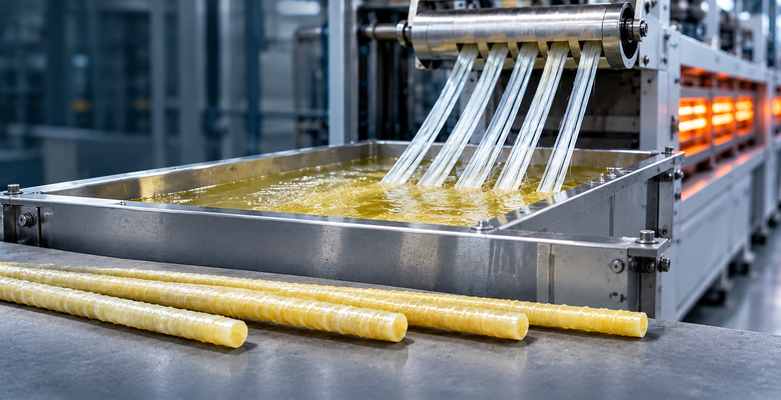
Why the polymer matrix matters as much as the reinforcing fiber — and how the right resin affects durability, production efficiency and compliance with construction standards.
When someone decides to start manufacturing fiberglass rebar, the first questions usually concern production equipment.
- How many bars can the machine produce?
- What diameters can it manufacture?
- How much electricity does it consume?
- How many operators are required?
These are important questions. But there is another decision that can have an equally significant impact on the finished product.
Which polymer resin should the manufacturer use?
Two GFRP reinforcing bars can contain the same glass fiber, have the same diameter and look almost identical. Yet their mechanical properties, long-term durability and suitability for structural applications may differ considerably.
One reason is the resin.
The polymer matrix is responsible for much more than holding the glass fibers together. It plays an essential role in protecting the reinforcement, transferring stresses between fibers and maintaining the integrity of the composite.
And because GFRP reinforcement is increasingly used in concrete structures exposed to moisture, chlorides and aggressive environments, selecting the correct resin system becomes a critical engineering decision.
The choice also affects manufacturing.
Different resins have different viscosities, curing characteristics, processing windows and temperature requirements. A production system that performs well with one formulation may require substantial adjustment when another resin is introduced.
For manufacturers, understanding these relationships is essential.
In this article, we compare three widely used thermosetting resin families — vinyl ester, epoxy and polyester — and explain what their differences mean for industrial GFRP rebar manufacturing.
Quick Answer: What Is the Best Resin for GFRP Rebar?
For manufacturers producing GFRP reinforcing bars intended for structural concrete applications under the U.S. ACI 440.11-22 framework, a suitable vinyl ester thermosetting resin is the established choice.
Vinyl ester systems are recognized within the applicable code framework and have demonstrated favorable durability characteristics in published research.
Epoxy resins can also produce high-performance fiber-reinforced composites. In some experimental studies, epoxy-based GFRP bars have demonstrated durability comparable to vinyl ester systems. However, epoxy should not automatically be treated as interchangeable with vinyl ester for products intended to comply with ACI 440.11-22.
Polyester resins are widely used in the broader composites industry, but conventional polyester-based GFRP bars have generally demonstrated less favorable durability under alkaline exposure in several comparative studies.
The final decision should consider the intended application, applicable standards, fiber compatibility, processing characteristics and verified performance of the finished reinforcing bar.
The best resin is not necessarily the least expensive or the fastest-curing formulation. It is the one that allows the manufacturer to produce a qualified, durable and commercially competitive product.
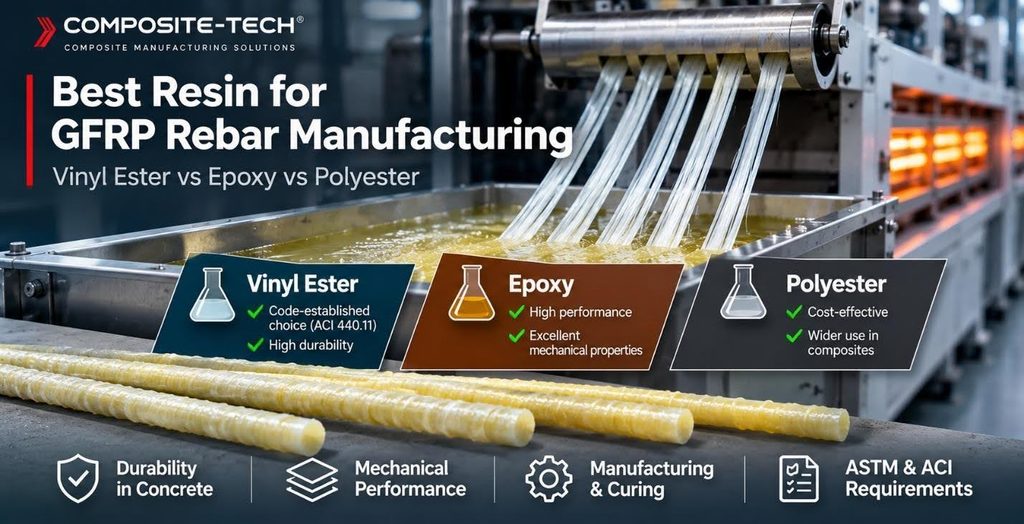
Why Does Resin Matter in Fiberglass Rebar?
GFRP stands for Glass Fiber Reinforced Polymer.
The material consists of two principal components:
- Fibres de verre, which provide most of the longitudinal tensile strength and stiffness.
- The polymer matrix, which surrounds the fibers and allows them to function as an integrated composite.
It is tempting to think that the glass fibers are responsible for nearly all the important properties of the reinforcement.
Ce n'est pas correct.
A fiber bundle without an appropriate polymer matrix would not behave like a finished GFRP reinforcing bar.
The resin contributes to several essential functions.
Load Transfer Between Fibers
The polymer matrix helps transfer stresses between individual glass filaments. A continuous glass fiber roving contains thousands of filaments. These fibers need to work together as part of the composite structure. If the resin does not penetrate the fiber bundle adequately, some filaments may not participate effectively in carrying load.
Protection Against Environmental Exposure
Concrete is not a chemically neutral environment. Its pore solution is typically highly alkaline. Over time, moisture and dissolved chemical species can interact with the reinforcing composite. The resin provides an important protective barrier, although its effectiveness depends on the formulation, quality of impregnation and long-term environmental conditions.
Maintaining Composite Geometry
During production, glass fibers are formed into a reinforcing bar with a specified cross-section and surface profile. Once cured, the resin helps maintain that geometry.
Influence on Thermal Performance
The polymer matrix has temperature-dependent mechanical characteristics. As temperature rises toward the resin system’s glass transition region, its stiffness and other properties may change significantly. This is one reason why glass transition temperature is an important property in GFRP product qualification.
Influence on Long-Term Durability
Exposure to moisture, alkaline solutions and elevated temperature can affect the polymer matrix and the fiber–matrix interface. The extent of deterioration depends on the complete composite system. A reinforcing bar with excellent initial tensile strength may still exhibit unacceptable performance after prolonged environmental exposure. For manufacturers, this means that resin selection cannot be separated from the intended application of the finished product.
The Three Main Resin Systems Used in GFRP Manufacturing
Vinyl ester, epoxy and polyester are all used in fiber-reinforced polymer manufacturing. However, they have different chemical structures and processing characteristics. The following comparison summarizes their practical significance.
Vinyl Ester vs Epoxy vs Polyester: Comparison Table
| Propriété | Vinyl Ester | Epoxy | Polyester |
| Use in composite manufacturing | Established | Established | Established |
| Typical material positioning | Structural and chemically resistant composites | High-performance and specialized composites | Economical general-purpose composites |
| Compatibility with continuous pultrusion | Formulation-dependent; widely used | Formulation-dependent | Formulation-dependent |
| Resistance to alkaline exposure | Favorable with suitable formulations | Can be favorable with suitable formulations | Often less favorable in comparative GFRP studies |
| Manufacturing cure requirements | Depend on selected formulation | Depend on selected formulation | Depend on selected formulation |
| Relative raw material economics | Formulation- and supplier-dependent | Often premium | Often economical |
| Suitability for ACI 440.11-22 GFRP applications | Within the established material framework when all requirements are met | Not automatically covered | Not within the established vinyl-ester framework |
| Main manufacturing consideration | Balance processing, durability and qualification | Validate cure, processing and application acceptance | Carefully assess durability and market requirements |
This table describes general characteristics of resin families. Specific products may behave differently, and no resin designation alone guarantees compliance or durability.
The differences become clearer when we examine each material separately.
Vinyl Ester Resin: The Established Choice for Structural GFRP Rebar
Vinyl ester resins occupy an important position in the manufacture of composite reinforcement. They combine processing characteristics suitable for continuous composite production with chemical and physical properties that can support demanding applications. In particular, properly formulated vinyl ester systems have demonstrated favorable performance in research involving alkaline environments. This matters because reinforcing bars are expected to remain embedded in concrete for many years.
Unlike a composite component used indoors under controlled conditions, a reinforcing bar may experience prolonged exposure to moisture, alkaline pore solutions and temperature changes. The resin must therefore contribute to the long-term integrity of the composite.
What Makes Vinyl Ester Attractive?
One important advantage is the balance between processing and performance. Suitable vinyl ester formulations can be used in continuous procédés de fabrication where fiber impregnation and controlled thermal curing are required. They also have an established history in corrosion-resistant composite applications.
However, not all vinyl ester resins are identical. Two commercial formulations may differ in viscosity, cure behavior, thermal properties and long-term durability.
A manufacturer should evaluate the specific resin grade, not simply the words vinyl ester on the supplier’s label.
Why Standards Matter
The American Concrete Institute’s ACI CODE-440.11-22 establishes requirements for structural concrete reinforced with qualifying GFRP bars. Its scope is based on solid, round GFRP bars manufactured with vinyl ester polymer matrices and conforming to the referenced edition of ASTM D7957/D7957M.
This is an important distinction.
A manufacturer may be capable of producing a technically sound reinforcing bar using another resin system. But that does not automatically mean the product falls within the material scope of ACI 440.11-22.
For a factory entering the U.S. construction market, the intended code-compliance route should therefore influence resin selection from the beginning.
A production line should not be commissioned around a resin formulation before the manufacturer understands which product specifications and design provisions its customers will require.
Epoxy Resin: High Performance, but Not Automatically Interchangeable
Epoxy resins are widely used in advanced composite materials. Their properties can be tailored through resin chemistry, curing agents and processing conditions. They are found in aerospace components, industrial structures, composite profiles and many other applications. Epoxy systems can provide excellent mechanical characteristics and environmental performance when appropriately formulated and processed.
Research has also examined epoxy-based GFRP reinforcing bars for concrete applications.
What Does Research Show?
A study published in Composites Part B: Engineering in 2017 compared GFRP bars manufactured using vinyl ester, epoxy and polyester resin systems.
The researchers evaluated mechanical and physical properties and investigated durability under accelerated alkaline exposure. In that particular experimental program, the vinyl ester and epoxy bars demonstrated more favorable performance and lower degradation than the polyester bars.
This is an important result. It demonstrates that the resin family influences the behavior of the finished reinforcement. However, it does not mean that every epoxy formulation will outperform every vinyl ester formulation.
The performance of a GFRP bar depends on the resin grade, reinforcing fiber, interface characteristics and manufacturing conditions.
Manufacturing Considerations for Epoxy
Epoxy resins can require different processing conditions from vinyl ester systems.
Depending on the formulation, the manufacturer may need to adjust:
- Resin temperature and viscosity;
- Mixing and material preparation;
- Available processing time;
- Fiber impregnation conditions;
- Thermal curing schedule;
- Production speed;
- Post-curing requirements.
The production equipment must be capable of maintaining appropriate conditions throughout the process. For manufacturers, an epoxy system should be selected because its verified properties are required by the target application. It should not be chosen solely because it is described as a premium resin.
The U.S. Standards Question
There is another important consideration. The current ACI 440.11-22 design framework is associated with GFRP bars using vinyl ester polymer matrices. An epoxy-based product therefore requires separate consideration of the applicable specifications, design rules and project acceptance requirements.
A technically successful manufacturing process and acceptance under a particular structural design code are different matters.
This distinction should be understood before investing in commercial production.
Polyester Resin: Lower Initial Cost Does Not Guarantee Lower Lifetime Cost
Polyester resins are among the most familiar materials in the composites industry. They are used in fiberglass panels, tanks, profiles, molded products and numerous industrial components.
Certain polyester formulations can offer attractive raw material economics and relatively straightforward processing. This makes them interesting to manufacturers focused on minimizing initial material expenses. However, producing reinforcement for concrete involves requirements that are different from those for many general-purpose fiberglass products.
The Problem with Alkaline Exposure
Several published investigations have examined the behavior of GFRP bars made with polyester, vinyl ester and epoxy matrices. In a frequently cited 2017 study, polyester-based GFRP bars exhibited greater deterioration after accelerated alkaline conditioning than the corresponding vinyl ester and epoxy systems evaluated in the same program.
The researchers observed less favorable mechanical and physical performance in the polyester bars. Other studies have also reported increased degradation in selected polyester-based reinforcement systems. This does not establish that every polyester resin is unsuitable for every composite application.
It means that manufacturers should be cautious about using conventional polyester systems for structural reinforcement exposed to concrete environments.
Why Resin Purchase Price Can Be Misleading
Imagine a manufacturer comparing two resin suppliers. One offers a lower price per kilogram. The other offers a formulation that is more expensive but has better demonstrated durability and satisfies the relevant product qualification requirements. Choosing the cheaper resin may initially appear economically attractive. But what happens if the resulting reinforcement cannot meet the mechanical, thermal or durability requirements demanded by customers?
The manufacturer may face rejected production, additional testing, limited market access or the need to reformulate the product.
In such a case, the lower raw material price does not translate into a lower cost of commercially acceptable reinforcement.
Manufacturing economics should be calculated per meter of saleable, qualified product — not simply per kilogram of resin purchased.
What Scientific Research Says About Resin Durability
Resin selection is not merely a matter of manufacturer preference. It has been investigated through experimental studies involving different polymer systems and exposure conditions. One particularly useful study was conducted by researchers including Brahim Benmokrane, Ahmed H. Ali and their colleagues.
Published in 2017, the investigation compared glass-fiber reinforcing bars manufactured with three different resin matrices:
- Vinyl ester;
- Epoxy;
- Isophthalic polyester.
The bars were subjected to accelerated alkaline exposure at elevated temperature. The researchers then evaluated changes in their physical and mechanical properties. Their findings showed that the vinyl ester and epoxy systems investigated retained properties more favorably than the tested polyester system.
The study was especially valuable because it addressed the behavior of finished reinforcing bars rather than merely comparing isolated resin samples.
Why This Matters
The durability of a reinforcing bar cannot be established by testing resin alone. The complete composite includes the fibers, polymer matrix and interface between them. Moisture and chemical exposure may influence the way stresses are transferred between the fibers. Consequently, degradation can affect mechanical performance even when the bar appears relatively unchanged.
More recent studies have continued investigating these mechanisms. Research published in Construction and Building Materials in 2024 examined the durability of GFRP bars containing epoxy, vinyl ester and polyester matrices under accelerated environmental conditions and sustained loading.
The results again demonstrated that the choice of polymer matrix can influence the retention of mechanical properties. But there is an important limitation to every accelerated-aging experiment. Laboratory exposure at elevated temperature does not provide a universal prediction of service life for every concrete structure. The results must be interpreted in relation to the tested materials, exposure conditions and assumptions.
For professional manufacturers, the practical conclusion is clear:
Select a resin system using relevant durability evidence, and verify the finished product under the applicable qualification requirements.
Why Resin Selection Changes the Manufacturing Process
So far, we have considered the properties of the finished reinforcement. But resin selection also influences what happens inside the factory. Barres d'armature en PRFV is generally manufactured through a continuous composite process. Glass fiber rovings are prepared, impregnated with resin, formed into reinforcing bars, given the required surface profile, cured and cooled. The material moves through these stages continuously. For industrial production, all operations must remain synchronized. This becomes more challenging as the line speed increases.
Resin Viscosity and Impregnation
Resin viscosity affects how easily the polymer can penetrate a bundle of glass fibers. A highly viscous formulation may require different processing conditions from a lower-viscosity system. Temperature, fiber sizing, mechanical action and the configuration of the impregnation equipment can influence wet-out. However, lower viscosity is not automatically better. The manufacturer must consider the entire formulation and process, including its effect on resin retention and subsequent curing.
Processing Time
Thermosetting resins have a limited processing window after the curing reaction has been initiated. The useful processing time depends on the chemistry and manufacturing conditions. A resin that begins reacting too quickly may create difficulties in the impregnation system. A formulation with a poorly matched curing response may require changes to the thermal processing stages.
Curing Characteristics
Curing converts the liquid resin system into a solid polymer matrix. Different formulations require different combinations of temperature and time. The correct heating schedule must be established for the selected material and reinforcement geometry. A thicker bar may require different processing conditions from a smaller bar because heat must reach the required regions of the composite.
Production Speed
The faster a reinforcing bar moves through the heating sections, the shorter its residence time. This creates an important relationship between resin chemistry and equipment productivity. A production line may have sufficient mechanical pulling capacity to operate at a particular speed. But if the resin cannot achieve the required degree of cure under those conditions, the finished product may not be acceptable.
The maximum mechanical speed of a production line is not necessarily the maximum speed at which qualified reinforcement can be manufactured.
This distinction is fundamental to evaluating Équipement de production GFRP.
How Composite-Tech Addresses Resin Impregnation and Curing
Composite-Tech develops industrial production equipment intended to control the stages that influence the quality of fiber-reinforced polymer reinforcement. The company’s CT6 New Generation incorporates specialized systems for fiber preparation, impregnation, surface formation, polymerization and cooling. These processes are particularly relevant when manufacturers need to operate at industrial production speeds.
Ultrasonic-Assisted Resin Impregnation
A continuous glass fiber roving contains numerous individual filaments. The resin must penetrate the bundle sufficiently to create a consistent composite structure.
Composite-Tech’s CT6 New Generation uses an ultrasonic-assisted impregnation system. According to the company’s documentation technique, ultrasonic treatment is integrated into the impregnation module to assist resin penetration.
The system also incorporates a pneumatic squeezing mechanism designed to control excess polymer binder.
This creates two related processing objectives.
- First, the fibers must receive adequate impregnation.
- Second, the manufacturer must control the quantity of resin retained in the composite.
Both are important.
Insufficient impregnation can create defects. Excessive resin consumption can increase manufacturing expenses without necessarily improving the finished product. The appropriate operating settings must be established for each fiber and resin combination.
Short-Wave Infrared Heating
After impregnation and surface formation, the reinforcing bars enter the thermal processing stages. CT6 New Generation includes a short-wave infrared heating module before the principal curing ovens. This additional heating stage is designed to support the initial polymerization process. It forms part of the overall thermal treatment system.
The objective is to achieve suitable curing conditions while maintaining the required continuous production speed. However, infrared heating does not eliminate the need to validate the curing schedule. Manufacturers must verify that the selected resin achieves the required properties under actual production conditions.
Five Controlled Curing Ovens
The CT6 New Generation configuration incorporates five curing ovens. These heating sections provide additional thermal treatment as the reinforcement moves through the production line. The operating temperatures and line speed must be coordinated with the resin formulation. This is why the production process should be developed around the selected material system rather than assuming that one temperature profile will work for every resin.
Two-Stage Cooling
After curing, the reinforcement must be cooled before finishing. Composite-Tech uses a two-stage cooling arrangement. The bars first pass through air cooling and then through water cooling. This process is designed to manage temperature reduction and limit the risk of damage associated with abrupt thermal changes. As with impregnation and curing, cooling conditions must be appropriate for the selected composite.
Together, these technologies provide a coordinated manufacturing system.
The objective is not simply to manufacture reinforcement faster. It is to produce consistent reinforcement at a commercially useful speed.
How Resin Chemistry Influences CT6 Production Capacity
Composite-Tech’s CT6 New Generation is designed to manufacture up to six reinforcing bars simultaneously. The actual number of active bars and their production speed depend on the diameter.
According to the CT6 New Generation installation and operation manual dated July 17, 2026, the equipment has the following indicative maximum production capacities.
CT6 New Generation: GFRP Production Capacity
| Rebar Diameter | Simultaneous Bars | Combined Production Speed |
| 4 mm | 6 | Up to 48 m/min |
| 6 mm | 6 | Up to 42 m/min |
| 8 mm | 6 | Up to 39.6 m/min |
| 10 mm | 6 | Up to 36 m/min |
| 12 mm | 4 | Up to 16 m/min |
| 14 mm | 3 | Up to 10.5 m/min |
| 16 mm | 2 | Up to 6 m/min |
| 18 mm | 1 | Up to 2.5 m/min |
| 20 mm | 1 | Up to 2 m/min |
Source: Composite-Tech CT6 New Generation Installation and Operation Manual, IME.005, July 2026.
These figures represent manufacturer-declared indicative maximum performance. The manual specifically notes that production speeds depend on the polymerization characteristics of the resin and environmental parameters. This qualification is important.
For example, the documented maximum combined output at 10 mm is 36 meters per minute. That corresponds to six reinforcing bars moving through the production line at up to 6 meters per minute each. But achieving that output requires the entire process to remain compatible with the selected resin formulation. The glass fibers must be impregnated adequately. The surface profile must remain consistent. The polymer must achieve the required cure. The bars must be cooled and handled without introducing unacceptable defects.
If any one of these operations becomes a limiting factor, the process settings must be adjusted.
For manufacturers, the important question is therefore not simply:
How fast can the machine run?
It is:
At what validated production speed can the machine consistently manufacture reinforcing bars that meet the required product specification?
This is a much more useful measure of industrial performance.
ASTM D7957 and ACI 440.11: What Manufacturers Must Understand
For companies planning to manufacture GFRP reinforcement for the United States, product qualification is a major consideration. Two documents are especially relevant.
ASTM D7957/D7957M
ASTM D7957/D7957M establishes requirements for qualifying GFRP reinforcing bars intended for concrete reinforcement. The 2026 edition addresses the geometric, material, mechanical and physical properties of qualifying bars.
These include characteristics such as:
- Fiber mass content;
- Glass transition temperature;
- Degree of cure;
- Tensile properties;
- Transverse shear properties;
- Bond strength;
- Dimensional characteristics;
- Qualification and production quality control.
The existence of these requirements demonstrates why a manufacturer’s choice of resin and processing conditions matters. Producing a bar with an acceptable external appearance is not sufficient. The finished product must satisfy the applicable specification.
Code ACI-440.11-22
ACI 440.11-22 establishes requirements for structural concrete reinforced with qualifying GFRP bars within its scope. The code references ASTM D7957/D7957M-22.
The American Concrete Institute’s companion design handbook explains that the code’s material framework is limited to solid, round GFRP reinforcement manufactured with vinyl ester polymer matrices. This means that manufacturers should distinguish between the publication of a newer ASTM edition and the edition incorporated into an applicable design code.
The latest ASTM publication does not automatically replace the edition referenced by an adopted building code.
A manufacturer should therefore confirm the relevant code edition, product standard and project requirements before making resin-selection and qualification decisions.
Can Epoxy or Polyester GFRP Rebar Be Manufactured?
Yes. Both resin families have been used experimentally and commercially in composite reinforcement manufacturing. But the ability to manufacture a reinforcing bar does not establish its acceptance under ACI 440.11-22.
Other material systems may be suitable for particular applications or projects subject to their own technical requirements and approval processes.
Can the Production Machine Be ASTM-Certified?
This question is sometimes misunderstood.
ASTM D7957 is a product specification for qualifying reinforcing bars. It is not a certification standard for an entire production machine.
A production line may be designed to manufacture reinforcement capable of meeting the specification. However, compliance must be demonstrated through the finished product, applicable testing, quality control and relevant documentation.
For manufacturers entering regulated construction markets, that distinction is essential.
How to Evaluate a Resin Before Starting Commercial Production
Selecting a resin should be treated as part of the overall product-development and manufacturing qualification process. An effective evaluation begins with the target market. A manufacturer supplying reinforcement for ordinary industrial products may have different requirements from one supplying structural concrete projects governed by specific design standards.
The selected resin must be compatible with both the intended product and the available manufacturing equipment.
Resin Selection Checklist
| Evaluation Criterion | Pourquoi c'est important |
| Intended application | Determines required material performance |
| Applicable product standard | Establishes qualification requirements |
| Design code and project acceptance | Influences market eligibility |
| Resin chemistry | Determines the basic polymer matrix system |
| Fiber compatibility | Influences impregnation and the fiber–matrix interface |
| Viscosity and processing characteristics | Affect continuous impregnation |
| Curing behavior | Determines suitable thermal processing conditions |
| température de transition vitreuse | Relevant to thermal performance and qualification |
| Degré de guérison | Indicates whether the polymerization process has reached the required state |
| Environmental durability | Influences long-term property retention |
| Production stability | Influences repeatability and rejected material |
| Finished-product testing | Provides evidence of actual performance |
| Manufacturing cost per qualified meter | Determines commercial competitiveness |
The manufacturer should evaluate these factors as a connected system. For example, a resin may offer attractive laboratory properties but require a curing schedule that is incompatible with the intended production rate. Another resin may process efficiently but fail to meet the durability requirements of the target application.
The most appropriate formulation is the one that satisfies the relevant requirements while supporting a stable and economically viable process.
Why Resin Cost Should Be Calculated per Saleable Meter
For a new GFRP manufacturing business, raw material prices are important. However, the relationship between resin price and finished-product cost is not straightforward. A lower purchase price per kilogram does not guarantee a lower manufacturing cost per meter.
The amount of resin retained in the finished composite matters. So does the percentage of manufactured reinforcement that passes quality control.
Consider two hypothetical production processes.
- In the first, the manufacturer purchases an inexpensive resin but experiences inconsistent impregnation and frequent production interruptions.
- In the second, a more suitable resin system allows the manufacturer to maintain stable processing and produce a higher proportion of acceptable reinforcement.
The second process may have better manufacturing economics even if its resin purchase price is higher.
This is why professional production analysis should consider:
- Raw material consumption per meter.
- Energy consumption per meter.
- Labor requirements per meter.
- Production yield.
- Rejected-product volume.
- The cost of maintaining the required product specifications.
A good manufacturing system must address all these factors.
For investors evaluating industrial GFRP equipment, this provides a more meaningful basis for comparing technologies de production than equipment price alone.
The Future of Resin Technology in FRP Reinforcement
Research into composite reinforcement continues to develop. Although conventional thermosetting systems remain important, researchers are also investigating alternative polymer matrices.
Thermoplastic composites are one area of interest. Unlike conventional thermosetting polymers, certain thermoplastics can soften when heated and potentially be reprocessed under suitable conditions. This creates possibilities for alternative manufacturing methods and end-of-life processing. However, thermoplastic reinforcement should not be assumed to be equivalent to conventional vinyl ester GFRP bars. Its processing conditions, long-term behavior and qualification requirements must be evaluated separately.
Other developments involve modifications to resin chemistry, improved fiber–matrix interfaces and methods intended to increase durability.
For equipment manufacturers, these developments reinforce the importance of flexible processing technology. A production system should allow engineers to control the relevant parameters rather than relying on a fixed recipe that may become unsuitable as materials evolve. At the same time, new materials must be supported by sufficient experimental evidence. For structural reinforcement, long-term reliability matters more than novelty.
Why the Right Production Equipment Matters
Choosing an appropriate resin is essential. But even an excellent resin system cannot compensate for fundamentally inadequate manufacturing conditions.
- Poor impregnation can create internal defects.
- Insufficient curing can compromise material properties.
- Uncontrolled cooling can introduce additional manufacturing problems.
- Inconsistent pulling and surface formation can affect product geometry.
These risks must be addressed through equipment design and process control.
Composite-Tech develops manufacturing equipment intended to coordinate these operations within a continuous industrial process. Its CT6 New Generation combines multi-bar production with ultrasonic-assisted impregnation, controlled resin squeezing, short-wave infrared heating, multiple curing zones and two-stage cooling.
The purpose of this integrated approach is to support reliable processing at commercially useful production speeds. For manufacturers, the value of such technology lies in the ability to establish repeatable manufacturing conditions. However, equipment capability does not replace product development. Each resin and fiber combination must be evaluated under the intended processing conditions. Finished reinforcement must then be tested against the relevant requirements.
Successful GFRP manufacturing begins with compatible materials, continues through controlled production and ends with verified product quality.
Choosing the Right GFRP Manufacturing Technology
Manufacturing fiberglass rebar involves much more than combining glass fibers and polymer resin. The two materials must form a consistent composite structure. The resin must be compatible with the fibers. The impregnation process must provide sufficient wet-out. The curing system must develop the required polymer properties. And the finished reinforcement must meet the specifications demanded by its intended market.
For manufacturers planning to establish or expand GFRP production, these requirements should guide equipment selection. Composite-Tech develops industrial manufacturing systems for glass and other fiber-reinforced polymer reinforcement. Its CT6 New Generation is designed for high-output production using specialized impregnation, curing, cooling and automated processing technologies.
Planning a GFRP rebar manufacturing project?
Composite-Tech can assist with production equipment selection, factory configuration and the technical requirements of establishing an industrial composite reinforcement production line.
Contact our team to discuss the intended reinforcement diameters, fiber type, resin system and required production capacity.
Composite-Tech — Advanced Manufacturing Technology for Fiber-Reinforced Polymer Reinforcement.
Conclusion
The selection of resin is one of the most consequential decisions in GFRP rebar manufacturing. Vinyl ester, epoxy and polyester systems have different chemical characteristics, processing requirements and documented performance histories.
For manufacturers targeting structural concrete applications under the existing ACI 440.11-22 framework, vinyl ester is the established choice. Epoxy can offer attractive performance for suitable composite applications, but the relevant qualification and design requirements must be considered. Polyester remains important in the wider composites industry, although its use in durable concrete reinforcement requires particular attention to environmental performance and applicable standards.
Ultimately, the best resin cannot be selected from a price list alone. It must be evaluated as part of the complete reinforcing system.
The reinforcing fiber determines much of the composite’s tensile performance. The resin helps those fibers work together and protects the structure they form. The manufacturing process determines how successfully those materials become a finished product.
A reliable GFRP reinforcing bar requires all three. And for manufacturers seeking to build a competitive business, that is where the real engineering begins.
Frequently Asked Questions About GFRP Rebar Resins
What type of resin is used to manufacture fiberglass rebar?
GFRP rebar has been manufactured using vinyl ester, epoxy and polyester thermosetting resins. The appropriate system depends on the intended application, manufacturing process and applicable product requirements. Vinyl ester is the established matrix within the ACI 440.11-22 structural GFRP framework.
Is vinyl ester better than epoxy for GFRP rebar?
Not universally. Both resin families can provide favorable properties when properly formulated. Some published studies have demonstrated good durability for both systems. However, vinyl ester has an important advantage for manufacturers targeting applications within the existing ACI 440.11-22 framework.
Can polyester resin be used to manufacture GFRP rebar?
Polyester resins can be used to manufacture fiberglass composites, including certain reinforcement products. However, several studies have reported greater degradation in polyester-based GFRP bars under accelerated alkaline exposure than in the evaluated vinyl ester and epoxy systems. The intended product requirements must be checked before selecting polyester.
Pourquoi l'imprégnation de résine est-elle importante ?
Resin impregnation determines how effectively the polymer matrix penetrates the glass fiber bundle. Insufficient impregnation can create dry regions, voids and inconsistent composite properties.
Does resin selection affect GFRP production speed?
Yes. Resin chemistry and curing characteristics influence the appropriate processing conditions. Production speed must be compatible with impregnation, polymerization and cooling requirements.
What is glass transition temperature in GFRP rebar?
Glass transition temperature, commonly abbreviated Tg, describes the temperature region where an amorphous polymer matrix undergoes a significant change in molecular mobility and mechanical behavior. It is one of the physical properties considered in GFRP product qualification.
Does a higher Tg always mean a better resin?
No. Tg is important, but it is only one property. A resin must also be evaluated for durability, fiber compatibility, mechanical characteristics, processing behavior and applicable qualification requirements.
Can a high-speed GFRP machine work with different resin systems?
A suitably designed production system may accommodate different compatible formulations through appropriate process settings. However, the achievable speed and finished-product quality must be validated for each resin system.
Does ASTM D7957 certify GFRP production equipment?
No. ASTM D7957/D7957M is a product specification for qualifying GFRP reinforcing bars. Compliance must be demonstrated through the finished reinforcement and applicable testing and quality control procedures.
How does Composite-Tech improve resin impregnation?
Composite-Tech’s CT6 New Generation incorporates ultrasonic-assisted impregnation and a pneumatic squeezing mechanism. These systems are designed to support resin penetration and control excess polymer binder during continuous manufacturing.
Technical References
- ASTM International. ASTM D7957/D7957M-26. Standard Specification for Glass Fiber Reinforced Polymer (GFRP) Bars for Concrete Reinforcement.
- American Concrete Institute. ACI CODE-440.11-22. Building Code Requirements for Structural Concrete Reinforced with Glass Fiber-Reinforced Polymer (GFRP) Bars.
- American Concrete Institute / NEx. GFRP-Reinforced Concrete Design Handbook, MNL-7(23), 2023.
- Benmokrane, B., Ali, A. H., Mohamed, H. M., ElSafty, A., and Manalo, A. (2017). Laboratory Assessment and Durability Performance of Vinyl-Ester, Polyester, and Epoxy Glass-FRP Bars for Concrete Structures. Composites Part B: Engineering, 114, 163–174. DOI: 10.1016/j.compositesb.2017.02.002.
- Research article. (2024). Durability Assessment of GFRP Bars Embedded in UHP-ECCs Subjected to an Accelerated Aging Environment with Sustained Loading. Construction and Building Materials. DOI: 10.1016/j.conbuildmat.2024.135364.
- Composite-Tech. CT6 New Generation Installation and Operation Manual, IME.005, July 17, 2026.
Apprendre encore plus: