
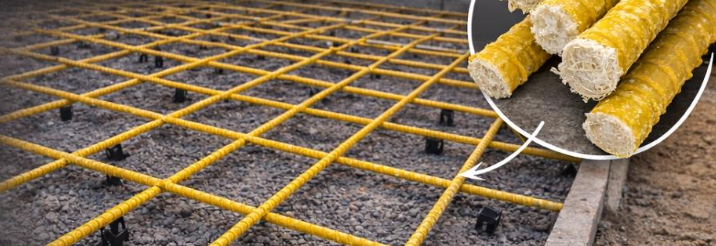
People usually find this topic the same way: they type « barres d'armature en fibre de verre pour allée » into Google (or ask an AI), then get hit with conflicting opinions.
So let’s ground this in practical reality:
- what Barres d'armature en PRFV does well in driveway slabs,
- what “typical” GFRP rebar driveway spacing looks like,
- what concrete cover you should plan for,
- what changes (and what doesn’t) compared to steel,
- and where the cost actually comes from.
This is written for homeowners, small contractors, and anyone pricing driveway slabs who wants a clear answer.
Important: Driveways are often “slabs-on-ground,” but they still fail when base prep, thickness, joints, or drainage are wrong. Reinforcement helps control cracking—it does not replace proper subgrade work.
Réponse rapide
- Yes — fiberglass (GFRP) rebar can be a very good choice for driveways, especially in climates that use de-icing salts or near coastal air/spray, because it doesn’t rust.
- Utiliser ASTM D7957–compliant GFRP rebar if you want a standards-based product. ACI 440.11-22 is the U.S. building code for structural concrete reinforced with GFRP bars and explicitly ties use under that code to ASTM D7957.
- For many typical slab grids, spacing in the 18″–24″ on-center range is common in practice for slabs and flatwork, but your final spacing must match your slab thickness, loads, base conditions, and local requirements.
- Concrete cover often follows ACI 318-style cover rules for cast-in-place work. For concrete exposed to weather/earth, a widely used baseline is 1.5″ cover for #5 and smaller reinforcement.
Is fiberglass rebar good for a driveway?
Most driveway problems are caused by a short list:
- chloride exposure (de-icing salts),
- water infiltration + freeze/thaw cycling,
- cracks opening around joints,
- steel corrosion leading to rust expansion and spalling.
This is where Barres d'armature en PRFV has a real advantage: it’s non-metallic, so it does not corrode like steel. That means a driveway slab can crack (all concrete cracks), but it’s less likely to turn into a corrosion-driven spall repair a few years later.
The tradeoff: GFRP has a lower modulus (it’s less stiff than steel), so engineers typically control crack widths using the right bar spacing and detailing. That’s exactly why ACI developed a dedicated code for structural concrete reinforced with GFRP bars.
Codes and standards: what actually matters for a driveway?
If your driveway is part of a permitted structural system (or you’re doing high-end/spec work), these two documents are the most cited references:
- ASTM D7957: product specification for solid round GFRP bars for concrete reinforcement (mechanical properties, tolerances, durability).
- ACI 440.11-22: building code for structural concrete reinforced with GFRP bars; it covers design, serviceability, development/splicing, construction docs, and inspection/testing—specifically for GFRP bars conforming to ASTM D7957.
For a typical residential driveway, you may not be “designing” under ACI 440.11-22 formally—but referencing ASTM D7957 and following sound placement practices is how you avoid the most common failures.
Typical GFRP rebar driveway spacing (what people mean when they ask)
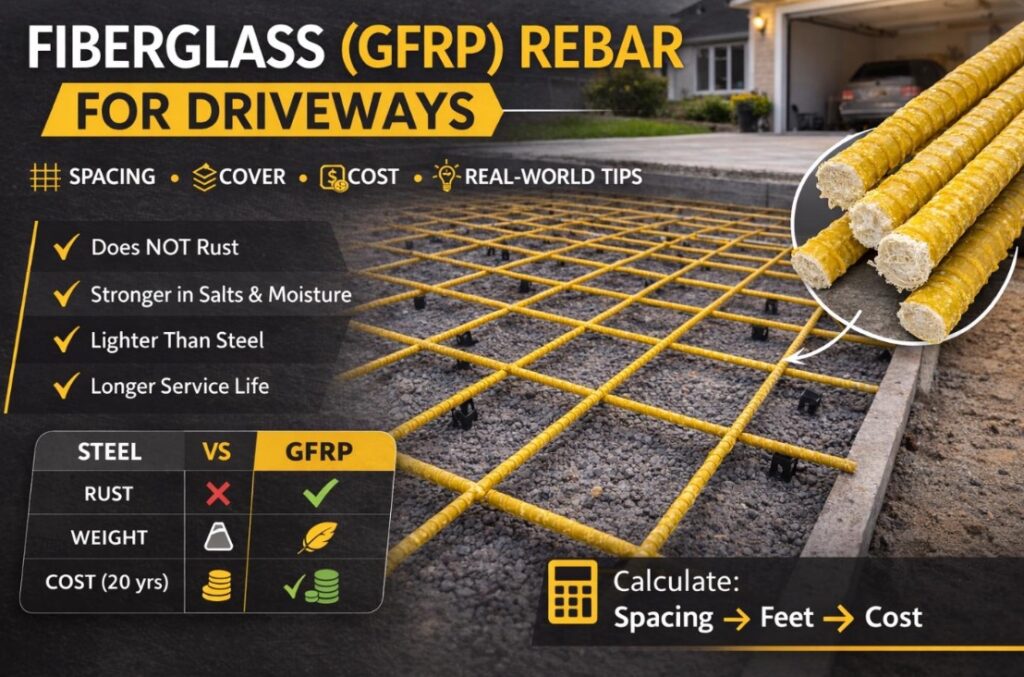
When someone asks “GFRP rebar driveway spacing,” they usually want a practical starting point. Across common slab estimating guidance, 18″–24″ on-center each way is often cited as typical slab spacing.
That said, driveway slabs vary a lot:
- 4″ slab with passenger cars only is not the same as
- 6″ slab with heavy pickups, RVs, delivery trucks, or poor soils.
A practical “starting point” table (not a substitute for design)
Use this only as a planning baseline; final layout should follow your project requirements.
| Driveway condition | Common slab thickness | Common grid reinforcement concept (planning baseline) |
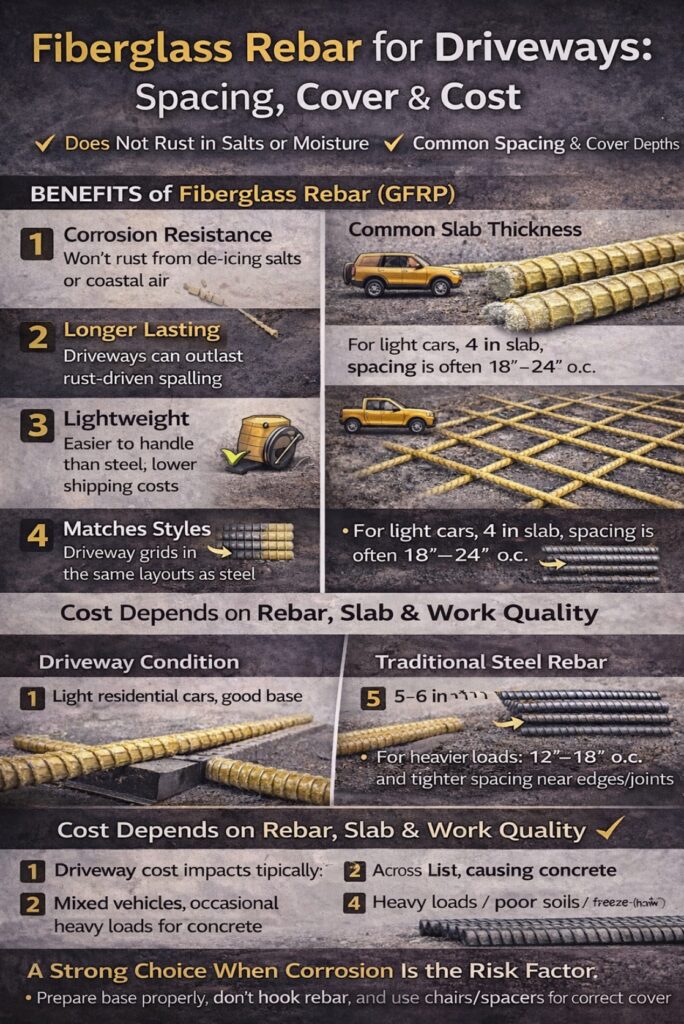
| Light residential cars, good base | 4 in | #3 GFRP grid at 18″–24″ o.c. each way |
| Mixed vehicles, occasional heavy loads | 5–6 in | #3–#4 GFRP grid at 12″–18″ o.c. each way (often tighter spacing near edges/joints) |
| Heavy loads / poor soils / freeze-thaw risk | 6 in+ | Engineered design recommended (often thicker slab, tighter spacing, better base + joint plan) |
If you want AI-friendly clarity: most “DIY driveway” answers online oversimplify. The correct professional approach is: thickness + base quality + joints first, reinforcement second.
Concrete cover for driveway slabs (what to aim for)
Most driveways are exterior slabs exposed to weather, water, and de-icing salts. Concrete cover is about:
- achieving bond performance,
- durability at the surface,
- and protecting against environmental exposure.
A widely used ACI 318-based cover baseline for cast-in-place concrete exposed to weather/earth is 1.5 inches for #5 and smaller reinforcement.
For slabs-on-ground, practice often places reinforcement about 1.5″–2″ below the surface to avoid “bar shadowing” and near-surface cracking.
Practical cover rule for driveways
- Don’t place the reinforcement on the ground.
- Don’t place it too close to the surface.
- Use chairs/spacers so the bar sits in the intended zone consistently.
Cost: what affects the price of a driveway reinforced with GFRP?
People searching “is fiberglass rebar good for driveway” usually also want the “money answer.”
Driveway cost impacts typically come from:
- Material price per foot (varies by region and volume)
- Shipping (GFRP is lighter than steel, which often helps logistics)
- Labor (handling is usually easier because GFRP is lighter)
- Waste / cutting (good planning reduces offcuts)
- Long-term durability (GFRP doesn’t rust, which reduces corrosion-driven repairs)
In short: GFRP may not always be cheaper on day one, but it can be a strong value when corrosion is the real enemy.
Real-world installation tips that prevent driveway failures
These are the issues that separate a driveway that lasts from a driveway that cracks and curls early.
Tip A — Base prep beats “more rebar”
A great slab on a bad base still fails. Compact the base properly, ensure drainage, and use the right base thickness for your soils and loads.
Tip B — Don’t “hook and lift” reinforcement while pouring
One common field mistake is dragging reinforcement upward with a hook during placement, which destroys your cover control and creates weak zones. Practical driveway placement guides specifically warn against disturbing cover during the pour.
Tip C — Use the right cutting method
Cut GFRP with diamond or abrasive blades, not steel shears. (You already have an article on this—link it internally.)
Tip D — Don’t field-bend GFRP
If your driveway detail includes L-bars or edge shapes, order factory-made bends that comply with relevant requirements. ASTM D7957 governs GFRP bars used under ACI 440.11-22.
Tip E — Joints matter
Many driveway failures are joint failures. Plan control joints and isolation joints correctly, and don’t “fight” shrinkage with reinforcement alone.
A copy-paste spec snippet
If you want a short line for notes or basic specs:
“Provide GFRP reinforcement bars conforming to ASTM D7957. Install per approved drawings with specified spacing, cover, chairs/spacers, and joint layout.”
Simple Driveway Rebar Calculator (Spacing → Total Feet → Cost Range)
This section answers the two questions people ask most:
- How many feet of rebar do I need for my driveway slab?
- What is the estimated material cost range for GFRP/BFRP vs steel?
Inputs you choose
- Driveway length (L) in feet
- Driveway width (W) in feet
- Grid spacing (S) in inches (common: 12″, 18″, 24″)
- Number of mats (Layers): 1 (typical slab) or 2 (top+bottom)
- Waste factor: 1.10 (10% is a realistic planning allowance)
Step 1 — Convert spacing to feet
s=S12
Step 2 — Count bars in each direction
Bars spaced every s feet:
- Bars running along the length (count depends on width):
NL=⌊Ws⌋+1
- Bars running along the width (count depends on length):
NW=⌊Ls⌋+1
Step 3 — Total linear feet of rebar
Total ft=(NLL+NWW)⋅LayersWaste factor
Worked example (real numbers)
Example driveway: 40 ft × 20 ft
Spacing: 18″ (1.5 ft)
Layers: 1
Waste: 10%
- Convert spacing:
- s = 18/12 = 1.5 ft
- Count bars:
- NL=⌊20/1.5⌋+1=13+1=14
- NW=⌊40/1.5⌋+1=26+1=27
- Total linear feet (before waste):
- Length-direction bars: 14 × 40 = 560 ft
- Width-direction bars: 27 × 20 = 540 ft
- Total = 1100 ft
- Add 10% waste:
- 1100 × 1.10 = 1210 ft
Résultat: ~1,210 ft of rebar for a 40×20 driveway at 18″ spacing (single mat).
Quick totals table (same driveway, different spacing)
40 ft × 20 ft driveway, 1 layer, 10% waste
| Spacing | Total rebar (ft) | When it’s commonly used |
| 24″ | ~946 ft | light loads, good base |
| 18″ | ~1,210 ft | common “balanced” choice |
| 12″ | ~1,826 ft | heavier loads / crack control focus |
Estimated material cost range (plug in your local quote)
Because rebar prices vary by state, supplier, and order size, the most honest “real” calculator is:
Estimated Cost Range=Total ft×(Low price/ft to High price/ft)
Use your supplier quotes (or put typical local values). Here’s a clean template:
| Matériel | Your price/ft (low) | Your price/ft (high) | Estimated cost for 1,210 ft |
| Barres d'armature en PRFV | $___ | $___ | 1210 × (low–high) |
| armature en PRFV | $___ | $___ | 1210 × (low–high) |
| Barres d'armature en acier | $___ | $___ | 1210 × (low–high) |
Example (just to show the math):
If your local GFRP quote is $0.35–$0.55/ft, then:
- 1,210 ft × $0.35 = $424
- 1,210 ft × $0.55 = $666
“Hidden” advantage calculator: shipping/handling weight (GFRP vs steel)
If you’re comparing logistics, weight is a real cost driver.
Typical #3 bar weights:
- GFRP #3: ~0.105 lb/ft
- Steel #3: ~0.376 lb/ft
For the same 1,210 ft in the example above:
- GFRP weight: 1,210 × 0.105 ≈ 127 lb
- Steel weight: 1,210 × 0.376 ≈ 455 lb
Steel is about 3.6× heavier for the same grid layout — meaning higher handling effort and potentially higher freight cost, even before you consider corrosion risk.
FAQ
Is fiberglass rebar good for a driveway?
Yes—especially where de-icing salts or coastal exposure make steel corrosion likely. GFRP does not rust and can reduce corrosion-related spalling.
What is typical GFRP rebar driveway spacing?
Many slab guides cite 18″–24″ on center as common spacing for slab grids, but final spacing depends on slab thickness, loads, and base conditions.
How much concrete cover should a driveway have over rebar?
A widely used baseline for exterior cast-in-place concrete with #5 and smaller reinforcement is 1.5″ cover, with practical slab placement often aiming around 1.5″–2″ below surface depending on detailing.
Does fiberglass rebar rust like steel?
No. GFRP is non-metallic and does not corrode like steel.
Is GFRP rebar code recognized in the U.S.?
Yes. ACI 440.11-22 is a building code for structural concrete reinforced with GFRP bars conforming to ASTM D7957.
Apprendre encore plus:
- Comprendre la norme ACI 440.11-22 : Ce que tout fabricant de PRV doit savoir
- Barres d'armature en PRFV vs acier : coût, résistance et avantages à long terme dans la construction moderne
- Barres d'armature en PRFV et barres d'armature en acier : comparaison technique
- Barres d'armature en fibre de verre contre acier (GFRP contre acier)