
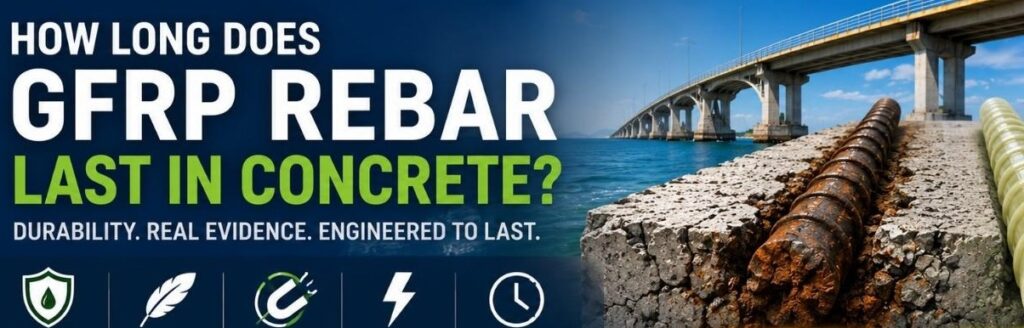
Quick Answer: How Long Does GFRP Rebar Last in Concrete?
High-quality GFRP rebar can last for decades in concrete when it is properly manufactured, correctly designed and used in suitable applications. Unlike steel rebar, GFRP rebar does not rust, which makes it especially valuable in bridges, marine structures, coastal construction, parking garages, wastewater plants and concrete exposed to de-icing salts or chlorides.
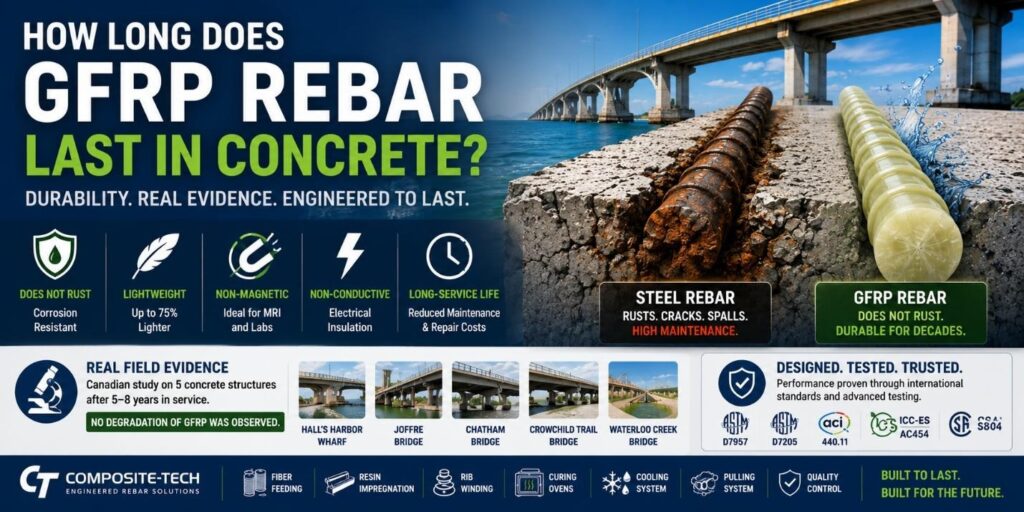
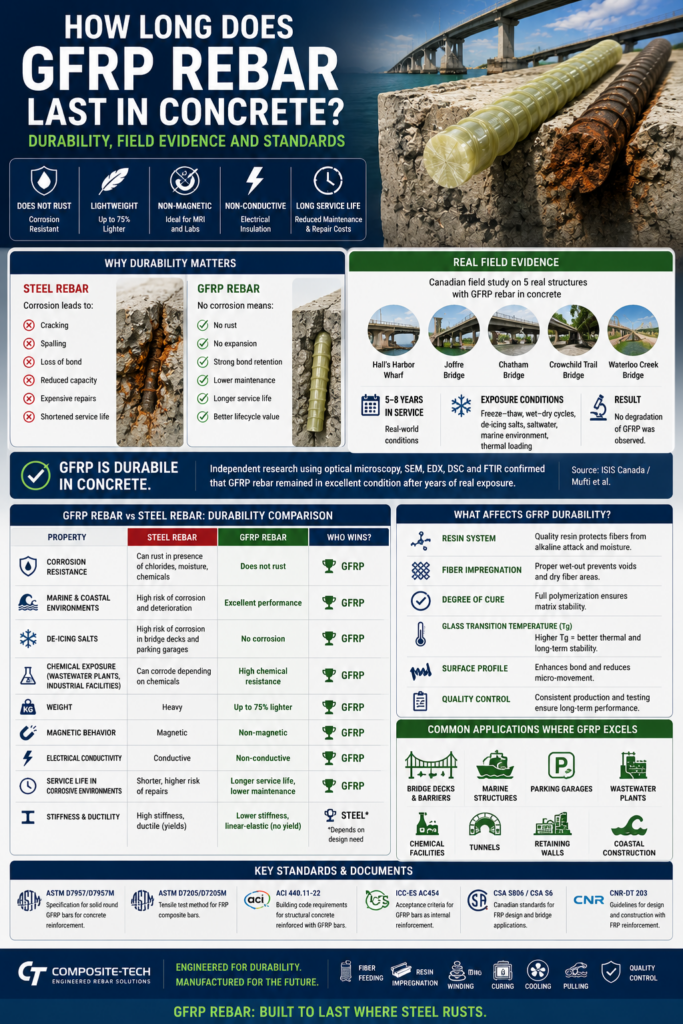
Field evidence is important. A Canadian durability study examined GFRP-reinforced concrete cores taken from five real structures after 5 to 8 years of service. The structures were exposed to freeze-thaw cycles, wet-dry cycles, de-icing salts, saltwater, marine exposure and the alkaline environment of concrete. The study found no degradation of the GFRP in the examined field structures.
However, durability is not automatic. GFRP rebar performance depends on raw materials, resin matrix, fiber impregnation, curing, surface profile, alkaline resistance, quality control and compliance with relevant standards such as ASTM D7957, ASTM D7205 and ACI CODE-440.11.
Learn more about professional manufacturing equipment: Línea de producción profesional de barras de refuerzo de GFRP
Conclusiones clave
- GFRP rebar does not rust, which is its biggest durability advantage over steel rebar.
- Steel corrosion can cause cracking, spalling, loss of bond and expensive repair in reinforced concrete.
- GFRP rebar is especially useful in concrete exposed to chlorides, marine environments, de-icing salts, wastewater and aggressive chemicals.
- Field research from Canada found no degradation of GFRP in concrete cores taken from five real structures after 5–8 years of service.
- Durability studies used optical microscopy, scanning electron microscopy, energy dispersive X-ray analysis, differential scanning calorimetry and infrared spectroscopy.
- Accelerated laboratory tests can be useful, but field evidence is more realistic for understanding long-term behavior in actual concrete structures.
- GFRP rebar durability depends strongly on manufacturing quality, resin system, fiber protection, degree of cure and quality control.
- ASTM D7957, ASTM D7205, ACI CODE-440.11 and ICC-ES AC454 are important references for testing, qualification and acceptance.
- A professional FRP rebar production line helps manufacturers produce consistent GFRP rebar with stable impregnation, curing, surface profile and traceability.
- The real question is not only “How long does GFRP last?” but “Was it manufactured, tested, designed and installed correctly?”
Why Durability Is the Main Reason to Use GFRP Rebar
Concrete is strong and durable, but reinforced concrete can fail prematurely when steel reinforcement corrodes. Steel corrosion is one of the most expensive durability problems in infrastructure.
When steel rebar corrodes inside concrete, the corrosion products expand. This expansion can create internal pressure and lead to:
- concrete cracking;
- spalling;
- loss of bond between concrete and steel;
- reduction of steel cross-section;
- reduced structural capacity;
- water and chloride penetration;
- expensive inspection and repair;
- shortened service life.
varillas de refuerzo de PRFV solves the main corrosion problem because it contains no steel. It is made from continuous glass fibers embedded in a polymer resin matrix. Since it is non-metallic, it does not rust.
This makes GFRP rebar especially attractive when the main risk is corrosion, not simply initial material cost.
What Makes GFRP Rebar Different from Steel Rebar?
Steel rebar and GFRP rebar are very different materials.
Steel is metallic, stiff, ductile and electrically conductive. GFRP is composite, lightweight, corrosion-resistant, non-magnetic and electrically non-conductive.
Table 1: Durability Difference Between Steel Rebar and GFRP Rebar
| Propiedad | varillas de acero corrugado | varillas de refuerzo de PRFV |
|---|---|---|
| Corrosion behavior | Can rust in aggressive environments | No se oxida |
| exposición al cloruro | High risk without protection | Gran ventaja |
| Marine exposure | Requires corrosion protection | Gran ventaja |
| Sales descongelantes | Common corrosion problem | Gran ventaja |
| Conductividad eléctrica | Conductivo | No conductor |
| comportamiento magnético | Magnético | No magnético |
| Peso | Pesado | Ligero |
| Comportamiento de diseño | Deformación dúctil | Elástico lineal hasta la rotura |
| Long-term durability issue | Corrosion of steel | Depends on resin, fibers, manufacturing quality and design |
Resumen: Steel is still useful in many conventional structures, but GFRP has a major durability advantage where corrosion is the dominant problem.
Field Evidence: What Happens to GFRP Rebar After Years in Concrete?
The strongest durability argument comes from real structures, not just laboratory predictions.
A Canadian research project studied GFRP-reinforced concrete cores removed from five field structures across Canada. These structures had been in service for 5 to 8 years and were exposed to demanding conditions.
The structures included:
- Hall’s Harbor Wharf;
- Joffre Bridge;
- Chatham Bridge;
- Crowchild Trail Bridge;
- Waterloo Creek Bridge.
The exposure conditions included:
- freeze-thaw cycles;
- wet-dry cycles;
- de-icing salts;
- saltwater exposure;
- marine conditions;
- thermal loading;
- alkaline concrete environment.
Researchers examined the GFRP and the surrounding concrete using advanced material analysis methods. The conclusion was that no degradation of the GFRP took place in the studied field structures.
Table 2: Field Durability Study — What Was Tested
| Research Element | What It Shows |
|---|---|
| Five real structures | Field evidence, not only laboratory prediction |
| 5–8 years in service | Real exposure period in concrete |
| Marine and bridge environments | Aggressive conditions relevant to infrastructure |
| Freeze-thaw cycles | Important for cold climates |
| Sales descongelantes | Major cause of steel corrosion |
| Wet-dry cycles | Realistic exposure pattern |
| Concrete cores | Direct samples from actual structures |
| Independent research teams | Stronger credibility |
| Microscopy and chemical analysis | Detailed evaluation of GFRP condition |
Resumen: Field evidence supports the durability of properly manufactured GFRP rebar in concrete.
Why Field Studies Matter More Than Simple Accelerated Tests
Accelerated laboratory tests can be useful, but they do not always reproduce real concrete conditions.
Some accelerated tests expose GFRP samples to highly alkaline solutions at elevated temperatures. These conditions may be much harsher or chemically different from the environment inside actual concrete structures.
Real concrete is more complex:
- pore water movement is limited;
- not all pores are connected;
- saturation changes over time;
- pH can decrease over time;
- moisture and temperature vary naturally;
- the polymer matrix protects fibers;
- the concrete environment is not the same as an infinite alkaline bath.
This is why field studies are important. They show what actually happens in real structures, not only what may happen in aggressive laboratory simulations.
What Testing Methods Can Reveal About GFRP Durability
Durability cannot be proven by looking at the bar from the outside. Researchers and laboratories use technical methods to evaluate the material.
Table 3: Methods Used to Evaluate GFRP Durability
| Method | What It Evaluates |
|---|---|
| Optical microscopy | Bond and interface between GFRP and concrete |
| Scanning electron microscopy | Fiber, matrix and microstructural condition |
| Energy dispersive X-ray analysis | Chemical changes and possible alkali migration |
| Differential scanning calorimetry | Glass transition temperature and matrix condition |
| Infrared spectroscopy | Chemical changes in the resin matrix |
| Tensile testing | Mechanical performance of the bar |
| Pruebas de bonos | Load transfer between GFRP and concrete |
| Alkaline resistance testing | Durability in concrete-like environments |
| Moisture absorption testing | Water uptake behavior |
| Glass transition temperature testing | Thermal stability of the polymer matrix |
For manufacturers and buyers, this means durability should be supported by test data, not only by marketing claims.
The Role of Resin Matrix in Long-Term Durability
GFRP rebar is made from glass fibers and polymer resin. The glass fibers carry most of the tensile load, but the resin matrix is also critical.
The resin matrix:
- binds fibers together;
- transfers stress between fibers;
- protects glass fibers from moisture and alkali;
- defines thermal behavior;
- affects chemical resistance;
- influences long-term durability.
If the resin is poorly selected, poorly mixed or poorly cured, the bar can lose performance. If the resin system is properly selected and fully cured, it can help protect the fibers and support long-term durability.
This is why manufacturing technology matters.
Why Degree of Cure and Glass Transition Temperature Matter
Two important quality indicators for GFRP rebar are:
- degree of cure;
- glass transition temperature.
The degree of cure shows whether the resin has properly polymerized. Poor curing can leave the matrix weak, unstable or more vulnerable to moisture and chemicals.
Glass transition temperature, often called Tg, is a thermal property of the resin matrix. It helps indicate whether the matrix has sufficient thermal stability for its intended environment.
Table 4: Resin Quality Factors for GFRP Rebar
| Factor | Por qué es importante |
|---|---|
| Resin type | Affects chemical resistance and durability |
| Impregnación de resina | Protects fibers and transfers load |
| Degree of cure | Shows whether polymerization is complete |
| Glass transition temperature | Indicates thermal stability |
| Void content | Voids can reduce strength and durability |
| Fiber-matrix bond | Critical for load transfer |
| Moisture absorption | Affects long-term performance |
| Alkaline resistance | Important inside concrete |
A professional production line must control curing, not just heat the bar.
Manufacturing Quality: The Hidden Factor Behind Durability
Not all GFRP rebar has the same durability. Two bars with the same nominal diameter can behave differently if they are produced with different fibers, resin systems, impregnation quality or curing control.
A high-quality GFRP rebar requires stable control over:
- fiber feeding;
- roving tension;
- resin impregnation;
- relación fibra-resina;
- bar forming;
- rib winding;
- perfil de superficie;
- polimerización;
- cooling;
- pulling speed;
- cutting or coiling;
- batch testing;
- traceability.
If manufacturing is unstable, the bar may contain internal defects that are not visible at first.
Table 5: Manufacturing Problems That Can Reduce Durability
| Manufacturing Problem | Possible Long-Term Risk |
|---|---|
| Impregnación deficiente | Dry fibers, weak load transfer, lower durability |
| Resina sobrante | Higher cost and unstable properties |
| Vacíos | Moisture pathways and lower mechanical performance |
| Under-curing | Weak matrix and lower chemical resistance |
| Thermal shock during cooling | Surface microcracks and internal stress |
| Poor rib winding | Weak bond with concrete |
| Diameter variation | Engineering uncertainty |
| Weak fiber alignment | Lower tensile performance |
| No traceability | Difficult quality control and certification |
Durability starts in the production line.
How Composite-Tech Production Technology Supports Durable GFRP Rebar
Composite-Tech production lines are designed to help manufacturers produce professional-quality GFRP rebar with stable and repeatable properties.
Key process advantages include:
- controlled fiber feeding;
- stable resin impregnation;
- accurate bar forming;
- bobinado de nervaduras controlado por ordenador;
- Polimerización potenciadora patentada mediante infrarrojo de onda corta;
- curing ovens;
- Sistema patentado de refrigeración por aire y agua en dos etapas;
- sistema de tracción de alta fuerza;
- correas de tracción resistentes a productos químicos;
- cutting and coiling systems;
- support for quality control and documentation.
This matters because GFRP durability depends on the complete production process. A professional line helps reduce variation and supports consistent product quality.
Why Two-Stage Cooling Matters for Surface Integrity
After curing, GFRP rebar exits the oven at a high temperature. Cooling must be controlled carefully.
If a hot composite bar is exposed immediately to intense water cooling, thermal shock may occur. This can create internal stress or surface microdamage.
Composite-Tech uses a two-stage cooling approach:
- Air cooling first — removes peak temperature more gradually.
- Water cooling second — completes cooling after the thermal shock risk is reduced.
This is important because surface quality affects bond behavior, durability and customer confidence.
Why Surface Profile Matters for Long-Term Performance
GFRP rebar must bond with concrete. The bar surface is not decorative; it is part of the reinforcement system.
Common surface profiles include:
- ribbed surface;
- helically wrapped surface;
- superficie recubierta de arena;
- wrapped and sand-coated surface;
- combined mechanical surface enhancement.
A good surface profile improves mechanical interlock with concrete. A poor surface profile can reduce bond performance.
Composite-Tech uses computer-controlled rib winding to help maintain stable rib geometry and repeatable surface quality.
Standards: Why ASTM and ACI Matter for GFRP Durability
GFRP rebar should be evaluated through standards and test methods.
Important standards and technical documents include:
- ASTM D7957/D7957M;
- ASTM D7205/D7205M;
- ASTM D7617/D7617M;
- ASTM D7913/D7913M;
- ACI CODE-440.11;
- ACI SPEC-440.5;
- ICC-ES AC454;
- CSA S806;
- CSA S6;
- CNR-DT 203.
ASTM D7957 is especially important because it addresses GFRP bars for concrete reinforcement and includes geometric, mechanical, physical and durability requirements, quality control, certification, marking and traceability.
ACI CODE-440.11 is important because it gives structural concrete design and detailing requirements for GFRP-reinforced concrete.
Table 6: Standards-Based Durability Requirements
| Requirement | Por qué es importante |
|---|---|
| Resistencia a la tracción | Confirms main load-carrying performance |
| Tensile modulus | Needed for stiffness and serviceability |
| Cepa definitiva | Defines strain at failure |
| fuerza de unión | Confirms load transfer to concrete |
| resistencia al corte transversal | Evaluates shear-related behavior |
| Contenido de fibra | Affects strength and durability |
| Glass transition temperature | Shows resin thermal stability |
| Degree of cure | Confirms polymerization quality |
| Moisture absorption | Related to long-term performance |
| Alkaline resistance | Critical for concrete environment |
| Marking | Helps identify product |
| Trazabilidad | Connects product to production lot and test data |
A serious GFRP manufacturer should build production and documentation around these requirements.
Where GFRP Rebar Durability Matters Most
GFRP rebar is most valuable where steel corrosion is a high-risk problem.
Table 7: Best Applications for GFRP Durability
| Solicitud | Why Durability Matters |
|---|---|
| Tableros de puentes | De-icing salts and moisture attack steel |
| Estructuras marinas | Saltwater exposure creates high corrosion risk |
| Edificios costeros | Salt-rich air and humidity reduce steel durability |
| garajes de estacionamiento | Chlorides from vehicles and de-icing salts are common |
| plantas de tratamiento de aguas residuales | Chemical exposure can damage conventional reinforcement |
| Suelos industriales | Moisture and chemicals can create corrosion risk |
| Muros de contención | Soil chemistry and moisture affect durability |
| Túneles | Moisture and special non-metallic requirements can matter |
| Electrical infrastructure | Non-conductive reinforcement can be useful |
| Estructuras de resonancia magnética y de laboratorio | Non-magnetic reinforcement is required |
The strongest business case for GFRP is usually not weight alone. It is durability.
How Long Can GFRP Rebar Last?
The service life of GFRP rebar depends on:
- product quality;
- sistema de resina;
- tipo de fibra;
- degree of cure;
- concrete environment;
- exposure conditions;
- design stress level;
- temperature;
- moisture;
- alkaline resistance;
- control de calidad;
- applicable standards;
- correct installation.
It is common for high-quality GFRP rebar to be promoted for long service-life structures, especially where corrosion is the main durability threat. However, responsible engineering requires using project-specific design assumptions, standards, exposure conditions and test data.
A better way to ask the question is:
Can high-quality GFRP rebar reduce corrosion-related durability risk compared with steel?
In corrosion-critical environments, the answer is yes.
GFRP Rebar vs Steel Rebar: Durability Decision Table
Table 8: When Durability Favors GFRP
| Condición del proyecto | Durability Risk for Steel | GFRP Advantage |
|---|---|---|
| Chlorides present | Alto | No se oxida |
| Marine exposure | Muy alto | Strong corrosion resistance |
| Sales descongelantes | Alto | No steel corrosion |
| Wet-dry cycles | Medium to high | Non-metallic reinforcement |
| Freeze-thaw with salts | Alto | Removes steel corrosion mechanism |
| Wastewater exposure | Alto | Better chemical resistance potential |
| Low-exposure indoor concrete | Bajo | Steel may be sufficient |
| High fire exposure without design provisions | Project-specific | Requires engineering review |
| High stiffness requirement | Not durability-related | Steel may be preferred |
Durability is not the only design factor, but it is often the factor that makes GFRP the better choice.
What Buyers Should Ask Before Choosing GFRP Rebar
A buyer should not choose GFRP rebar only by price.
Table 9: Durability Checklist for Buyers
| Pregunta | Por qué es importante |
|---|---|
| What resin system is used? | Resin affects chemical resistance |
| What is the tensile strength? | Confirms mechanical performance |
| What is the tensile modulus? | Needed for design |
| What is the glass transition temperature? | Shows thermal stability |
| Is alkaline resistance data available? | Important for concrete |
| Is moisture absorption tested? | Related to durability |
| What surface profile is used? | Affects bond |
| Is the bar tested according to ASTM methods? | Supports credibility |
| Is batch traceability available? | Required for serious projects |
| Is the manufacturer using professional equipment? | Supports consistency |
| Are test reports available? | Builds trust |
| Are bent elements factory-made? | Important because GFRP cannot be bent after curing |
This checklist helps separate professional GFRP reinforcement from low-quality products.
What Manufacturers Should Understand
For manufacturers, GFRP durability is not just a material claim. It is a production responsibility.
A manufacturer must be able to produce rebar that is:
- consistent in diameter;
- stable in weight per meter;
- properly impregnated;
- fully cured;
- correctly cooled;
- mechanically tested;
- properly surfaced for bond;
- traceable by batch;
- supported by documentation;
- suitable for standards-based markets.
Composite-Tech production lines are designed for this professional manufacturing model.
FAQ: How Long Does GFRP Rebar Last in Concrete?
Does GFRP rebar rust in concrete?
No. Las barras de refuerzo de GFRP no se oxidan porque están hechas de fibras de vidrio y resina polimérica, no de acero.
How long can GFRP rebar last in concrete?
High-quality GFRP rebar can be used in long-service-life concrete structures. Its actual service life depends on product quality, design stress, resin system, exposure conditions, temperature, moisture, alkaline resistance and applicable standards.
Is GFRP rebar durable in concrete?
Field research on GFRP-reinforced concrete cores from real structures found no degradation after 5–8 years of service in aggressive conditions, including freeze-thaw cycles, wet-dry cycles, de-icing salts and marine exposure.
Why is GFRP rebar better than steel in aggressive environments?
GFRP does not rust, while steel can corrode when exposed to chlorides, moisture, saltwater or chemicals. This can reduce maintenance and repair risk in corrosion-critical structures.
What can damage low-quality GFRP rebar?
Poor impregnation, low-quality resin, under-curing, voids, surface defects, thermal shock, weak fiber alignment and lack of quality control can reduce performance.
What standards apply to GFRP rebar durability?
Important standards and documents include ASTM D7957, ASTM D7205, ASTM D7617, ASTM D7913, ACI CODE-440.11, ACI SPEC-440.5, ICC-ES AC454, CSA S806, CSA S6 and CNR-DT 203.
Why is ASTM D7957 important?
ASTM D7957 is important because it specifies requirements for GFRP bars used for concrete reinforcement, including mechanical, physical, durability, quality control, certification and traceability requirements.
Why is ACI 440.11 important?
ACI CODE-440.11 provides requirements for structural concrete reinforced with GFRP bars, including design, detailing, serviceability, durability, inspection and testing.
Is field evidence better than accelerated laboratory testing?
Both are useful, but field evidence is especially valuable because it shows how GFRP performs in real concrete structures under natural exposure conditions.
Where should GFRP rebar be used for durability?
GFRP is especially useful in bridges, marine structures, coastal buildings, parking garages, wastewater plants, chemical facilities, industrial floors, retaining walls and concrete exposed to de-icing salts.
Can GFRP rebar replace steel rebar directly?
No. GFRP should not be treated as a direct one-to-one replacement by diameter. It has different stiffness, failure behavior and design rules. Engineers must use FRP-specific design methods.
Why does production equipment matter for durability?
Production equipment controls impregnation, curing, cooling, rib winding, pulling and surface quality. These factors directly affect the long-term performance and consistency of GFRP rebar.
Conclusión
GFRP rebar durability is one of the strongest reasons to use composite reinforcement in concrete. Unlike steel rebar, GFRP does not rust. This makes it especially valuable in structures exposed to chlorides, saltwater, de-icing salts, wastewater and aggressive industrial environments.
Field evidence from real structures shows that properly manufactured GFRP can remain durable in concrete after years of service in harsh conditions. But durability is not automatic. It depends on resin quality, fiber protection, impregnation, curing, surface profile, cooling, testing, design and standards.
For buyers and engineers, the message is clear: ask for technical data, standards, test reports and traceability.
For manufacturers, the message is even clearer: the production line determines product consistency. Composite-Tech manufactures professional FRP rebar production lines designed to support stable, standards-ready GFRP rebar production for serious construction markets.
Más información:
- Línea de producción profesional de barras de refuerzo de GFRP
- When Is GFRP Rebar Better Than Steel Rebar?
- GFRP Rebar vs Steel Rebar: Numerical Comparison
- Cómo iniciar un negocio de fabricación de barras de refuerzo de PRFV
- Cómo interpretar la ficha técnica de una barra de refuerzo de GFRP: resistencia, módulo, área, adherencia y durabilidad.
- Línea de producción de varillas de refuerzo de FRP CT2
- Línea de producción de barras de refuerzo dobladas de GFRP
- Documentación técnica de Composite-Tech