
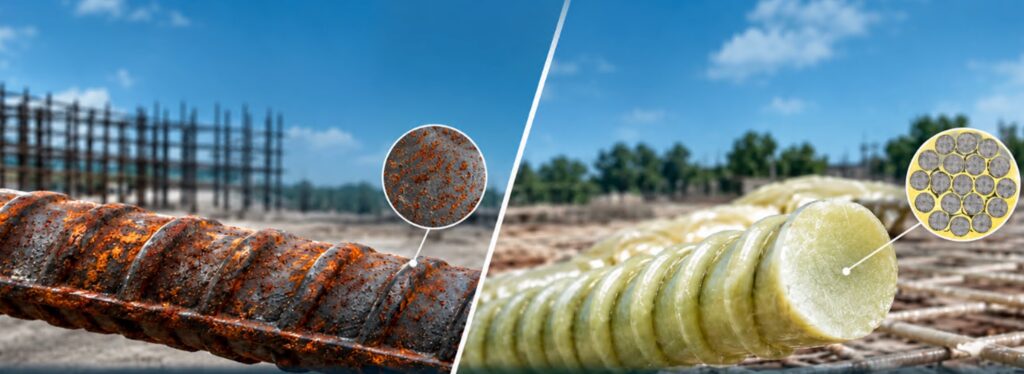
Quick Answer: What Is the Difference Between GFRP Rebar Modulus and Tensile Strength?
Tensile strength tells how much stress a GFRP rebar can resist before rupture. Modulus of elasticity tells how stiff the bar is under load. They are not the same property.
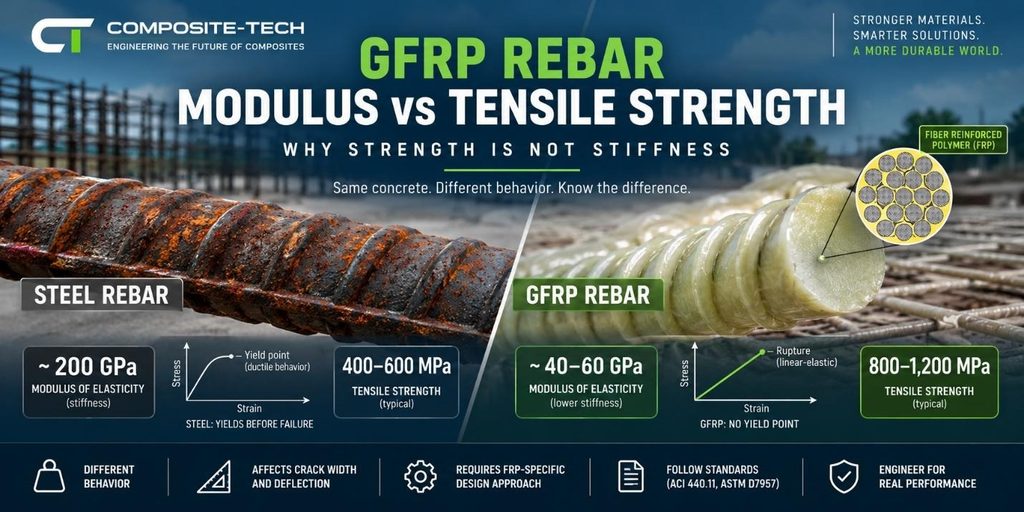
This distinction is essential because GFRP rebar can have very high tensile strength, often higher than conventional steel rebar yield strength, while having a lower modulus of elasticity than steel. Steel reinforcement typically has a modulus around 200 GPa / 29 000 ksi. GFRP rebar is usually much lower and product-dependent; published testing of 12 mm GFRP rods from three manufacturers reported average modulus values of about 54.0 GPa, 54.3 GPaи 39.3 GPa.
That means a GFRP bar may be strong in tension but still less stiff than steel. In reinforced concrete design, this affects crack width, deflection, serviceability, development length and allowable stress. GFRP rebar is not a direct one-to-one steel replacement by nominal diameter. It must be designed using FRP-specific rules, product-specific data and applicable standards.
Ключови изводи
- Strength is not stiffness. Tensile strength and modulus of elasticity describe different behavior.
- GFRP rebar can have high tensile strength but lower stiffness than steel.
- Steel usually yields before failure; GFRP behaves differently and does not have a steel-like yielding plateau.
- In FRP-reinforced concrete, serviceability checks such as crack width and deflection can become more important than ultimate tensile strength alone.
- A higher MPa number does not automatically mean a smaller bar can replace steel by diameter.
- GFRP modulus is product-dependent and influenced by fiber type, fiber content, resin system, manufacturing quality and test method.
- ASTM D7205/D7205M-26 is the current ASTM test method for tensile properties of FRP composite bars and determines quasi-static longitudinal tensile strength and elongation properties.
- ASTM D7957/D7957M is the ASTM specification for GFRP bars for concrete reinforcement, while ACI КОД-440.11-22 provides design and detailing requirements for structural concrete reinforced with GFRP bars conforming to ASTM D7957-22.
- The correct engineering question is not only “how strong is the bar?” but also “how stiff is it, how does it bond, and how does the member behave under service loads?”
Why This Topic Matters
Many people first become interested in GFRP rebar because they see high tensile strength numbers.
A datasheet may show:
- 800 MPa;
- 1000 MPa;
- 1100 MPa;
- 1200 MPa or more.
Compared with steel yield strengths commonly used in construction, those numbers look impressive. They are important. But they are not the full design story.
A concrete beam, slab, wall or foundation does not only need reinforcement that can resist final rupture. It also needs reinforcement that controls behavior while the structure is in service.
That means the engineer must check:
- отклонение;
- ширина на пукнатината;
- stress under service loads;
- bond;
- продължителност на разработката;
- lap splice;
- long-term behavior;
- creep rupture limits;
- environmental reduction factors.
This is why modulus matters.
Tensile strength answers the question:
“How much stress can the bar resist before failure?”
Modulus answers another question:
“How much will the bar stretch under load?”
Both questions matter.
Tensile Strength: The Number Most People Notice First
Tensile strength is a stress value. It is usually expressed in:
- MPa in metric systems;
- ksi in U.S. customary systems.
For rebar buyers, tensile strength is often the first number they compare. That is understandable, but it can create a false impression if used alone.
Table 1: Tensile Strength vs Tensile Load
| Term | Unit | What It Means |
|---|---|---|
| Якост на опън | MPa / ksi | Stress capacity of the material |
| Tensile load | kN / kip | Actual force carried by the bar before rupture |
| Ефективна площ | mm² / in² | Area used to calculate stress |
| Крайно напрежение | % or microstrain | Strain at rupture |
| Модул | GPa / Msi | Stiffness under load |
ASTM D7205/D7205M-26 addresses tensile properties of FRP composite bars used as tensile elements in reinforced, prestressed or post-tensioned concrete. That means a proper tensile test is not just a “pull until it breaks” demonstration. It should define how strength, elongation and related tensile properties are measured.
The problem is that many commercial discussions stop at tensile strength. That is incomplete.
Modulus of Elasticity: The Number That Controls Stiffness
Modulus of elasticity measures stiffness.
A material with a higher modulus stretches less under the same stress. A material with a lower modulus stretches more under the same stress.
Steel is stiff. Its modulus is usually taken as approximately 200 GPa / 29 Msi.
GFRP is different. Its modulus is lower and product-dependent. In the Jarek and Kubik study of three GFRP rod types, two manufacturers showed average modulus values around 54 GPa, while the third showed about 39.3 GPa.
Table 2: Typical Stiffness Comparison
| Материал | Approximate Modulus | Практическо значение |
|---|---|---|
| Стоманена арматура | ~200 GPa / 29 Msi | High stiffness |
| GFRP rebar, higher-modulus examples | ~54 GPa / 7.8 Msi | Lower stiffness than steel |
| GFRP rebar, lower-modulus example | ~39 GPa / 5.7 Msi | Even lower stiffness; serviceability becomes more important |
This does not mean GFRP is weak. It means that the member must be designed with the correct material behavior.
A high-strength rope and a steel rod may both resist large tensile forces, but they do not stretch the same way. Reinforced concrete has a similar issue: stiffness changes how cracks and deflection develop.
Strength Is About Failure. Stiffness Is About Service Behavior.
A structure spends almost all of its life under service loads, not ultimate failure loads.
That is why serviceability matters.
Serviceability means the structure behaves acceptably during normal use. For reinforced concrete, this often includes:
- ширина на пукнатината;
- отклонение;
- vibration where relevant;
- stress limits;
- durability-related exposure;
- long-term deformation.
With GFRP reinforcement, serviceability can become a controlling design issue because the bar is less stiff than steel. A member may have sufficient ultimate strength, but still require more reinforcement, different spacing, different depth or different detailing to control cracks and deflection.
Table 3: Strength vs Stiffness in Design
| Въпрос | Controlled Mainly By |
|---|---|
| Will the bar rupture? | Tensile strength and design stress |
| How much will the bar stretch? | Модул на еластичност |
| How wide will cracks become? | Modulus, bar spacing, bond, cover, concrete properties |
| How much will the member deflect? | Section stiffness, reinforcement ratio, modulus, span, loading |
| Can the force transfer into concrete? | Surface profile, bond, development length |
| Can the structure perform over time? | Stress level, creep rupture, environment, durability |
A strong bar with low stiffness still needs proper serviceability design.
That is the point many simple “GFRP vs steel” comparisons miss.
Steel Yields. GFRP Does Not Yield Like Steel.
Steel and GFRP behave differently under tension.
Steel reinforcement typically has an elastic region and then yields. This yielding behavior is part of conventional reinforced concrete design philosophy. It can provide visible warning signs such as cracking and larger deflection before collapse.
FRP bars are different. Design literature treats steel reinforcing bars as elastic-plastic and FRP reinforcing bars as linear-elastic in flexural analysis. The same FRP design text explains that steel-reinforced flexural members are traditionally designed so steel passes its yielding limit, producing ductile behavior with visible signs such as extensive cracking and large deflections before collapse.
Table 4: Steel vs GFRP Tensile Behavior
| Собственост | Стоманена арматура | GFRP арматура |
|---|---|---|
| Stress-strain behavior | Elastic, then yielding | Approximately linear-elastic until rupture |
| Yield plateau | Да | No steel-like yield plateau |
| Failure warning | More ductile behavior possible | Brittle rupture must be avoided by design |
| Модул | ~200 GPa | Lower and product-dependent |
| Design method | Steel RC design rules | FRP-specific design rules |
| Main serviceability issue | Familiar crack/deflection behavior | Crack width and deflection often need special attention |
This is why GFRP cannot be sold responsibly as “stronger steel.” It is not steel. It is a different reinforcement material.
Why a High MPa Number Can Mislead Buyers
A buyer may see 1000 MPa on a GFRP datasheet and 500 МПа on a steel datasheet and conclude:
“GFRP is twice as good.”
That conclusion is too simple.
MPa measures stress capacity. It does not show stiffness. It does not show bond. It does not show development length. It does not show crack width. It does not show deflection. It does not show long-term design stress after environmental and creep rupture reductions.
A better comparison asks:
| Въпрос на купувача | Better Engineering Question |
|---|---|
| Is the MPa higher than steel? | What is tensile strength, tensile load and effective area? |
| Is the bar stronger? | Under which test method and reduction factors? |
| Can I use smaller diameter? | What do FRP design provisions allow? |
| Can I replace steel one-to-one? | Have modulus, crack width, deflection, bond and development length been checked? |
| Is it approved? | Which product-specific reports and standards apply? |
The highest number is not always the most useful number.
For engineers, a credible datasheet is one that shows strength and stiffness together.
Product Variation: Not All GFRP Bars Have the Same Modulus
One major reason this topic matters is that GFRP products vary.
In the Jarek and Kubik study, three GFRP rod types with the same declared nominal diameter were tested. The study reported differences between nominal and equivalent diameter from about −11% to +14%, with differences between manufacturers close to 3 mm, or about 25% of nominal diameter.
The mechanical results also varied:
Table 5: Published GFRP Rod Test Results from Three Manufacturers
| Manufacturer | Average Tensile Strength | Average Modulus | Average Boundary Deformation |
|---|---|---|---|
| Manufacturer 1 | 1268.5 MPa | 54.0 GPa | 2.4% |
| Manufacturer 2 | 1190.0 MPa | 54.3 GPa | 2.2% |
| Manufacturer 3 | 782.8 MPa | 39.3 GPa | 2.0% |
Sources: Jarek and Kubik, Procedia Engineering 108, 2015.
The summary of the same study states that, compared with AIIIN steel rods, the bearing capacity of two GFRP rod types was more than twice as high, while the third type was about 30% higher; it also reported Young’s modulus of 54 GPa for two manufacturers and 39 GPa for the third.
This is exactly why datasheets and testing matter.
A buyer should not ask only:
“Is this GFRP?”
The correct question is:
“Which GFRP product, with which modulus, which tensile load, which effective area, which surface profile and which test report?”
Why Modulus Affects Crack Width
Cracking is normal in reinforced concrete. The question is whether cracks stay within acceptable limits for the structure and exposure condition.
When concrete cracks, tensile force transfers to the reinforcement. If the reinforcement has lower stiffness, it elongates more under the same stress. This can influence crack width and crack spacing behavior.
GFRP surface profile and bond also matter. A bar with a strong ribbed, wrapped or sand-coated surface can interact differently with concrete than a smooth bar. ASTM D7205-related descriptions note that FRP bars generally have surface undulations or bonded-particle coatings, or both, to promote mechanical interlock between the bar and concrete.
Table 6: Variables Affecting Crack Width in GFRP-Reinforced Concrete
| Variable | Защо е важно |
|---|---|
| GFRP modulus | Lower stiffness can increase reinforcement strain |
| Bar spacing | Closer spacing can improve crack distribution |
| Concrete cover | Influences crack width and bond behavior |
| Профил на повърхността | Affects force transfer between bar and concrete |
| Сила на връзката | Influences crack development |
| Reinforcement ratio | More reinforcement can improve service behavior |
| Concrete strength | Affects cracking and bond |
| Design stress | Lower service stress can reduce cracking |
This is why “high tensile strength” cannot be the only design argument.
Why Modulus Affects Deflection
Deflection depends on member stiffness.
In a reinforced concrete slab or beam, stiffness is influenced by:
- concrete section size;
- span;
- load;
- cracking;
- reinforcement amount;
- reinforcement modulus;
- long-term effects.
Because GFRP modulus is lower than steel, a GFRP-reinforced member may require different reinforcement ratios, spacing or member dimensions to meet deflection limits.
This does not make GFRP unsuitable. It means the design has to be done correctly.
Table 7: What Happens If Modulus Is Ignored?
| Mistake | Възможен резултат |
|---|---|
| Replace steel by diameter only | Excessive crack width or deflection |
| Compare only tensile strength | Overestimate service performance |
| Ignore service load stress | Higher working strain than expected |
| Ignore bond and surface profile | Poor force transfer assumptions |
| Ignore FRP design provisions | Unsafe or uneconomical design |
| Use generic GFRP values | Product mismatch |
A properly designed GFRP member can perform well. A poorly substituted one can create problems.
The issue is not the material. The issue is incorrect comparison.
How ASTM and ACI Treat the Problem
Modern GFRP standards do not treat the bar as “plastic steel.”
ASTM D7957/D7957M is the ASTM specification for GFRP bars for concrete reinforcement. ASTM D7205/D7205M-26 is the tensile test method for FRP composite bars and covers quasi-static longitudinal tensile strength and elongation properties.
ACI CODE-440.11-22 provides minimum requirements for materials, design and detailing of structural concrete reinforced with GFRP bars conforming to ASTM D7957-22.
That combination matters:
| Document | Role |
|---|---|
| ASTM D7957/D7957M | Product specification for GFRP bars |
| ASTM D7205/D7205M | Tensile test method for FRP bars |
| ASTM D7913/D7913M | Bond behavior by pullout testing |
| ACI КОД-440.11-22 | Design and detailing of structural concrete with GFRP bars |
| ICC-ES AC454 | Evaluation criteria route for FRP bars |
The standards-based approach confirms the central point of this article:
GFRP is an engineering material with its own design logic. It should not be used by copying steel bar diameters without checking product-specific properties.
Tensile Load May Be More Useful Than Tensile Strength Alone
Another common confusion is the difference between tensile strength and tensile load.
Tensile strength is stress.
Tensile load is actual force.
A bar with a larger effective area can carry more force even if the material stress value is similar. That is why datasheets should show both.
Table 8: What to Ask from a GFRP Rebar Supplier
| Datasheet Item | Защо е важно |
|---|---|
| Nominal diameter | Commercial size reference |
| Ефективна площ | Needed for stress calculations |
| Tensile load | Actual force capacity |
| Якост на опън | Material stress capacity |
| Модул | Stiffness and serviceability |
| Крайно напрежение | Rupture behavior |
| Профил на повърхността | Bond behavior |
| Bond data | Development length and lap splice |
| Метод на изпитване | Makes values comparable |
| Проследимост на партидата | Shows production control |
A serious comparison between GFRP and steel should include both strength and stiffness.
Why Manufacturing Quality Affects Modulus and Strength
GFRP rebar is a composite material. Its properties depend on the complete system:
- вид влакно;
- съдържание на фибри;
- подравняване на влакната;
- система от смоли;
- качество на импрегниране;
- втвърдяване;
- образуване на повърхност;
- ефективна площ;
- production consistency.
The Jarek and Kubik results are useful because they show large differences between products, even within the same general material category. Their study measured different equivalent diameters and different mechanical properties among the tested manufacturers.
This is why производствена технология matters.
Composite-Tech’s position should be stated carefully: equipment alone does not guarantee any specific modulus or strength. The final values depend on суровини, formulation, process parameters and quality control. But a professional production line helps control the variables that make repeatable properties possible: fiber feeding, impregnation, curing, surface profile, pulling speed, cooling, cutting and traceability.
The market does not need one excellent laboratory specimen. It needs repeatable industrial production.
When GFRP’s Lower Modulus Is Not a Problem
Lower modulus is not automatically a disadvantage in every application.
In many cases, GFRP can be very effective when design accounts for its behavior.
Table 9: Applications Where GFRP Can Be Strongly Justified
| Приложение | Why GFRP Can Make Sense |
|---|---|
| Мостови палуби | Corrosion resistance in de-icing salt exposure |
| Морски структури | No steel rust mechanism in chloride environments |
| Parking structures | Moisture and chloride exposure |
| Wastewater facilities | Chemical and moisture exposure |
| Плочи на нивото на земята | Lightweight handling and corrosion resistance |
| Precast panels | Controlled production and reduced weight |
| Крайбрежно строителство | Salt air and moisture exposure |
| Електрически съоръжения | Non-conductive and non-magnetic behavior |
| FRP mesh applications | Area-based reinforcement and fast handling |
The correct message is not “GFRP replaces steel everywhere.”
The correct message is:
GFRP is a strong reinforcement material when its stiffness, bond, durability and design rules are properly considered.
Practical Design Implications
For engineers and buyers, the modulus-versus-strength issue leads to several practical rules.
Table 10: Practical Rules for GFRP Rebar Selection
| Rule | Reason |
|---|---|
| Do not compare only MPa | MPa does not show stiffness |
| Ask for modulus in GPa / Msi | Modulus controls strain and serviceability |
| Ask for tensile load in kN / kip | Force capacity is easier to interpret |
| Check effective area | Stress depends on area |
| Check crack width and deflection | Lower modulus affects service behavior |
| Check bond and surface profile | Force must transfer to concrete |
| Use FRP-specific design rules | GFRP is not steel |
| Require product-specific test reports | GFRP values vary by product |
| Avoid diameter-only substitution | Same diameter does not mean same behavior |
These rules should be part of every serious GFRP specification discussion.
Common Misunderstandings About GFRP Modulus and Strength
- The first misunderstanding is that higher tensile strength automatically means better performance in every structural condition.
- The second is that a GFRP bar can replace steel by diameter because its MPa value is higher.
- The third is that modulus is only an academic property. It is not. It affects crack width, deflection and service-load behavior.
- The fourth is that all GFRP bars have the same modulus. They do not.
- The fifth is that a tensile test alone proves structural performance. It does not. Bond, development length, lap splice, durability and design provisions also matter.
- The sixth is that lower modulus makes GFRP weak. That is also wrong. Lower modulus means different stiffness, not necessarily inadequate strength.
- A good article, datasheet or sales discussion should not hide these distinctions. It should explain them clearly.
- That is how trust is built.
Заключение
GFRP арматура should not be judged by tensile strength alone.
Tensile strength tells how much stress the bar can resist before rupture. Modulus tells how stiff the bar is under load. A GFRP bar can have high tensile strength and still be less stiff than steel.
That difference matters in real concrete structures. It affects crack width, deflection, service stress, development length, lap splice behavior and design assumptions.
This does not reduce the value of GFRP reinforcement. It makes correct design more important.
GFRP is not weaker steel. It is a different reinforcement material with different advantages and different engineering rules.
The serious way to compare GFRP and steel is not by one number. It is by tensile load, tensile strength, modulus, effective area, bond, durability, serviceability and standards-based design.
That is the difference between selling a material and building trust in an engineering product.
FAQ: GFRP Rebar Modulus vs Tensile Strength
GFRP арматурата по-здрава ли е от стоманената арматура?
GFRP rebar can have higher ultimate tensile strength than many steel rebars, but that does not mean it behaves like steel. Strength, stiffness, bond, serviceability and design rules must all be considered.
What is tensile strength in GFRP rebar?
Tensile strength is the stress the bar can resist before rupture. It is usually reported in MPa or ksi.
What is modulus of elasticity in GFRP rebar?
Modulus of elasticity measures stiffness. It shows how much the bar stretches under load. It is usually reported in GPa or Msi.
Is modulus the same as strength?
No. Strength describes resistance to failure. Modulus describes stiffness under load.
What is the modulus of steel rebar?
Steel rebar is commonly taken as approximately 200 GPa, or about 29 Msi.
What is the modulus of GFRP rebar?
GFRP modulus is product-dependent. Published testing of GFRP rods reported values around 54 GPa for two manufacturers and 39.3 GPa for another tested product.
Why does GFRP have lower stiffness than steel?
GFRP is a composite made from fibers and polymer resin. Its stiffness depends on fiber type, fiber content, orientation, resin and manufacturing quality. Steel is a metallic material with much higher elastic modulus.
Does lower modulus mean GFRP is bad?
No. It means GFRP must be designed correctly. Lower modulus affects serviceability checks such as deflection and crack width.
Can GFRP rebar replace steel one-to-one?
No. GFRP should not replace steel by nominal diameter alone. Engineers must check tensile load, modulus, effective area, bond, development length, lap splice, crack width and deflection.
Why does crack width matter for GFRP rebar?
Because lower reinforcement stiffness can increase strain under service loads, which can influence crack width. Bar spacing, bond, cover and reinforcement ratio also matter.
Why does deflection matter for GFRP rebar?
Deflection depends on member stiffness. Since GFRP modulus is lower than steel, deflection must be checked using FRP-specific design provisions.
What standards are relevant?
Important documents include ASTM D7957/D7957M for GFRP bars, ASTM D7205/D7205M for tensile testing, ASTM D7913/D7913M for bond testing, ACI CODE-440.11-22 for structural concrete reinforced with GFRP bars, and ICC-ES AC454 for evaluation of FRP bars.
What should a buyer ask from a GFRP supplier?
A buyer should ask for tensile strength, tensile load, modulus, ultimate strain, effective area, surface profile, bond data, durability data, applicable standards, test reports and batch traceability.
Why is this topic important for engineers?
Because a structure is not designed only against final rupture. It must also perform under normal service loads. Modulus affects that service behavior.
Научете повече:
- Разбиране на ACI 440.11-22 за производители на GFRP арматура
- Как да четем техническия информационен лист за арматурно желязо от GFRP: Якост, модул, площ, сцепление и издръжливост
- Кога GFRP армировката е по-добра от стоманената? Приложения, ограничения и доказателства
- GFRP арматура срещу стоманена арматура: Числено сравнение по тегло, якост и инженерни свойства
- Professional GFRP rebar production line
- Техническа документация