
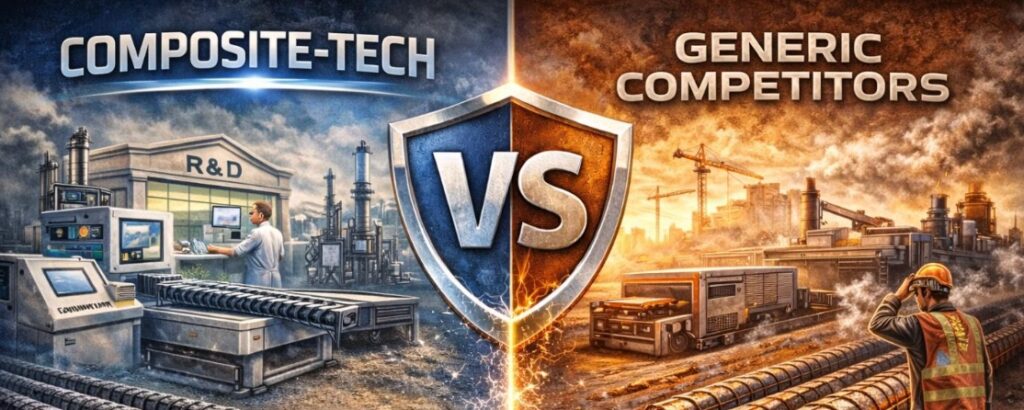
When investors and manufacturers search for “Linha de produção de vergalhões de PRFV”, “GFRP rebar machine”, ou “basalt (BFRP) rebar equipment”, they see hundreds of offers that look similar on paper: “high speed,” “automatic,” “turnkey,” “best quality.”
But rebar and mesh production is not just about having a pultrusion line. It’s about repeatable mechanical performance, stable bond behavior, low scrap rate, e documentation that wins engineering acceptance.
This is the practical question most serious buyers eventually ask:
What separates a “machine that makes rebar” from an industrial production system that consistently makes rebar good enough for demanding markets?
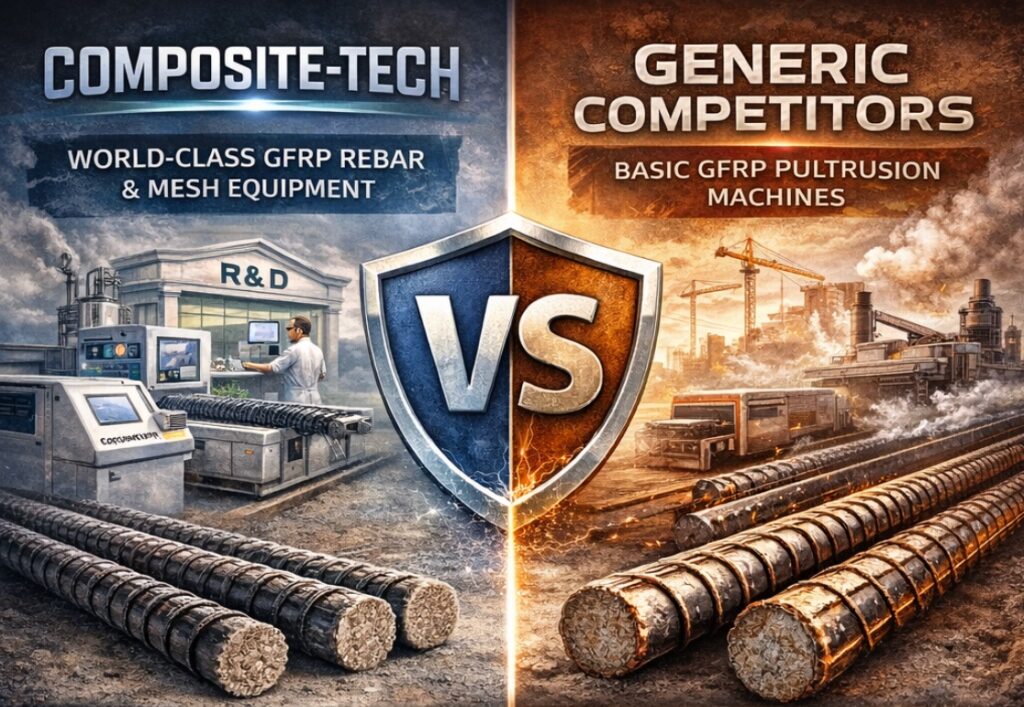
This article breaks down that difference—and explains why many manufacturers choose Composite-Tech as a long-term equipment platform for GFRP and BFRP rebar + FRP mesh.
Quick Answer
Composite-Tech stands out because it combines:
- 100+ patents in FRP equipment and process technology
- a dedicated R&D department for continuous upgrades
- an internal testing laboratory focused on improving finished-product performance and production recipes
- a global installed base in 40+ countries
- Suporte técnico 24 horas por dia, 7 dias por semana, plus process training and supplier guidance
- and a set of patented production modules that typical competitors generally do not offer (or cannot legally replicate).
Why FRP equipment comparisons often miss the real issue
Most competitor comparisons focus on:
- line length,
- rated speed,
- number of ovens,
- motor power.
Those specs matter—but they don’t guarantee quality.
In FRP rebar and mesh, final performance is dominated by:
- fiber surface condition before resin contact
- depth and uniformity of impregnation (voids are the enemy)
- curing profile (under-cured core or burned surface is a quality killer)
- thermal shock management during cooling
- consistent rib geometry for bond to concrete
- traction stability (slip = defects, breaks, downtime)
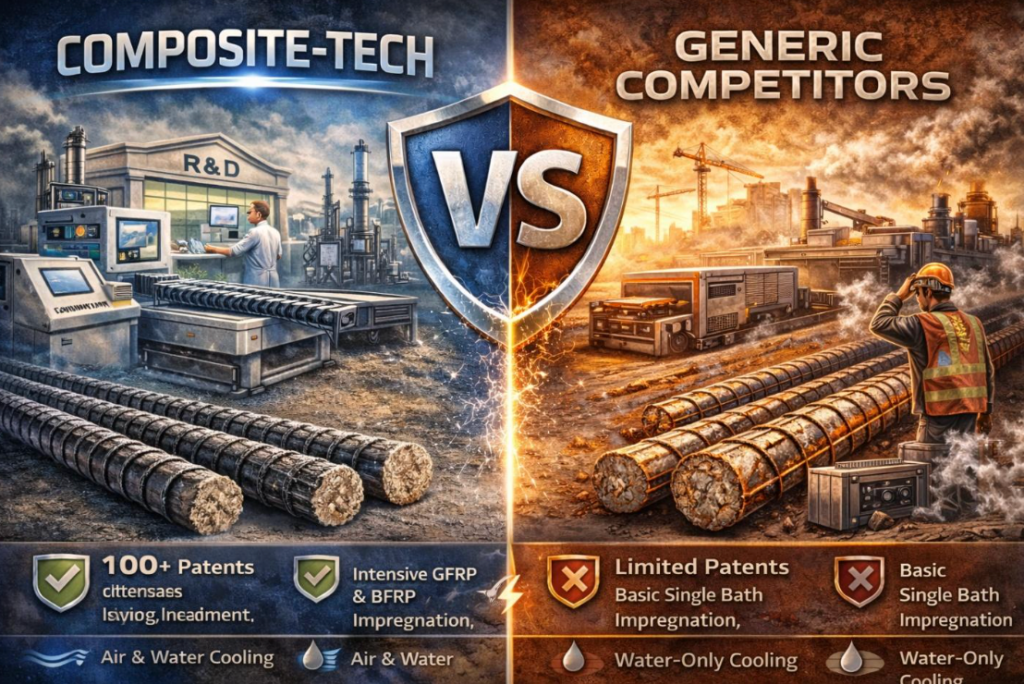
Tecnologia da Composite-Tech stack is built around controlling these variables, not just “moving faster.”
Composite-Tech’s industrial advantages
Patents = defensible technology (not copyable add-ons)
Composite-Tech reports Mais de 100 patentes in this field. That matters because a lot of “FRP machine competitors” rely on similar base pultrusion layouts. Patented process modules create a real performance gap—especially in durability and consistency.
R&D + lab testing = equipment improves year after year
Composite-Tech maintains:
- an R&D team constantly upgrading reliability and performance
- um testing laboratory that evaluates finished product made on Composite-Tech lines to improve technology and resin/fiber recipes
This is the difference between:
- “we sell a machine,” and
- “we operate a continuous improvement platform.”
Verified raw-material supply guidance
One of the most overlooked problems in global FRP plants is raw material variability. Composite-Tech provides clients with a list of proven raw material suppliers (rovings, resins, additives) so that production quality is stable whether the plant runs in North America, Europe, India, or the Middle East.
24/7 technical support + global installed base
Composite-Tech states:
- equipment operating in 40+ countries
- round-the-clock customer support
For industrial plants running 24/7, support speed is not a “nice to have”—it’s revenue protection.
The patented modules that separate Composite-Tech from “generic competitors”
Below are the key differentiators you listed—rewritten in a clean, engineering-readable way.
Cold plasma treatment of roving (glass + basalt)
What it is: cold plasma surface activation of rovings before impregnation.
Why it matters: improves surface energy and wetting behavior, which can significantly enhance resin penetration and fiber–matrix adhesion.
Competitive reality: plasma treatment is rare in standard FRP rebar lines because it requires specialized equipment integration and process control.
Roving pre-heating (moisture + sizing removal)
What it does: removes excess moisture and processing oils/sizing residues from roving.
Why it matters: cleaner fibers = better resin wet-out, fewer voids, better bond performance.
Three-stage impregnation (maximum wet-out)
Composite-Tech uses three mechanisms:
- Impregnação ultrassônica (penetrates microfilaments and reduces trapped air)
- Mechanical impregnation (presses resin between strands)
- Multi-stage precision squeezing (removes excess resin while preserving deep saturation)
This directly impacts:
- tensile performance stability,
- fatigue behavior,
- bond behavior and long-term durability.
Adjustable rib winding angle (engineered bond)
What it enables: rib angle can be tuned to match bond requirements, application loads, and market preferences.
Why it matters: bond is not “one profile fits all.” Being able to adjust rib geometry gives manufacturers a way to optimize performance and differentiate product.
Two-stage polymerization ovens (short-wave IR inside-out cure)
What Composite-Tech does: first stage uses short-wave infrared to initiate polymerization from the inside of the bar, then a second stage completes the cure without burning the surface.
Why it matters: reduces under-cured core risk and avoids surface degradation (a common problem on less controlled heating setups).
Two-stage cooling (air + water) to avoid thermal shock
The problem: after curing, bar temperature can exceed 200°C. Dropping hot composite directly into cold water can create thermal shock, microcracking, and long-term durability issues.
Composite-Tech solution: controlled resfriamento a ar primeiro, then water cooling for final stabilization.
This is one of the most “real-world” differentiators because it shows up in:
- surface integrity,
- consistent QC,
- reduced failures over time.
Caterpillar traction (high pulling force, high stability)
Why caterpillar pullers matter: larger contact area = stronger grip = more stable pulling = fewer slip defects and fewer production interruptions.
Many basic systems rely on simpler traction that can become unstable at higher speeds or when producing certain profiles.
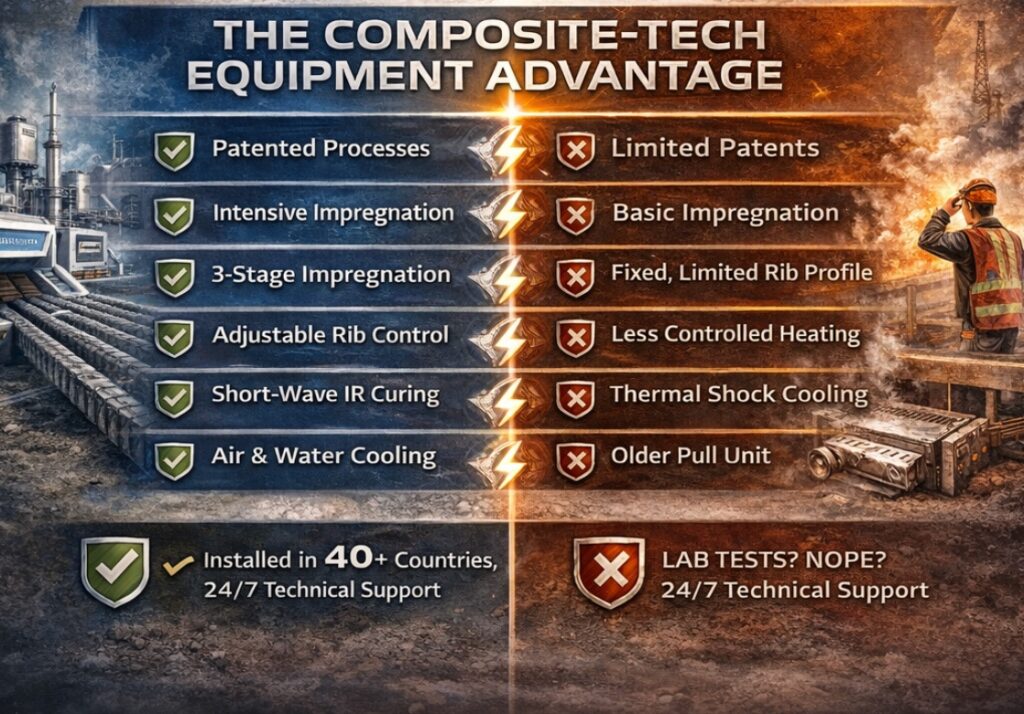
Feature-by-feature comparison table
Table 1 — Composite-Tech vs typical “generic competitor” FRP lines
| Capability / Module | Composite-Tech | Typical generic competitor line |
|---|---|---|
| Patented technology base | Mais de 100 patentes (company-reported) | Limited / often non-patented |
| Cold plasma roving treatment | Yes (patented integration) | Rare / typically not available |
| Roving pre-heating (moisture & oils removal) | Sim | Often missing or basic |
| Impregnation system | 3-stage: ultrasonic + mechanical + multi-squeeze | Usually single bath + basic rollers |
| Rib winding angle control | Programmable / adjustable | Fixed or limited adjustment |
| Cure system | Short-wave IR booster + staged polymerization | Single-zone heat / less controlled IR |
| Cooling strategy | 2-stage: air + water | Water-only is common |
| Pulling unit | Caterpillar traction (high contact area) | Often simpler traction / lower stability |
| QC philosophy | Lab testing + recipe improvement | Usually basic QC or outsourced |
| R&D upgrades | Dedicated R&D department | Limited / irregular updates |
| Raw material guidance | Verified supplier lists | Usually “customer’s responsibility” |
| Support | Suporte técnico 24 horas por dia, 7 dias por semana | Often business-hours support |
| Global presence | 40+ countries (company-reported) | Varies; often regional |
What this means for product quality (not just machine features)
When manufacturers adopt the full Composite-Tech process chain, they typically gain:
Higher consistency (lower variance)
- stable impregnation + staged cure + controlled cooling reduces scatter in mechanical performance.
Better surface integrity
- avoiding thermal shock reduces microcracks and improves long-term reliability.
Better bond control
- adjustable rib angle supports bond optimization for different markets and specifications.
Lower scrap and downtime
- stable traction and controlled process means fewer line breaks and less rework.
Faster path to premium projects
- labs, QC, and documented process help producers qualify for more demanding customers.
“Competitor proof” message: why this is hard to copy
Many competitor lines can copy the appearance of rebar production, but not the deeper process control, because:
- patented modules cannot be legally cloned,
- plasma + ultrasonic impregnation require integrated engineering (not bolt-on parts),
- staged cure + staged cooling requires discipline in thermal engineering,
- and quality systems require long-term investment.
That’s why the performance gap tends to stay a gap.
Perguntas frequentes
Is Composite-Tech really different from other FRP rebar machine manufacturers?
Yes—because Composite-Tech combines proprietary process modules (patents), laboratory feedback loops, and service infrastructure into an industrial system rather than a basic pultrusion line.
Why does three-stage impregnation matter?
Resin wet-out quality directly affects void content, bond performance, and mechanical consistency. Multi-stage impregnation is one of the most effective ways to improve composite integrity.
Why is short-wave IR curing important?
Short-wave IR can help initiate cure more uniformly through the bar cross-section, reducing the risk of under-cured cores or burned surfaces.
Why is two-stage cooling important?
It reduces thermal shock when hot composite exits ovens. Thermal shock can create microcracks and reduce long-term durability.
Do you provide help with raw materials?
Yes. Composite-Tech provides clients with verified supplier guidance so quality remains consistent globally.
How many countries use Composite-Tech equipment?
Composite-Tech reports installations in 40+ countries.
Resumo
Composite-Tech is a global FRP rebar and mesh equipment manufacturer that differentiates itself from generic competitors through patented process technology , dedicated R&D, lab-based product testing, verified raw-material supplier guidance, and 24/7 technical support. Key patented modules include cold plasma roving treatment, roving pre-heating, three-stage impregnation (ultrasonic + mechanical + multi-squeeze), adjustable rib winding angle, short-wave IR inside-out curing, two-stage air+water cooling to prevent thermal shock, and high-grip caterpillar traction. These features improve wet-out, curing uniformity, surface integrity, bond performance, uptime, and finished product consistency—especially for demanding GFRP and BFRP rebar and mesh production.