Quick Answer: Is GFRP Rebar Better Than Steel Rebar?
GFRP rebar is better than steel rebar in corrosion-critical concrete structures, such as bridges, marine structures, coastal buildings, parking garages, wastewater plants and infrastructure exposed to de-icing salts. It is non-corrosive, lightweight, electrically non-conductive and suitable for long-service-life applications.
However, GFRP rebar is not a universal one-to-one replacement for steel in every project. Steel has a higher modulus of elasticity and ductile yielding behavior, while GFRP has different design rules, lower stiffness and linear-elastic behavior until failure. The best choice depends on the structure, exposure conditions, design standard, lifecycle cost and engineering requirements.
For manufacturers, the growing demand for corrosion-resistant reinforcement creates a strong opportunity to produce GFRP rebar using professional FRP rebar production equipment.
Dowiedz się więcej: Professional GFRP Rebar Production Line
Najważniejsze wnioski
- Steel rebar is strong, familiar and widely used, but it can corrode in aggressive environments.
- GFRP rebar does not rust, which makes it attractive for bridges, marine structures, parking garages, tunnels and coastal infrastructure.
- GFRP rebar is much lighter than steel, making transport and handling easier.
- Steel has higher stiffness and ductile yielding behavior; GFRP has high tensile strength but lower modulus and linear-elastic behavior until failure.
- GFRP rebar may cost more upfront, but it can reduce lifecycle costs where corrosion would otherwise create maintenance and repair expenses.
- GFRP rebar should be designed according to relevant standards and should not be treated as a direct steel substitute without engineering checks.
- For producers, GFRP rebar demand is strongest where owners understand durability, corrosion resistance and lifecycle value.
- A professional FRP rebar production line is essential for consistent product quality, controlled rib geometry, proper curing and stable manufacturing cost.
What Is Steel Rebar?
Steel rebar is the traditional reinforcement used in concrete structures. Concrete is strong in compression but weak in tension. Steel rebar provides tensile reinforcement and helps concrete elements resist bending, cracking and structural loads.
Steel has several important advantages:
- high stiffness;
- ductile yielding behavior;
- wide availability;
- established design codes;
- strong contractor familiarity;
- easy on-site bending;
- mature supply chain;
- broad use in almost all types of reinforced concrete.
For many ordinary buildings and non-aggressive environments, steel remains a practical and economical reinforcement material. The problem begins when steel is exposed to moisture, chlorides, de-icing salts, marine environments or chemicals. In these conditions, corrosion can become a major durability risk.
Czym jest pręt zbrojeniowy GFRP?
Pręty zbrojeniowe GFRP stands for glass fiber reinforced polymer rebar. It is a composite reinforcement made from continuous glass fibers embedded in a polymer resin matrix. Instead of relying on metal, GFRP rebar uses high-strength fibers to carry tensile loads.
GFRP rebar is:
- non-corrosive;
- lightweight;
- non-magnetic;
- electrically non-conductive;
- resistant to many aggressive environments;
- suitable for long-service-life infrastructure;
- useful in concrete structures exposed to salts, moisture or chemicals.
GFRP rebar is normally manufactured by pulling glass fiber roving through resin impregnation, rib winding, curing, cooling and cutting or coiling. The quality of the final bar depends on the raw materials, impregnation process, curing technology, rib geometry and production line stability.
Learn more about the proces produkcyjny
GFRP Rebar vs Steel Rebar: Main Comparison
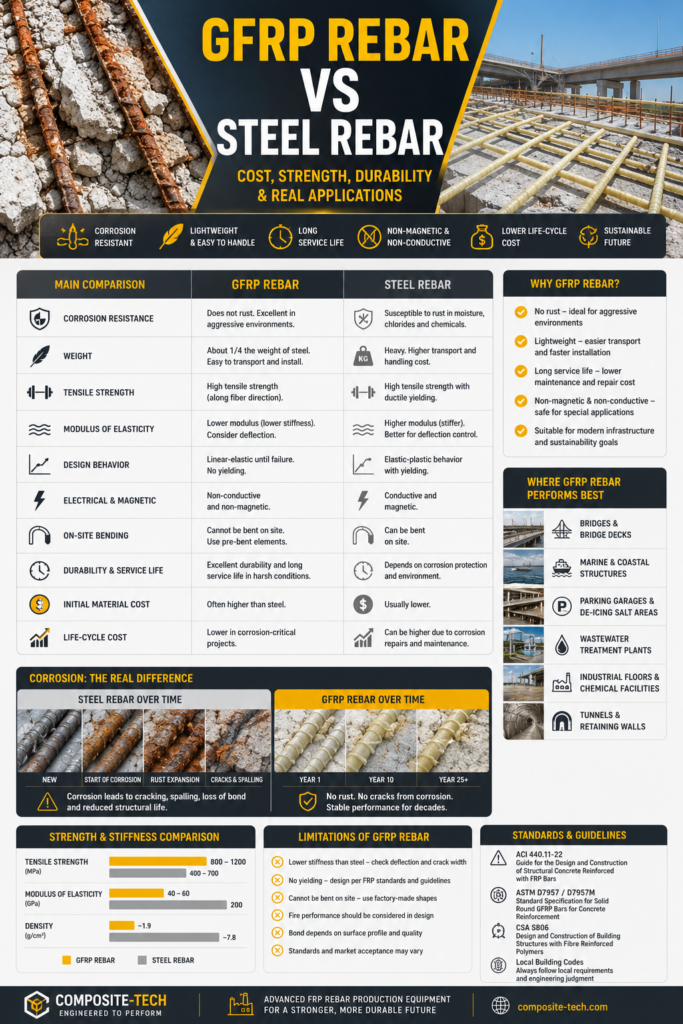
Table 1: GFRP Rebar vs Steel Rebar
| Funkcja | Pręty zbrojeniowe GFRP | Pręty zbrojeniowe |
| Odporność na korozję | Does not rust | Can corrode in moisture, chlorides and aggressive environments |
| Waga | Much lighter than steel | Ciężki |
| Wytrzymałość na rozciąganie | High tensile strength along fiber direction | High tensile strength with ductile yielding |
| Moduł sprężystości | Lower than steel | Higher stiffness |
| Przewodność elektryczna | Nieprzewodzący | Przewodzący |
| Właściwości magnetyczne | Niemagnetyczny | Magnetyczny |
| On-site bending | Cannot be bent after curing | Can be bent on site |
| Durability in aggressive environments | Excellent when properly designed and manufactured | Depends on corrosion protection |
| Design behavior | Linear-elastic until failure | Elastic-plastic with yielding |
| Common use cases | Bridges, marine, coastal, parking garages, industrial floors, wastewater plants | General reinforced concrete construction |
| Initial material cost | Often higher than black steel | Usually lower |
| Lifecycle cost | Can be lower in corrosion-critical projects | Can increase due to corrosion repair and maintenance |
Summary: Steel rebar is still the standard reinforcement for many conventional projects. Pręty zbrojeniowe GFRP is stronger as a durability solution when corrosion resistance, low weight and long service life are more important than the lowest initial material cost.
Why Corrosion Is the Main Reason to Choose GFRP Rebar
The biggest weakness of steel reinforcement is corrosion. When steel corrodes inside concrete, corrosion products can expand and create internal pressure. This can lead to cracking, spalling, loss of bond and reduction of structural durability.
Corrosion is especially common in:
- bridge decks exposed to de-icing salts;
- marine and coastal structures;
- parking garages;
- wastewater treatment plants;
- chemical facilities;
- concrete exposed to chlorides;
- industrial floors;
- retaining walls in aggressive soil;
- infrastructure in humid or salt-rich environments.
In these applications, the initial price of steel is not the only cost. The real cost includes inspection, repair, downtime, structural rehabilitation and reduced service life.
GFRP rebar is attractive because it removes the steel corrosion problem from the reinforcement system.
Cost Comparison: Initial Price vs Lifecycle Value
Many buyers ask: Is GFRP rebar more expensive than steel?
The simple answer is: GFRP rebar often has a higher upfront material price than black steel rebar. But in corrosion-critical projects, the better question is not “Which material is cheaper per meter?” The better question is: Which reinforcement gives the lowest lifecycle cost?
Table 2: Initial Cost vs Lifecycle Cost
| Cost Factor | Pręty zbrojeniowe GFRP | Pręty zbrojeniowe |
| Initial material cost | Often higher | Usually lower |
| Transport cost | Lower due to low weight | Higher due to weight |
| Handling and installation | Easier to handle due to lightweight | Heavier and more labor-intensive |
| Corrosion protection | Not required for rust prevention | May require coatings, stainless steel, inhibitors or increased concrete cover |
| Maintenance risk | Lower in aggressive environments | Higher where corrosion is likely |
| Repair risk | Lower in corrosion-critical structures | Can be significant over service life |
| Lifecycle value | Strong where corrosion is a major problem | Strong where corrosion exposure is low |
Summary: Steel can be cheaper at the purchasing stage. GFRP can be more economical over the life of a structure when corrosion would otherwise create expensive repairs.
Strength Comparison: Tensile Strength, Stiffness and Design Behavior
GFRP rebar and steel rebar behave differently under load.
Steel rebar has a high modulus of elasticity and ductile yielding. This means steel can deform plastically before failure, giving engineers a familiar design behavior.
GFRP rebar has high tensile strength in the direction of the fibers, but it has a lower modulus of elasticity than steel. It does not yield like steel. Instead, it behaves linearly until failure.
Table 3: Mechanical Behavior Comparison
| Nieruchomość | Pręty zbrojeniowe GFRP | Pręty zbrojeniowe |
| Wytrzymałość na rozciąganie | High in fiber direction | High and standardized |
| Stiffness | Lower modulus than steel | Higher modulus |
| Yielding behavior | No yielding | Ductile yielding |
| Failure behavior | Linear-elastic until failure | Elastic-plastic before failure |
| Design focus | Deflection, crack width, creep rupture, bond and serviceability | Strength, ductility, yielding and standard reinforced concrete design |
| Engineering approach | Requires FRP-specific design rules | Familiar conventional RC design |
This difference is important. GFRP rebar should not be selected only by matching the diameter of steel rebar. Engineers must check serviceability, deflection, crack width, bond, development length and applicable design standards.
Weight and Handling: A Practical Advantage of GFRP Rebar
One of the most visible advantages of GFRP rebar is weight. GFRP rebar is much lighter than steel, which can reduce transportation effort and make handling easier on site.
This can be useful for:
- remote construction sites;
- bridge deck projects;
- tunnel work;
- marine construction;
- projects with limited lifting equipment;
- fast installation teams;
- export logistics;
- large-volume rebar supply.
Lightweight reinforcement can help reduce manual handling fatigue and simplify logistics, especially when rebar is supplied in coils.
However, weight alone should not be the only reason to choose GFRP. The main value is still corrosion resistance and durability.
Durability: Where GFRP Rebar Has the Strongest Advantage
GFRP rebar is most valuable in environments where steel corrosion creates long-term risk.
Table 4: Best Applications for GFRP Rebar
| Application | Why GFRP Rebar Is Attractive |
| Pokłady mostowe | Resistance to de-icing salts and moisture |
| Konstrukcje morskie | No rust in saltwater exposure |
| Coastal buildings | Better durability in salt-rich air and humidity |
| Garaże parkingowe | Resistance to chloride exposure from vehicles and de-icing salts |
| Oczyszczalnie ścieków | Resistance to aggressive chemical environments |
| Industrial floors | Lightweight and corrosion-resistant reinforcement |
| Tunnels | Useful where corrosion resistance and non-magnetic properties matter |
| Retaining walls | Good option in aggressive soils |
| Precast concrete | Easier handling and corrosion-free reinforcement |
| Concrete slabs | Suitable for selected durability-focused applications |
Summary: The stronger the corrosion risk, the stronger the case for GFRP rebar.
Limitations of GFRP Rebar
A professional article about GFRP rebar must be honest. GFRP is not perfect for every application.
Table 5: GFRP Rebar Limitations and How to Manage Them
| Limitation | What It Means | How to Manage It |
| Lower modulus than steel | Higher deflection or wider cracks may occur if not designed correctly | Use FRP-specific design methods and serviceability checks |
| No yielding | GFRP does not behave like ductile steel | Design according to FRP standards and guidelines |
| Cannot be bent on site | Bends must be manufactured before curing | Use factory-made bent elements and stirrups |
| Fire performance considerations | Polymer matrix is sensitive to high temperature | Use proper concrete cover and fire design checks |
| Different bond behavior | Surface geometry is critical | Use quality ribbed or sand-coated bars |
| Standards and acceptance | Some markets require technical approval | Follow ACI, ASTM, CSA or local standards |
| Market education needed | Contractors may be unfamiliar with GFRP | Provide technical documentation and case studies |
Summary: GFRP rebar works best when it is treated as an engineered composite reinforcement, not as a simple copy of steel.
Can GFRP Rebar Replace Steel Rebar?
Yes, GFRP rebar can replace steel rebar in many applications, but not automatically and not without engineering design.
It is especially suitable for:
- corrosion-critical structures;
- non-magnetic applications;
- lightweight reinforcement needs;
- long-service-life concrete;
- structures exposed to salts, chemicals or moisture.
It may not be the best choice for every conventional building element where steel is cheap, available and corrosion risk is low.
Table 6: When to Choose GFRP Rebar vs Steel Rebar
| Project Condition | Better Choice |
| High corrosion exposure | Pręty zbrojeniowe GFRP |
| Marine or coastal environment | Pręty zbrojeniowe GFRP |
| Parking garage with de-icing salts | Pręty zbrojeniowe GFRP |
| Non-magnetic reinforcement required | Pręty zbrojeniowe GFRP |
| Lowest initial cost is the only priority | Pręty zbrojeniowe ze stali |
| High stiffness is the main requirement | Steel rebar or engineering review |
| Standard building with low corrosion exposure | Steel rebar may be sufficient |
| Long service life and low maintenance are priorities | Pręty zbrojeniowe GFRP |
The correct decision should consider engineering requirements, exposure conditions, design code, material availability and lifecycle cost.
GFRP Rebar and Concrete Bond: Why Surface Profile Matters
Concrete reinforcement works only if load can transfer between concrete and the bar. For GFRP rebar, bond behavior depends heavily on surface treatment.
Common surface types include:
- ribbed profile;
- sand-coated surface;
- helically wrapped profile;
- combined ribbed and coated surfaces.
A smooth GFRP rod is not enough for serious concrete reinforcement. The bar surface must provide mechanical interlock and stable bond performance.
That is why professional FRP rebar production equipment must create consistent rib geometry. Composite-Tech production lines use computer-controlled rib winding to adjust and maintain the rib angle precisely for different diameters and production requirements.
Why GFRP Rebar Quality Depends on Production Equipment
Not all GFRP rebar is equal. Two bars with the same diameter can perform differently if they are produced with different raw materials, resin systems or equipment.
Important production factors include:
- fiber quality;
- resin system;
- impregnation control;
- fiber-resin ratio;
- rib geometry;
- curing temperature;
- degree of polymerization;
- cooling method;
- pulling stability;
- quality control.
A professional production line is important because it controls the process from roving to finished bar.
Composite-Tech FRP rebar production lines include advanced features such as:
- controlled resin impregnation;
- computer-controlled rib winding;
- patented short-wave infrared booster polymerization;
- curing ovens with stainless-steel heating elements;
- patented two-stage air-and-water cooling;
- high-force pulling system;
- chemically resistant rubber pulling belts.
These technologies are designed to support stable production, better surface quality and more predictable product performance.
Business Opportunity: Why Manufacturers Are Entering the GFRP Rebar Market
The comparison between GFRP and steel is not only important for engineers. It is also important for manufacturers and investors.
As more infrastructure owners look for corrosion-resistant reinforcement, demand for locally produced GFRP rebar can grow. This creates opportunities for:
- steel distributors expanding into composite reinforcement;
- construction material manufacturers;
- precast concrete suppliers;
- infrastructure material producers;
- entrepreneurs entering advanced building materials;
- companies targeting export markets.
A manufacturer that can produce consistent GFRP rebar, mesh and bent elements can serve multiple market segments.
Learn more about starting production: How to Start a GFRP Rebar Manufacturing Business
GFRP Rebar vs Steel Rebar for Manufacturers
Table 7: Market Positioning for Manufacturers
| Business Question | GFRP Rebar Opportunity |
| Who buys it? | Contractors, distributors, bridge builders, marine contractors, precast producers and infrastructure projects |
| What is the main sales argument? | Corrosion resistance and lifecycle durability |
| Where is demand strongest? | Coastal regions, infrastructure markets, marine construction and parking garages |
| What products can be produced? | Straight rebar, coiled rebar, FRP mesh, bent elements and custom shapes |
| What helps sell it? | Technical documentation, testing, standards, case studies and engineering education |
| What equipment matters most? | Stable FRP rebar production line with controlled impregnation, rib winding, curing, cooling and pulling |
For producers, the strongest strategy is not to sell GFRP only as “lighter than steel.” The stronger message is: GFRP rebar is a corrosion-resistant reinforcement solution for longer-lasting concrete structures.
Learn more about GFRP rebar production and Composite-Tech equipment, visit:
- GFRP Rebar vs Steel Rebar: Numerical Comparison by Weight, Strength and Engineering Properties
- Linia produkcyjna prętów zbrojeniowych FRP CT2
- FRP Production Lines in USA
- GFRP Bent Rebar Production Line
- Composite-Tech Technical Documentation
- Composite-Tech News & Blog
FAQ: GFRP Rebar vs Steel Rebar
Is GFRP rebar stronger than steel rebar?
GFRP rebar can have high tensile strength in the direction of the fibers, but it has a lower modulus of elasticity than steel and does not yield like steel. Strength comparison must consider design behavior, stiffness, serviceability and project requirements.
Does GFRP rebar rust?
No. GFRP rebar does not rust because it is made from glass fibers and polymer resin, not steel. This is one of its main advantages in aggressive environments.
Is GFRP rebar more expensive than steel?
GFRP rebar often has a higher initial material cost than black steel rebar. However, in corrosion-critical structures, it can offer better lifecycle value by reducing corrosion-related maintenance and repair costs.
Can GFRP rebar replace steel rebar?
Yes, GFRP rebar can replace steel rebar in many applications, especially where corrosion resistance is important. However, it must be designed according to FRP-specific engineering rules and standards.
Why is GFRP rebar used in bridges?
GFRP rebar is used in bridges because bridge decks are often exposed to moisture and de-icing salts, which can corrode steel reinforcement. GFRP provides corrosion resistance and can help improve durability.
Can GFRP rebar be bent on site?
No. GFRP rebar should not be bent on site after curing. Bent elements, stirrups and special shapes must be produced during manufacturing.
What are the disadvantages of GFRP rebar?
The main disadvantages are lower stiffness compared with steel, no yielding behavior, the need for FRP-specific design, limited on-site bending and special attention to fire and bond performance.
Where should GFRP rebar be used?
GFRP rebar is best used in bridges, marine structures, coastal construction, parking garages, wastewater plants, industrial floors, tunnels, retaining walls and concrete exposed to salts or chemicals.
Is steel rebar still better for some projects?
Yes. Steel rebar can still be the better choice for many standard structures where corrosion risk is low, initial cost is the main priority and conventional reinforced concrete design is sufficient.
Why does GFRP rebar need a ribbed or coated surface?
The surface profile improves bond between the bar and concrete. Without proper surface geometry, the reinforcement may not transfer loads effectively.
What equipment is needed to produce GFRP rebar?
A professional production line includes fiber creels, roving heater, resin impregnation module, rib winding system, curing ovens, cooling module, pulling device and cutting or coiling system.
Where can I buy equipment to manufacture GFRP rebar?
Composite-Tech manufactures professional FRP rebar production lines, FRP mesh lines and bent element equipment for companies entering or expanding in the composite reinforcement market.
Wniosek
The comparison of GFRP rebar vs steel rebar is not about declaring one material the winner in every situation. Steel remains a strong, familiar and widely used reinforcement material. But in corrosion-critical environments, GFRP rebar offers a major advantage: it does not rust.
For bridges, marine structures, coastal buildings, parking garages, wastewater plants and infrastructure exposed to salts or chemicals, GFRP rebar can deliver strong lifecycle value. It is lightweight, corrosion-resistant, non-magnetic and suitable for modern durability-focused construction.
The key is correct design and consistent product quality. GFRP rebar must be manufactured on professional equipment and used according to relevant engineering standards.
Composite-Tech provides professional production lines for companies that want to manufacture GFRP rebar, FRP mesh and bent composite reinforcement elements for the growing global market.