
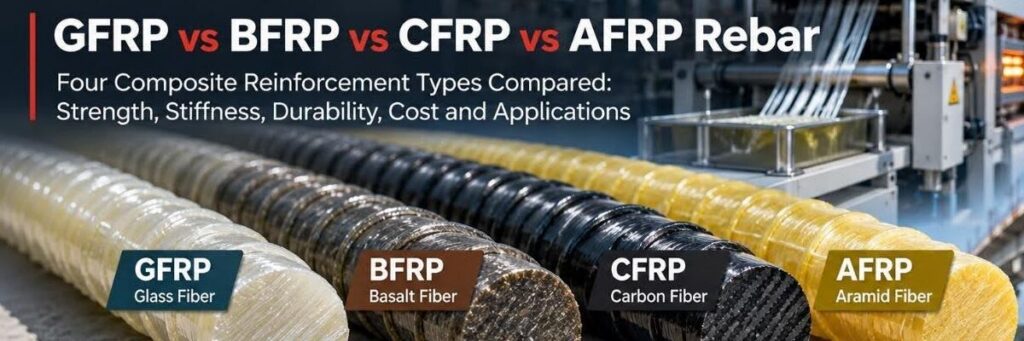
Glass, basalt, carbon and aramid fiber rebar compared — from mechanical properties and durability to manufacturing technology and industrial applications.
When engineers discuss fiber-reinforced polymer reinforcement, the conversation usually begins with GFRP — glass fiber reinforced polymer rebar. That makes sense. Glass fiber is widely available, relatively economical and already supported by established technical standards for concrete reinforcement. But glass is only one of the fibers that can be used to manufacture composite reinforcing bars.
Basalt, carbon and aramid fibers offer different combinations of tensile strength, stiffness, density and chemical resistance. Each has characteristics that may be valuable in specific engineering applications. The challenge is knowing which differences actually matter.
Carbon fiber, for example, can provide substantially greater stiffness than conventional glass fiber. Basalt is often promoted as a technically superior alternative to glass. Aramid is known for its high tensile strength and low weight. Yet none of these facts automatically means that a reinforcing bar manufactured from one fiber will perform better than a bar made from another.
A finished FRP reinforcing bar is not simply a bundle of fibers. It is an engineered composite product whose properties depend on the reinforcing fiber, polymer matrix, manufacturing process and quality control.
This distinction is particularly important for concrete engineers, infrastructure contractors and companies considering investments in FRP reinforcement manufacturing.
In this article, we compare the four main types of FRP rebar, explain their practical advantages and limitations, and examine how modern production technologies can be adapted to different fiber systems.
Quick Answer: What Are the Four Main Types of FRP Rebar?
The four principal types of fiber-reinforced polymer reinforcement are GFRP, BFRP, CFRP and AFRP.
GFRP uses glass fibers and generally offers the most established combination of manufacturing economics, commercial availability and structural design references.
BFRP uses basalt fibers and provides an alternative mineral-fiber reinforcement system with properties that depend on the fiber grade and finished composite.
CFRP uses carbon fibers and is especially interesting where high tensile stiffness, high strength-to-weight performance or specialized engineering properties justify a greater material cost.
AFRP uses aramid fibers and offers high tensile strength and low density, making it relevant to selected specialized applications.
There is no universally superior FRP rebar. The best choice depends on the required mechanical properties, environmental exposure, available standards, manufacturing economics and intended application.
What Is FRP Rebar?
Fiber Reinforced Polymer, or FRP, is a composite material made from reinforcing fibers embedded in a polymer matrix.
In reinforcing bars, the fibers are generally aligned along the longitudinal direction because their primary function is to resist tensile forces. The polymer matrix surrounds the fibers, helps transfer stresses between them, maintains the bar’s shape and protects the reinforcing system.
FRP reinforcement differs fundamentally from conventional steel rebar. Steel is a relatively homogeneous metallic material with well-established yielding behavior. FRP is anisotropic: its mechanical properties depend on direction, fiber orientation and composite construction. Most conventional FRP reinforcing bars exhibit approximately linear-elastic behavior in longitudinal tension until rupture, without the distinct yielding plateau associated with reinforcing steel. That difference has important consequences for structural design.
For example, a GFRP bar may have high tensile strength but substantially lower tensile stiffness than steel. This means that replacing steel reinforcement with GFRP cannot be based solely on nominal bar diameter or tensile strength. Serviceability, deflection, cracking, bond, development length and other design requirements must also be considered. Understanding these differences is essential before comparing the various FRP fiber systems.
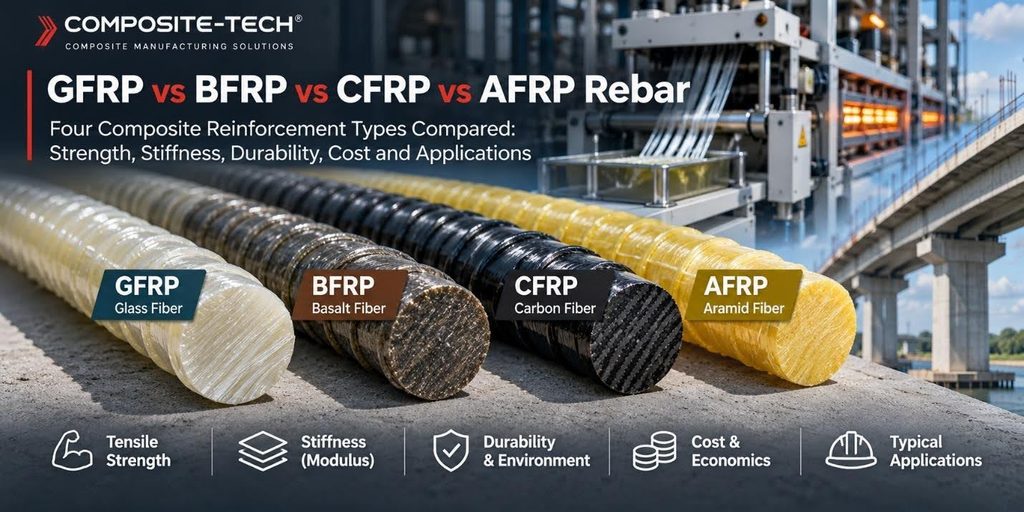
Glass, Basalt, Carbon and Aramid: Understanding the Four Fiber Types
GFRP — Glass Fiber Reinforced Polymer
GFRP is manufactured using continuous glass fibers embedded in a compatible polymer resin. It is one of the most commercially established composite reinforcement materials for concrete construction.
Its principal advantages include low weight, high longitudinal tensile strength and resistance to the conventional electrochemical corrosion mechanism that affects steel reinforcement. GFRP is particularly interesting for concrete exposed to chlorides, moisture and other environments where steel corrosion may contribute to maintenance and deterioration. Common applications include bridge decks, marine structures, parking facilities, concrete pavements, precast products and selected industrial structures.
Another important advantage is its technical acceptance framework. In the United States, ASTM D7957/D7957M establishes product requirements for qualifying GFRP reinforcing bars. CODICE ACI-440.11-22 provides structural design requirements for concrete reinforced with GFRP bars within its scope. This makes GFRP attractive not only as a material but also as a manufacturing business. A producer entering the market can work within an established system of product specifications, testing procedures and engineering design references.
For many manufacturers, GFRP is the logical starting point for industrial FRP reinforcement production.
BFRP — Basalt Fiber Reinforced Polymer
BFRP reinforcement uses continuous basalt fibers manufactured from processed basalt rock. Like GFRP, the finished reinforcing bar consists of continuous fibers embedded in a polymer matrix. Basalt fibers are often discussed because of their mineral origin and potentially attractive mechanical characteristics. However, the performance of basalt reinforcement depends on the specific fiber grade, resin formulation, fiber content and manufacturing process.
It is a mistake to assume that all BFRP bars are automatically stronger, stiffer or more durable than GFRP bars. Published research contains overlapping mechanical property ranges for glass- and basalt-based composites. One BFRP product may outperform a particular GFRP product, while another comparison may produce a different result. For engineers, product-specific laboratory data remains essential.
A Significant Development: ASTM D8505
The publication of ASTM D8505/D8505M has provided an important technical reference for basalt-based reinforcement. The 2025 edition covers specified basalt and glass fiber reinforced polymer bars for concrete reinforcement. Its scope includes straight, solid, round reinforcing bars with external surface enhancement. This represents an important development for BFRP manufacturers.
However, ASTM D8505 does not automatically authorize BFRP reinforcement in every structural application.
The applicable structural design requirements and project acceptance procedures must still be established. For manufacturers, BFRP may be commercially attractive where customers specifically request basalt reinforcement or where the producer has a clear market-development strategy.
CFRP — Carbon Fiber Reinforced Polymer
Carbon fiber occupies a different position in the composite materials industry. Its most important distinguishing characteristic is the availability of fiber grades with very high tensile stiffness.
Compared with conventional GFRP, CFRP reinforcement can achieve a substantially higher longitudinal modulus of elasticity. This is particularly relevant when deformation control or structural stiffness is important.
Carbon fiber composites are already widely used in aerospace, high-performance industrial products and structural strengthening systems. CFRP is also used in specialized reinforcement and prestressing applications.
The difficulty is economic. Carbon fibers are generally more expensive than conventional reinforcing glass fibers. For a manufacturer supplying large quantities of ordinary concrete reinforcement, that price difference can significantly affect the competitiveness of the finished product. A higher-performance fiber does not automatically create a more profitable business. If customers do not require the additional properties, they may have little reason to pay the higher price.
An Important Difference: Electrical Conductivity
Carbon fibers are electrically conductive. Consequently, CFRP should not automatically be described as an electrically insulating reinforcement material. This is an important distinction from conventional glass- and basalt-fiber composites, which generally provide electrical insulation when formulated appropriately.
Electrical conductivity can be useful in certain specialized applications. However, direct contact between conductive CFRP and steel in the presence of an electrolyte can also create galvanic corrosion concerns. This interaction must be evaluated in the relevant structural and environmental conditions.
CFRP is therefore not simply a more expensive version of GFRP. It is a different reinforcement system with different engineering opportunities and design considerations.
AFRP — Aramid Fiber Reinforced Polymer
Aramid fibers are high-performance organic fibers known for their tensile properties and relatively low density. They are used in several advanced composite applications where lightweight construction and tensile performance are important. When embedded in an appropriate polymer matrix, aramid fibers can form AFRP reinforcing bars, rods and tendons. Aramid reinforcement has been investigated for prestressing and specialized structural applications.
Its advantages include low weight and potentially high longitudinal tensile strength. However, aramid-based composites require careful consideration of environmental durability. Moisture absorption, alkaline exposure and temperature effects can influence performance, depending on the fiber grade and polymer system. Aramid also has different compressive and transverse characteristics from glass and carbon fiber composites.
These considerations help explain why AFRP reinforcement is generally more specialized than conventional GFRP rebar.
For manufacturers, AFRP may be interesting when there is a defined customer requirement that justifies the use of aramid fibers. It is less suitable as a default material choice for a new factory whose primary objective is producing economical reinforcement for a broad construction market.
GFRP vs BFRP vs CFRP vs AFRP: Technical Comparison
The four types of reinforcement share the basic principle of continuous fibers embedded in a polymer matrix. However, they differ in mechanical behavior, raw material costs and commercial applications.
The following table provides a practical overview.
Table 1. Comparison of Four FRP Rebar Types
| Proprietà | GFRP | BFRP | CFRP | AFRP |
| Reinforcing fiber | Glass | Basalt | Carbon | Aramid |
| Material category | Inorganic mineral fiber | Inorganic mineral fiber | Carbon fiber | Organic polymer fiber |
| Longitudinal tensile strength | Alto | Alto | High to very high | High to very high |
| Typical stiffness positioning | Moderare | Moderare | Potentially very high | Moderate to high |
| Relative fiber cost | Generally economical | Supplier- and grade-dependent | Generally premium | Generally premium |
| Conventional steel-rust mechanism | Not applicable | Not applicable | Not applicable | Not applicable |
| Electrical behavior | Generally insulating | Generally insulating | Conduttivo | Generally insulating |
| Main commercial position | Established concrete reinforcement | Alternative mineral-fiber reinforcement | Specialized high-performance reinforcement | Specialized lightweight reinforcement |
| U.S. standards position | ASTM D7957; established ACI design route | ASTM D8505 product specification | Requires applicable product and design qualification | Requires applicable product and design qualification |
This table describes broad material characteristics, not guaranteed properties of individual reinforcing bars. Electrical behavior also depends on the complete composite configuration.
The comparison becomes more interesting when we examine stiffness and tensile strength separately.
Which FRP Rebar Has the Highest Tensile Strength?
Carbon and aramid fibers are often associated with exceptionally high tensile strength. But the answer depends on what is being compared.
A manufacturer’s raw fiber datasheet describes the properties of the fibers themselves. A finished FRP bar has different characteristics because it contains both fibers and polymer resin. It may also contain winding material, surface ribs or other manufacturing features. The final tensile strength depends on the composite construction.
Scientific reviews report broad and overlapping property ranges for FRP reinforcing bars.
Table 2. Mechanical Properties Reported in Research Literature
| Rebar Type | Reported Tensile Strength | Reported Tensile Modulus |
| GFRP | 483–1,600 MPa | 35–51 GPa |
| BFRP | 600–1,500 MPa | 50–65 GPa |
| CFRP | 600–3,690 MPa | 120–580 GPa |
| AFRP | 1,720–2,540 MPa | 41–125 GPa |
Representative ranges compiled from published research on FRP reinforcing bars. They reflect different products, fiber grades and research programs rather than a controlled comparison of four identically manufactured bars. These values must not be used as design specifications.
The table demonstrates two important points. First, high tensile strength is not exclusive to one FRP material. Second, the differences in stiffness can be more pronounced than differences in ultimate tensile strength.
For comparison, conventional reinforcing steel has a modulus of elasticity of approximately 200 GPa. Some CFRP systems can approach or exceed that value, while conventional GFRP and BFRP bars generally have substantially lower longitudinal moduli. This distinction is critical for structural engineers.
A reinforcing bar may have enough tensile strength to resist the ultimate design force but still require additional consideration of deflection or crack width.
Strength tells us how much stress a material can resist. Stiffness tells us how much it deforms under that stress. They are not interchangeable properties.
Which FRP Rebar Is the Most Durable?
One of the principal reasons for using FRP reinforcement is its resistance to conventional steel corrosion. Steel reinforcement can corrode through electrochemical processes when the protective conditions within concrete are compromised. FRP bars do not undergo the same iron-rusting mechanism. That is a significant advantage in many concrete applications. However, it does not mean every FRP composite is unaffected by the environment.
Long-term performance depends on the complete material system. Important exposure conditions include moisture, alkaline solutions, elevated temperature, sustained loading and environmental cycling. For example, concrete pore solutions are highly alkaline. The long-term durability of reinforcement in such an environment depends on the fibers, polymer matrix, fiber–matrix interface and quality of manufacturing.
GFRP and BFRP products may exhibit different levels of property retention depending on their formulations and conditioning histories. Aramid-based reinforcement can be sensitive to certain moisture and alkaline exposure conditions. Carbon fibers themselves may offer high chemical stability, but the CFRP composite must still be evaluated as a complete material. The matrix, interface and surface system remain important.
Why Manufacturing Quality Matters
Consider two reinforcing bars manufactured from the same glass fiber. One has uniform resin impregnation and a properly cured polymer matrix. The other contains internal voids, dry fiber areas and incomplete curing. Although the fiber designation is identical, the two bars may behave differently when exposed to moisture or alkaline environments. The same principle applies to basalt, carbon and aramid reinforcement.
Durability is a property of the finished composite system, not a guarantee provided by the name of the reinforcing fiber.
For this reason, long-term performance claims should be supported by relevant testing and product-specific documentation.
Which FRP Rebar Is the Most Cost-Effective?
For manufacturers and construction buyers, cost is often the deciding factor. However, comparing only the purchase price of the reinforcing fiber does not provide a complete answer. A finished FRP rebar contains fiber, resin and other processing materials. Its manufacturing cost also depends on production speed, raw material utilization, electricity consumption, labor and rejected-product rates.
A low-cost fiber can result in an expensive product if the manufacturing process is inefficient. Conversely, advanced production technology can improve the economics of a commercially established fiber system.
GFRP: The Commercial Starting Point
For many manufacturers, glass fiber provides a practical combination of availability, cost and mechanical performance. It is particularly attractive when the business intends to supply substantial quantities of reinforcement for established construction applications.
Its existing standards framework is another commercial advantage.
BFRP: An Alternative with Market-Specific Potential
Basalt may be attractive when local supply conditions are favorable or when the target market specifically requires basalt-based reinforcement. However, the business case must be established using real purchasing prices and finished-product specifications.
The assumption that BFRP always commands a higher selling price or delivers a higher margin is not sufficient.
CFRP: Performance-Driven Manufacturing
Carbon fiber generally requires a larger material budget. Its commercial justification is strongest where customers need the properties offered by a particular CFRP system. For a factory producing standard construction reinforcement, CFRP may not be the most economical starting material. For a specialized high-performance market, the calculation can be very different.
AFRP: Specialized Opportunities
Aramid reinforcement presents similar commercial considerations. Its use is more likely to be justified by a specific technical requirement than by the need to manufacture large volumes of economical general-purpose concrete reinforcement.
For investors, the conclusion is straightforward:
The most profitable FRP material is not necessarily the strongest or most expensive. It is the material that can be manufactured consistently, meets the customer’s requirements and can be sold at a sustainable margin.
That brings us to an equally important question: the production equipment.
Can the Same Production Line Manufacture GFRP, BFRP, CFRP and AFRP Rebar?
This question is becoming increasingly relevant to manufacturers considering a long-term investment in composite reinforcement. The basic production principle is similar for different continuous-fiber FRP materials. Reinforcing fibers are prepared, impregnated with a compatible resin, formed into the required profile and cured through a controlled manufacturing process.
However, similar manufacturing principles do not mean identical production requirements.
Glass, basalt, carbon and aramid fibers differ in their physical characteristics, surface chemistry, handling behavior and compatibility with polymer resins. As a result, a production line must provide sufficient process flexibility to accommodate the selected material system. This may involve changes to fiber feeding, tension settings, impregnation parameters, resin selection, curing conditions and surface formation.
What Changes When the Fiber Type Changes?
| Manufacturing Parameter | Why Adjustment May Be Necessary |
| Alimentazione a fibra | Different rovings require appropriate handling |
| Fiber tension | Mechanical characteristics differ between fibers |
| Fiber preparation | Surface treatment and moisture conditions may differ |
| Resin selection | Matrix compatibility and application requirements vary |
| Impregnazione della resina | Wet-out behavior depends on fiber and resin properties |
| Contenuto di fibre | Influences strength, stiffness and product geometry |
| Curing schedule | Must match the selected polymer formulation |
| Raffreddamento | Depends on composite geometry and thermal behavior |
| Velocità di trazione | Must be validated for each material system |
| Controllo qualità | Product specifications and testing requirements differ |
For this reason, changing fiber type should be treated as a controlled manufacturing development process. It is not enough to replace glass fiber bobbins with carbon or aramid rovings and assume that the finished reinforcement will meet the intended specification. For manufacturers planning to offer several FRP products, this flexibility becomes an important equipment-selection consideration.
Composite-Tech: Manufacturing Technology for Different Reinforcing Fibers
Composite-Tech develops industrial production equipment for continuous fiber-reinforced polymer reinforcement. The company’s manufacturing technology is built around controlling the operations that determine composite quality: fiber preparation, impregnation, surface formation, polymerization, cooling and continuous pulling. Its equipment platform can be engineered for different reinforcing fiber systems, including glass, basalt, carbon and aramid. Each configuration requires appropriate material selection, processing parameters and product qualification.
The company’s approach is particularly relevant because the manufacturing challenges become more demanding when production speed increases.
A faster pulling system alone does not solve incomplete impregnation, insufficient curing or unstable product geometry. For that reason, Composite-Tech has developed several specialized processing technologies.
Ultrasonic-Assisted Resin Impregnation
One of the most important stages in FRP production is introducing the polymer resin throughout the reinforcing fiber bundle. A roving contains numerous individual filaments. If the resin does not penetrate the bundle properly, internal defects may remain even when the finished bar looks acceptable.
Composite-Tech uses a patented ultrasonic-assisted impregnation system designed to improve resin penetration during continuous processing. The equipment also incorporates controlled pneumatic squeezing to help manage excess polymer binder.
The objective is to achieve consistent impregnation and appropriate resin content. This is especially important because both insufficient impregnation and unnecessary resin consumption can affect manufacturing economics. The same engineering challenge exists when working with different reinforcing fibers, although the appropriate processing conditions must be established separately.
Short-Wave Infrared Polymerization
Another challenge is ensuring sufficient resin curing during continuous production. The faster reinforcement moves through the line, the less time it spends in the heating sections.
Composite-Tech incorporates a short-wave infrared booster before the principal curing ovens. The system is designed to support initial heating and polymerization as part of a coordinated thermal process. Subsequent curing zones continue the required treatment.
This approach allows engineers to manage the interaction between material chemistry, reinforcement diameter and production speed. It does not eliminate the need to validate each resin formulation.
Two-Stage Air-and-Water Cooling
Following curing, the composite reinforcement must be cooled before further processing.
Composite-Tech uses a two-stage system in which air cooling precedes water cooling. The purpose is to manage the temperature transition and reduce the risk of defects associated with abrupt cooling.
As with impregnation and curing, the cooling process must be adjusted to the selected composite system.
Automated Production and Monitoring
The manufacturing process also requires coordinated pulling, rib formation, cutting and product handling.
Composite-Tech integrates these operations into its industrial equipment. The CT6 New Generation configuration additionally includes optical monitoring intended to help identify visible production deviations. Such monitoring supports process supervision but does not replace laboratory testing.
Together, these technologies reflect the company’s approach to industrial FRP manufacturing: controlling the complete production process rather than concentrating on a single machine parameter.
CT6 New Generation: High-Output GFRP Manufacturing
For manufacturers intending to produce GFRP reinforcement at industrial scale, production capacity is a major commercial consideration. Composite-Tech’s CT6 New Generation is designed to manufacture up to six reinforcing bars simultaneously.
Its July 2026 technical documentation provides diameter-specific production capacities for the fiberglass reinforcement configuration.
CT6 New Generation: Manufacturer-Declared Production Capacity
| Diametro nominale | Simultaneous Bars | Produzione combinata, fino a |
| 4 mm | 6 | 48 m/min |
| 6 mm | 6 | 42 m/min |
| 8 mm | 6 | 39,6 m/min |
| 10 millimetri | 6 | 36 m/min |
| 12 mm | 4 | 16 m/min |
| 14 mm | 3 | 10,5 m/min |
| 16 mm | 2 | 6 m/min |
| 18 mm | 1 | 2,5 m/min |
| 20 mm | 1 | 2 m/min |
Source: Composite-Tech CT6 New Generation Installation and Operation Manual, IME.005, July 17, 2026.
At 10 mm diameter, the line can manufacture six bars simultaneously at a pulling speed of up to 6 meters per minute per bar. This corresponds to a combined production rate of 36 meters per minute. Over an uninterrupted eight-hour shift, theoretical output reaches 17,280 linear meters. The technical manual also specifies that the line can be controlled by one or a maximum of two operators, with approximately 18–20 kW of electrical power demand after warm-up.
These are indicative equipment specifications. Actual production depends on resin characteristics, materie prime and operating conditions.
Importantly, these published capacities refer to the documented GFRP configuration. They must not be automatically applied to basalt, carbon or aramid reinforcement.
Each alternative fiber system requires its own production parameters and validated performance data. For manufacturers, the commercial importance of CT6 lies in its combination of multiple simultaneous bars, specialized processing technologies and automated operation. The production line is designed to support substantial output without requiring a separate independent machine for each reinforcing bar.
Why Manufacturing Quality Matters More Than the Fiber Name
Consider two hypothetical reinforcing bars. Both are manufactured using carbon fiber. Both have the same nominal diameter.
Both are advertised as high-strength CFRP reinforcement. Yet one may have a higher fiber volume fraction, better fiber alignment and a more consistent polymer matrix. The other may contain voids, poorly distributed resin or incomplete curing. Their mechanical properties may differ substantially. This is not unique to carbon fiber.
The same problem can occur with GFRP, BFRP and AFRP.
A professional manufacturer must therefore monitor and verify the characteristics of the finished reinforcement. These include tensile load capacity, tensile strength, longitudinal modulus, effective cross-sectional area, surface profile, bond behavior and relevant durability properties. The appropriate tests depend on the material and intended application.
Production traceability also matters. A supplier should be able to identify the raw materials used for a production batch and connect them to relevant manufacturing records and test results. For construction engineers, this information is more meaningful than an unsupported statement that one fiber type is superior to another.
The finished bar must demonstrate its performance. The fiber name alone cannot do that.
Standards: Are GFRP, BFRP, CFRP and AFRP Treated Equally?
NO.
Different FRP materials do not automatically have the same product specifications or structural design acceptance.
This is especially important in the United States.
ASTM D7957/D7957M-26
This specification covers qualifying glass fiber reinforced polymer bars for concrete reinforcement. Its scope includes specified GFRP bars supplied in cut lengths and bent shapes with external surface enhancement.
It addresses geometric, material, mechanical and physical properties, as well as qualification and production quality control.
ASTM D8505/D8505M-25
This specification covers certain basalt and glass fiber reinforced polymer reinforcing bars. Its scope focuses on straight, solid, round bars with external surface enhancement.
It does not extend automatically to carbon- or aramid-fiber reinforcement.
CODICE ACI-440.11-22
This code establishes structural design requirements for concrete reinforced with qualifying GFRP bars. The edition specifically references GFRP reinforcement conforming to ASTM D7957-22.
The existence of newer ASTM product standards does not automatically change the referenced requirements in an adopted structural design code.
What About CFRP and AFRP?
Carbon and aramid composites have established applications in structural engineering, including strengthening systems and specialized reinforcement.
However, the ASTM D7957 and D8505 specifications described above do not provide a general qualification route for CFRP or AFRP reinforcing bars. Their use requires evaluation under the applicable product specifications, design provisions, project approvals and jurisdictional requirements.
For manufacturers, the practical lesson is important:
The ability to manufacture a composite material and the authorization to use that material in a particular structural application are two separate matters.
Equipment capability does not automatically establish product compliance.
Which FRP Rebar Should a New Manufacturer Produce?
For a company considering an investment in composite reinforcement manufacturing, the most important decision is not necessarily which fiber has the highest tensile strength. It is which finished product can be manufactured economically and sold into a sufficiently developed market. A factory requires customers, qualified products, reliable raw materials and a repeatable production process.
A Practical Manufacturing Decision Guide
| Obiettivo aziendale | Material to Evaluate First | Motivo |
| Enter the established non-metallic concrete reinforcement market | GFRP | Commercial availability and established technical references |
| Develop a basalt-based reinforcement product | BFRP | Alternative mineral-fiber product category |
| Target specialized high-stiffness reinforcement | CFRP | Availability of high-modulus fiber grades |
| Develop specialized lightweight tensile reinforcement | AFRP | Material properties suited to selected applications |
| Build a flexible FRP manufacturing business | GFRP initially, with other fibers evaluated as needed | Allows initial focus on a defined market while preserving development options |
These are commercial starting points, not universal engineering recommendations. For example, a factory may have an excellent technical reason to manufacture CFRP reinforcement from the beginning. But that decision should be based on a specific market requirement rather than the assumption that carbon fiber is always better.
Similarly, choosing basalt should be supported by a realistic assessment of available fibers, expected selling prices and technical qualification requirements. For many new manufacturers, GFRP offers a practical entry point because the market is more familiar with the material and its standards framework is comparatively developed. The ability to evaluate additional fiber systems later can nevertheless be valuable.
Beyond Straight Rebar: Building a Complete Composite Reinforcement Business
Manufacturers entering the FRP industry should also consider the range of products their customers may require. Construction projects frequently need more than straight reinforcement. Depending on the application, buyers may also require composite reinforcement mesh, prefabricated bent elements, cut-to-length bars and other customized products. These products require specialized manufacturing processes.
Composite-Tech develops equipment for straight FRP rebar, reinforcement mesh and factory-made bent composite elements. An integrated manufacturing business can therefore consider several complementary product categories.
The commercial benefit is straightforward. A producer supplying both straight reinforcement and mesh may be able to serve a wider range of construction customers than a manufacturer offering only one product. A company capable of supplying factory-made bent elements can address additional project-specific requirements. However, expanding the product range should follow demonstrated customer demand.
For many new factories, the most effective strategy is to establish one qualified product line, develop reliable sales and then expand into complementary products.
The Future of FRP Reinforcement Is About Materials and Manufacturing Technology
The development of composite reinforcement is often discussed as a competition between glass, basalt, carbon and aramid fibers. But that is only part of the story.
A material with excellent theoretical properties is not automatically a commercially successful reinforcing product.
- It must be manufactured consistently.
- It must meet the relevant technical requirements.
- It must be supplied at a price the market can support.
- And it must have a clear application in which its properties deliver meaningful value.
This is why manufacturing technology is becoming increasingly important.
Modern equipment must coordinate fiber preparation, impregnation, resin-content control, curing, cooling and finishing. t must also support repeatable product geometry and reliable quality control.
Composite-Tech develops equipment around these manufacturing requirements. Its CT6 New Generation demonstrates how multi-bar production can be combined with ultrasonic-assisted impregnation, short-wave infrared heating and controlled cooling. The same broader engineering approach can support the development of different composite reinforcement systems, provided each fiber and resin combination is properly evaluated.
For industrial investors, this creates an important opportunity. Rather than treating FRP manufacturing as a business limited to one type of reinforcement, companies can develop expertise in continuous composite processing and expand according to market requirements. The technology selected at the beginning can influence how easily that business develops in the future.
Explore Advanced FRP Manufacturing Technology with Composite-Tech
Selecting the right reinforcing fiber is only one part of developing a successful composite reinforcement product. The manufacturing process must also provide consistent impregnation, controlled polymerization, repeatable geometry and reliable production quality.
Composite-Tech develops industrial equipment for fiber-reinforced polymer reinforcement manufacturing, including high-output rebar production lines, FRP mesh equipment and factory-made bent-element systems.
Our engineering approach combines specialized composite processing technologies with automated continuous manufacturing. Whether your project involves conventional GFRP reinforcement, basalt-based products or specialized carbon and aramid composite systems, equipment configuration should begin with the intended material properties and target applications.
Planning to manufacture FRP reinforcement?
Contatta Composite-Tech to discuss your target fiber type, resin system, reinforcement diameters, required production capacity and factory configuration. Our team can help evaluate the appropriate manufacturing equipment and technical requirements for your project.
Composite-Tech — Advanced Manufacturing Technology for Fiber-Reinforced Polymer Reinforcement.
Conclusione
Glass, basalt, carbon and aramid fibers each have a place in the development of composite reinforcement.
- GFRP offers an established combination of performance, manufacturing economics and technical acceptance.
- BFRP provides an alternative mineral-fiber reinforcement system with its own material and commercial characteristics.
- CFRP offers opportunities where high stiffness and specialized mechanical properties justify its cost.
- AFRP remains relevant for selected lightweight and high-performance applications.
But the most important lesson is that no reinforcing fiber guarantees the performance of a finished composite bar. That performance depends on the complete material system and the manufacturing process.
For engineers, the right choice begins with verified product properties and applicable design requirements. For manufacturers, the right choice also depends on production efficiency, quality control and the market for the finished product.
The future of FRP reinforcement will be shaped not only by the development of better fibers, but also by the technologies used to turn those fibers into reliable, commercially competitive products.
Frequently Asked Questions About GFRP, BFRP, CFRP and AFRP Rebar
What are the four main types of FRP rebar?
The four main categories are GFRP (glass fiber reinforced polymer), BFRP (basalt fiber reinforced polymer), CFRP (carbon fiber reinforced polymer) and AFRP (aramid fiber reinforced polymer). They differ primarily in their reinforcing fibers and resulting material characteristics.
Which is stronger: GFRP or CFRP rebar?
CFRP can offer higher tensile stiffness and high tensile strength, depending on the carbon fiber grade and composite design. However, the tensile strength ranges of finished FRP bars overlap. A reliable comparison requires product-specific test data.
Is basalt rebar better than fiberglass rebar?
Not automatically. BFRP and GFRP properties depend on fiber grade, resin system, fiber content, manufacturing conditions and testing. Neither material should be considered universally superior.
Which FRP rebar has the highest stiffness?
CFRP can achieve the highest longitudinal tensile modulus among the four commonly discussed FRP reinforcement categories, particularly when high-modulus carbon fibers are used. Actual stiffness depends on the finished composite.
Which FRP rebar is the most economical?
For many conventional concrete reinforcement applications, GFRP offers an attractive combination of raw material availability, established production technology and commercial acceptance. Actual economics depend on the manufacturer, product specification and market.
Is CFRP rebar electrically conductive?
Carbon fibers are electrically conductive, and CFRP may therefore conduct electricity. This distinguishes CFRP from typical glass- and basalt-based reinforcement systems. The electrical behavior of the finished product should be evaluated for the intended application.
Does ASTM D7957 cover carbon or aramid rebar?
No. ASTM D7957/D7957M covers specified GFRP reinforcing bars. Carbon and aramid reinforcing bars require evaluation under other applicable requirements.
What ASTM standard covers basalt FRP rebar?
ASTM D8505/D8505M-25 covers specified straight basalt and glass fiber reinforced polymer bars for concrete reinforcement.
Can the same production line manufacture glass, basalt, carbon and aramid rebar?
A suitably engineered production platform can be configured for different reinforcing fibers. However, each material requires appropriate feeding, impregnation, resin selection, curing conditions and product qualification. The same production speeds cannot be assumed for all fiber types.
Why is ultrasonic impregnation important in FRP manufacturing?
Ultrasonic-assisted impregnation is intended to improve resin penetration within continuous fiber bundles. When combined with controlled resin squeezing, it can support consistent material processing and resin-content control. Actual improvements require validation for the selected materials and conditions.
How fast can Composite-Tech CT6 manufacture GFRP rebar?
According to its July 2026 technical documentation, CT6 New Generation can manufacture six 10 mm GFRP bars simultaneously at up to 6 m/min per bar, providing a combined output of up to 36 m/min. Actual results depend on the production conditions.
Which FRP rebar is best for a new manufacturing business?
GFRP is often a practical starting point because of its commercial availability and established technical standards. BFRP, CFRP and AFRP may be attractive for specific markets. The decision should be based on customer demand, production economics and product qualification requirements.
Technical References
- ASTM International. ASTM D7957/D7957M-26 — Standard Specification for Glass Fiber Reinforced Polymer (GFRP) Bars for Concrete Reinforcement.
- ASTM International. ASTM D8505/D8505M-25 — Standard Specification for Basalt and Glass Fiber Reinforced Polymer (FRP) Bars for Concrete Reinforcement.
- American Concrete Institute. ACI CODE-440.11-22 — Building Code Requirements for Structural Concrete Reinforced with Glass Fiber-Reinforced Polymer (GFRP) Bars.
- Research publication. Research Progress on Short-Term Mechanical Properties of FRP Bars and FRP-Reinforced Concrete Beams. Journal of Traffic and Transportation Engineering (English Edition), DOI: 10.1016/j.jtte.2023.06.005.
- Research publication. An Analysis of the Transfer Lengths of Different Types of Prestressed Fiber-Reinforced Polymer Reinforcement. Published research on mechanical properties of glass, basalt, carbon and aramid FRP bars.
- Composite-Tech. CT6 New Generation Installation and Operation Manual, IME.005, July 17, 2026.
Saperne di più:
- GFRP vs. BFRP Rebar Machinery Comparison
- Barre d'armatura in basalto o in GFRP: quale scegliere?
- Barre in GFRP vs barre in acciaio: confronto tecnico
- Barre di rinforzo in GFRP contro barre di rinforzo in acciaio: costi, resistenza, durata e applicazioni reali
- Barre d'armatura in basalto o in GFRP: quale scegliere?