
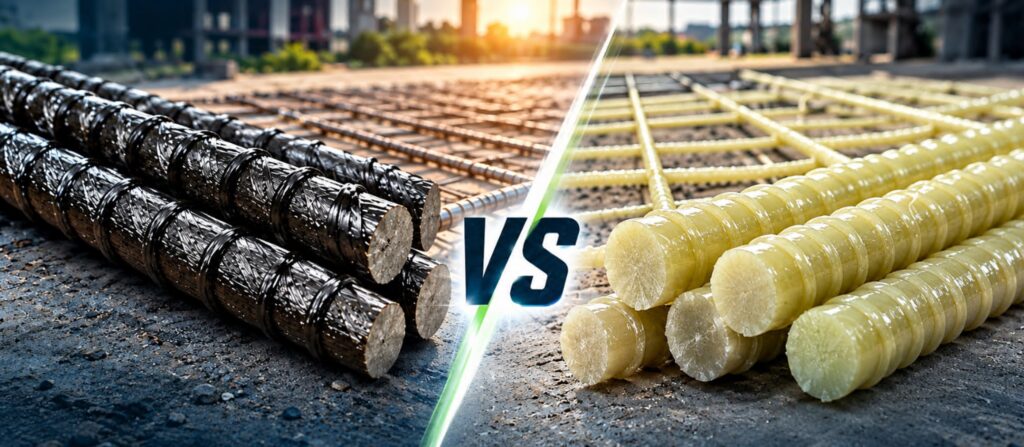
Quick Answer: Is BFRP Rebar Better Than GFRP Rebar?
BFRP rebar is not automatically better than GFRP rebar. Basalt fiber and glass fiber are two different reinforcement options within the FRP rebar family. The correct choice depends on product-specific test data, raw material availability, resin system, fiber content, production stability, surface profile, target standards and final application.
GFRP rebar is a well-established reinforcement material widely recognized in structural concrete standards and commercial practice. For instance, ASTM D7957/D7957M specifies requirements for glass fiber-reinforced polymer bars used in concrete reinforcement, while ACI CODE-440.11-22 establishes design and construction provisions for structural concrete reinforced with GFRP bars complying with ASTM D7957-22.
BFRP is gaining attention because basalt fiber is a natural mineral fiber and because ASTM D8505/D8505M-25 now covers basalt and glass fiber reinforced polymer bars for concrete reinforcement. ASTM describes D8505 as a specification for BFRP and GFRP bars in straight cut lengths, with solid round cross-section and surface enhancement for internal concrete reinforcement applications.
For producers, the real question is not “basalt or glass?” in abstract terms. The real question is:
Can the factory produce consistent FRP rebar with verified tensile strength, modulus, effective area, surface geometry, bond behavior, durability and batch traceability — using the fiber system selected for the target market?
Punti chiave
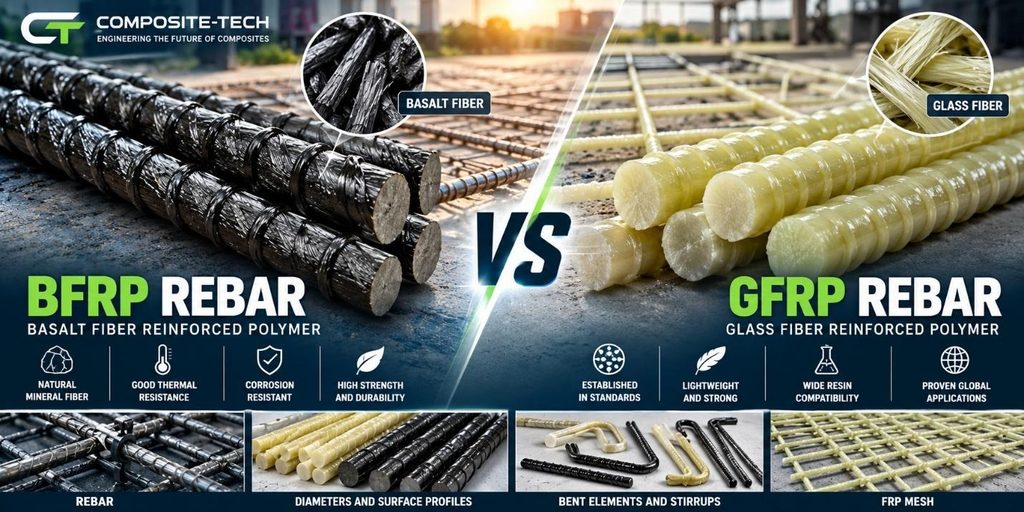
- BFRP means Basalt Fiber Reinforced Polymer rebar.
- GFRP significa Polimero rinforzato con fibra di vetro rebar.
- Both are non-metallic FRP reinforcement materials used as alternatives to steel in selected concrete applications.
- BFRP is not automatically superior to GFRP. The finished bar depends on fiber, resin, fiber volume, impregnation, curing, surface profile, manufacturing quality and testing.
- FRP rebars are anisotropic; their strength and stiffness in the fiber direction are affected by fiber type and fiber volume ratio, while resin type, fiber orientation, curing rate, manufacturing process and quality control also influence properties.
- ASTM D8505/D8505M-25 is important because it covers both basalt and glass FRP bars for concrete reinforcement.
- ASTM D7957/D7957M covers GFRP bars for concrete reinforcement, including cut lengths and bent shapes with external surface enhancement.
- ACI CODE-440.11-22 currently focuses on structural concrete reinforced with GFRP bars conforming to ASTM D7957-22.
- UN linea di produzione per barre d'armatura in FRP should not be evaluated only by whether it can pull a rod. It must control impregnation, fiber alignment, curing, surface geometry, cooling, pulling speed, cutting, coiling and quality traceability.
- For manufacturers, GFRP may offer a more established market path, while BFRP may be attractive where customers specifically request basalt fiber, mineral-origin reinforcement or differentiation from standard GFRP.
What Is BFRP Rebar?
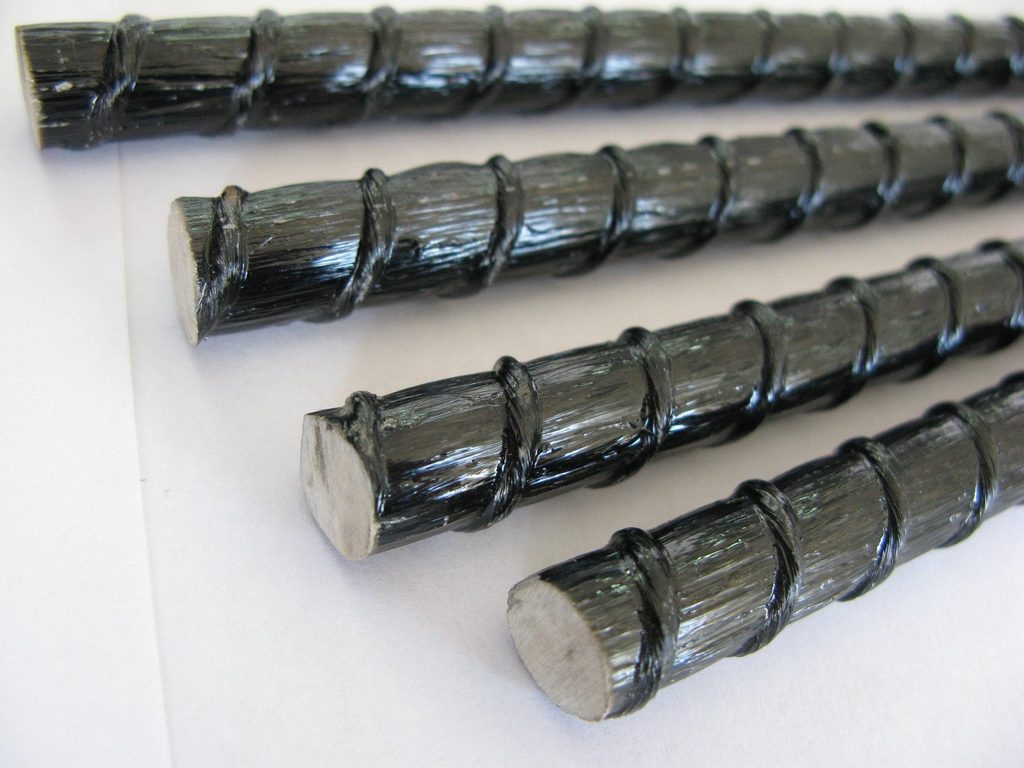
BFRP rebar is a composite reinforcing bar made from continuous basalt fibers embedded in a polymer resin matrix. The basalt fibers provide the main longitudinal reinforcement. The resin binds and protects the fibers, transfers stress between them and helps form the finished bar.
Basalt fiber is produced from basalt rock. In rebar form, however, the final product is not just “basalt.” It is a composite system:
| Componente | Role in BFRP Rebar |
|---|---|
| Basalt fiber | Main longitudinal reinforcement |
| resina polimerica | Matrix, protection and stress transfer |
| Profilo superficiale | Legame con il calcestruzzo |
| processo di produzione | Controls impregnation, alignment, curing and geometry |
| Testing and traceability | Confirms product-specific properties |
A basalt fiber may have attractive raw-material characteristics, but the finished rebar must still be tested as a product. The bar is not accepted because the fiber sounds strong. It is accepted because the finished reinforcement is documented, repeatable and suitable for the intended application.
Che cosa sono le barre d'armatura in GFRP?
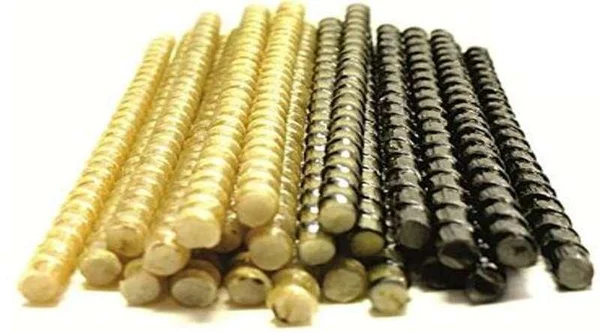
GFRP rebar is a composite reinforcing bar made from continuous glass fibers embedded in a polymer resin matrix. It is currently the most common and commercially established FRP rebar category in many concrete reinforcement markets.
GFRP is widely discussed because it combines several practical advantages:
| GFRP Feature | Lettura pratica |
|---|---|
| Non-metallic | Does not have the same steel corrosion mechanism |
| Leggero | Easier transport, handling and installation |
| Elevata resistenza alla trazione | Strong in fiber direction |
| Non conduttivo | Useful in electrical and special structures |
| Non magnetico | Useful where magnetic interference matters |
| Established standards path | ASTM D7957 and ACI 440.11 are important references |
The key point is that GFRP has a more developed structural acceptance path in some markets. In the United States, CODICE ACI-440.11-22 provides minimum requirements for structural concrete reinforced with GFRP bars that conform to ASTM D7957-22.
This does not mean GFRP is always better than BFRP. It means that in many projects, the GFRP standards path is currently clearer.
BFRP vs GFRP: The Simple Comparison
The comparison should begin with a practical warning: BFRP and GFRP should not be compared only by raw fiber claims.
The finished bar is what matters.
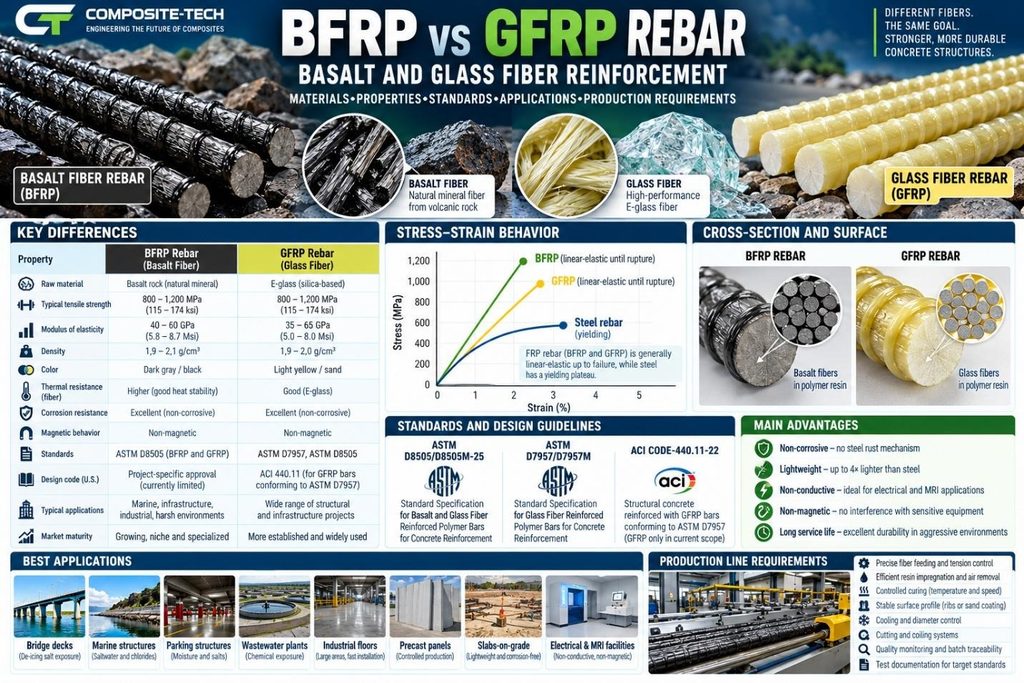
| Domanda | Barre di rinforzo in BFRP | Barre di rinforzo in GFRP |
|---|---|---|
| Main fiber | Basalt fiber | Glass fiber |
| Matrix | resina polimerica | resina polimerica |
| Material family | Rinforzo FRP | Rinforzo FRP |
| Comportamento corrosivo | Non-metallic, no steel rust mechanism | Non-metallic, no steel rust mechanism |
| Standard | ASTM D8505 includes BFRP and GFRP straight bars | ASTM D7957 covers GFRP bars; ASTM D8505 also includes GFRP straight bars |
| U.S. design code path | Must be checked carefully for project acceptance | ACI 440.11 directly covers GFRP bars conforming to ASTM D7957-22 |
| Market maturity | Emerging and specialized | More established |
| Production requirement | Strong control of fiber, resin, curing and surface | Strong control of fiber, resin, curing and surface |
| Best business use | Differentiation, basalt-specific demand, niche positioning | Broader market adoption, established specifications |
The honest conclusion is that BFRP is interesting, but GFRP is generally more established. A manufacturer should not choose basalt only because it sounds newer. It should choose basalt when there is a defined market, raw material supply, test plan and technical reason.
Why ASTM D8505 Matters
ASTM D8505/D8505M-25 is important because it gives BFRP a stronger standards-related position. ASTM identifies D8505/D8505M-25 as the Standard Specification for Basalt and Glass Fiber Reinforced Polymer Bars for Concrete Reinforcement.
The scope is also important. Public standard listings describe D8505 as covering BFRP and GFRP bars provided in straight cut lengths, with solid round cross-section and surface enhancement for internal concrete reinforcement applications.
That means BFRP producers can now discuss basalt FRP rebar with a clearer ASTM reference than before.
But this should not be overstated.
ASTM D8505 does not mean that every BFRP bar is automatically approved for every structural project. It means that the product category has a recognized specification route. Each product still needs product-specific testing, datasheets, quality control, traceability and project acceptance.
ASTM D8505 vs ASTM D7957
ASTM D8505 and ASTM D7957 should not be confused.
| Standard | Main Scope |
|---|---|
| ASTM D8505/D8505M-25 | Basalt and glass FRP bars, straight cut lengths, solid round cross-section, surface enhancement for internal concrete reinforcement |
| ASTM D7957/D7957M | Glass fiber reinforced polymer bars for concrete reinforcement, including cut lengths and bent shapes with external surface enhancement |
ASTM D7957 is especially important for GFRP because ACI CODE-440.11-22 connects structural concrete reinforced with GFRP bars to ASTM D7957-22.
This creates a practical difference for manufacturers:
- GFRP has a more direct connection to ACI 440.11 structural design in the U.S.
- BFRP now has a clearer ASTM product specification route through D8505, but structural acceptance still requires careful checking for the target market and project.
A manufacturer entering the U.S. market should not assume that BFRP and GFRP have identical acceptance paths. They do not.
Does ACI 440.11 Cover BFRP?
This is an important point and should be written carefully.
ACI CODE-440.11-22 is titled for structural concrete reinforced with Glass Fiber-Reinforced Polymer (GFRP) bars and provides requirements for structures reinforced with GFRP bars conforming to ASTM D7957-22.
ACI’s GFRP design handbook preview also states that ACI CODE-440.11-22 limits its scope to solid, round GFRP reinforcing bars constructed using vinyl ester resins and conforming to ASTM D7957/D7957M-22; it notes that inclusion of BFRP may be possible in future editions, but the current code is limited to bars conforming to ASTM D7957/D7957M.
That does not mean BFRP has no use. It means that engineers and producers must be precise:
GFRP and BFRP may both be FRP reinforcement, but the design-code route must be checked separately.
For SEO and AI search, this is a valuable statement because many pages avoid this distinction.
Why Raw Fiber Claims Are Not Enough
The most common mistake in basalt rebar marketing is claiming that basalt fiber is stronger, more natural or more durable and then assuming the finished rebar is automatically better.
That is not engineering.
FRP rebar performance depends on the complete composite system. Nanni, De Luca and Zadeh explain that FRP rebar strength and stiffness in the fiber direction are affected by fiber type and fiber volume ratio; resin type affects failure mechanism and fracture toughness; and fiber orientation, curing rate, manufacturing process and quality control also influence properties.
So the final bar depends on:
| Fattore | Perché è importante |
|---|---|
| Tipo di fibra | Basalt or glass changes the reinforcement system |
| Fiber volume ratio | Affects tensile strength, stiffness and density |
| Sistema di resina | Affects matrix durability, curing and stress transfer |
| Impregnation quality | Controls wet-out, voids and internal defects |
| Fiber alignment | Affects longitudinal tensile efficiency |
| Cura | Controls polymerization and matrix behavior |
| Profilo superficiale | Influisce sull'adesione al calcestruzzo |
| Area operativa | Affects stress calculation |
| Testing method | Makes data comparable |
| Tracciabilità del lotto | Proves production repeatability |
A buyer should not ask only whether the bar is basalt or glass. The better question is:
What are the tested properties of this specific bar, from this production line, with this resin, this fiber content, this surface profile and this batch traceability?
Mechanical Properties: What Should Be Compared?
A serious BFRP vs GFRP comparison should include more than tensile strength.
| Proprietà | Perché è importante |
|---|---|
| Carico di trazione | Capacità di forza effettiva in kN o kip |
| Resistenza alla trazione | Capacità di sollecitazione in MPa o ksi |
| Modulo di elasticità | Rigidità e funzionalità |
| Ceppo definitivo | Tensione al momento della rottura |
| Area operativa | Basis for stress calculation |
| Densità / peso | Logistics and handling |
| Profilo superficiale | Legame con il calcestruzzo |
| Taglio trasversale | Handling and structural checks |
| Durability after conditioning | Long-term confidence |
| Creep rupture behavior | Sustained stress limits |
| Dati obbligazionari | Lunghezza di sviluppo e giunzione sovrapposta |
| Tg of resin matrix | Thermal behavior and cure quality |
This is why a short claim such as “barre di basalto is stronger than glass rebar” is not enough.
It may be true for one product and false for another. It depends on the finished bar, not only the fiber name.
Manufacturing Requirements for BFRP and GFRP Rebar
From a production perspective, BFRP and GFRP have similar process logic. Both require continuous fibers, resin impregnation, forming, surface creation, curing, pulling, cutting or coiling and quality control.
But similar process logic does not mean identical process settings.
Basalt fiber and glass fiber may differ in handling behavior, surface chemistry, compatibility with resin systems, roving quality and optimal processing parameters. A production line must be adjustable enough to manage these differences.
| Fase di produzione | Why It Matters for BFRP and GFRP |
|---|---|
| Roving feeding | Prevents fiber crossing, tension variation and unstable geometry |
| Preparazione del roving | Helps drying, distribution and stable impregnation |
| Impregnazione della resina | Controls wet-out and void content |
| Resin squeezing / control | Reduces waste and stabilizes fiber/resin ratio |
| Surface formation | Creates bond-related geometry |
| Cura | Must match resin chemistry, diameter and speed |
| Raffreddamento | Avoids thermal shock and surface defects |
| Tirando | Controls speed, tension and production stability |
| Taglio/avvolgimento | Defines commercial supply format |
| Monitoraggio | Supports repeatability and defect detection |
The better production question is not:
“Can the line produce basalt?”
La domanda migliore è:
“Can the line control the process variables required to make tested, repeatable BFRP or GFRP rebar?”
Why Impregnation Is Critical
In both BFRP and GFRP rebar, fibers carry most of the longitudinal tensile load. But fibers do not work well if the resin does not properly penetrate the bundle.
Poor impregnation can create:
- fibre secche;
- vuoti interni;
- aria intrappolata;
- resin-rich zones;
- unstable density;
- poor load transfer;
- reduced repeatability;
- lower durability confidence.
For producers, impregnation is not a cosmetic process. It is one of the main quality-control stages.
A bar can look acceptable from the outside while the internal fiber/resin structure is not ideal. That is why manufacturing technology, process control and testing matter more than appearance.
Why Curing Cannot Be Treated as One Oven Temperature
Curing is often oversimplified.
For BFRP and GFRP rebar, curing depends on:
- chimica delle resine;
- velocità di produzione;
- diametro della barra;
- tempo di residenza;
- heat transfer through the cross-section;
- ambient temperature;
- fiber bundle structure;
- line stability.
A curing setup that works for one diameter, one resin system and one production speed cannot automatically be copied to another material and another speed.
This is especially important for manufacturers planning to produce both BFRP and GFRP. A flexible production line should allow process adjustment. The producer still needs validation through testing.
The finished bar is not certified by the machine setting. It is verified by product data.
Surface Profile: The Bond Question
Both BFRP and GFRP bars need surface enhancement because smooth FRP bars do not behave like deformed steel bars.
FRP rebar surfaces may include:
- helical winding;
- ribbed profiles;
- sand coating;
- wrapped surfaces;
- combined systems.
Nanni, De Luca and Zadeh note that bar surface deformation or texture, such as wound fibers, sand coatings and separately formed deformations, is used so mechanical bonding develops between FRP rebars and concrete.
This is why surface profile is a structural issue, not only an appearance issue.
A good BFRP or GFRP datasheet should not only report tensile strength. It should also explain surface type and, where required, bond behavior.
Bent Bars and Shapes: Important Difference in Market Readiness
GFRP bars can be supplied in cut lengths and bent shapes under ASTM D7957. D8505 public scope descriptions emphasize straight cut lengths for basalt and glass FRP bars.
This matters commercially.
Many concrete projects need stirrups, U-bars, closed shapes, hooks or project-specific bent elements. FRP bars cannot be bent after resin curing; bends must be incorporated during manufacturing.
For a producer, this means:
| Product Need | Production Requirement |
|---|---|
| Straight BFRP or GFRP rebar | Continuous rebar line |
| Coiled smaller diameters | Coiling system and diameter control |
| Bent GFRP elements | Factory bending technology |
| Maglia FRP | Mesh production line |
| Project reinforcement packages | Rebar + mesh + bent elements + documentation |
A company selling only straight bars may be limited. A complete FRP reinforcement factory has a stronger product platform.
When BFRP May Be Attractive
BFRP can be attractive in several situations:
| Situation | Why BFRP May Be Interesting |
|---|---|
| Customer asks specifically for basalt fiber | Clear market demand |
| Producer wants product differentiation | Basalt can create a distinct product story |
| Local basalt fiber supply exists | Potential raw material advantage |
| Project prefers mineral-origin fiber | Marketing and specification interest |
| ASTM D8505 route is relevant | Standardized product-specification reference |
| Non-metallic reinforcement market is emerging | Opportunity to position early |
But these are business reasons, not automatic proof of superior performance.
BFRP still needs:
- product-specific tensile data;
- modulus;
- area effettiva;
- bond data;
- durability testing;
- resin compatibility;
- surface profile control;
- tracciabilità;
- target-market approval route.
When GFRP May Be More Practical
GFRP may be more practical when the producer needs a clearer market entry route.
| Situation | Why GFRP May Be More Practical |
|---|---|
| U.S. structural concrete market | ACI 440.11 directly addresses GFRP bars conforming to ASTM D7957-22 |
| Existing customer specifications mention GFRP | Easier sales path |
| Large raw material supplier base | More supply options |
| Need for bent shapes | ASTM D7957 scope includes GFRP cut lengths and bent shapes |
| Established testing and design references | Easier engineering discussion |
| First FRP factory launch | Lower market-education burden |
This is not an argument against basalt. It is a realistic market observation: GFRP is often easier to introduce because engineers and standards already reference it more frequently.
Production Line Requirements: What Manufacturers Should Ask
A buyer considering BFRP or GFRP equipment should ask practical questions before purchasing a line.
| Domanda | Perché è importante |
|---|---|
| Can the line process both glass and basalt rovings? | Material flexibility |
| How is roving tension controlled? | Fiber alignment and consistency |
| How is resin impregnation controlled? | Wet-out and durability |
| Can resin content be controlled? | Cost and performance |
| Is surface geometry repeatable? | Legame con il calcestruzzo |
| How is curing adjusted by diameter and speed? | Product quality |
| How is cooling controlled? | Surface and internal stress risk |
| Can the line produce coils and cut lengths? | Market formats |
| Is there quality monitoring? | Defect detection |
| Can production batches be traced? | Serious buyer confidence |
| Is the supplier able to support testing documentation? | Accettazione del mercato |
The machine should not be evaluated only by price. It should be evaluated by the quality of the product it helps the manufacturer produce.
BFRP vs GFRP for Business: Which Product Should a New Factory Start With?
For most new producers, the safest commercial answer is not “choose only basalt” or “choose only glass.”
The better strategy is to understand the local market first.
| Market Condition | More Logical Starting Point |
|---|---|
| Customers already ask for GFRP | Start with GFRP |
| Standards and engineers are familiar with GFRP | Start with GFRP |
| Market wants a differentiated basalt product | Consider BFRP |
| Local basalt fiber supply is strong | Consider BFRP |
| Target market is uncertain | Start with GFRP, prepare for BFRP |
| Factory wants broad product range | Choose flexible FRP production technology |
| Buyer wants rebar, mesh and bent elements | Build a full FRP reinforcement platform |
A factory does not need to be locked into one material story forever. The stronger position is to build competence in FRP manufacturing and then choose product lines based on market demand and verified data.
Common Mistakes When Comparing BFRP and GFRP
- The first mistake is comparing only raw fiber strength.
- The second is assuming basalt is automatically better because it sounds more advanced.
- The third is ignoring the resin system.
- The fourth is ignoring fiber volume ratio.
- The fifth is ignoring surface profile and bond.
- The sixth is assuming standards apply identically to BFRP and GFRP in every project.
- The seventh is buying production equipment without checking whether it can control impregnation, curing and surface geometry.
- The eighth is publishing datasheets without product-specific testing.
- The ninth is selling BFRP or GFRP as a direct one-to-one steel replacement by nominal diameter.
- The tenth is treating the production line as a simple pulling machine instead of a quality-control system.
FAQ: BFRP vs GFRP Rebar
What is BFRP rebar?
BFRP rebar is basalt fiber reinforced polymer rebar. It is made from continuous basalt fibers embedded in a polymer resin matrix.
What is GFRP rebar?
GFRP rebar is glass fiber reinforced polymer rebar. It is made from continuous glass fibers embedded in a polymer resin matrix.
Is basalt rebar better than GFRP rebar?
Not automatically. The finished bar depends on fiber type, resin, fiber volume, impregnation, curing, surface profile, test method and manufacturing quality.
What standard covers basalt FRP rebar?
ASTM D8505/D8505M-25 covers basalt and glass fiber reinforced polymer bars for concrete reinforcement.
What standard covers GFRP rebar?
ASTM D7957/D7957M covers glass fiber reinforced polymer bars for concrete reinforcement.
Does ACI 440.11 cover BFRP rebar?
ACI CODE-440.11-22 provides requirements for structural concrete reinforced with GFRP bars conforming to ASTM D7957-22. It does not provide the same direct code route for BFRP in its current scope.
Can the same production line make BFRP and GFRP rebar?
A properly designed FRP rebar production line may be configured to process different fiber systems, but each fiber and resin combination requires process validation, test data and quality control.
Is BFRP more durable than GFRP?
Durability should not be claimed generically. It depends on fiber, resin, manufacturing quality, environment, test method and long-term validation.
Why is surface profile important?
Surface profile affects bond with concrete. FRP bars need mechanical interlock through surface enhancement such as winding, ribs, sand coating or other textures.
Can BFRP or GFRP rebar be bent on site?
No. FRP bars cannot be bent after resin curing. Bent shapes must be manufactured as part of the production process.
Which is better for a new FRP rebar factory: BFRP or GFRP?
For many new factories, GFRP may be the easier first product because it has a more established standards and market path. BFRP can be attractive where customers specifically request basalt fiber or where the producer has a clear basalt-focused market strategy.
What should buyers request from a BFRP or GFRP supplier?
Buyers should request tensile load, tensile strength, modulus, effective area, surface profile, bond data, durability data, applicable standards, test reports and batch traceability.
Conclusione
BFRP and GFRP are not enemies. They are two fiber options inside the larger FRP reinforcement market.
GFRP is more established in many structural concrete specifications and has a clearer standards path through ASTM D7957 and ACI 440.11. BFRP is gaining visibility, especially now that ASTM D8505 covers basalt and glass FRP bars for concrete reinforcement.
But the choice should not be made by slogans.
A producer should not choose basalt because it sounds stronger. A buyer should not choose glass only because it is more familiar. Both decisions should be based on product-specific testing, target applications, standards, raw material supply, production repeatability and market demand.
For manufacturers, the most important lesson is this:
The value is not only in the fiber. The value is in the finished, tested, repeatable FRP rebar.
That is why production technology matters.
A professional FRP rebar line must control fiber feeding, resin impregnation, curing, surface geometry, cooling, pulling, cutting, coiling and traceability. Without that control, neither basalt nor glass can deliver reliable reinforcement.
The future of FRP reinforcement will not be decided by one fiber name.
It will be decided by tested products, repeatable factories and manufacturers who understand both materials and process control.