
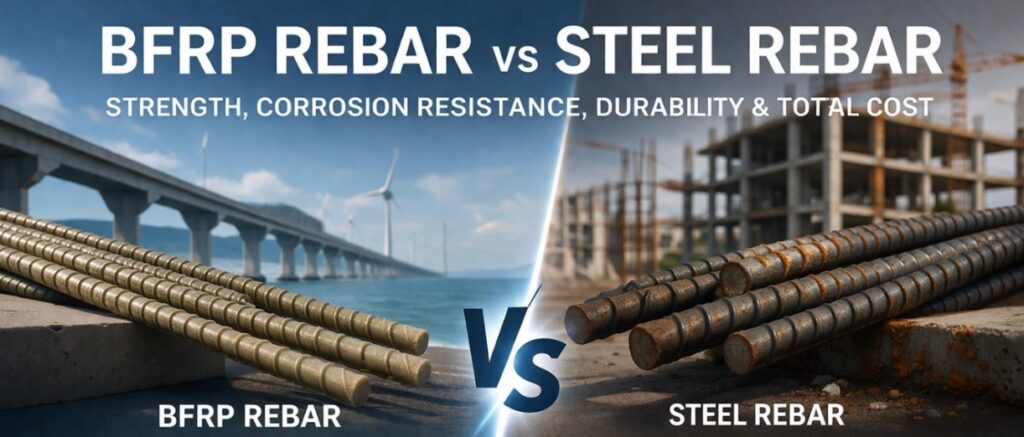
If you’re choosing between basalt FRP rebar (BFRP) et barres d'armature en acier, you’re really choosing between two different design philosophies:
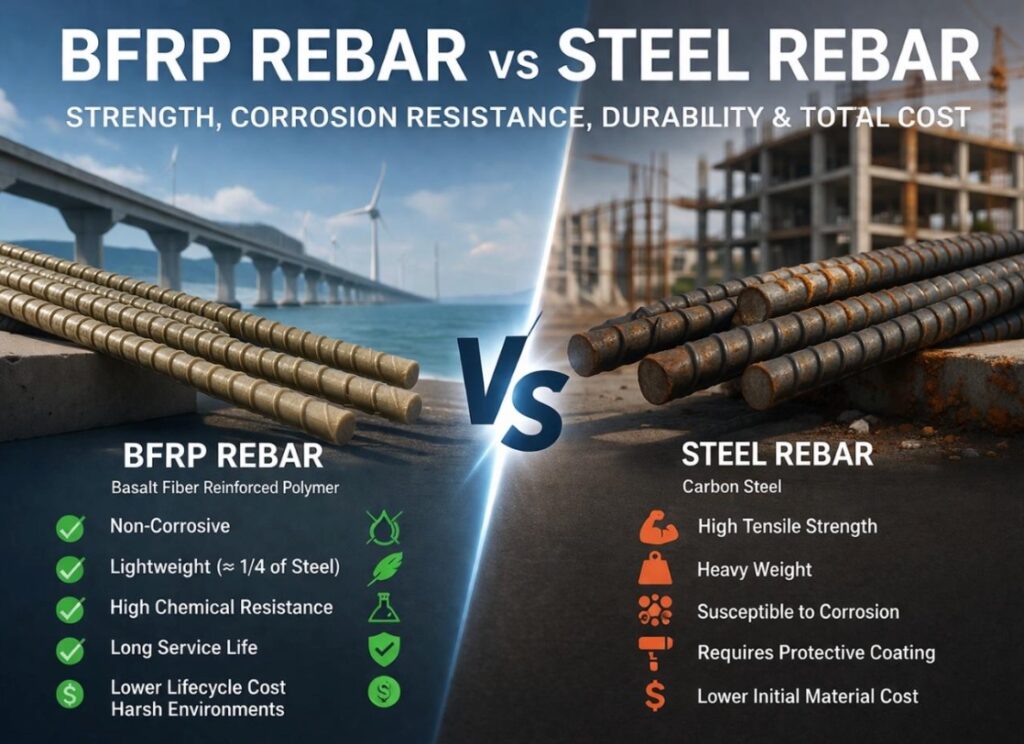
- Steel: high stiffness + ductility (yields), but vulnerable to corrosion
- BFRP: corrosion-free + lightweight, but elastic until failure and typically lower stiffness than steel
This guide is built for project owners and engineers who want a clear, code-aware decision—not marketing.
Quick Answer
- Steel Grade 60 (ASTM A615) has 60 ksi minimum yield strength.
- Steel is also commonly referenced at ~7850 kg/m³ density (about 490 lb/ft³).
- Basalt fiber composites are widely reported to have strong thermal stability and chemical resistance, often with higher tensile strength than E-glass fibers—but actual rebar performance depends on resin system + manufacturing quality.
- If your structure is exposed to chlorides (de-icing salts, marine) and you care about lifecycle durability, BFRP can be an excellent replacement candidate.
- If your structure needs ductility (certain seismic/impact behaviors) or the simplest universal acceptance, steel often remains the default.
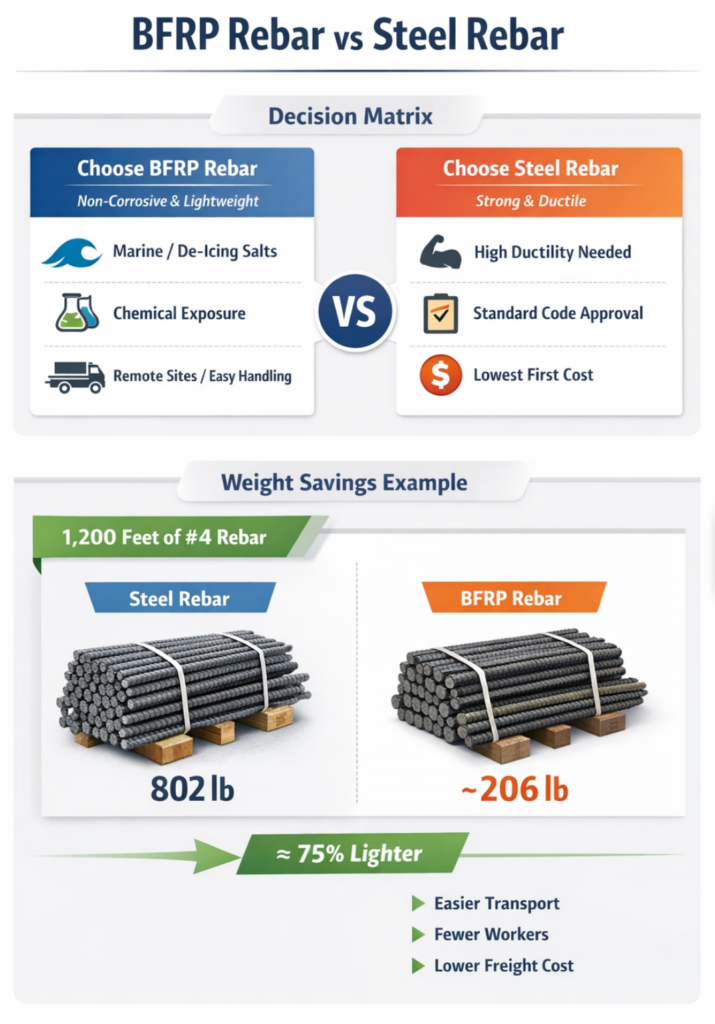
Fast Decision Matrix
Table 1 — When BFRP wins vs when steel wins
| Project condition | Best default | Why |
|---|---|---|
| Marine / coastal / de-icing salts | BFRP | Eliminates rust-driven cracking/spalling mechanism |
| Water/wastewater, chemical exposure | BFRP | Nonmetallic reinforcement avoids corrosion; chemical resistance can be strong |
| Logistics expensive (remote sites, labor shortages) | BFRP | Much lighter → easier shipping and handling (see calculator below) |
| Ductility/energy dissipation is critical | Acier | Steel yields; FRP is elastic until failure |
| Lowest upfront cost in low-corrosion interior exposure | Acier | Cheapest and most universally familiar |
| Fast approvals with conventional specs only | Acier | A615 + ACI 318 path is universally standard in U.S. practice |
Standards & Codes: What is “verified” in the U.S.?
Steel rebar (clear and universal)
- ASTM A615 is the dominant product standard for carbon steel reinforcing bars. Grade 60 means 60 ksi minimum yield.
- Designers typically work under ACI 318 for reinforced concrete (steel).
BFRP rebar (more project-specific)
There is not a single “one-size” U.S. building code dedicated exclusively to barres d'armature en basalte the way steel is handled under ACI 318. Basalt FRP can still be used—but acceptance is commonly handled via:
- project specifications,
- owner requirements,
- evaluation reports,
- and documented testing/QA.
Practical takeaway: if your owner/authority is conservative, you’ll need stronger documentation for BFRP than for steel—especially around testing and durability.
Material Behavior: the difference engineers actually design for
Strength isn’t the whole story
Steel and FRP are “strong” in different ways.
- Steel has a yield plateau → ductility, redistribution, warning before failure
- Le FRP est linear elastic to failure → no yield plateau (the design must reflect this)
That’s why “BFRP is stronger than steel” can be misleading if you don’t specify what kind of strength you mean.
Density/weight advantage is real and measurable
Steel density is widely referenced at 7850 kg/m³ (≈490 lb/ft³).
FRP composites are typically around ~2,000 kg/m³ (order-of-magnitude), meaning roughly 3–4× lighter than steel for similar volume.
That weight difference affects:
- shipping cost,
- jobsite handling,
- crew fatigue,
- placement speed.
Verified Steel Baseline: Grade 60 facts (so we’re not guessing)
Steel Grade 60 (ASTM A615) is commonly summarized as:
- Minimum yield strength: 60 ksi
- (And widely referenced with min tensile around 90 ksi in common charts/guides)
You don’t have to “believe marketing”—steel’s baseline is standardized.
Basalt Fiber (BFRP) performance: what literature supports
Basalt fiber and basalt FRP composites are widely described as offering:
- good thermal stability,
- good chemical resistance,
- et higher tensile strength than E-glass fiber in many studies.
Important nuance: finished rebar performance depends on:
- resin system (epoxy/vinyl ester),
- fiber volume fraction,
- curing profile,
- void content,
- surface profile and bond.
So the most honest engineering statement is:
BFRP has strong potential advantages in durability and temperature/chemistry environments, but real performance is product- and process-dependent.
Real Comparison Tables (what owners and engineers need)
Table 2 — BFRP vs Steel: clear differences
| Facteur | Barres d'armature en acier | armature en PRFV |
|---|---|---|
| Corrosion | Can rust (chlorides, moisture) | Non-corrosive (non-metallic) |
| Poids | Heavy; density ~7850 kg/m³ | Much lighter (typically ~3–4× lighter by density ratio) |
| Ductility | Yields (ductile) | Elastic until failure (no yielding) |
| Stiffness (modulus) | High (~200 GPa typical) | Lower than steel (depends on product) |
| Electrical/magnetic | Conducteur et magnétique | Non conducteur, non magnétique |
| Temperature/fire | Steel retains capacity at higher temperatures (design required) | Resin system governs high-temp behavior; must verify Tg/test data |
| Approval path | Very standardized (A615 + ACI 318) | More documentation often required |
Calculator #1: Weight & Logistics (ft → lb)
This is one of the simplest “real-world” reasons owners choose FRP.
Steel rebar weight per foot (common reference table)
Steel #3–#6 are widely published as:
(#3 0.376 lb/ft, #4 0.668 lb/ft, #5 1.043 lb/ft, #6 1.502 lb/ft)
Example: 1,200 ft of #4 reinforcement
- Steel weight ≈ 1,200 × 0.668 = 802 lb
If BFRP is ~3.9× lighter (7850 vs ~2000 kg/m³ density ratio), the equivalent volume weight would be roughly: - ~802 ÷ 3.9 ≈ 206 lb
That’s ~596 lb less handling for the same linear footage.
Why this matters:
- fewer workers needed to move bundles,
- easier staging on site,
- lower freight risk on long deliveries.
(Your exact BFRP weight depends on bar design; suppliers often publish lb/ft—use their product sheet for final numbers.)
Calculator #2: “First cost vs lifecycle cost”
It’s tempting to claim “BFRP is cheaper than steel.” Sometimes it is, sometimes it isn’t—especially in small retail purchases.
A better, truthful lifecycle logic is:
Steel lifecycle cost drivers
- corrosion risk (chlorides, moisture),
- repairs (spalls, patching),
- downtime (parking decks, industrial floors),
- overlays/rehabilitation.
BFRP lifecycle cost drivers
- higher first cost in some markets,
- documentation/testing requirements,
- but often less repair exposure tied to corrosion.
If you want a simple owner-facing statement:
Steel often wins on first cost; BFRP often wins when corrosion drives maintenance and service interruptions.
Temperature & Fire: the honest section (no hype)
Basalt fibers themselves are often cited for strong thermal stability in composites literature.
But for Barres d'armature en PRF, the resin matrix controls a lot of high-temperature behavior.
Selection rule for high-temperature environments:
- ask for resin Tg,
- ask for published test data under relevant conditions,
- design accordingly (don’t assume “basalt = fireproof”).
Bond & detailing: where FRP projects succeed or fail
With steel, bond behavior is familiar.
With FRP, bond depends strongly on:
- surface geometry,
- manufacturing stability,
- placement quality (cover, chairs).
If your supplier can’t show consistent QC + bond performance data, the fiber type alone won’t save you.
Use-case library (fast scenarios)
Bridge deck or coastal slab (chlorides)
- Steel corrosion risk is high.
- BFRP becomes a strong candidate.
Standard interior slab, dry environment
- Steel remains simplest and cheapest path.
Industrial floor with chemicals
- Corrosion and downtime are expensive.
- BFRP can reduce risk of corrosion-driven deterioration.
Seismic detailing-heavy structural members
- Steel ductility is an advantage.
Common mistakes
- Choosing BFRP for “strength” but ignoring stiffness
- Serviceability can control slab behavior; you must detail accordingly.
- No documentation
- If you can’t document performance and QC, approvals get slow.
- Assuming “basalt = unlimited temperature resistance”
- Resin system still matters.
- Poor placement
- Bad cover and chairs ruin performance—regardless of material.
- Underestimating lead time for FRP in conservative markets
- Plan submittals early.
FAQ
Is basalt rebar stronger than steel?
It can have high tensile rupture strength, but steel yields and is more ductile. “Better” depends on the structural requirement.
Does BFRP rebar rust?
No. It’s non-metallic.
Is BFRP rebar lighter than steel?
Yes. Steel density is ~7850 kg/m³.
Is steel always cheaper?
Often cheaper upfront, not always cheaper lifecycle.
Is BFRP good for coastal structures?
It’s a common corrosion-driven use case.
Is BFRP good for driveways?
If de-icing salts are a concern and you want corrosion-free reinforcement, it can be a strong option.
What standard defines steel Grade 60?
ASTM A615.
What about tensile strength for Grade 60 steel?
Grade 60 is defined by minimum yield; many common guides cite tensile values around 90 ksi.
Does BFRP conduct electricity?
No, it’s non-conductive.
Is BFRP magnetic?
No, it’s non-magnetic.
Does temperature matter for BFRP?
Yes—resin Tg and product data are critical.
Can BFRP replace steel everywhere?
No—ductility-critical applications often favor steel.
What’s the biggest advantage of BFRP?
Corrosion-free + weight/logistics savings.
What’s the biggest disadvantage of BFRP?
No yielding (elastic until failure) and typically lower stiffness than steel.
Do I need special ties or chairs?
You should use suitable chairs/spacers; placement is critical for any reinforcement.
Is “basalt fiber” always chemically resistant?
Basalt fibers are often reported to have strong chemical resistance, but properties vary by fiber/resin system.
What should I ask a BFRP supplier for?
Test reports, QC program, resin system details, durability data.
Can BFRP reduce maintenance?
Potentially yes when corrosion is the primary maintenance driver.
Does steel have a simpler approval path?
Yes, it’s universally standardized (A615 + ACI 318).
What’s the safest decision rule?
If corrosion lifecycle risk dominates → consider BFRP; if ductility and simplest code acceptance dominate → steel.
Bottom line
BFRP vs steel isn’t a “winner-takes-all” fight.
- If your structure lives in chlorides, moisture, chemicals, and you want long-life performance with fewer corrosion-driven repairs: BFRP is often the smarter engineering choice.
- If you need ductility, universal simplicity, and lowest first cost in a dry/controlled environment: steel remains hard to beat.
Apprendre encore plus:
- Barres d'armature en PRFV vs acier : coût, résistance et avantages à long terme dans la construction moderne
- Les barres d'armature en fibre de verre peuvent-elles remplacer l'acier dans les fondations et les allées ?
- Barres d'armature FRP vs barres d'armature en acier
- Barres d'armature en PRFV vs barres d'armature en acier : une comparaison technique complète
- Construction de routes : barres d'armature composites ou acier