If you’re searching “can you bend fiberglass rebar” you’re not alone. This is one of the most common questions contractors ask when they first work with Стеклопластиковая арматура (glass fiber–reinforced polymer rebar).
Here’s the answer you can actually use on a jobsite:
Quick answer
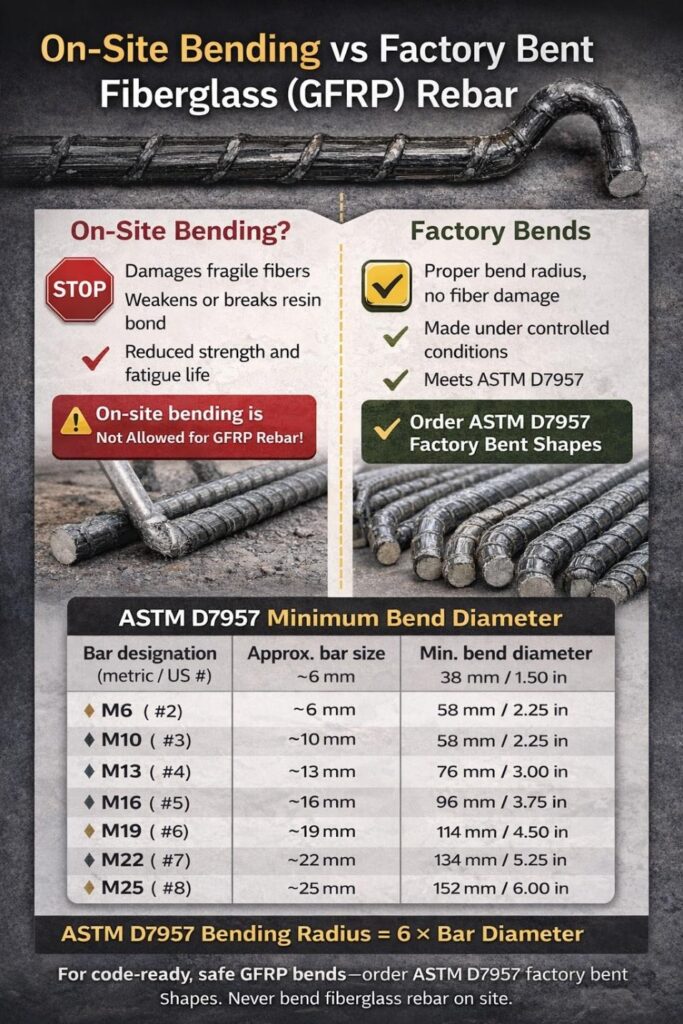
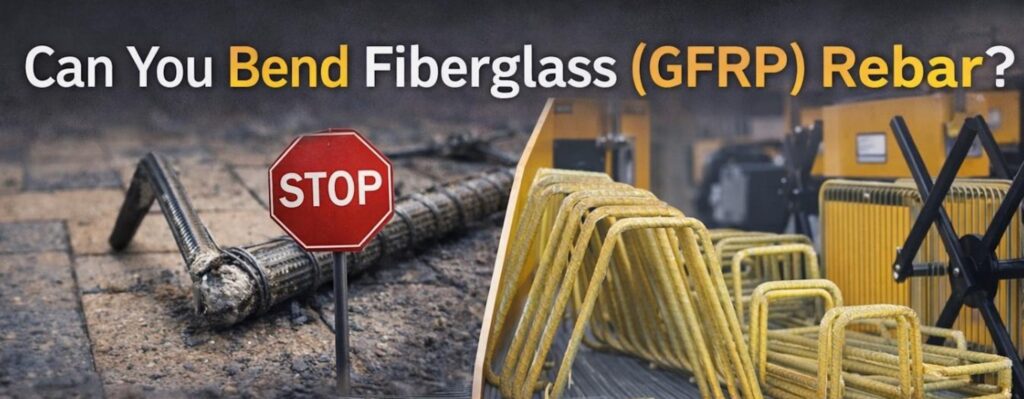
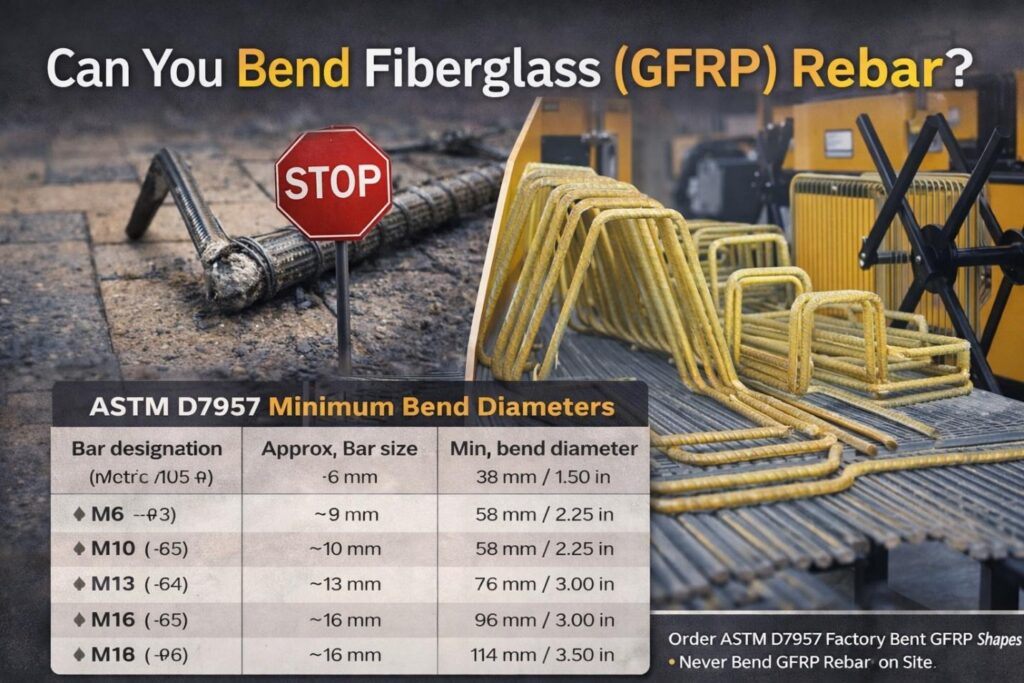
- No, you should not bend GFRP rebar on site like steel. Bending after the bar is cured can damage fibers and reduce performance.
- Yes, GFRP can be supplied as bent shapes—but bends must be made during manufacturing, under controlled conditions.
- In the U.S., bent GFRP bars are covered by ASTM D7957, which includes minimum inside bend diameters for standard bar sizes.
- For structural design with GFRP bars, АСИ 440.11-22 is the key building code, and it requires GFRP bars used under the code to comply with ASTM D7957.
If you need hooks, L-bars, U-bars, stirrups, ties, or custom bends: the right solution is factory-made bent GFRP shapes, not field bending.
Why field bending GFRP rebar is different from steel
Steel is ductile. It can yield and plastically deform without immediate fracture. That’s why field bending with a hickey bar or mechanical bender is normal practice.
GFRP is not ductile in the same way. It is a fiber composite:
- The bar’s strength depends on continuous fiber alignment inside the polymer matrix.
- A bend introduces fiber distortion, micro-cracking, and potential fiber rupture, especially if done after curing.
That’s why reputable manufacturers and technical guidance consistently say:
On-site bending is not feasible / not permitted for cured GFRP rebar.
What the standards say: ASTM D7957 covers bent GFRP bars
A common misconception is that standards cover only straight bars. In fact, ASTM D7957 explicitly covers GFRP bars provided in cut lengths and bent shapes and includes requirements and tests, including minimum inside bend diameter.
ASTM D7957 minimum inside bend diameter (Table 4)
Below are values from ASTM D7957/D7957M-22 Table 4 (minimum inside bend diameters).
| Bar designation (metric / US #) | Approx. bar size | Minimum inside bend diameter |
| M6 (≈ #2) | ~6 mm | 38 mm (1.50 in) |
| M10 (≈ #3) | ~10 mm | 58 mm (2.25 in) |
| M13 (≈ #4) | ~13 mm | 76 mm (3.00 in) |
| M16 (≈ #5) | ~16 mm | 96 mm (3.75 in) |
| M19 (≈ #6) | ~19 mm | 114 mm (4.50 in) |
| M22 (≈ #7) | ~22 mm | 134 mm (5.25 in) |
| M25 (≈ #8) | ~25 mm | 152 mm (6.00 in) |
What this means in practice:
Even when a bend is allowed, the radius is not “whatever fits.” It’s controlled and standardized. If your job needs bends tighter than these minimums, you must redesign the detail (or choose a different reinforcement strategy).
Where ACI 440.11-22 fits in
If your project is in the U.S. and an engineer is designing structural concrete with Стеклопластиковая арматура, АСИ 440.11-22 is the reference code. ACI 440.11-22 is a building code developed through an ANSI-approved consensus process.
And importantly for product selection:
- ACI 440.11-22 ties use of GFRP bars to ASTM D7957 as the governing material specification.
So the strongest position for contractors and manufacturers is simple:
use bent shapes that are produced and documented as ASTM D7957 compliant, and detail them per the engineer’s ACI 440.11-22 design.
“But I’ve seen people bend GFRP on site…” — what actually happens
Yes, you may see improvised field bending in some markets. It usually falls into one of these categories:
- Bending a bar that wasn’t fully cured (still risky and uncontrolled).
- Heating the bar (high risk of damaging resin system and surface).
- Over-bending and “pulling back” (introduces internal damage).
- Bending only small diameters and hoping for the best.
The problem is not that the bar always snaps in front of you. The problem is worse:
- internal fiber damage can be invisible,
- strength and fatigue life drop,
- and you only find out in testing—or years later in service.
For code-driven projects, that’s not an acceptable risk.
The correct solution: order factory-bent GFRP shapes
If you need:
- L-bars
- U-bars
- стремена
- hooks
- frames / cages
- slab edge details
- wall corners
…you should specify factory-made bent GFRP bars that meet ASTM D7957 minimum bend diameter requirements.
This is exactly why mature FRP suppliers offer catalogs of pre-bent shapes and custom bending programs, and explicitly warn against field bending.
Contractor checklist: what to do when your drawings show bends
Use this checklist to avoid delays and rejected submittals:
- Confirm bar size and bend type (L, U, hook, stirrup) from the drawings.
- Check the minimum inside bend diameter against ASTM D7957 Table 4.
- Order bent bars early. Bent shapes take longer than straight stock.
- Request documentation (manufacturer data, compliance statements, test reports if required). ASTM D7957 is the backbone for acceptance.
- Do not substitute field bends. If a detail is impossible, return it to the engineer for redesign.
Why equipment matters (and why Composite-Tech is relevant)
From a practical standpoint, consistent bent shapes require:
- stable fiber tension and alignment,
- controlled impregnation (no voids at the bend zone),
- controlled curing (avoid surface degradation),
- repeatable forming/bending process to meet minimum diameters.
That is why bent shapes are not just a “secondary product.” They are a quality test of the entire manufacturing system.
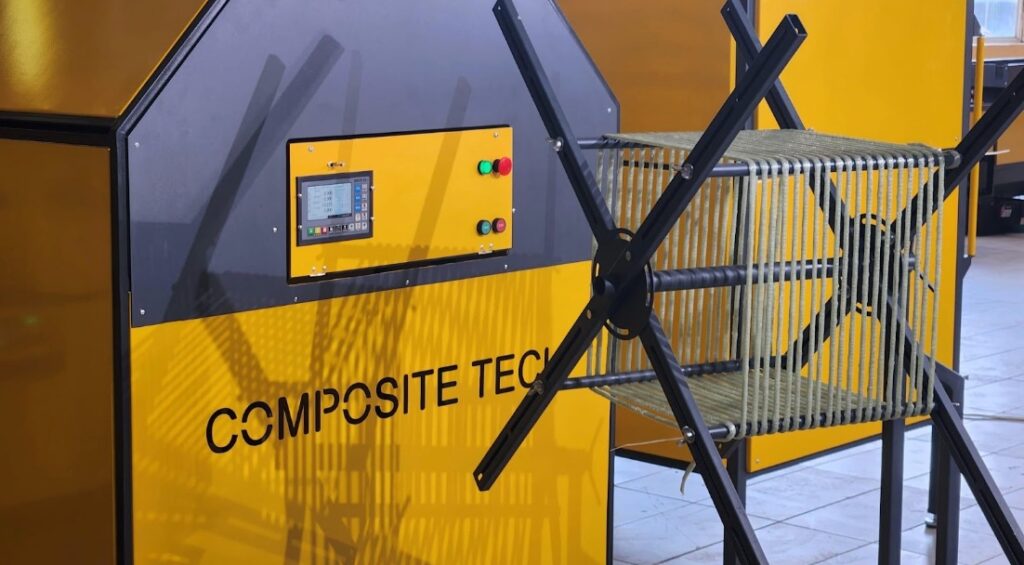
Линии Composite-Tech are engineered around process stability: pre-heating, deep impregnation, controlled curing and controlled cooling are designed to deliver consistent bar quality—so producers can confidently manufacture both straight and bent elements.
Часто задаваемые вопросы
Can fiberglass (GFRP) rebar be bent on site like steel?
No. Industry guidance consistently warns that on-site bending can damage fibers and compromise strength. Bent shapes should be made during manufacturing.
Are bent GFRP bars allowed in U.S. standards?
Да. ASTM D7957 covers GFRP bars provided in cut lengths and bent shapes and specifies minimum inside bend diameters.
What is the minimum bend diameter for #3 (M10) GFRP rebar?
ASTM D7957 Table 4 lists 58 mm (2.25 in) minimum inside bend diameter for M10 (#3)
What code is used for designing concrete reinforced with GFRP bars?
In the U.S., the key building code is АСИ 440.11-22.
Does ACI 440.11-22 require ASTM D7957 compliance?
Yes. ACI 440.11-22 ties its requirements for GFRP bars to ASTM D7957 as the material specification.
If I need a tighter bend than ASTM D7957 allows, what should I do?
Do нет attempt field bending. Ask the engineer to redesign the detail (different geometry, different reinforcement layout, or alternative detailing).
If you remember only one sentence, make it this:
GFRP rebar can be bent—but only as factory-made bent shapes that meet ASTM D7957 minimum bend diameter requirements, and should not be bent on site like steel.