If you look at what engineers and investors are typing into Google today — “fiberglass rebar production line,” “basalt rebar machine,” “GFRP rebar plant USA,” “FRP mesh equipment” — you can see how quickly composites have moved from niche to mainstream.
Industry reports forecast that the global FRP rebar market will grow from around USD 0.7 billion in the mid-2020s to well over USD 1 billion by 2030, with a compound annual growth rate in the 8–11% range. North America is one of the main growth engines, driven by bridges, highways and infrastructure where corrosion of steel rebar is simply too expensive to tolerate over a 75–100-year life cycle.
On this background, one question comes up again and again:
Why do U.S. companies that want to produce fiberglass (GFRP) and basalt (BFRP) rebar and mesh so often end up choosing Composite-Tech equipment?
Let’s answer that without hype.
They know FRP is no longer a “hype wave” but a structural trend
Analysts from multiple research firms agree on the basics: FRP rebar demand is growing because of three converging pressures:
- escalating costs of corrosion in reinforced concrete,
- tougher durability and service-life requirements,
- and the need to reduce life-cycle CO₂ emissions and maintenance.
For American companies this means one thing: they need an equipment partner that can support a long-term, code-driven market, not just sell a one-off experiment.
Composite-Tech fits that picture well:
- the company positions itself as a global leader in FRP production lines (rebar, mesh, bent elements and more), with machines operating on several continents;
- according to its project portfolio, more than ten large and around twelve medium-sized FRP producers in the United States already run their fiberglass and basalt rebar and mesh plants on Composite-Tech equipment;
- in addition, a number of major European, Indian and Middle-Eastern/Arab manufacturers—companies whose brand names are widely recognized in infrastructure and construction—have also chosen Composite-Tech lines for their flagship composite facilities.
In other words: the same technology that U.S. investors are evaluating today is already in daily use across a global network of serious producers.
U.S. plants need more than a line — they need a code-ready product
In the U.S. nobody buys a GFRP rebar machine just to get “something that looks like rebar.” Owners and engineers ask much harder questions:
- Can we produce bars that conform to ASTM D7957 and related standards for solid GFRP/BFRP rebar?
- Can designers safely use this product in calculations according to ACI 440.11-22 and other ACI 440 documents?
- Will mechanical properties and dimensions be stable enough for long-term projects and third-party testing?
Composite-Tech developed its Linhas de produção de vergalhões de FRP with exactly these questions in mind, working together with universities and regulators from the U.S., Canada, Japan, Italy, the Netherlands and other countries.
Key elements of the Composite-Tech process chain
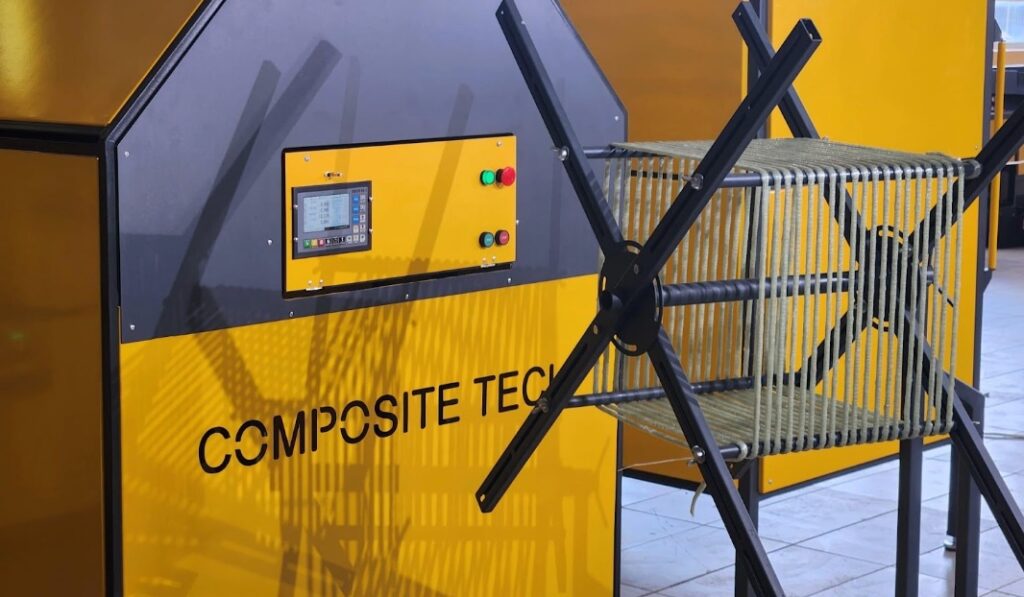
According to the company’s technical documentation e Perguntas frequentes, every Composite-Tech fiberglass and basalt rebar line is built around a patented technological chain:
- Pré-aquecimento do roving
- A dedicated pre-heating module is the first unit on the line.
- It removes moisture and excess silane sizing from the rovings.
- This “opens” the fiber bundle and prepares it for deep resin penetration.
- Triple impregnation
- Pneumatic squeezing mechanically presses resin between the strands.
- Ativação ultrassônica breaks micro air bubbles and helps resin reach every filament.
- UM special grid/calibrating plate shapes the bundle and performs an ultra-thin squeeze to remove excess resin and stabilize fiber content.
- Rib-winding module with adjustable angle
- Composite-Tech CT-4 and CT-6 lines can wind ribs at virtually any angle and pitch.
- This allows producers to tailor bond behavior to different markets and test methods (for bridge decks, industrial floors, slabs-on-grade, etc.).
- Short-wave IR booster ovens
- Infrared ovens with short wavelengths initiate polymerization from inside the bar.
- This prevents surface burning while the core is still under-cured and shortens the required heating length at a given line speed.
- Two-stage cooling: air + water
- When a bar exits the ovens its temperature is typically above 200 °C.
- Composite-Tech uses intensive air cooling first to remove the thermal peak and reduce gradients.
- Only then does the bar enter a water bath that finishes cooling and stops polymerization without thermal shock.
Para vergalhões de fibra de vidro (GFRP) this chain yields higher effective tensile strength and more uniform properties along the bar. For basalt rebar (BFRP), which is stiffer and less forgiving of poor tensioning and temperature control, this process is absolutely critical: a simple, generic pultrusion setup simply cannot unlock the full potential of basalt fiber.
That’s why American companies who want to sell into serious infrastructure projects prefer to buy a Composite-Tech FRP rebar production line, not just any “fiberglass rebar machine.”
U.S. investors count the dollars: ROI of Composite-Tech lines
Almost every U.S. investor starts the conversation from the financial side. Here Composite-Tech can offer very clear arguments.
Independent ROI analyses and case studies show that the production cost of GFRP rebar on modern composite lines can be up to three times lower than the cost of steel rebar with comparable service performance, especially when corrosion and maintenance are included in the comparison. For a market where steel rebar alone totals many billions of dollars annually in the U.S., even a small substitution by FRP represents a substantial business opportunity.
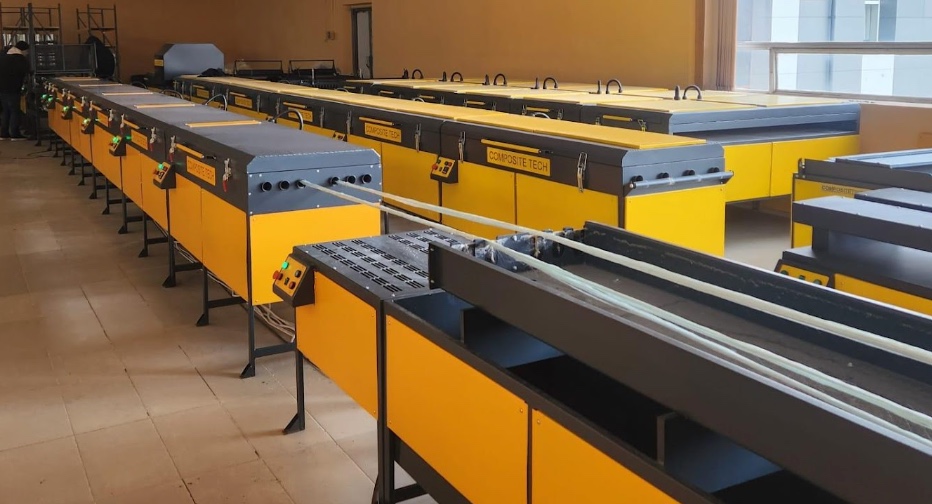
Composite-Tech’s own project data reinforce this:
- lines are designed for operação contínua 24 horas por dia, 7 dias por semana with minimal scheduled maintenance;
- depending on plant size and local pricing, customers report payback times in the range of months to a few years, not decades;
- consistent quality and high line speeds allow producers to sell not only into local retail markets but also into large infrastructure and industrial projects with demanding specifications.
For an American company, this means that a fiberglass or basalt rebar plant built on Equipamento Composite-Tech is not an R&D playground, but a serious, scalable industrial business.
Service, training and partnership matter in the U.S.
U.S. industrial customers are used to certain standards:
- equipment must come with clear documentation and training;
- the supplier should provide installation, commissioning and on-site startup support;
- remote diagnostics and process support are expected, not “nice to have.”
Composite-Tech emphasizes that, in addition to supplying FRP rebar, mesh and bent-element production lines, it also provides:
- assistance in planning the production layout,
- installation and commissioning,
- operator and maintenance training,
- long-term technical support and process optimization.
For the U.S. market—where experienced operators and process engineers are not always easy to find—this “equipment + technology + training” approach is often more valuable than the lowest possible purchase price of a machine.
Why Composite-Tech, and not just any FRP machine builder
There are many vendors selling something under the label “FRP rebar production line” ou “basalt rebar machine.” But Composite-Tech stands out in several ways that American clients care about:
- Deep specialization in rebar and mesh
- Composite-Tech offers a full portfolio: lines for GFRP and BFRP rebar, fiberglass and basalt mesh, bent elements, stirrups and more.
- The technology is engineered specifically for structural reinforcement, not for generic pultruded profiles.
- Patented technology
- The company holds a large family of patents covering the crucial parts of its process chain: roving pre-heating, triple impregnation, IR booster ovens, two-stage cooling and others.
- Competitors cannot simply copy these solutions, so Composite-Tech customers gain a real, defensible technical advantage.
- Focus on mechanical performance and durability, not only on meters per minute
- Composite-Tech constantly links equipment settings with the requirements of ACI, ASTM and international standards.
- The goal is not just to make bars fast, but to make bars that pass independent testing and satisfy engineers.
- Global reference base
- As noted above, more than ten large and about twelve medium-sized FRP manufacturers in the U.S. already operate Composite-Tech rebar and mesh lines.
- Beyond the U.S., major producers in Europe, India and the Arab world—names widely known in the construction and infrastructure sectors—have also chosen Composite-Tech equipment for their core FRP manufacturing facilities.
- This kind of reference list simply cannot be matched by occasional or generic FRP machine builders.
- Transparency for Western partners
- Website, documentation and marketing materials are available in clear technical English.
- The company actively collaborates with universities and research institutions and maintains a visible presence in Western professional media and platforms such as LinkedIn.
For a U.S. investor, this combination of specialization, patents, global references and communication style strongly reduces project risk.
What U.S. customers ultimately value in Composite-Tech lines
Summarizing the feedback from American clients, several points repeat again and again:
- U.S. producers of fiberglass and basalt rebar and mesh get equipment that delivers high-quality product from day one, instead of requiring years of trial-and-error modifications.
- Investors see a clear, evidence-based business case and payback horizon, supported by real plants—not just theoretical spreadsheets.
- Designers and specifiers can trust that the bars and mesh produced on Composite-Tech lines are capable of meeting the expectations associated with ACI and ASTM-driven projects.
- Operations teams work with robust, industrial-grade lines built from European, American and Japanese components, with recipe-based control and remote support.
Because of this unique combination of technology, economics and partnership, U.S. companies that are serious about entering the market for fiberglass and basalt rebar and mesh consistently come to the same conclusion:
For a plant that must run reliably for 10–15 years and supply FRP reinforcement to demanding infrastructure and building projects, Composite-Tech is not just another equipment vendor. It is the strategic choice.
Because of this unique combination of technology, economics and partnership, U.S. companies that are serious about entering the market for fiberglass and basalt rebar and mesh consistently come to the same conclusion:
For a plant that must run reliably for 10–15 years and supply FRP reinforcement to demanding infrastructure and building projects, Composite-Tech is not just another equipment vendor. It is the strategic choice.