
संक्षिप्त उत्तर: कंक्रीट में जीएफआरपी रीबार कितने समय तक टिकता है?
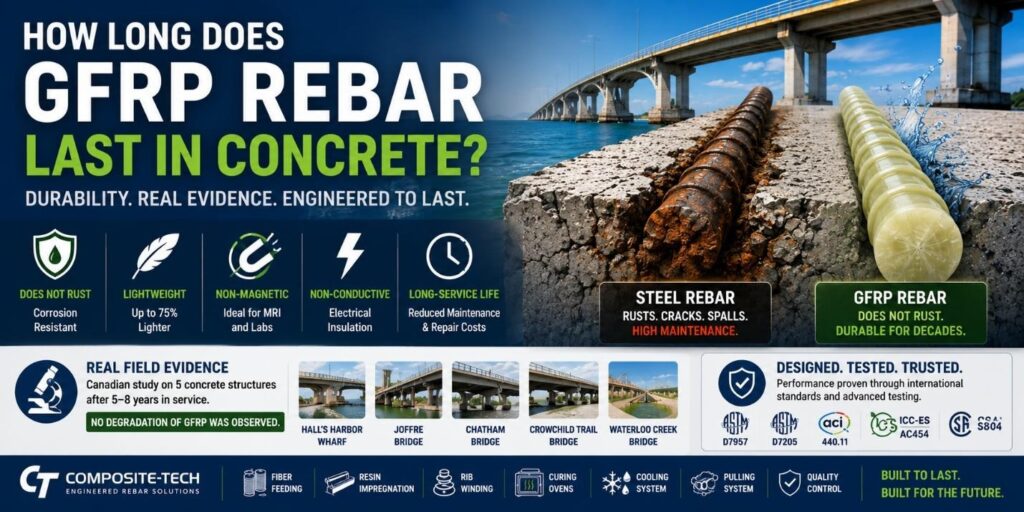
उच्च गुणवत्ता वाली जीएफपी रीबार उचित निर्माण, सही डिजाइन और उपयुक्त अनुप्रयोगों में उपयोग किए जाने पर कंक्रीट में दशकों तक टिक सकती है। स्टील रीबार के विपरीत, जीएफपी रीबार में जंग नहीं लगता, जो इसे पुलों, समुद्री संरचनाओं, तटीय निर्माण, पार्किंग गैरेज, अपशिष्ट जल संयंत्रों और बर्फ पिघलाने वाले लवणों या क्लोराइड के संपर्क में आने वाले कंक्रीट के लिए विशेष रूप से उपयोगी बनाता है।.
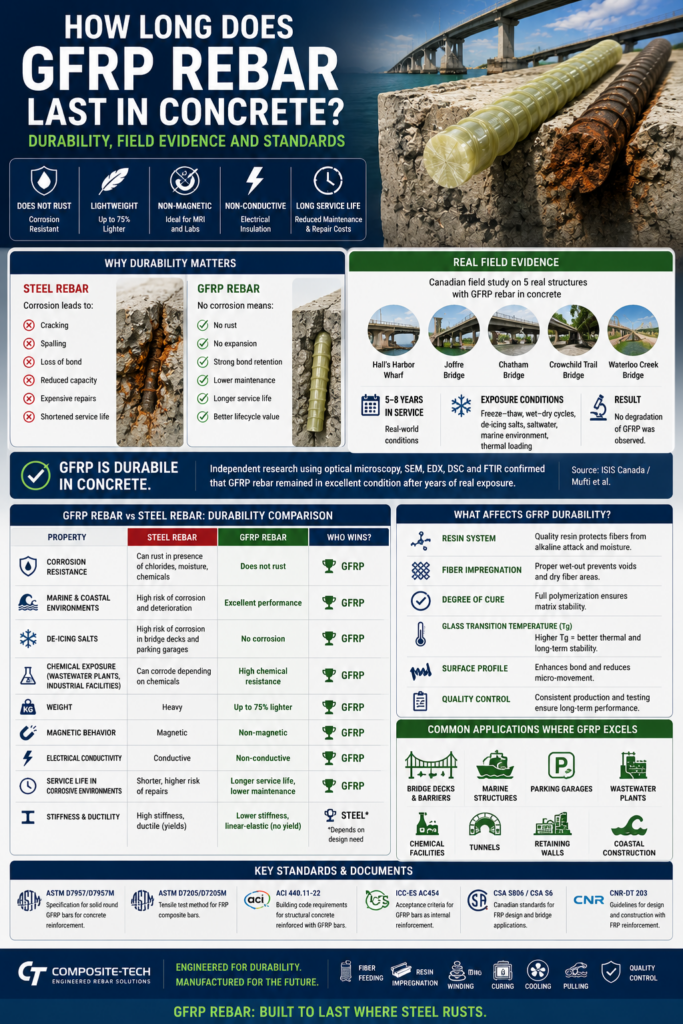
जमीनी साक्ष्य महत्वपूर्ण हैं। कनाडा में किए गए एक टिकाऊपन अध्ययन में पांच वास्तविक संरचनाओं से लिए गए जीएफपी-प्रबलित कंक्रीट के नमूनों की 5 से 8 वर्षों के उपयोग के बाद जांच की गई। ये संरचनाएं जमने-पिघलने के चक्र, गीले-सूखे चक्र, बर्फ पिघलाने वाले लवण, खारे पानी, समुद्री वातावरण और कंक्रीट के क्षारीय वातावरण के संपर्क में थीं। अध्ययन में जांच की गई जमीनी संरचनाओं में जीएफपी के क्षरण का कोई संकेत नहीं मिला।.
हालांकि, स्थायित्व स्वतः नहीं आता। जीएफआरपी रीबार का प्रदर्शन कच्चे माल, राल मैट्रिक्स, फाइबर संसेचन, उपचार, सतह प्रोफ़ाइल, क्षारीय प्रतिरोध, गुणवत्ता नियंत्रण और प्रासंगिक मानकों जैसे कि एएसटीएम डी7957, एएसटीएम डी7205 और एसीआई कोड-440.11 के अनुपालन पर निर्भर करता है।.
पेशेवर विनिर्माण उपकरणों के बारे में अधिक जानें: पेशेवर जीएफआरपी रीबार उत्पादन लाइन
चाबी छीनना
- जीएफआरपी रीबार में जंग नहीं लगता, जो स्टील रीबार की तुलना में इसकी सबसे बड़ी मजबूती का लाभ है।.
- प्रबलित कंक्रीट में इस्पात का क्षरण दरारें, टूटना, बंधन का नुकसान और महंगी मरम्मत का कारण बन सकता है।.
- जीएफआरपी रीबार उन कंक्रीट के लिए विशेष रूप से उपयोगी है जो क्लोराइड, समुद्री वातावरण, बर्फ पिघलाने वाले लवण, अपशिष्ट जल और आक्रामक रसायनों के संपर्क में आते हैं।.
- कनाडा में किए गए क्षेत्रीय शोध में पाया गया कि पांच वास्तविक संरचनाओं से लिए गए कंक्रीट कोर में 5-8 वर्षों के उपयोग के बाद जीएफपी में कोई गिरावट नहीं आई।.
- स्थायित्व संबंधी अध्ययनों में ऑप्टिकल माइक्रोस्कोपी, स्कैनिंग इलेक्ट्रॉन माइक्रोस्कोपी, ऊर्जा विसरणीय एक्स-रे विश्लेषण, विभेदक स्कैनिंग कैलोरीमेट्री और अवरक्त स्पेक्ट्रोस्कोपी का उपयोग किया गया।.
- त्वरित प्रयोगशाला परीक्षण उपयोगी हो सकते हैं, लेकिन वास्तविक कंक्रीट संरचनाओं में दीर्घकालिक व्यवहार को समझने के लिए क्षेत्र के साक्ष्य अधिक यथार्थवादी होते हैं।.
- जीएफआरपी रीबार की मजबूती काफी हद तक निर्माण गुणवत्ता, रेजिन सिस्टम, फाइबर संरक्षण, उपचार की डिग्री और गुणवत्ता नियंत्रण पर निर्भर करती है।.
- ASTM D7957, ASTM D7205, ACI CODE-440.11 और ICC-ES AC454 परीक्षण, योग्यता और स्वीकृति के लिए महत्वपूर्ण संदर्भ हैं।.
- एक पेशेवर एफआरपी रीबार उत्पादन लाइन निर्माताओं को स्थिर संसेचन, उपचार, सतह प्रोफ़ाइल और पता लगाने की क्षमता के साथ सुसंगत जीएफआरपी रीबार का उत्पादन करने में मदद करती है।.
- असली सवाल सिर्फ यह नहीं है कि "जीएफआरपी कितने समय तक चलता है?" बल्कि यह है कि "क्या इसका निर्माण, परीक्षण, डिजाइन और स्थापना सही ढंग से की गई थी?"“
जीएफआरपी रीबार का उपयोग करने का मुख्य कारण इसकी मजबूती क्यों है?
कंक्रीट मजबूत और टिकाऊ होता है, लेकिन स्टील सुदृढीकरण में जंग लगने पर प्रबलित कंक्रीट समय से पहले ही खराब हो सकता है। स्टील में जंग लगना अवसंरचना में टिकाऊपन से जुड़ी सबसे महंगी समस्याओं में से एक है।.
कंक्रीट के अंदर स्टील की छड़ों में जंग लगने पर, जंग से बने पदार्थ फैलते हैं। इस फैलाव से आंतरिक दबाव उत्पन्न हो सकता है और इसके परिणामस्वरूप निम्नलिखित हो सकता है:
- कंक्रीट में दरारें पड़ना;
- छिलना;
- कंक्रीट और स्टील के बीच बंधन का टूटना;
- इस्पात के अनुप्रस्थ काट में कमी;
- संरचनात्मक क्षमता में कमी;
- पानी और क्लोराइड का प्रवेश;
- महंगी जांच और मरम्मत;
- सेवा जीवन कम हो जाता है।.
जीएफआरपी रीबार इसमें स्टील नहीं होता, इसलिए यह जंग लगने की मुख्य समस्या का समाधान करता है। यह पॉलिमर रेज़िन मैट्रिक्स में अंतर्निहित निरंतर कांच के रेशों से बना होता है। चूंकि यह अधात्विक है, इसलिए इसमें जंग नहीं लगता।.
इससे जीएफपी रीबार विशेष रूप से आकर्षक बन जाता है जब मुख्य जोखिम जंग लगना होता है, न कि केवल प्रारंभिक सामग्री लागत।.
जीएफआरपी रिबार स्टील रिबार से किस प्रकार भिन्न है?
स्टील रिबार और जीएफआरपी रिबार बहुत अलग-अलग पदार्थ हैं।.
स्टील धात्विक, कठोर, तन्य और विद्युत चालक होता है। जीएफआरपी मिश्रित, हल्का, संक्षारण-प्रतिरोधी, गैर-चुंबकीय और विद्युत का गैर-चालक होता है।.
तालिका 1: स्टील रीबार और जीएफआरपी रीबार के बीच स्थायित्व में अंतर
| संपत्ति | स्टील रीबार | जीएफआरपी रीबार |
|---|---|---|
| संक्षारण व्यवहार | कठोर वातावरण में जंग लग सकता है | इसमें जंग नहीं लगता |
| क्लोराइड के संपर्क में आना | सुरक्षा के बिना उच्च जोखिम | मजबूत लाभ |
| समुद्री जोखिम | जंग से सुरक्षा आवश्यक है | मजबूत लाभ |
| बर्फ पिघलाने वाले नमक | सामान्य जंग की समस्या | मजबूत लाभ |
| इलेक्ट्रिकल कंडक्टीविटी | प्रवाहकीय | गैर-प्रवाहकीय |
| चुंबकीय व्यवहार | चुंबकीय | गैर चुंबकीय |
| वज़न | भारी | लाइटवेट |
| डिजाइन व्यवहार | तन्य उपज | विफलता तक रैखिक-लोचदार |
| दीर्घकालिक स्थायित्व का मुद्दा | इस्पात का क्षरण | यह राल, रेशों, विनिर्माण गुणवत्ता और डिजाइन पर निर्भर करता है। |
सारांश: कई पारंपरिक संरचनाओं में स्टील अभी भी उपयोगी है, लेकिन जहां जंग लगना मुख्य समस्या है, वहां जीएफपी में स्थायित्व का एक बड़ा लाभ है।.
जमीनी साक्ष्य: कंक्रीट में कई वर्षों तक रहने के बाद जीएफआरपी रीबार का क्या होता है?
स्थायित्व के संबंध में सबसे मजबूत तर्क वास्तविक संरचनाओं से मिलता है, न कि केवल प्रयोगशाला में की गई भविष्यवाणियों से।.
एक कनाडाई शोध परियोजना ने कनाडा भर में स्थित पांच फील्ड संरचनाओं से निकाले गए जीएफआरपी-प्रबलित कंक्रीट कोर का अध्ययन किया। ये संरचनाएं 5 से 8 वर्षों से सेवा में थीं और कठिन परिस्थितियों के संपर्क में थीं।.
इन संरचनाओं में निम्नलिखित शामिल थे:
- हॉल हार्बर घाट;
- जॉफ्रे ब्रिज;
- चैथम ब्रिज;
- क्रोचाइल्ड ट्रेल ब्रिज;
- वाटरलू क्रीक ब्रिज।.
जोखिम की स्थितियों में निम्नलिखित शामिल थे:
- जमने-पिघलने के चक्र;
- गीले-सूखे चक्र;
- बर्फ पिघलाने वाले नमक;
- खारे पानी के संपर्क में आना;
- समुद्री परिस्थितियाँ;
- तापीय भारण;
- क्षारीय कंक्रीट वातावरण।.
शोधकर्ताओं ने उन्नत सामग्री विश्लेषण विधियों का उपयोग करके जीएफआरपी और आसपास के कंक्रीट की जांच की। निष्कर्ष यह निकला कि अध्ययन किए गए क्षेत्र संरचनाओं में जीएफआरपी का कोई क्षरण नहीं हुआ।.
तालिका 2: क्षेत्र में टिकाऊपन का अध्ययन — किन-किन चीजों का परीक्षण किया गया
| अनुसंधान तत्व | यह क्या दर्शाता है |
|---|---|
| पाँच वास्तविक संरचनाएँ | प्रयोगशाला की भविष्यवाणियों के अलावा, जमीनी साक्ष्य भी महत्वपूर्ण हैं। |
| 5-8 वर्ष की सेवा | कंक्रीट में वास्तविक जोखिम अवधि |
| समुद्री और पुल के वातावरण | बुनियादी ढांचे से संबंधित आक्रामक स्थितियां |
| जमने-पिघलने के चक्र | ठंडी जलवायु के लिए महत्वपूर्ण |
| बर्फ पिघलाने वाले नमक | इस्पात के संक्षारण का प्रमुख कारण |
| गीले-सूखे चक्र | यथार्थवादी एक्सपोज़र पैटर्न |
| कंक्रीट कोर | वास्तविक संरचनाओं से सीधे नमूने |
| स्वतंत्र अनुसंधान टीमें | अधिक विश्वसनीयता |
| सूक्ष्मदर्शी और रासायनिक विश्लेषण | जीएफआरपी की स्थिति का विस्तृत मूल्यांकन |
सारांश: जमीनी साक्ष्य कंक्रीट में उचित रूप से निर्मित जीएफआरपी रीबार की मजबूती का समर्थन करते हैं।.
सरल त्वरित परीक्षणों की तुलना में क्षेत्रीय अध्ययन अधिक महत्वपूर्ण क्यों हैं?
त्वरित प्रयोगशाला परीक्षण उपयोगी हो सकते हैं, लेकिन वे हमेशा वास्तविक ठोस परिस्थितियों को पुन: उत्पन्न नहीं करते हैं।.
कुछ त्वरित परीक्षणों में जीएफआरपी नमूनों को उच्च तापमान पर अत्यधिक क्षारीय विलयनों के संपर्क में लाया जाता है। ये स्थितियाँ वास्तविक कंक्रीट संरचनाओं के अंदर के वातावरण की तुलना में कहीं अधिक कठोर या रासायनिक रूप से भिन्न हो सकती हैं।.
असली कंक्रीट अधिक जटिल है:
- छिद्रों में पानी की आवाजाही सीमित होती है;
- सभी छिद्र आपस में जुड़े हुए नहीं होते;
- संतृप्ति समय के साथ बदलती रहती है;
- समय के साथ पीएच का स्तर घट सकता है;
- नमी और तापमान में प्राकृतिक रूप से भिन्नता होती है;
- पॉलिमर मैट्रिक्स रेशों की रक्षा करता है;
- ठोस वातावरण अनंत क्षारीय स्नान के समान नहीं है।.
इसीलिए क्षेत्रीय अध्ययन महत्वपूर्ण हैं। वे वास्तविक संरचनाओं में वास्तव में क्या होता है, यह दर्शाते हैं, न कि केवल आक्रामक प्रयोगशाला सिमुलेशन में क्या हो सकता है।.
परीक्षण विधियों से जीएफआरपी की टिकाऊपन के बारे में क्या पता चल सकता है?
किसी छड़ की मजबूती का आकलन उसे बाहर से देखकर नहीं किया जा सकता। शोधकर्ता और प्रयोगशालाएँ सामग्री का मूल्यांकन करने के लिए तकनीकी विधियों का उपयोग करते हैं।.
तालिका 3: जीएफआरपी की स्थायित्वता का मूल्यांकन करने के लिए उपयोग की जाने वाली विधियाँ
| तरीका | यह किसका मूल्यांकन करता है |
|---|---|
| ऑप्टिकल माइक्रोस्कोपी | जीएफआरपी और कंक्रीट के बीच बंधन और इंटरफ़ेस |
| स्कैनिंग इलेक्ट्रॉन माइक्रोस्कोपी | फाइबर, मैट्रिक्स और सूक्ष्म संरचनात्मक स्थिति |
| ऊर्जा विसरणीय एक्स-रे विश्लेषण | रासायनिक परिवर्तन और संभावित क्षार स्थानांतरण |
| खास तरह की स्कैनिंग उष्मामिति | ग्लास संक्रमण तापमान और मैट्रिक्स स्थिति |
| अवरक्त स्पेक्ट्रोस्कोपी | रेजिन मैट्रिक्स में रासायनिक परिवर्तन |
| तन्यता परीक्षण | बार का यांत्रिक प्रदर्शन |
| बॉन्ड परीक्षण | जीएफआरपी और कंक्रीट के बीच भार स्थानांतरण |
| क्षार प्रतिरोध परीक्षण | कंक्रीट जैसे वातावरण में टिकाऊपन |
| नमी अवशोषण परीक्षण | जल अवशोषण व्यवहार |
| ग्लास संक्रमण तापमान परीक्षण | पॉलिमर मैट्रिक्स की तापीय स्थिरता |
निर्माताओं और खरीदारों के लिए, इसका मतलब है कि टिकाऊपन को केवल विपणन दावों से नहीं, बल्कि परीक्षण डेटा द्वारा समर्थित किया जाना चाहिए।.
दीर्घकालिक स्थायित्व में रेजिन मैट्रिक्स की भूमिका
जीएफआरपी रीबार कांच के रेशों और पॉलिमर राल से बना होता है। अधिकांश तन्यता भार कांच के रेशों द्वारा वहन किया जाता है, लेकिन राल मैट्रिक्स भी महत्वपूर्ण भूमिका निभाता है।.
रेजिन मैट्रिक्स:
- रेशों को आपस में बांधता है;
- रेशों के बीच तनाव का स्थानांतरण करता है;
- यह कांच के रेशों को नमी और क्षार से बचाता है;
- तापीय व्यवहार को परिभाषित करता है;
- रासायनिक प्रतिरोध को प्रभावित करता है;
- यह दीर्घकालिक स्थायित्व को प्रभावित करता है।.
यदि राल का चयन ठीक से न किया गया हो, उसे ठीक से मिलाया न गया हो या उसकी शुद्धता ठीक से निर्धारित न की गई हो, तो छड़ का प्रदर्शन खराब हो सकता है। यदि राल प्रणाली का चयन सही ढंग से किया गया हो और उसे पूरी तरह से शुद्ध किया गया हो, तो यह रेशों की रक्षा करने और दीर्घकालिक स्थायित्व प्रदान करने में सहायक हो सकता है।.
इसीलिए विनिर्माण प्रौद्योगिकी महत्वपूर्ण है।.
उपचार की डिग्री और ग्लास संक्रमण तापमान क्यों मायने रखते हैं?
जीएफआरपी रीबार के लिए दो महत्वपूर्ण गुणवत्ता संकेतक हैं:
- इलाज की डिग्री;
- ग्लास संक्रमण तापमान.
उपचार की अवस्था से पता चलता है कि राल का बहुलकीकरण ठीक से हुआ है या नहीं। अपर्याप्त उपचार से मैट्रिक्स कमजोर, अस्थिर या नमी और रसायनों के प्रति अधिक संवेदनशील हो सकता है।.
ग्लास ट्रांज़िशन तापमान, जिसे अक्सर Tg कहा जाता है, रेज़िन मैट्रिक्स का एक ऊष्मीय गुण है। यह इंगित करने में मदद करता है कि क्या मैट्रिक्स अपने इच्छित वातावरण के लिए पर्याप्त ऊष्मीय स्थिरता रखता है।.
तालिका 4: जीएफआरपी रीबार के लिए राल गुणवत्ता कारक
| कारक | यह क्यों मायने रखती है |
|---|---|
| राल प्रकार | रासायनिक प्रतिरोध और स्थायित्व को प्रभावित करता है |
| राल संसेचन | फाइबर की रक्षा करता है और भार स्थानांतरित करता है |
| इलाज की डिग्री | यह दर्शाता है कि बहुलकीकरण पूर्ण हुआ है या नहीं। |
| ग्लास संक्रमण तापमान | ऊष्मीय स्थिरता को दर्शाता है |
| शून्य सामग्री | रिक्त स्थान मजबूती और टिकाऊपन को कम कर सकते हैं। |
| फाइबर-मैट्रिक्स बंधन | भार स्थानांतरण के लिए महत्वपूर्ण |
| नमी अवशोषण | दीर्घकालिक प्रदर्शन को प्रभावित करता है |
| क्षार प्रतिरोध | कंक्रीट के अंदर महत्वपूर्ण |
एक पेशेवर उत्पादन लाइन को केवल बार को गर्म करने से ही नहीं, बल्कि उसकी क्योरिंग को भी नियंत्रित करना चाहिए।.
विनिर्माण गुणवत्ता: टिकाऊपन के पीछे छिपा हुआ कारक
सभी जीएफआरपी रीबार की मजबूती एक जैसी नहीं होती। समान नाममात्र व्यास वाले दो बार अलग-अलग फाइबर, रेजिन सिस्टम, संसेचन गुणवत्ता या उपचार नियंत्रण के साथ उत्पादित होने पर अलग-अलग व्यवहार कर सकते हैं।.
उच्च गुणवत्ता वाले जीएफआरपी रीबार के लिए निम्नलिखित पर स्थिर नियंत्रण आवश्यक है:
- फाइबर युक्त आहार;
- अस्थिर तनाव;
- रेजिन संसेचन;
- फाइबर-रेजिन अनुपात;
- बार बनाना;
- पसली घुमाव;
- सतही प्रोफाइल;
- बहुलकीकरण;
- शीतलन;
- खींचने की गति;
- काटना या कुंडलित करना;
- बैच परीक्षण;
- पता लगाने की क्षमता।.
यदि उत्पादन प्रक्रिया अस्थिर है, तो छड़ में आंतरिक दोष हो सकते हैं जो शुरू में दिखाई नहीं देते हैं।.
तालिका 5: विनिर्माण संबंधी समस्याएं जो स्थायित्व को कम कर सकती हैं
| विनिर्माण समस्या | संभावित दीर्घकालिक जोखिम |
|---|---|
| खराब गर्भाधान | सूखे रेशे, कमजोर भार स्थानांतरण, कम टिकाऊपन |
| अतिरिक्त राल | उच्च लागत और अस्थिर संपत्तियाँ |
| रिक्तियों | नमी के प्रवेश मार्ग और कम यांत्रिक प्रदर्शन |
| कम इलाज | कमजोर मैट्रिक्स और कम रासायनिक प्रतिरोध |
| शीतलन के दौरान ऊष्मीय झटका | सतही सूक्ष्म दरारें और आंतरिक तनाव |
| खराब पसली घुमाव | कंक्रीट के साथ कमजोर बंधन |
| व्यास में भिन्नता | इंजीनियरिंग अनिश्चितता |
| कमजोर फाइबर संरेखण | कम तन्यता प्रदर्शन |
| पता लगाने की क्षमता नहीं | गुणवत्ता नियंत्रण और प्रमाणीकरण में कठिनाई |
टिकाऊपन की शुरुआत उत्पादन प्रक्रिया से ही होती है।.
कंपोजिट-टेक उत्पादन तकनीक टिकाऊ जीएफआरपी रीबार को कैसे सहारा देती है
कंपोजिट-टेक उत्पादन लाइनें निर्माताओं को स्थिर और दोहराने योग्य गुणों वाले पेशेवर-गुणवत्ता वाले जीएफआरपी रीबार का उत्पादन करने में मदद करने के लिए डिज़ाइन की गई हैं।.
प्रमुख प्रक्रिया लाभों में शामिल हैं:
- नियंत्रित फाइबर युक्त आहार;
- स्थिर रेजिन संसेचन;
- सटीक बार निर्माण;
- कंप्यूटर-नियंत्रित रिब वाइंडिंग;
- पेटेंटकृत शॉर्ट-वेव इन्फ्रारेड बूस्टर पॉलीमराइजेशन;
- पकाने वाले ओवन;
- पेटेंटकृत दो-चरणीय वायु और जल शीतलन प्रणाली;
- उच्च बल खींचने वाली प्रणाली;
- रासायनिक रूप से प्रतिरोधी खींचने वाली बेल्ट;
- काटने और कुंडलित करने की प्रणालियाँ;
- गुणवत्ता नियंत्रण और प्रलेखन के लिए सहायता।.
यह महत्वपूर्ण है क्योंकि जीएफआरपी की मजबूती पूरी उत्पादन प्रक्रिया पर निर्भर करती है। एक पेशेवर उत्पादन प्रक्रिया भिन्नता को कम करने और उत्पाद की गुणवत्ता में निरंतरता बनाए रखने में सहायक होती है।.
सतह की अखंडता के लिए दो-चरणीय शीतलन क्यों महत्वपूर्ण है?
क्योरिंग के बाद, जीएफआरपी रीबार उच्च तापमान पर ओवन से बाहर निकलता है। कूलिंग को सावधानीपूर्वक नियंत्रित किया जाना चाहिए।.
यदि किसी गर्म कंपोजिट बार को तुरंत तीव्र जल शीतलन के संपर्क में लाया जाए, तो थर्मल शॉक हो सकता है। इससे आंतरिक तनाव या सतह पर सूक्ष्म क्षति हो सकती है।.
कंपोजिट-टेक दो-चरण वाली शीतलन विधि का उपयोग करता है:
- पहले एयर कूलिंग — यह अधिकतम तापमान को अधिक धीरे-धीरे कम करता है।.
- जल शीतलन द्वितीय — थर्मल शॉक का खतरा कम होने के बाद शीतलन प्रक्रिया पूरी हो जाती है।.
यह महत्वपूर्ण है क्योंकि सतह की गुणवत्ता बॉन्ड के व्यवहार, स्थायित्व और ग्राहक के भरोसे को प्रभावित करती है।.
दीर्घकालिक प्रदर्शन के लिए सतह प्रोफ़ाइल क्यों मायने रखती है?
जीएफआरपी रीबार का कंक्रीट के साथ मजबूत बंधन होना आवश्यक है। रीबार की सतह सजावटी नहीं होती; यह सुदृढ़ीकरण प्रणाली का एक हिस्सा है।.
सामान्य सतह प्रोफाइल में निम्नलिखित शामिल हैं:
- धारीदार सतह;
- सर्पिलाकार रूप से लिपटी सतह;
- रेत से लेपित सतह;
- लिपटी हुई और रेत से लेपित सतह;
- संयुक्त यांत्रिक सतह संवर्धन।.
अच्छी सतह संरचना कंक्रीट के साथ बेहतर यांत्रिक जुड़ाव प्रदान करती है। खराब सतह संरचना बंधन क्षमता को कम कर सकती है।.
Composite-Tech यह कंप्यूटर-नियंत्रित रिब वाइंडिंग का उपयोग करके स्थिर रिब ज्यामिति और दोहराव योग्य सतह गुणवत्ता बनाए रखने में मदद करता है।.
मानक: जीएफआरपी की टिकाऊपन के लिए एएसटीएम और एसीआई क्यों महत्वपूर्ण हैं?
जीएफआरपी रीबार का मूल्यांकन मानकों और परीक्षण विधियों के माध्यम से किया जाना चाहिए।.
महत्वपूर्ण मानकों और तकनीकी दस्तावेजों में निम्नलिखित शामिल हैं:
- एएसटीएम डी7957/डी7957एम;
- एएसटीएम डी7205/डी7205एम;
- एएसटीएम डी7617/डी7617एम;
- एएसटीएम डी7913/डी7913एम;
- एसीआई कोड-440.11;
- एसीआई विनिर्देश-440.5;
- आईसीसी-ईएस एसी454;
- सीएसए एस806;
- सीएसए एस6;
- सीएनआर-डीटी 203.
ASTM D7957 विशेष रूप से महत्वपूर्ण है क्योंकि यह कंक्रीट सुदृढीकरण के लिए GFRP बार से संबंधित है और इसमें ज्यामितीय, यांत्रिक, भौतिक और स्थायित्व संबंधी आवश्यकताएं, गुणवत्ता नियंत्रण, प्रमाणन, अंकन और पता लगाने की क्षमता शामिल है।.
एसीआई कोड-440.11 महत्वपूर्ण है क्योंकि यह जीएफआरपी-प्रबलित कंक्रीट के लिए संरचनात्मक कंक्रीट डिजाइन और विवरण संबंधी आवश्यकताओं को निर्धारित करता है।.
तालिका 6: मानक-आधारित स्थायित्व आवश्यकताएँ
| मांग | यह क्यों मायने रखती है |
|---|---|
| तन्यता ताकत | मुख्य भार वहन क्षमता की पुष्टि करता है |
| तनन अनुपात | Needed for stiffness and serviceability |
| अंतिम तनाव | Defines strain at failure |
| बंधन की मजबूती | Confirms load transfer to concrete |
| अनुप्रस्थ अपरूपण शक्ति | Evaluates shear-related behavior |
| फाइबर सामग्री | Affects strength and durability |
| ग्लास संक्रमण तापमान | Shows resin thermal stability |
| इलाज की डिग्री | Confirms polymerization quality |
| नमी अवशोषण | Related to long-term performance |
| क्षार प्रतिरोध | कंक्रीट पर्यावरण के लिए महत्वपूर्ण |
| Marking | Helps identify product |
| Traceability | Connects product to production lot and test data |
A serious GFRP manufacturer should build production and documentation around these requirements.
Where GFRP Rebar Durability Matters Most
GFRP rebar is most valuable where steel corrosion is a high-risk problem.
Table 7: Best Applications for GFRP Durability
| आवेदन | Why Durability Matters |
|---|---|
| पुल डेक | De-icing salts and moisture attack steel |
| समुद्री संरचनाएं | Saltwater exposure creates high corrosion risk |
| तटीय इमारतें | Salt-rich air and humidity reduce steel durability |
| गाड़ी खड़ी करने के गैरेज | Chlorides from vehicles and de-icing salts are common |
| अपशिष्ट जल संयंत्र | Chemical exposure can damage conventional reinforcement |
| औद्योगिक फर्श | Moisture and chemicals can create corrosion risk |
| रोकने वाली दीवारें | Soil chemistry and moisture affect durability |
| सुरंगों | Moisture and special non-metallic requirements can matter |
| विद्युत अवसंरचना | Non-conductive reinforcement can be useful |
| एमआरआई और प्रयोगशाला संरचनाएं | Non-magnetic reinforcement is required |
The strongest business case for GFRP is usually not weight alone. It is durability.
How Long Can GFRP Rebar Last?
The service life of GFRP rebar depends on:
- product quality;
- रेजिन प्रणाली;
- फाइबर का प्रकार;
- degree of cure;
- concrete environment;
- exposure conditions;
- design stress level;
- temperature;
- moisture;
- alkaline resistance;
- गुणवत्ता नियंत्रण;
- applicable standards;
- correct installation.
It is common for high-quality GFRP rebar to be promoted for long service-life structures, especially where corrosion is the main durability threat. However, responsible engineering requires using project-specific design assumptions, standards, exposure conditions and test data.
A better way to ask the question is:
Can high-quality GFRP rebar reduce corrosion-related durability risk compared with steel?
In corrosion-critical environments, the answer is yes.
GFRP Rebar vs Steel Rebar: Durability Decision Table
Table 8: When Durability Favors GFRP
| परियोजना की स्थिति | Durability Risk for Steel | GFRP Advantage |
|---|---|---|
| Chlorides present | उच्च | इसमें जंग नहीं लगता |
| समुद्री जोखिम | बहुत ऊँचा | Strong corrosion resistance |
| बर्फ पिघलाने वाले नमक | उच्च | No steel corrosion |
| गीले-सूखे चक्र | Medium to high | Non-metallic reinforcement |
| Freeze-thaw with salts | उच्च | Removes steel corrosion mechanism |
| Wastewater exposure | उच्च | Better chemical resistance potential |
| Low-exposure indoor concrete | कम | स्टील पर्याप्त हो सकता है |
| High fire exposure without design provisions | Project-specific | Requires engineering review |
| High stiffness requirement | Not durability-related | स्टील को प्राथमिकता दी जा सकती है |
Durability is not the only design factor, but it is often the factor that makes GFRP the better choice.
What Buyers Should Ask Before Choosing GFRP Rebar
A buyer should not choose GFRP rebar only by price.
Table 9: Durability Checklist for Buyers
| सवाल | यह क्यों मायने रखती है |
|---|---|
| What resin system is used? | Resin affects chemical resistance |
| तन्यता सामर्थ्य क्या है? | Confirms mechanical performance |
| तन्यता मापांक क्या है? | Needed for design |
| कांच संक्रमण तापमान क्या है? | Shows thermal stability |
| Is alkaline resistance data available? | Important for concrete |
| Is moisture absorption tested? | टिकाऊपन से संबंधित |
| What surface profile is used? | Affects bond |
| Is the bar tested according to ASTM methods? | Supports credibility |
| क्या बैच ट्रेसिबिलिटी उपलब्ध है? | Required for serious projects |
| Is the manufacturer using professional equipment? | Supports consistency |
| Are test reports available? | Builds trust |
| Are bent elements factory-made? | Important because GFRP cannot be bent after curing |
This checklist helps separate professional GFRP reinforcement from low-quality products.
निर्माताओं को क्या समझना चाहिए
For manufacturers, GFRP durability is not just a material claim. It is a production responsibility.
A manufacturer must be able to produce rebar that is:
- consistent in diameter;
- stable in weight per meter;
- properly impregnated;
- fully cured;
- correctly cooled;
- mechanically tested;
- properly surfaced for bond;
- traceable by batch;
- supported by documentation;
- suitable for standards-based markets.
कंपोजिट-टेक उत्पादन लाइनें are designed for this professional manufacturing model.
FAQ: How Long Does GFRP Rebar Last in Concrete?
क्या कंक्रीट में जीएफआरपी सरिया में जंग लग जाती है?
नहीं। जीएफआरपी रीबार में जंग नहीं लगता क्योंकि यह स्टील से नहीं बल्कि कांच के रेशों और पॉलिमर रेजिन से बना होता है।.
कंक्रीट में जीएफआरपी रीबार कितने समय तक टिक सकता है?
उच्च गुणवत्ता वाले जीएफआरपी रीबार का उपयोग दीर्घायु कंक्रीट संरचनाओं में किया जा सकता है। इसकी वास्तविक सेवा अवधि उत्पाद की गुणवत्ता, डिजाइन तनाव, राल प्रणाली, मौसम की स्थिति, तापमान, नमी, क्षार प्रतिरोध और लागू मानकों पर निर्भर करती है।.
क्या कंक्रीट में जीएफआरपी रीबार टिकाऊ होता है?
वास्तविक संरचनाओं से प्राप्त जीएफआरपी-प्रबलित कंक्रीट कोर पर किए गए क्षेत्रीय अनुसंधान में पाया गया कि कठोर परिस्थितियों में 5-8 वर्षों की सेवा के बाद भी उनमें कोई गिरावट नहीं आई, जिसमें जमने-पिघलने के चक्र, गीले-सूखे चक्र, बर्फ पिघलाने वाले लवण और समुद्री जोखिम शामिल हैं।.
प्रतिकूल वातावरण में स्टील की तुलना में जीएफपी रीबार बेहतर क्यों है?
जीएफआरपी में जंग नहीं लगता, जबकि स्टील क्लोराइड, नमी, खारे पानी या रसायनों के संपर्क में आने पर खराब हो सकता है। इससे जंग के प्रति संवेदनशील संरचनाओं में रखरखाव और मरम्मत का जोखिम कम हो सकता है।.
निम्न गुणवत्ता वाले जीएफआरपी रीबार को क्या नुकसान पहुंचा सकता है?
खराब संसेचन, निम्न गुणवत्ता वाली राल, अपर्याप्त उपचार, रिक्त स्थान, सतही दोष, थर्मल शॉक, कमजोर फाइबर संरेखण और गुणवत्ता नियंत्रण की कमी प्रदर्शन को कम कर सकती है।.
जीएफआरपी रीबार की टिकाऊपन के लिए कौन से मानक लागू होते हैं?
महत्वपूर्ण मानकों और दस्तावेजों में ASTM D7957, ASTM D7205, ASTM D7617, ASTM D7913, ACI CODE-440.11, ACI SPEC-440.5, ICC-ES AC454, CSA S806, CSA S6 और CNR-DT 203 शामिल हैं।.
ASTM D7957 क्यों महत्वपूर्ण है?
ASTM D7957 महत्वपूर्ण है क्योंकि यह कंक्रीट सुदृढ़ीकरण के लिए उपयोग किए जाने वाले GFRP बार के लिए आवश्यकताओं को निर्दिष्ट करता है, जिसमें यांत्रिक, भौतिक, स्थायित्व, गुणवत्ता नियंत्रण, प्रमाणन और पता लगाने की क्षमता संबंधी आवश्यकताएं शामिल हैं।.
ACI 440.11 क्यों महत्वपूर्ण है?
एसीआई कोड-440.11 जीएफआरपी बार से प्रबलित संरचनात्मक कंक्रीट के लिए आवश्यकताओं का प्रावधान करता है, जिसमें डिजाइन, विवरण, उपयोगिता, स्थायित्व, निरीक्षण और परीक्षण शामिल हैं।.
क्या फील्ड में मिले सबूत त्वरित प्रयोगशाला परीक्षण से बेहतर हैं?
दोनों ही उपयोगी हैं, लेकिन जमीनी स्तर पर प्राप्त साक्ष्य विशेष रूप से मूल्यवान हैं क्योंकि वे दिखाते हैं कि प्राकृतिक परिस्थितियों में वास्तविक कंक्रीट संरचनाओं में जीएफआरपी कैसा प्रदर्शन करता है।.
मजबूती के लिए जीएफपी रीबार का उपयोग कहाँ किया जाना चाहिए?
जीएफआरपी विशेष रूप से पुलों, समुद्री संरचनाओं, तटीय भवनों, पार्किंग गैरेज, अपशिष्ट जल संयंत्रों, रासायनिक सुविधाओं, औद्योगिक फर्शों, रिटेनिंग दीवारों और बर्फ पिघलाने वाले लवणों के संपर्क में आने वाले कंक्रीट में उपयोगी है।.
क्या जीएफपी रिबार सीधे स्टील रिबार की जगह ले सकता है?
नहीं। GFRP को व्यास के आधार पर FRP के सीधे प्रतिस्थापन के रूप में नहीं माना जाना चाहिए। इसकी कठोरता, विफलता व्यवहार और डिज़ाइन नियम अलग-अलग होते हैं। इंजीनियरों को FRP के लिए विशिष्ट डिज़ाइन विधियों का उपयोग करना चाहिए।.
टिकाऊपन के लिए उत्पादन उपकरण क्यों महत्वपूर्ण हैं?
उत्पादन उपकरण संसेचन, उपचार, शीतलन, रिब वाइंडिंग, पुलिंग और सतह की गुणवत्ता को नियंत्रित करते हैं। ये कारक जीएफआरपी रीबार के दीर्घकालिक प्रदर्शन और स्थिरता को सीधे प्रभावित करते हैं।.
निष्कर्ष
GFRP rebar durability is one of the strongest reasons to use composite reinforcement in concrete. Unlike steel rebar, GFRP does not rust. This makes it especially valuable in structures exposed to chlorides, saltwater, de-icing salts, wastewater and aggressive industrial environments.
Field evidence from real structures shows that properly manufactured GFRP can remain durable in concrete after years of service in harsh conditions. But durability is not automatic. It depends on resin quality, fiber protection, impregnation, curing, surface profile, cooling, testing, design and standards.
For buyers and engineers, the message is clear: ask for technical data, standards, test reports and traceability.
For manufacturers, the message is even clearer: the production line determines product consistency. Composite-Tech manufactures professional FRP rebar production lines designed to support stable, standards-ready GFRP rebar production for serious construction markets.
और अधिक जानें:
- पेशेवर जीएफआरपी रीबार उत्पादन लाइन
- When Is GFRP Rebar Better Than Steel Rebar?
- जीएफआरपी रीबार बनाम स्टील रीबार: संख्यात्मक तुलना
- जीएफआरपी रीबार निर्माण व्यवसाय कैसे शुरू करें
- जीएफआरपी रीबार की तकनीकी डेटाशीट कैसे पढ़ें: सामर्थ्य, मापांक, क्षेत्रफल, बंधन और स्थायित्व
- CT2 FRP रीबार उत्पादन लाइन
- जीएफआरपी बेंट रीबार उत्पादन लाइन
- कंपोजिट-टेक तकनीकी दस्तावेज़ीकरण