
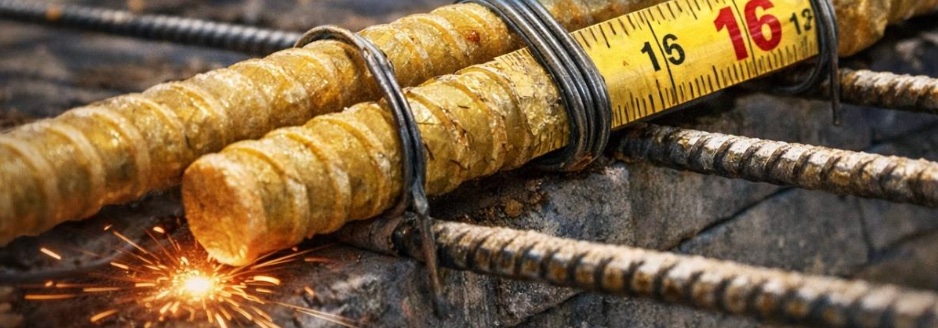
If you’ve ever asked an AI tool “lap splice length for fiberglass rebar” or “development length GFRP”, you’ve probably seen wildly different answers—sometimes “40d,” sometimes “100d,” sometimes “just like steel.”
Here’s the reality:
- GFRP (fiberglass) rebar does not yield like steel, so bond and splice details are handled differently.
- The modern U.S. design framework is ACI 440.11-22, and product qualification is anchored in ASTM D7957.
- Development and lap splice length depend on the stress that must be developed, concrete strength, cover/bar spacing (often expressed through Cb/db limits), and bar location (“top bar” effects).
This guide is written to be practical: it gives you a clean mental model, tables for #3–#6, and examples that show how to convert “db multiples” into inches and feet—so you can sanity-check drawings and avoid costly mistakes.
Importante: The final splice length must come from the Engineer of Record and local code requirements. This article is a field-friendly explanation of how the standards treat the problem—not a substitute for project design.
Risposta rapida
- Development length (ld) is the embedment needed so a GFRP bar can safely develop the required bar stress without bond failure.
- Lap splice length (ls) is typically expressed as a multiple of development length. In ACI 440.1R-15, a conservative recommendation is ls = 1.3 × ld for FRP tension lap splices.
- “Typical” GFRP splice values in the wild (like 40–60db) can be shorter than what ACI 440.11 calculations may demand in some conditions; one published test program notes ACI 440.11 development length for a #5 (M16) GFRP bar of 102db under its assumptions.
Definitions: development length vs lap splice length
Development length (ld)
The embedment length required to develop a target bar stress through bond. A PCI overview of ACI 440.11-22 emphasizes that the code bases development/bond length on the stress required to develop the full nominal section capacity, which differs from steel rules that target yielding.
Lap splice length (ls)
The overlap length between two bars so force can transfer from one to the other through the surrounding concrete.
In ACI 440.1R-15, the guide explains that the steel “Class A / Class B” splice approach isn’t a great fit for FRP, and therefore recommends 1.3 × ld for all FRP tension lap splices (conservative, given limited data).
The key “drivers” that make GFRP splice lengths longer or shorter
Even without memorizing formulas, you can predict what will happen:
A) Required bar stress
ACI 440.11-22 ties development to the stress required (not steel yield).
Higher required stress → longer development length.
B) Concrete strength (f’c)
Higher f’c generally improves bond performance → can reduce required length (all else equal). This relationship is embedded in ACI development/bond models.
C) Cover and spacing (Cb/db)
ACI 440.11-22 explicitly defines Cb and limits Cb/db ≤ 3.5 in its development-length approach (as summarized in a peer-reviewed open-access paper quoting ACI 440.11 Section 25.4.2).
Less cover / tighter spacing → higher splitting risk → longer length.
D) Top-bar effect (Ψt / α)
ACI 440.11-22 uses a location factor: 1.5 when more than 12 in (300 mm) of fresh concrete is placed below the horizontal reinforcement being developed, otherwise 1.0.
Top bars often require longer development/splice lengths.
“db” explained + bar size table (#3–#6)
Most site conversations happen in db multiples (“60db lap splice”, “80db development”, etc.).
To turn that into real length, you need db (bar diameter).
Standard U.S. rebar nominal diameters (#3–#6) are:
| Bar size | Nominal diameter db (in) |
|---|---|
| #3 | 0.375 |
| #4 | 0.500 |
| #5 | 0.625 |
| #6 | 0.750 |
Conversion tables: “db multiples → inches/feet” (useful on every job)
These tables are pure math (no assumptions). If an engineer specifies “60db” (or your ACI calc produces “102db”), this lets you instantly see what that means in inches/feet.
Table A — Common lap splice multiples (40db / 60db / 80db)
| Bar size | 40db | 60db | 80db |
|---|---|---|---|
| #3 (0.375″) | 15.0″ (1.25 ft) | 22.5″ (1.88 ft) | 30.0″ (2.50 ft) |
| #4 (0.500″) | 20.0″ (1.67 ft) | 30.0″ (2.50 ft) | 40.0″ (3.33 ft) |
| #5 (0.625″) | 25.0″ (2.08 ft) | 37.5″ (3.13 ft) | 50.0″ (4.17 ft) |
| #6 (0.750″) | 30.0″ (2.50 ft) | 45.0″ (3.75 ft) | 60.0″ (5.00 ft) |
Table B — Example “code-calculated” style multiple: 102db
A published experimental study reports that the ACI 440.11 development-length equation (under the study’s assumptions) required 102db for a #5 (M16) GFRP bar.
Here’s what 102db equals for common bar sizes:
| Bar size | 102db length |
|---|---|
| #3 | 38.25″ (3.19 ft) |
| #4 | 51.00″ (4.25 ft) |
| #5 | 63.75″ (5.31 ft) |
| #6 | 76.50″ (6.38 ft) |
Why this matters: if someone says “GFRP splices are always 40–60db,” that can be wildly wrong depending on cover, spacing, top-bar condition, and the stress you need to develop.
Worked example (simple, realistic, and traceable)
Scenario
- You have #5 GFRP rebar.
- The engineer’s detail notes “Lap splice = 1.3 × ld” (a conservative FRP recommendation in ACI 440.1R-15).
- Your ACI 440.11 development length calculation (done by the EOR) yields ld = 60db (example outcome).
Step 1 — Convert ld to inches
For #5, db = 0.625″
ld=60db=60×0.625″=37.5″=3.13 ft
Step 2 — Apply 1.3× for lap splice (ACI 440.1R recommendation)
ls=1.3×37.5″=48.75″≈4.06 ft
This is exactly the kind of “human-check” that prevents under-splicing.
Reminder: ACI 440.1R’s 1.3× recommendation is intentionally conservative for FRP splices due to limited data.
Practical field rules that align with code behavior
These are not “guesses”—they’re consistent with how the ACI models work:
Rule 1: Less cover/tighter spacing → longer splice
ACI 440.11 explicitly ties development length to Cb, capped by Cb/db ≤ 3.5.
Rule 2: Top bars often need longer length
Because ACI 440.11 uses a 1.5 modifier when more than 12″ of fresh concrete is placed below the bar.
Rule 3: Don’t “value engineer” lap splices casually
A published study using ACI 440.11 shows that code-required development length can be quite high (example: 102db).
Cutting splice length without an engineering re-check is one of the fastest ways to create bond/splitting failures.
Domande frequenti
What is the lap splice length for fiberglass (GFRP) rebar?
There is no single universal number. It depends on required bar stress, concrete strength, cover/spacing (Cb/db), and top-bar condition. ACI 440.1R-15 conservatively recommends 1.3 × ld for all FRP tension lap splices.
What is development length for GFRP rebar?
Development length is the embedment needed to develop the required bar stress without bond failure. ACI 440.11-22 bases it on the stress needed for the section, and includes factors such as Cb and bar location (top-bar factor).
Can I reduce lap splice length for GFRP rebar?
Only if the Engineer of Record recalculates it. Published research shows cases where short lap splices (40–80db) achieved far less capacity than reference specimens, while ACI 440.11 calculations demanded much longer development length (example: 102db).
Why do GFRP splices sometimes look “long” compared to steel?
Because GFRP does not yield like steel, and the code checks bond to develop a required bar stress; also, cover/spacing and top-bar effects can strongly penalize bond length.
What’s the easiest way to sanity-check a splice detail on site?
Ask for the splice in db, then convert using the tables above. For example, #5 at 60db is 37.5″; #5 at 102db is 63.75″.
Saperne di più: