Quick Answer: Is GFRP Rebar a Good Replacement for Steel?
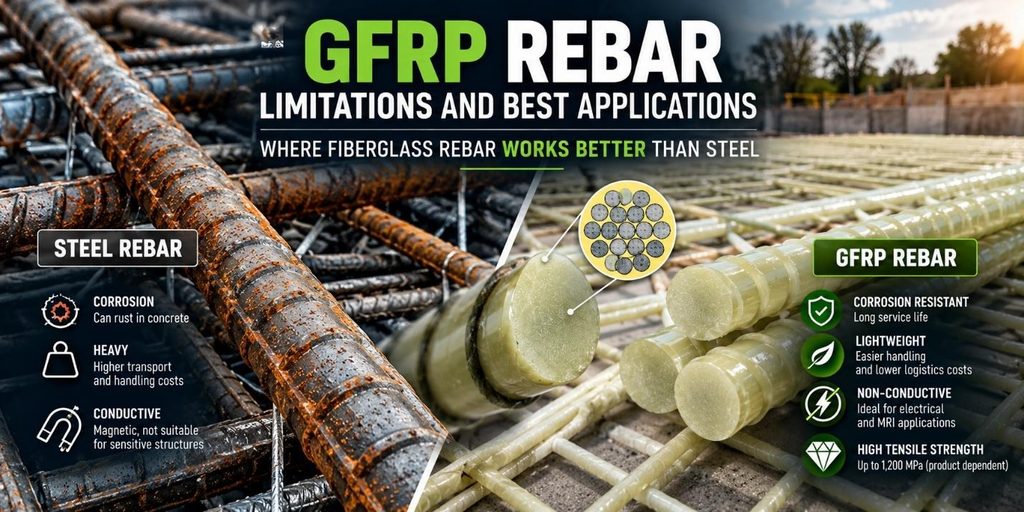
GFRP rebar is not a direct one-to-one replacement for steel by nominal diameter, but it is an excellent reinforcement material when used in the right applications and designed according to FRP-specific rules.
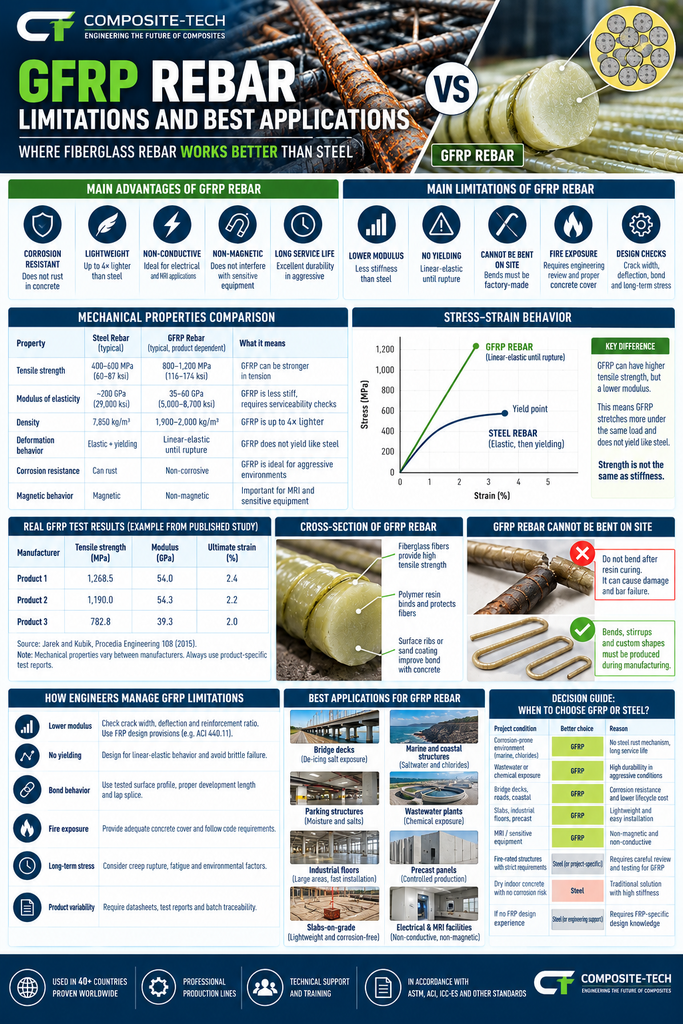
The main limitations of GFRP rebar are well known: it has a lower modulus of elasticity than steel, it does not yield like steel, it cannot be bent on site after curing, and engineers must check crack width, deflection, bond, development length, lap splice, fire exposure and long-term stress limits.
But these points shouldn’t stop you from using it. They just mean you need to use it the right way.
GFRP rebar is particularly useful in concrete structures where steel corrosion, weight, electrical conductivity or magnetic interference create real problems. This includes bridge decks, marine structures, coastal concrete, parking garages, wastewater treatment plants, industrial floors, slabs-on-grade, precast panels and non-magnetic or non-conductive concrete applications.
The correct question is not:
“Can GFRP replace steel everywhere?”
La pregunta correcta es:
“Where does GFRP solve problems that steel creates?”
Conclusiones clave
- GFRP rebar is not “bad steel.” It is a different reinforcement material. it’s a different material altogether.
- Its limitations are mostly design-related, not corrosion-related.
- Lower modulus means engineers must check crack width and deflection.
- No yielding means GFRP must be designed using FRP-specific rules, not copied from steel design.
- GFRP bars cannot be bent after curing; bent shapes must be made during manufacturing. FRP design literature notes that bars cannot be bent after resin curing and that bends must be incorporated during manufacturing.
- GFRP surface geometry matters because bond with concrete depends on surface profile, texture and mechanical interlock.
- FRP rebars are anisotropic; strength and stiffness depend on fiber type, fiber volume ratio, resin, fiber orientation, curing rate, manufacturing process and quality control.
- GFRP is strongest commercially where corrosion resistance, low weight and non-metallic behavior create measurable value.
- The market should not ask whether GFRP is universally better than steel. It should ask where GFRP is the smarter engineering choice.
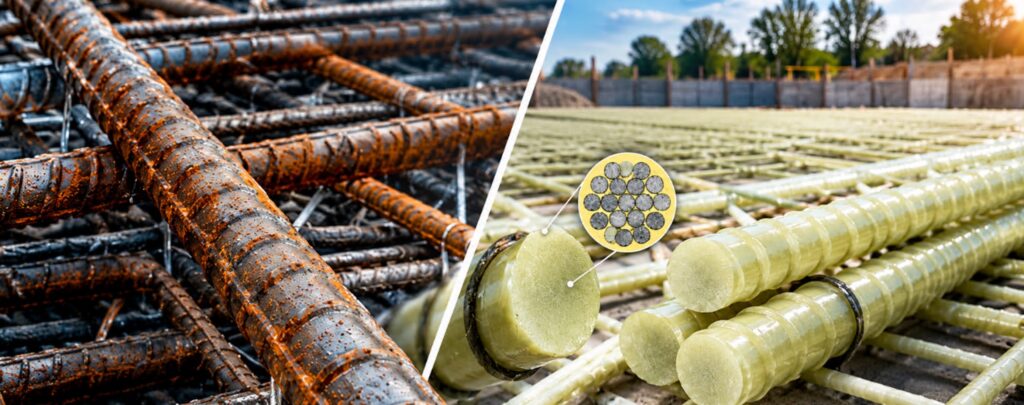
GFRP Rebar Is Not Weaker Steel. It Is a Different Material
The biggest mistake in discussions about varillas de refuerzo de PRFV is treating it as if it should behave exactly like steel.
Steel has stiffness, yield behavior, and a century of design tradition behind it. GFRP reinforcement has high tensile strength, low weight, corrosion resistance and non-metallic properties – it simply works differently in concrete.
This difference is not a flaw. It is a design condition.
| Propiedad | varillas de acero corrugado | varillas de refuerzo de PRFV |
| Corrosión | Can rust in concrete when protection is lost | Does not have the same steel corrosion mechanism |
| Módulo | High, about 200 GPa / 29 Msi | Menor y dependiente del producto |
| Comportamiento de tracción | Elástico, luego cede | Elástico lineal hasta la ruptura |
| Peso | Pesado | Much lighter |
| Conductividad eléctrica | Conductivo | No conductor |
| comportamiento magnético | Magnético | No magnético |
| Doblado en obra | Possible | Not possible after curing |
| Best use case | General reinforced concrete | Corrosion-prone, lightweight, non-metallic and specialized concrete applications |
A fair comparison doesn’t ask which material is “better” in the abstract. It asks which material is better for a specific exposure, structure, budget and design requirement.
The Real Limitations of GFRP Rebar
GFRP limitations should be explained honestly, but without making the material look impractical.
| Limitación | Qué significa | How Engineers Manage It |
| Módulo de elasticidad inferior al del acero | More strain under the same stress | Check crack width, deflection and reinforcement ratio |
| No steel-like yielding | Linear-elastic behavior until rupture | Use FRP-specific design rules and failure-mode checks |
| No se puede doblar en el sitio. | Shapes must be planned before installation | Use factory-made bent bars, stirrups and U-bars |
| Bond depends on surface profile | Tensile strength alone is not enough | Use tested ribbed, wrapped or sand-coated surfaces |
| Development length differs from steel | Anchorage must be designed specifically | Use product-specific bond data and design provisions |
| Fire exposure needs review | Resin matrix behaves differently from steel | Check cover, fire rating and project requirements |
| Product properties vary | Not all GFRP bars are equal | Require datasheets, test reports and traceability |
| Creep rupture and fatigue must be checked | Long-term stress levels matter | Apply design limits and environmental factors |
This table should be the heart of the article: it shows the limitations, but immediately shows that they are manageable.
Where GFRP Rebar Works Better Than Steel
The article should then pivot strongly into applications.
| Solicitud | Why GFRP Can Be the Better Choice |
| Tableros de puentes | De-icing salts accelerate steel corrosion; GFRP avoids the steel rust mechanism |
| Estructuras marinas | Saltwater and chlorides attack steel; GFRP is non-corrosive |
| Coastal concrete | Humidity and salt air make corrosion a long-term cost issue |
| garajes de estacionamiento | Chlorides from vehicles and de-icing salts damage steel reinforcement |
| Wastewater treatment plants | Moisture and chemical exposure create aggressive conditions |
| Suelos industriales | Large areas benefit from lighter handling and corrosion resistance |
| Losas sobre el terreno | Easier logistics, lower weight and corrosion-free reinforcement |
| Paneles prefabricados | Controlled factory placement and weight reduction |
| Instalaciones eléctricas | Non-conductive reinforcement can be valuable |
| MRI / non-magnetic structures | GFRP avoids magnetic interference |
| Aplicaciones de mallas de FRP | Area-based reinforcement, easier handling and corrosion resistance |
Better Question: Where Should Steel Be Replaced?
Not every structure needs GFRP. That is normal. No material is the best choice everywhere.
Steel remains a strong choice where stiffness, ductility, fire rating, conventional detailing and low initial familiarity matter most.
GFRP becomes more attractive when corrosion, lifecycle cost, weight, electrical conductivity, magnetic behavior or chemical exposure become major issues.
| Condición del proyecto | Better Candidate |
| Dry indoor concrete with no corrosion risk | Steel may be sufficient |
| Aggressive chloride exposure | GFRP often deserves serious evaluation |
| Marine and coastal concrete | GFRP can be highly logical |
| Fire-rated structural element with strict requirements | Requires careful review before using GFRP |
| Slabs, pavements and panels where corrosion and handling matter | GFRP or FRP mesh can be attractive |
| MRI or electrical facilities | GFRP may be preferable |
| Project with no FRP design expertise | Engineering support is needed before substitution |
| Long-life infrastructure with high corrosion repair cost | GFRP can improve lifecycle economics |
Why These Limitations Make Manufacturing Quality More Important
How GFRP rebar performs isn’t just about the materials it’s made from. The Proceso de fabricación plays a big part too.
FRP design literature notes that strength and stiffness are affected by fiber type and fiber volume ratio, while resin type, fiber orientation, curing rate, manufacturing process and quality control also influence FRP rebar properties.
That is why professional production equipment matters.
A serious GFRP rebar manufacturer must control:
- fiber feeding;
- fiber tension;
- resin impregnation;
- relación fibra/resina;
- curación;
- cooling;
- perfil de superficie;
- diameter and effective area;
- cutting or coiling;
- batch traceability;
- product testing.
Because GFRP is an engineering material with product-specific behavior, the production line is not just a machine. It’s an integral part of quality control.
To start your GFRP rebar manufacturing project, visit: Línea de producción profesional de barras de refuerzo de GFRP
Conclusión
GFRP rebar has limitations. That is not a problem. Every engineering material has limits.
The real problem is using a material without understanding where it works best.
GFRP should not be presented as steel with a different color. It is not steel. It has lower stiffness, no steel-like yielding, different bond behavior and special detailing requirements.
But in the right applications, these limitations are manageable — and the advantages are substantial.
Where corrosion, weight, electrical conductivity, magnetic behavior or aggressive exposure matter, GFRP can be a smarter reinforcement choice than steel.