
Quick Answer: Why Can FRP Mesh Be Easier to Sell Than Rebar?
FRP mesh can be easier to sell than straight GFRP rebar because many buyers understand mesh by area, not by complex structural substitution. Contractors, precast producers and slab installers can evaluate composite mesh in practical terms: square meters, weight, roll size, handling, corrosion resistance, installation speed and total job cost.
Straight GFRP rebar often requires more engineering discussion: bar size, modulus, tensile load, development length, lap splice, crack width, deflection and code approval. FRP mesh still requires proper technical documentation and project-specific design where used structurally, but for many slab, panel, pavement, industrial floor and non-corrosive reinforcement applications, the sales conversation can be more direct.
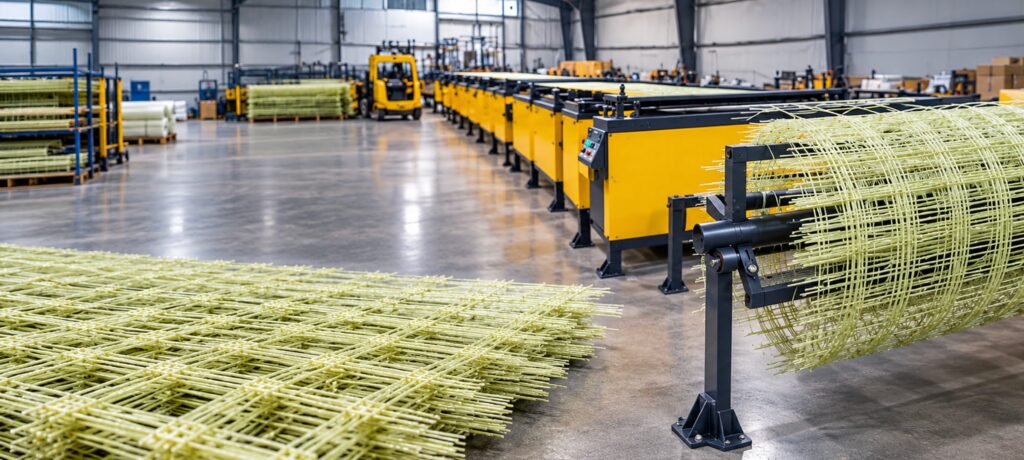
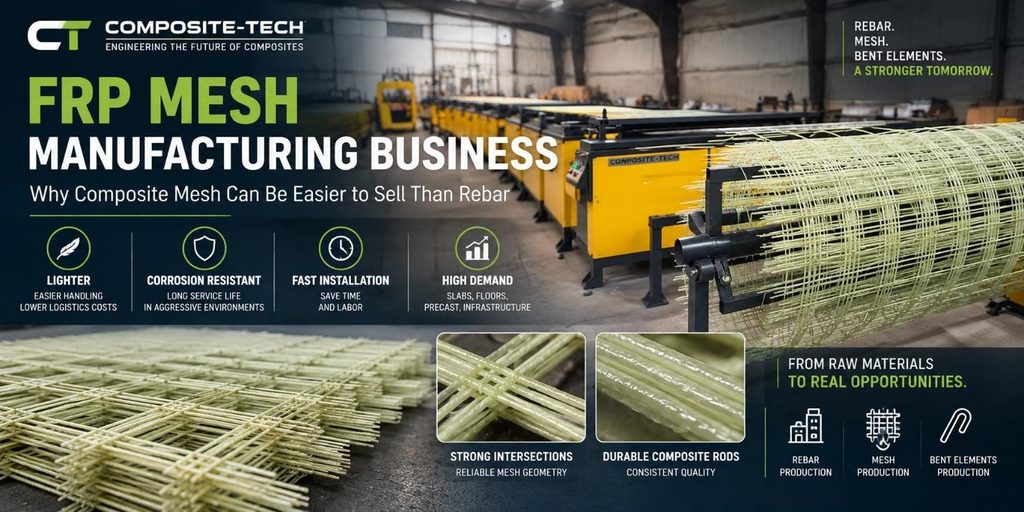
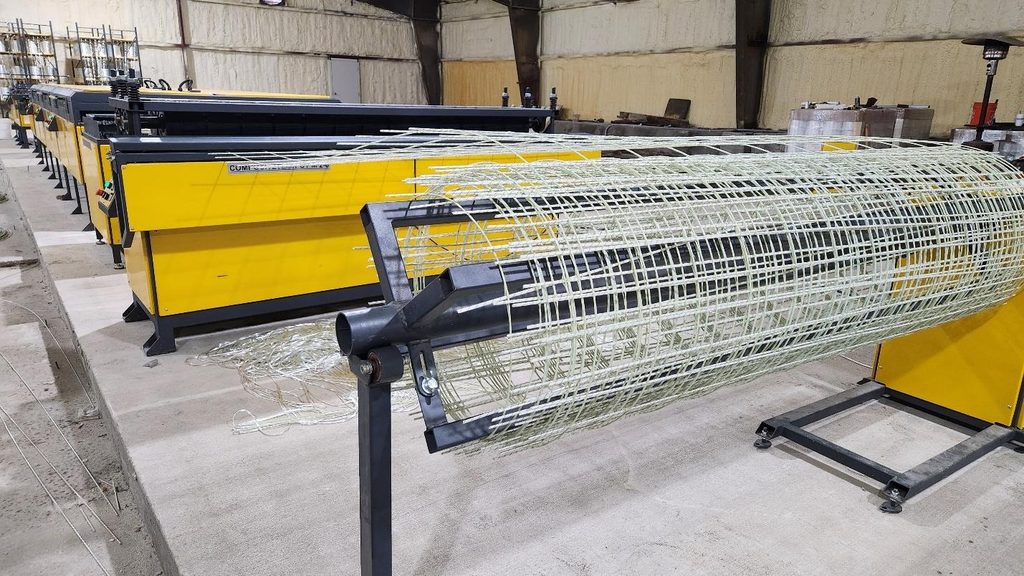
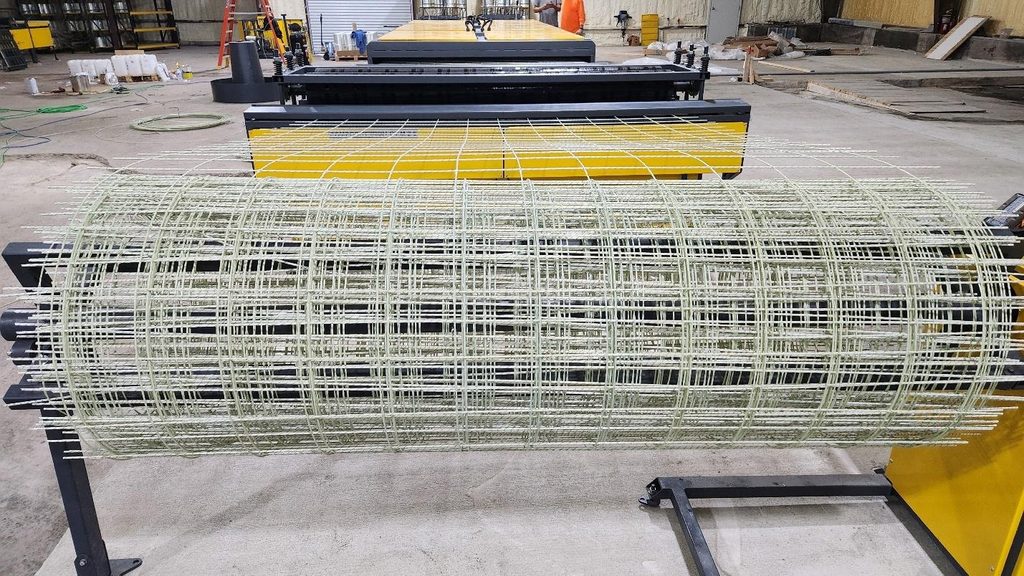
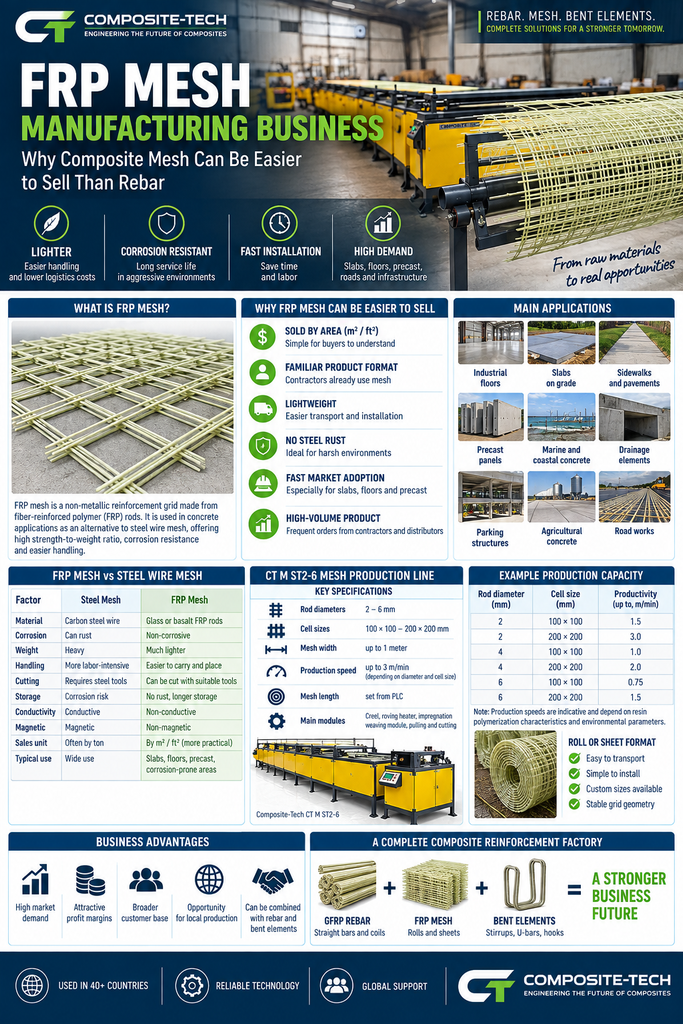
Composite-Tech’s CT M ST2-6 mesh line is designed to produce fiberglass mesh up to 1 meter wide from rods up to 6 mm thick, with customizable mesh size. The machine documentation lists possible rod diameters of 2–6 mm, cell sizes from 100×100 mm to 200×200 mm, and recommended production speeds up to 3 m/min depending on diameter and cell size.
For a manufacturer, this creates a clear business opportunity: FRP mesh can become a high-volume product that supports faster market entry while the broader market continues learning how to design with GFRP rebar.
Conclusiones clave
- FRP mesh is often easier to explain commercially than straight GFRP rebar because it is commonly sold by m² / ft², not by ton.
- The strongest applications include concrete slabs, industrial floors, sidewalks, precast panels, road works, coastal concrete, drainage structures and non-corrosive reinforcement layers.
- Mesh buyers usually care about weight, handling, installation speed, corrosion resistance, roll or sheet format, and price per area.
- GFRP rebar requires more engineering discussion because it is often compared with steel bars in structural design.
- FRP mesh can help a new composite reinforcement manufacturer enter the market faster, especially in applications where corrosion and handling are visible problems.
- A professional FRP mesh business should not rely only on low price. It needs repeatable rod quality, stable mesh geometry, good intersections, controlled curing, product traceability and clear technical documentation.
- Composite-Tech’s CT M ST2-6 line supports rods from 2–6 mm, cell sizes from 100–200 mm, and mesh production speeds up to 3 m/min bajo las condiciones indicadas.
- The broader FRP rebar market is projected to grow from USD 0.69 billion in 2025 to USD 1.19 billion by 2030, while the GFRP rebar market is projected to grow from USD 0.54 billion in 2025 to USD 0.95 billion by 2030.
- The best business model is not only FRP mesh or only GFRP rebar. It is a full composite reinforcement platform: rebar + mesh + bent elements + cut-to-length supply + project packages.
Why FRP Mesh Deserves Its Own Business Strategy
Many investors first enter the composite reinforcement market by asking about varillas de refuerzo de PRFV. That is logical. Rebar is the most familiar reinforcement product.
But mesh is often the product that helps the market understand composite reinforcement faster.
Steel mesh is already widely used in slabs, floors, pavements, panels and light reinforcement applications. Buyers are used to thinking about mesh by area. They ask:
- How many square meters do I need?
- How heavy is the mesh?
- Can workers carry it easily?
- Can it be rolled or stacked?
- How fast can it be installed?
- Will it rust?
- What is the cost per square meter?
These questions are more practical than theoretical.
With straight GFRP rebar, the discussion often becomes more technical: modulus, bar size, tensile load, serviceability, bond, development length, lap splice and substitution rules. Those topics matter. But they can slow down market adoption if the buyer is not yet familiar with FRP design.
Malla de FRP creates a different entry point.
It allows contractors, distributors and manufacturers to start with a product they already understand: reinforcement in a grid.
What Is FRP Mesh?
FRP mesh is a non-metallic reinforcement grid made from fiber-reinforced polymer rods. It may be made from glass fiber, basalt fiber or other reinforcement fibers depending on the product and manufacturer.
In construction, FRP mesh can be used as an alternative to steel wire mesh in selected applications where corrosion resistance, low weight and easier handling are valuable.
| Component | Función |
|---|---|
| FRP rods | Carry tensile force within the mesh grid |
| Resin matrix | Binds and protects the fibers |
| Perfil de superficie | Helps interaction with concrete |
| Intersections | Keep the grid geometry stable |
| Mesh cell size | Defines spacing and reinforcement distribution |
| Roll or sheet format | Affects logistics, handling and installation |
A serious FRP mesh product is not just “plastic mesh.” It is a manufactured composite reinforcement product. Its performance depends on rod quality, fiber content, resin impregnation, curing, surface profile, intersection stability and production consistency.
Why Mesh Can Be Easier to Sell Than Rebar
The word “easier” should be understood correctly. It does not mean that FRP mesh requires no engineering or no testing. It means that the buyer’s first commercial understanding is often simpler.
Table 1: GFRP Rebar vs FRP Mesh Sales Logic
| Factor | Straight GFRP Rebar | FRP Mesh |
|---|---|---|
| Common sales unit | Meter / foot / bar size | Square meter / square foot |
| Buyer comparison | Steel bar substitution | Steel wire mesh / welded mesh replacement |
| Main discussion | Structural design and bar behavior | Area coverage, weight, handling and corrosion |
| Adoption barrier | Higher if used structurally | Lower in many slab and panel applications |
| Installation perception | Requires explanation | Visually familiar grid format |
| Product handling | Bars or coils | Rolls, sheets or panels |
| Typical early markets | Bridges, marine, infrastructure, special concrete | Slabs, floors, precast, sidewalks, pavements |
| Buyer education level required | A menudo más alto | Often more practical and visual |
For many buyers, mesh is easier to understand because it is a product they can see, carry, roll out and compare on the job site.
That gives FRP mesh a strong commercial advantage.
Why Selling by Area Matters
Steel reinforcement is often discussed by ton. That creates confusion for lightweight composite materials.
FRP mesh is different because it naturally fits an area-based sales model.
Instead of asking for tons, the buyer asks:
“How many square meters of slab do I need to reinforce?”
This is a better way to sell composite reinforcement because GFRP and FRP products are much lighter than steel. A ton-based comparison can make lightweight materials look artificially expensive. Area-based comparison is more practical.
Table 2: Why Area-Based Selling Helps FRP Mesh
| Sales Method | Problem / Advantage |
|---|---|
| Price per ton | Poor method for lightweight composites |
| Price per kg / lb | Still incomplete for mesh |
| Price per linear meter | Useful for rods but less natural for mesh |
| Price per m² / ft² | Best commercial unit for mesh |
| Price per project package | Best for contractors and developers |
| Installed cost per slab area | Best full comparison |
For FRP mesh, the buyer should compare:
- mesh area;
- cell size;
- rod diameter;
- weight per area;
- roll or sheet dimensions;
- installation time;
- cutting and handling;
- exposición a la corrosión;
- total project cost.
This makes the product easier to price, specify and sell.
Main Applications for FRP Mesh
FRP mesh is strongest where corrosion resistance, low weight and fast handling create visible value.
Table 3: High-Potential Applications for FRP Mesh
| Solicitud | Why FRP Mesh Fits |
|---|---|
| Losas sobre el terreno | Area-based reinforcement and easier handling |
| Suelos industriales | Large surface area and installation efficiency |
| Sidewalks and pavements | Exposure to water, salts and freeze-thaw regions |
| Precast panels | Repeatable manufacturing and controlled placement |
| Parking structures | Moisture and chloride exposure |
| Coastal concrete | Saltwater and humid environments |
| Road works | Lightweight reinforcement and faster placement |
| Drainage elements | Moisture exposure and corrosion risk |
| Agricultural concrete | Chemicals, moisture and frequent washing |
| Non-structural concrete elements | Easier adoption and practical handling advantages |
The highest-potential markets are not always the most technically complex. They are often the markets where the buyer immediately sees the problem with steel mesh: weight, rust, handling and installation effort.
GFRP Mesh vs Steel Wire Mesh: The Practical Comparison
Steel mesh is familiar, but it has three basic disadvantages in many applications:
- it is heavy;
- it can corrode;
- it can be inconvenient to handle, cut and place.
FRP mesh addresses these issues through low density and non-metallic behavior.
Table 4: FRP Mesh vs Steel Mesh
| Factor | Malla de alambre de acero | FRP Mesh |
|---|---|---|
| Material | Carbon steel wire | Fiber-reinforced polymer rods |
| Corrosión | Can rust in aggressive exposure | Non-metallic; no steel rust mechanism |
| Peso | Pesado | Much lighter |
| Handling | More labor-intensive | Easier to carry and place |
| Cutting | Requires steel cutting tools | Can be cut with suitable tools for FRP |
| Storage | Corrosion risk if exposed | Better corrosion resistance |
| Conductivity | Conductivo | No conductor |
| comportamiento magnético | Magnético | No magnético |
| Sales logic | Often mass-based | Area-based |
| Technical requirement | Familiar standards | Product-specific documentation required |
The sales message should be practical:
FRP mesh is easier to transport, easier to handle, does not rust like steel, and can be sold directly by the area the contractor needs to reinforce.
That is stronger than simply saying “composite is better.”
Why FRP Mesh Can Help a New Factory Enter the Market Faster
A new GFRP rebar factory usually faces two challenges:
- producing consistent material;
- educating the market.
Structural rebar adoption can require design review, code discussion, engineer approval, test reports and project-specific documentation. This is normal. It is not a weakness of GFRP. It is the reality of structural materials.
Mesh can open doors faster because some applications are less difficult to explain commercially.
A contractor may hesitate to redesign a structural element with GFRP bars, but may be more open to testing composite mesh in slabs, pavements, precast elements, sidewalks or corrosion-prone non-metallic reinforcement layers.
Table 5: Why Mesh Can Accelerate Market Entry
| Market Barrier | How FRP Mesh Helps |
|---|---|
| Buyer unfamiliar with GFRP design | Mesh is visually familiar |
| Confusion about bar substitution | Mesh is sold by area and spacing |
| Concern about weight | Lightweight handling is immediately visible |
| Concern about rust | Non-metallic mesh solves a familiar steel problem |
| Need for product demonstration | Mesh is easy to demonstrate on site |
| Distributor hesitation | Rolls or sheets can be stocked and displayed |
| Contractor adoption | Installation benefit is easy to show |
A factory that produces both GFRP rebar and FRP mesh can approach the market from two sides: technical structural reinforcement and practical area reinforcement.
Production Technology: Why Mesh Quality Is Not Automatic
FRP mesh looks simple, but producing it consistently is not simple.
The manufacturer must control:
- rod diameter;
- fiber alignment;
- resin impregnation;
- curing;
- rod surface profile;
- intersection geometry;
- mesh cell size;
- mesh width;
- pulling and cutting;
- roll or panel format;
- traceability.
Composite-Tech’s CT M documentation lists the main machine components as creels, roving heaters, impregnation modules and a weaving module. It also describes the pulling device with cutting module as the system that pulls fiberglass reinforcement, determines traction speed and cuts mesh to a specified size.
That is important because mesh quality depends not only on the rods, but also on how those rods are positioned and fixed into a repeatable grid.
Table 6: Mesh Quality Control Points
| Production Variable | Por qué es importante |
|---|---|
| Rod diameter | Controls reinforcement amount and product consistency |
| Cell size | Determines spacing and area reinforcement |
| Intersection stability | Keeps mesh geometry during handling and placement |
| Perfil de superficie | Affects bond and concrete interaction |
| Curing quality | Affects mechanical consistency |
| Pulling speed | Affects production output and process stability |
| Cutting accuracy | Affects sheet or roll dimensions |
| Roll quality | Affects logistics and installation |
| Batch traceability | Supports serious customers and repeat orders |
A mesh product can fail commercially even if the rod itself is strong, if the mesh geometry is inconsistent or difficult to install.
CT M ST2-6: Example of Industrial FRP Mesh Production Logic
Composite-Tech’s CT M ST2-6 documentation gives a practical example of how a professional FRP mesh line is structured.
The line is designed to produce fiberglass mesh up to 1 meter wide from rods up to 6 mm thick, with customizable mesh size.
Table 7: CT M ST2-6 Mesh Format
| Parámetro | Valor |
|---|---|
| Rod diameters | 2–6 mm |
| Cell size range | 100×100 mm to 200×200 mm |
| Ancho de malla | Up to 1 meter |
| Mesh length | Set from PLC |
| Production type | Continuous fiberglass mesh production |
| Main modules | Creel, roving heater, impregnation, weaving, pulling/cutting |
The documentation also gives recommended production speeds.
Table 8: Recommended Mesh Production Speeds
| Rod Diameter | Cell Size | Productivity, up to |
|---|---|---|
| 2 mm | 100×100 mm | 1.5 m/min |
| 2 mm | 200×200 mm | 3.0 m/min |
| 4 mm | 100×100 mm | 1.0 m/min |
| 4 mm | 200×200 mm | 2.0 m/min |
| 6 mm | 100×100 mm | 0.75 m/min |
| 6 mm | 200×200 mm | 1.5 m/min |
The manual notes that these production speeds are indicative and depend on resin polymerization characteristics and environmental parameters.
This kind of data is useful for investors because it allows them to build a realistic production model by area, not only by machine price.
Why Mesh Production Can Improve Factory Margins
FRP mesh can improve a composite reinforcement factory’s business model in several ways.
First, it creates a second product category from the same general material ecosystem: fiber, resin, rods, curing, surface formation and reinforcement packaging.
Second, it gives the factory access to area-based markets where buyers may not yet be ready for structural GFRP rebar substitution.
Third, it creates more frequent sales opportunities because slabs, floors, panels and pavements are high-volume construction applications.
Table 9: How Mesh Adds Business Value
| Business Factor | Rebar Only | Rebar + Mesh |
|---|---|---|
| Product range | Narrower | Broader |
| Sales unit | Meter / foot | Meter / foot + m² / ft² |
| Customer base | Engineers, contractors, distributors | Contractors, slab installers, precast, distributors |
| Application range | Structural and non-structural | Structural plus high-volume area reinforcement |
| Market education | More technical | More visual and practical |
| Inventory options | Bars and coils | Bars, coils, rolls, sheets |
| Cross-selling | Limitado | Rebar + mesh + bent elements |
| Factory utilization | Depends on rebar demand | More flexible production planning |
For many manufacturers, mesh is not a secondary product. It can become one of the fastest-moving products in the catalog.
The Full Composite Reinforcement Factory Model
A strong business should not depend on one product only.
The better model is a production platform capable of serving multiple reinforcement needs.
Table 10: Product Ecosystem for Composite Reinforcement
| Producto | Commercial Role |
|---|---|
| Barras de refuerzo rectas de GFRP | Core reinforcement product |
| Coiled small diameters | Distributor-friendly and logistics-efficient |
| Cut-to-length bars | Contractor-ready supply |
| Malla de FRP | High-volume area reinforcement |
| Bent elements | Stirrups, U-bars, hooks and project detailing |
| Private-label production | Supply for local brands or distributors |
| Project reinforcement packages | Higher-value sales than commodity products |
Composite-Tech’s CT6 new generation rebar line, for example, is designed to produce six bars of fiberglass reinforcement at the same time en diámetros desde De 4 mm a 20 mm, with recommended productivity up to 36 m/min para 10 mm and up to 48 m/min para 4 mm, depending on resin and environmental conditions.
When a factory combines high-output rebar production with FRP mesh production, it can serve both engineering-driven and contractor-driven markets.
That combination is commercially stronger than selling only one product.
Where FRP Mesh Fits in the U.S. and European Markets
The U.S. and European markets differ, but the core buyer questions are similar.
In the United States, buyers commonly search for:
- fiberglass mesh for concrete slabs;
- GFRP mesh vs steel wire mesh;
- FRP mesh for industrial floors;
- fiberglass rebar mesh;
- corrosion-resistant concrete mesh;
- FRP rebar and mesh production line.
In Europe, buyers commonly search around:
- composite reinforcement mesh;
- GFRP mesh for concrete;
- fiberglass reinforcing mesh;
- basalt fiber mesh;
- FRP mesh price per square meter;
- production line for composite mesh.
Table 11: Metric and U.S. Sales Language
| Topic | Europe / International | United States |
|---|---|---|
| Area | m² | ft² |
| Rod diameter | mm | inch / approximate bar size |
| Peso | kg/m² | lb/ft² |
| Mesh size | 100×100 mm, 200×200 mm | 4×4 in, 6×6 in, 8×8 in approximate equivalents |
| Price | €/m² | $/ft² |
| Technical force | kN | kip |
| Fortaleza | MPa | ksi |
Standards and Technical Documentation: What Buyers Should Understand
FRP mesh should not be sold only with general claims. Serious buyers will ask for documentation.
For GFRP bars, ASTM D7957/D7957M covers GFRP bars for concrete reinforcement. The current ASTM listing identifies D7957/D7957M-26 as the standard specification for GFRP bars for concrete reinforcement. CÓDIGO ACI-440.11-22 provides building code requirements for structural concrete reinforced with GFRP bars.
For mesh, the correct technical approach depends on the target application and local approval route. A supplier should not imply that every mesh product is automatically accepted simply because GFRP bars are covered by standards.
Correct positioning:
FRP mesh should be supported by product-specific datasheets, rod test data, mesh geometry, material traceability, installation guidance and project-specific engineering approval where required.
Table 12: Technical Data Buyers May Request
| Data Item | Por qué es importante |
|---|---|
| Rod diameter | Defines reinforcement grid |
| Cell size | Defines reinforcement spacing |
| Mesh width and length | Defines project coverage |
| Weight per m² / ft² | Supports logistics and handling comparison |
| Fiber type | Affects mechanical properties |
| Resin type | Affects durability and curing behavior |
| Perfil de superficie | Affects concrete interaction |
| Tensile load of rods | Supports material comparison |
| Módulo | Supports serviceability understanding |
| Intersection behavior | Supports handling and placement confidence |
| Datos de durabilidad | Supports long-term exposure use |
| Batch traceability | Supports professional supply |
This is where professional manufacturers separate themselves from commodity sellers.
Why Quality Control Is Especially Important for Mesh
Mesh has more visible geometry than straight rebar. If cell size is inconsistent, intersections are weak, rods are not straight, or the roll is difficult to handle, the buyer sees it immediately.
Quality control should verify:
- rod diameter;
- cell size;
- mesh width;
- roll length;
- intersection consistency;
- surface appearance;
- cutting accuracy;
- product labeling;
- batch traceability;
- packaging stability.
Table 13: Common FRP Mesh Quality Problems
| Problema | Consecuencia comercial |
|---|---|
| Inconsistent cell size | Harder installation and lower buyer confidence |
| Weak intersections | Handling damage and project complaints |
| Poor rod curing | Mechanical inconsistency |
| Excess resin | Higher cost and poor appearance |
| Poor surface profile | Lower bond confidence |
| Irregular roll geometry | Difficult logistics and storage |
| No batch labels | Weak traceability |
| No datasheet | Harder to sell to serious buyers |
For mesh, the product must look professional before it even enters a laboratory. Contractors judge handling quality quickly.
Why Local FRP Mesh Production Can Beat Imported Supply
Imported mesh may include factory margin, packaging, freight, port handling, customs, distributor markup and long lead time.
Local production can reduce part of that burden.
Table 14: Imported FRP Mesh vs Local Manufacturing
| Factor | Imported Mesh | Local FRP Mesh Production |
|---|---|---|
| Lead time | Often longer | Shorter |
| Custom mesh sizes | Limitado | Easier |
| Roll/sheet format | Standard stock | Market-specific |
| Freight cost | Higher risk | Reduced for regional supply |
| Inventory control | Import-dependent | Factory-controlled |
| Private label | More complicated | Easier |
| Customer feedback | Slower | Direct |
| Project adaptation | Limitado | Faster |
This is why FRP mesh manufacturing can be attractive for regional investors. The factory is not only replacing steel mesh. It is replacing imported composite supply with local production.
How to Build an FRP Mesh Business
A good FRP mesh business should not begin with the question:
“How cheap can we make mesh?”
It should begin with:
“Which applications can we serve better than steel mesh or imported composite mesh?”
Practical Business Roadmap
Step 1: Identify target applications: slabs, floors, sidewalks, precast, roads, drainage
Step 2: Define mesh sizes and rod diameters required by the local market
Step 3: Compare steel mesh by m² / ft², weight and installation effort
Step 4: Prepare product datasheets and installation guidance
Step 5: Produce trial batches and collect contractor feedback
Step 6: Build distributor and contractor education materials
Step 7: Develop quality control and batch traceability
Step 8: Add rebar and bent elements to expand product range
Step 9: Build relationships with engineers and testing laboratories
Step 10: Move from product sales to project reinforcement packages
The most successful approach is not to wait for the market to understand everything. The manufacturer must educate the market with simple technical data.
Common Mistakes in the FRP Mesh Business
- The first mistake is treating mesh as a low-tech product. It is not. Mesh quality depends on rod quality, grid geometry, intersection consistency and production control.
- The second mistake is selling only on corrosion resistance. Corrosion resistance matters, but the buyer also cares about price per area, weight, handling and installation.
- The third mistake is copying steel mesh logic too closely. FRP mesh is lighter, non-metallic and often better sold by total installed value, not by mass.
- The fourth mistake is ignoring documentation. Serious buyers need datasheets, dimensions, tolerances, material information and installation guidance.
- The fifth mistake is producing only one mesh size. Different markets may need different diameters, spacing, roll lengths or sheet formats.
- The sixth mistake is buying equipment that cannot produce consistent cell size, stable rods or clean rolls.
- A weak mesh product damages confidence quickly. A clean, repeatable and well-documented mesh product helps the whole FRP reinforcement category.
Conclusión
FRP mesh can be one of the most practical entry points into the composite reinforcement market.
Straight GFRP rebar is a strong product, but it often requires more engineering education. Buyers must understand tensile strength, modulus, bond, development length, lap splice and structural design rules.
FRP mesh is different. It is visual, area-based and easier to explain through everyday construction language: square meters, weight, roll size, installation, corrosion resistance and total project value.
For manufacturers, this creates a strong business opportunity. FRP mesh can support faster market entry, broader customer access and better factory utilization. It can serve slabs, floors, sidewalks, precast panels, parking structures, drainage works and coastal concrete applications.
But the business only works if the product is consistent. Mesh quality depends on rod quality, cell geometry, intersection stability, curing, cutting, roll quality, documentation and traceability.
The best strategy is not to choose between GFRP rebar and FRP mesh.
The strongest strategy is to build a complete composite reinforcement manufacturing platform: rebar, mesh, elementos doblados, coils, cut-to-length supply and project-specific reinforcement packages.
That is where FRP mesh becomes more than a product.
It becomes a business accelerator.
FAQ: FRP Mesh Manufacturing Business
What is FRP mesh?
FRP mesh is a fiber-reinforced polymer reinforcement grid made from composite rods. It is used in concrete applications where low weight, corrosion resistance and easier handling are valuable.
What is GFRP mesh?
GFRP mesh is FRP mesh made with glass fiber reinforcement and polymer resin. It is a non-metallic alternative to steel wire mesh in selected concrete applications.
Why can FRP mesh be easier to sell than GFRP rebar?
FRP mesh is often sold by area, such as m² or ft². Buyers can understand it through slab area, roll size, weight, installation and corrosion resistance. Straight rebar usually requires more structural design discussion.
What applications are best for FRP mesh?
Common applications include slabs-on-grade, industrial floors, sidewalks, pavements, precast panels, parking structures, drainage elements, coastal concrete and non-corrosive reinforcement layers.
Is FRP mesh stronger than steel mesh?
The answer depends on rod diameter, fiber type, resin, geometry, test method and application. FRP mesh should not be evaluated by one general claim. Buyers should compare product-specific tensile data, mesh spacing, weight, durability and project requirements.
Does FRP mesh rust?
FRP mesh is non-metallic, so it does not have the same steel rust mechanism. This is one of its main advantages in moisture, chloride and chemical exposure environments.
How is FRP mesh sold?
FRP mesh is commonly sold by square meter or square foot, and also by roll, sheet or project package.
What rod diameters are used in FRP mesh?
Composite-Tech’s CT M ST2-6 documentation lists possible rod diameters from 2 mm to 6 mm for its mesh production line.
What mesh cell sizes can be produced?
According to the CT M ST2-6 documentation, possible cell sizes include 100×100 mm to 200×200 mm, with length set from the PLC.
What is a GFRP mesh production line?
A GFRP mesh production line is equipment that produces composite reinforcement mesh by forming FRP rods and arranging them into a controlled grid. It typically includes fiber feeding, roving preparation, resin impregnation, weaving or mesh formation, pulling, cutting and packaging modules.
Is FRP mesh production profitable?
FRP mesh production can be profitable when the manufacturer has efficient equipment, strong local demand, controlled raw material cost, repeatable mesh quality and clear sales channels into slabs, floors, precast, roads and corrosion-prone concrete applications.
Should a factory produce both GFRP rebar and FRP mesh?
In many markets, yes. A factory that produces both rebar and mesh can serve more customers, sell by both length and area, and build a broader composite reinforcement business.
What data should buyers request before purchasing FRP mesh?
Buyers should request rod diameter, cell size, mesh width and length, weight per area, fiber type, resin type, surface profile, tensile data, durability information, installation guidance and batch traceability.
Is FRP mesh automatically approved for structural use?
No. Structural use depends on local codes, project requirements, engineering design and product-specific documentation. The product must be evaluated for the intended application.
Más información:
- Producción de barras y mallas de refuerzo de GFRP frente a BFRP: La comparación definitiva de maquinaria y materiales B2B para 2026
- Por qué Composite-Tech es el líder mundial indiscutible en equipos para la fabricación de barras y mallas de refuerzo compuestas: Análisis de superioridad tecnológica
- Plan de Negocios 2026: Cómo lanzar una fábrica de barras y mallas de GFRP de alto margen con retorno de la inversión en 5 meses
- Equipos Composite-Tech frente a equipos FRP convencionales: ¿Qué es lo que realmente define una línea de producción de barras de refuerzo y mallas de primera clase?
- ¿Pueden las varillas de fibra de vidrio y la malla de PRFV realmente reemplazar al acero en los cimientos de las casas y las entradas de vehículos?
- Malla de PRFV vs. malla de alambre de acero para losas sobre el terreno y pisos industriales
- Por qué las empresas estadounidenses eligen Composite-Tech para la producción de varillas y mallas de refuerzo de fibra de vidrio y basalto