
Contenido
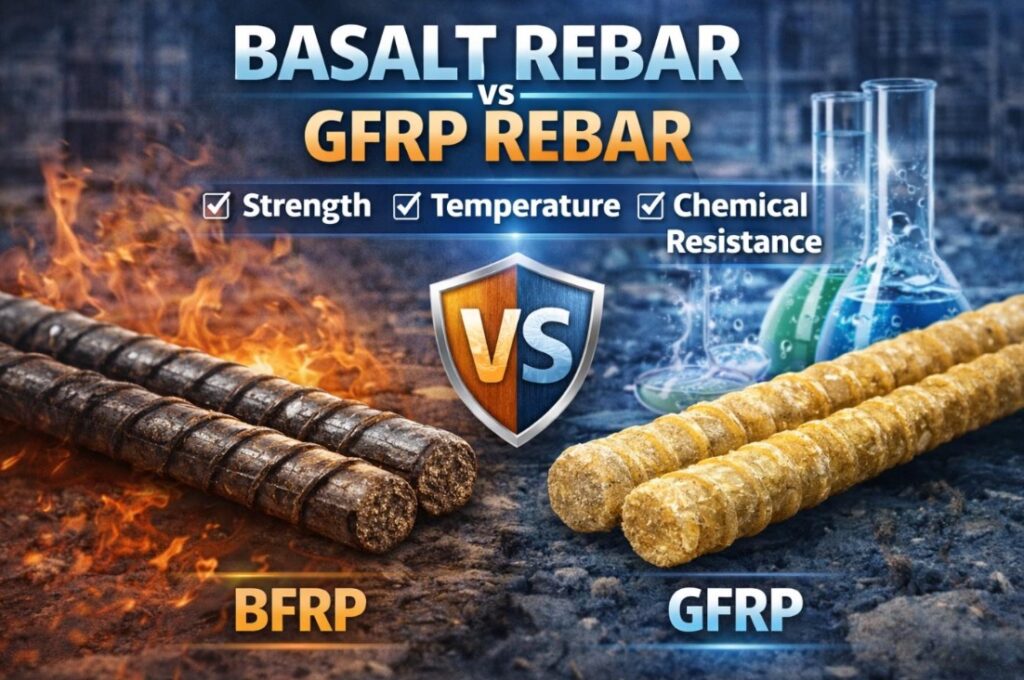
“Basalt vs fiberglass rebar” and “BFRP vs GFRP” are now common questions in Google and AI search because both materials solve the same pain point: steel corrosion in concrete.
But if you’re a project owner or a designer, you don’t need hype—you need a selection rule:
- Which one performs better for my exposure conditions?
- Which one is easier to specify and get approved?
- Where do temperature and chemical resistance actually matter?
This guide compares Basalt Fiber Reinforced Polymer (BFRP) rebar y Glass Fiber Reinforced Polymer (GFRP) rebar using published technical literature and U.S. standards.
Respuesta rápida
- If your project is in the USA and you need the clearest code path today, GFRP is usually the easiest to specify because ACI 440.11-22 is written for GFRP bars that conform to ASTM D7957.
- If your project has elevated temperature cycles or particularly aggressive chemical exposure, many studies report basalt fibers/composites can offer higher tensile strength, slightly higher stiffness, and stronger durability retention than typical E-glass systems—but performance still depends heavily on resin system and manufacturing quality.
- In practice, good GFRP and good BFRP can be close in headline tensile strength, and selection often comes down to (1) approvals/specs, (2) environment, (3) resin/QA, and (4) cost & availability.
Definitions: What are GFRP and BFRP rebar?
- varillas de refuerzo de PRFV: glass fibers embedded in a polymer matrix (commonly vinyl ester, epoxy, or polyester) with a surface profile (rib, wrap, sand coating) for bond. In the U.S., ASTM D7957 is the main product specification for solid round GFRP bars used as concrete reinforcement.
- varillas de refuerzo BFRP: basalt fibers embedded in a similar polymer matrix. Basalt fibers are produced from melted basalt rock and are widely studied as a reinforcement fiber with strong chemical resistance and good thermal behavior.
Standards and “specification reality” in the USA
This matters more than most people admit: the best material on paper is not the best choice if you can’t specify it cleanly.
GFRP: Clear U.S. code and product standard
- ACI 440.11-22 explicitly states it applies to structural concrete reinforced with GFRP bars that conform to ASTM D7957-22.
- ASTM D7957 scope: solid round GFRP bars (straight and bent) with surface enhancement for concrete reinforcement, including property limits and test methods.
BFRP: More variability by jurisdiction
Basalt FRP is widely used and researched, but U.S. adoption is more fragmented: you may be working through project specs, owner requirements, DOT acceptance frameworks, or evaluation reports rather than a single universally referenced “BFRP version of D7957.”
That doesn’t mean BFRP is “not allowed”—it means your submittal path may require more documentation.
Practical rule:
If you want the cleanest approval language in the U.S. today, GFRP often has the simplest route because the code/product standard pairing is explicit.
Mechanical properties: strength and stiffness (what engineers actually compare)
A note before numbers
FRP properties vary with:
- fiber type (basalt vs glass),
- fiber volume fraction,
- resin type (vinyl ester vs epoxy),
- surface treatment, cure profile, quality control.
So you should treat any “single number” as a range.
What literature says about basalt vs glass fibers
A highly cited composites paper notes basalt fibers are known for better tensile strength than E-glass and good resistance to chemical attack and fire-related conditions.
A more recent research paper comparing glass and basalt fiber contexts reports basalt fiber tensile strength approximately higher and modulus roughly 15–30% higher than glass fiber.
Also, a 2025 PMC article discussing FRP reinforcement notes GFRP and BFRP can be “almost identical” in tensile strength and corrosion resistance while differing in modulus, thermal resistance, cost, and sustainability.
Table 1 — Typical comparative ranges (order-of-magnitude guidance)
| Property (typical) | varillas de refuerzo de PRFV | BFRP Rebar | What it means |
|---|---|---|---|
| Resistencia a la tracción | often ~800–1200 MPa (varies by system) | often ~1000–1400 MPa (varies by system) | Basalt often trends higher, but overlap is real |
| Modulus (stiffness) | ~40–55 GPa | ~45–65 GPa | Basalt often slightly stiffer |
| Densidad | ~2.0 g/cm³ | ~2.0–2.2 g/cm³ | Both are far lighter than steel |
| Resistencia a la corrosión | high | very high | Both eliminate steel corrosion mechanism |
These ranges are consistent with published comparisons and engineering summaries, but product-specific test reports always win.
Temperature performance: when it actually changes your decision
Temperature questions usually come in two forms:
- Fire exposure (structural fire design)
- Operating temperature cycles (industrial plants, hot climates, thermal gradients)
Important: In FRP, resin often governs temperature limits
The fiber can tolerate high temperature better than the resin matrix. That’s why “fiber type alone” is not enough; glass transition temperature (Tg) of the resin system se vuelve crítico.
That said, basalt fibers are frequently cited as having strong fire/temperature resilience characteristics compared with glass fibers in broader composites literature.
Selection rule:
- If your project has elevated service temperatures or more severe thermal cycles, BFRP can be attractive—but confirm resin Tg, design temperature limits, and manufacturer durability data.
Chemical and durability resistance (alkali, chlorides, seawater)
Concrete pore solution is alkaline, and many structures also face chlorides (de-icing salts, marine spray).
Basalt vs glass in chemical environments
- Basalt fibers are widely reported to have strong chemical resistance characteristics in composites applications.
- Research shows basalt fiber alkali resistance can be improved through material selection, indicating meaningful variability across basalt fiber sources.
- A 2025 MDPI polymers paper comparing durability reports larger tensile/modulus reductions for GFRP than BFRP in certain aggressive exposures (the paper reports reductions around 22–32% for GFRP vs 6–12% for BFRP under its test conditions).
What this means for selection:
- In aggressive chemical environments, BFRP often has a strong durability argument—but you should demand test data for the exact resin/fiber system the supplier provides.
Bond behavior: the “hidden” factor that drives performance
For both GFRP and BFRP, bond to concrete depends heavily on:
- surface deformation (ribs / wrap / sand coat),
- bar diameter,
- concrete cover and confinement,
- and manufacturing consistency.
A 2025 Materials paper directly compares bond performance in glass and basalt fiber contexts and discusses relative fiber property differences and their influence on behavior.
Practical selection rule:
If you’re choosing between two suppliers, bond behavior and quality documentation often matter more than whether the fiber is basalt or glass.
Cost, availability, and “spec friction”
In many real projects:
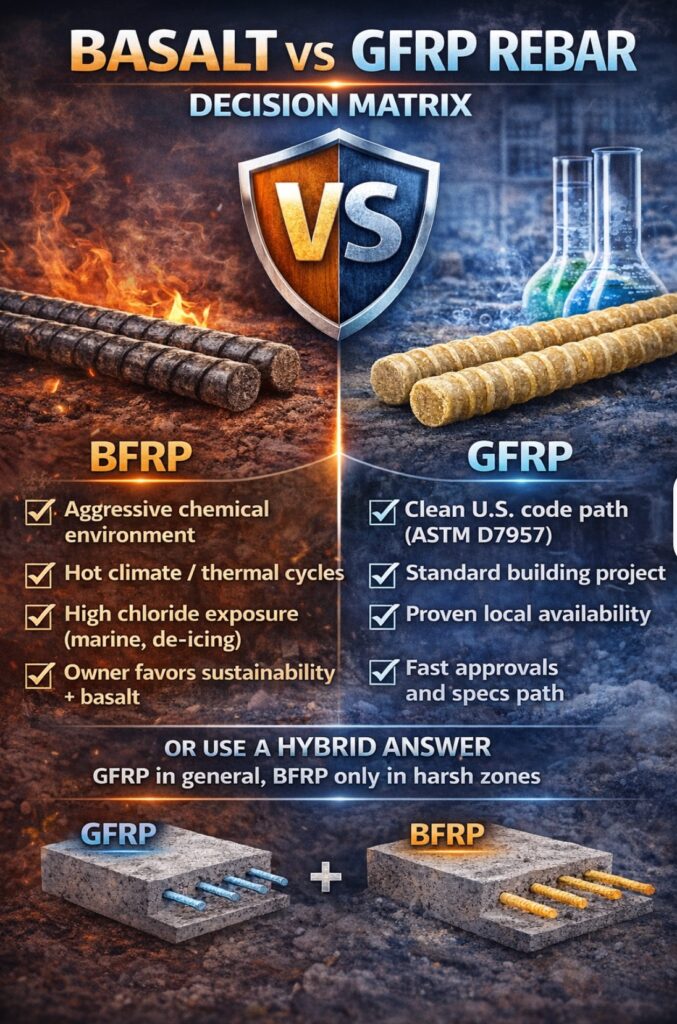
- GFRP wins when:
- you need fast approvals using ACI 440.11-22 + ASTM D7957 language,
- local supply is strong,
- you want predictable procurement.
- BFRP wins when:
- your environment is especially aggressive (chemicals/seawater),
- temperature cycles matter,
- you can support documentation and testing in submittals,
- or your owner/specifier wants basalt for sustainability/temperature reasons.
And in some cases, the correct answer is hybrid:
- GFRP in general reinforcement,
- BFRP in the highest exposure zones.
(That hybrid concept is also discussed in comparative FRP reinforcement studies.)
Decision matrix: Which one should you choose?
Table 2 — Fast selection matrix (engineer/owner-friendly)
| Project condition | Better default choice | Why |
|---|---|---|
| U.S. building project needing the cleanest code path | PRFV | ACI 440.11-22 explicitly covers GFRP bars conforming to ASTM D7957 |
| Marine / chloride-heavy exposure, long design life | BFRP or high-grade GFRP | BFRP often shows stronger durability retention in aggressive environments; confirm resin + tests |
| Elevated service temperatures / harsh thermal cycles | BFRP (often) | Basalt fiber is frequently cited for better high-temp/fire-related properties; resin Tg still critical |
| Projects where supply chain simplicity is top priority | PRFV | Broader ASTM D7957 supply ecosystem in U.S. |
| Owner wants maximum “corrosion-free” confidence + aggressive environment | BFRP | Many studies indicate BFRP retains properties better in harsh media; verify per product |
The part most people ignore: manufacturing quality can erase the advantage
Basalt fiber can be stronger than glass fiber—but only if the bar is manufactured with:
- proper fiber tension/alignment,
- deep impregnation,
- correct cure profile,
- and controlled cooling (to avoid microcracking).
The same is true for GFRP.
So if your goal is “pick the better material,” the real-world answer becomes:
Pick the supplier (and manufacturing process) that can prove consistent test results, durability retention, and bond performance—not just the fiber type.
Preguntas frecuentes
Is basalt rebar stronger than fiberglass (GFRP) rebar?
Often, basalt fiber is reported to have higher tensile strength than E-glass, and some comparative studies cite higher tensile strength and modulus for basalt vs glass fibers. However, finished rebar properties overlap and depend heavily on resin and manufacturing quality.
Which is better for chemical resistance: BFRP or GFRP?
Many durability studies indicate BFRP can retain tensile strength/modulus better than GFRP in certain aggressive environments, but performance depends on fiber source, sizing, and resin.
Which is easier to specify in the U.S. today?
GFRP is typically easier because ACI 440.11-22 is specifically written for GFRP bars conforming to ASTM D7957.
Do BFRP and GFRP have similar corrosion resistance?
Yes—both are non-metallic and eliminate the steel corrosion mechanism. Comparative FRP reinforcement research often treats corrosion resistance as similar while differentiating modulus, thermal resistance, cost, and sustainability.
Bottom line
If you want a clean, practical summary:
- Choose GFRP when you need the simplest U.S. specification path and broad standards language (ACI 440.11-22 + ASTM D7957).
- Choose BFRP when environment and temperature performance are the dominant risks—and you’re ready to support the extra documentation/testing that may be required.
- In all cases, quality control and manufacturing process can matter more than the fiber label on the brochure.